 Retro Replay Retro Replay gaming reviews, news, emulation, geek stuff and more!




Retro Replay Review
Gameplay
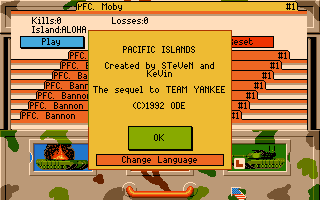
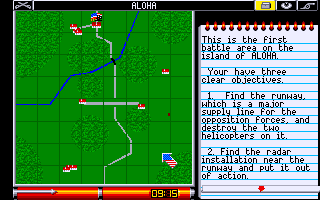
Pacific Islands picks up the split-screen interface popularized by its predecessor, Team Yankee, and expands on it in satisfying ways. As soon as you load a mission, the left and right viewports each offer you dynamic perspectives on the battlefield, letting you both monitor your forces and issue critical commands without losing situational awareness. This dual-pane approach feels intuitive and gives you a constant sense of being “in command” over your armored units, whether you’re on the move or hunkered down behind cover.
(HEY YOU!! We hope you enjoy! We try not to run ads. So basically, this is a very expensive hobby running this site. Please consider joining us for updates, forums, and more. Network w/ us to make some cash or friends while retro gaming, and you can win some free retro games for posting. Okay, carry on 👍)
The core experience blends a realistic tank simulation with classic wargame strategy, demanding that you balance tactical decision-making with careful vehicle management. You’ll need to monitor fuel, ammunition, and armor status while coordinating assaults, calling in air support, and timing your advances to exploit enemy weaknesses. The controls are surprisingly accessible for a game of this depth, with hotkeys and context-sensitive commands that streamline otherwise complex procedures.
Each of the five missions unfolds as a distinct encounter on the Yama Yama Isles, offering varied objectives from beachhead assaults to defensive holds. The level design encourages you to adapt your tactics: dense jungle chokepoints force close-quarters engagements, while open atolls allow long-range gunnery duels. There’s a palpable sense of progression as you master the nuances of combined arms warfare, and veteran strategy gamers will appreciate the precision required to pull off the most elegant maneuvers.
Graphics
One of Pacific Islands’ most immediately noticeable upgrades is its enhanced graphics engine, which brings the South Pacific theater to life far more vividly than Team Yankee ever could. Terrain textures are richer, with distinct foliage patterns in jungle regions and more believable sand gradients on the beaches. Even at lower resolutions common on early ’90s hardware, the visual improvements shine through, lending each map a stronger sense of place.
Unit models themselves benefit from higher polygon counts and better sprite work. Tanks exhibit more detailed hull and turret geometry, while explosions and smoke plumes feature smoother animations that enhance the drama of each firefight. Environmental effects—such as rippling water around landing craft and dynamic shadows under palm trees—add subtle realism without sacrificing performance.
Despite its age, Pacific Islands manages to maintain a crisp presentation that holds up if you’ve upgraded your vintage PC or run it in a high-resolution window. The improved draw distance means you can spot enemy units from farther away, which adds both strategic depth and a cinematic quality to recon missions. Overall, the game’s graphical strides are a noticeable leap over its predecessor, helping to immerse you in the fictional island conflict.
Story
Breaking from the historical narrative of Team Yankee, Pacific Islands spins a purely fictional tale of Cold War brinkmanship on a remote archipelago. A rogue Soviet commander has seized control of the Yama Yama Isles, turning them into a strategic stronghold that threatens naval routes across the South Pacific. Your task is to dislodge this occupation force in a series of five escalating missions.
While the storyline itself is straightforward, it provides a cohesive backdrop for each military operation. Briefings set the stage by outlining key objectives—such as disabling coastal batteries, rescuing downed pilots, or capturing vital airfields. The game’s text-based narrative may not rival blockbuster cutscenes, but it frames your tactical goals with enough color to make each victory feel earned.
The fictional scenario allows the designers to craft varied mission scenarios that wouldn’t fit a strictly historical setting. From amphibious beach assaults under heavy artillery fire to stealthy night raids on jungle encampments, each level feels unique. Though the story stops short of deep character development, it keeps you engaged by steadily raising the stakes as you advance toward the final showdown.
Overall Experience
Pacific Islands successfully builds on the foundation laid by Team Yankee, delivering a more refined and visually appealing tank-strategy hybrid. Whether you’re a fan of authentic vehicle simulation or classic wargaming, there’s plenty here to keep you invested. The streamlined controls and split-screen interface strike a good balance between accessibility and depth, making it a strong choice for both newcomers and veterans.
The game’s pacing is well judged: early missions ease you into the mechanics before ramping up difficulty and complexity. Replay value is boosted by the option to tackle each scenario with different force compositions or tactics, and there’s always a thrill in discovering a new ambush point or perfecting a coordinated air-ground strike. Sound design—complete with realistic engine roars, artillery volleys, and radio chatter—adds an extra layer of immersion.
Ultimately, Pacific Islands is a compelling sequel that stands on its own merits. It retains the strategic heart of Team Yankee while updating the presentation and mission design for a fresher, more engaging experience. If you’re in the market for a challenging Cold War wargame with a fictional South Pacific twist, this title deserves a spot on your shelf.


Reviews
There are no reviews yet.