 Retro Replay Retro Replay gaming reviews, news, emulation, geek stuff and more!




Retro Replay Review
Gameplay
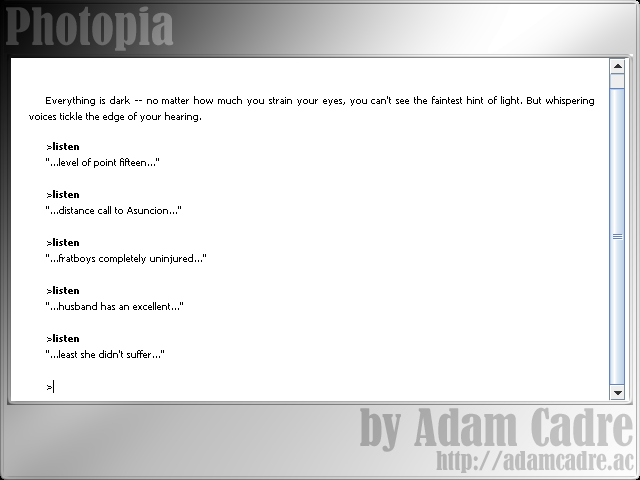
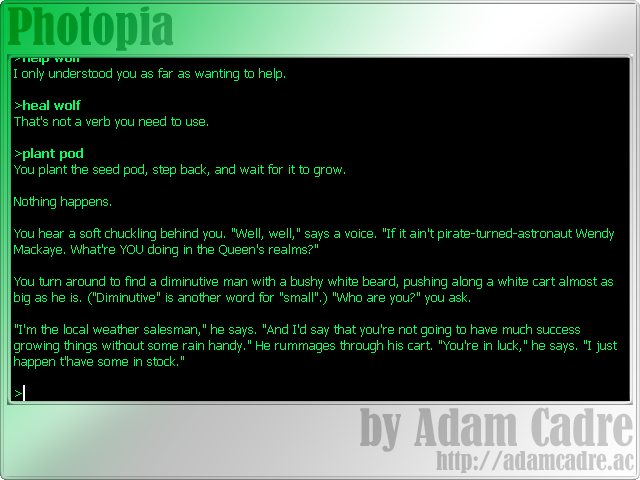
Photopia’s gameplay is rooted in the classic tradition of interactive fiction, relying solely on text-based narration and player input. Unlike modern adventures that depend on elaborate controls and action sequences, here you type simple commands or make choices that guide you through a mosaic of vignettes. This minimalist approach keeps the focus on narrative flow, allowing you to move seamlessly from one scenario to the next without the friction of complex mechanics.
(HEY YOU!! We hope you enjoy! We try not to run ads. So basically, this is a very expensive hobby running this site. Please consider joining us for updates, forums, and more. Network w/ us to make some cash or friends while retro gaming, and you can win some free retro games for posting. Okay, carry on 👍)
What sets Photopia apart is its structure: short, self-contained scenes linked by color motifs. One moment you’re speeding down a highway with a friend, the next you’re on the surface of Mars, and then you’re at home teaching your daughter about stars. There’s no backtracking, no hidden puzzles to stall your journey—only forward momentum toward the game’s emotional payoff. This design choice prioritizes storytelling over traditional puzzle-solving, which may feel refreshing or unconventional for adventure veterans.
Despite its narrative-driven core, Photopia still offers moments of interactivity that matter. Key choices—though few—shape small variations in tone and perspective, giving you a sense of agency without overwhelming you with branching complexity. If you’re looking for a leisurely stroll through an evocative tale rather than an epic quest peppered with riddles, Photopia’s smooth, streamlined gameplay is a welcome change of pace.
Graphics
Photopia features no visual graphics in the traditional sense; its “art” lives purely in the imagination, painted by vivid prose and carefully chosen text cues. In an era where visual fidelity often overshadows narrative drive, this game reminds us that sometimes the most powerful images are those we create in our own minds. Each scene conjures sights and colors that feel surprisingly tangible, despite existing only on the page.
The lack of a graphical interface can be disarming at first, especially if you’re accustomed to richly rendered environments or animated cutscenes. However, the game leverages text styling—such as color descriptors and pacing—to evoke mood shifts. For instance, reading about the crimson dunes of Mars or the dusky blue of a twilight highway can stir strong sensory impressions. In absence of pixels, the writing itself becomes the palette.
Sound effects and music are also absent in Photopia, which maintains its focus on quiet reflection. Instead of auditory cues, you rely on the rhythm of sentences and the emotional resonance of word choice. If you favor games that let you fill in the blanks with personal memories and associations, Photopia’s stripped-down audiovisual presentation offers a uniquely intimate experience.
Story
At its core, Photopia is an exploration of memory, color, and connection. Each vignette feels like a fragment—a highway conversation about life, a solitary mission on Mars, a tender lesson in the backyard—that only reveals its full significance once you reach the final scene. The narrative threads weave together unexpectedly, demonstrating how disparate moments can converge into a coherent emotional tapestry.
The use of color as the connective tissue is a masterstroke. Each chapter is named for a hue—Red, Blue, Yellow—and the emotional undertones of these colors guide your interpretation. Red might signal urgency or loss, Blue evokes calm or sadness, and Yellow sparks warmth or nostalgia. By the time the pieces align, you’ll find yourself reconsidering events you might have skimmed over at first.
While there are no traditional characters to develop over dozens of hours, the fleeting relationships—between friends in a speeding car, between a parent and child—leave a lasting impression. Photopia’s story isn’t about epic quests or grand villains; it’s about the small, resonant moments that shape a life. If you crave a narrative that lingers in your thoughts long after you’ve finished reading, this game delivers.
Overall Experience
Photopia stands out as an interactive fiction milestone, offering a compact yet emotionally rich journey. Its strength lies in brevity and focus: you can complete the entire experience in under an hour, but its impact can resonate for days. If you’re seeking a gaming session that fits into a coffee break yet leaves you pondering its themes overnight, this is the perfect pick.
The game’s pace is relentless in the best possible way—there is no filler, no optional sidequests to distract you. While this might disappoint players who crave dozens of hours of exploration, it will please those who appreciate a tightly edited narrative. Photopia proves that interactivity need not be measured in hours or graphical fidelity, but in the depth of emotion it evokes.
Ultimately, Photopia is less a game and more an experience: a poetic, color-driven odyssey that demonstrates the unique power of text-based storytelling. For prospective buyers who want a thought-provoking, artful adventure that emphasizes feeling over flashy visuals, Photopia is an unmissable gem in the world of interactive fiction.

Reviews
There are no reviews yet.