 Retro Replay Retro Gaming History, Reviews & Emulation
Retro Replay Review
Gameplay
Tyrian starts with the clean, satisfying instinct of pushing upward through a hostile scrolling battlefield, but it earns its reputation by giving that instinct somewhere to grow. In the first few missions, you are dodging fire, threading through terrain, and appreciating how quickly bright shots identify the immediate danger. Then the campaign economy begins to matter. Credits let you alter your ship between missions, so a rough stage is not just a test of reflexes. It is also a reason to reconsider what you brought into it.
The loadout system adds welcome personality to a genre that can otherwise reduce every run to chasing the next temporary power-up. Hulls, front and rear weapons, shields, generators, and sidekick weapons make the ship feel like your own evolving machine. You can experiment without losing the directness that makes a vertical shooter work. The better you understand which equipment suits your habits, the more satisfying difficult stretches become.
That does not mean Tyrian is relaxed. The brown, rock-lined stages can get crowded, and the pressure rises when incoming fire overlaps with enemies and restrictive terrain. Still, the strongest moments come from holding your nerve in that clutter and letting a tuned loadout do its work. If you want a more immediate session, the arcade modes strip away the longer-term planning and focus on shooting and collecting weapon pickups. The original two-player arcade option is an especially good fit for sharing the chaos.
Graphics
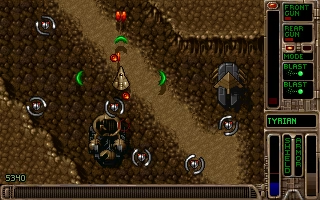
The overhead canyon combat has a dense, tactile look. Your metallic pointed craft flies above a larger dark green mechanical vessel, while circular gun emplacements sit among a packed brown gorge of raised edges and layered rock ridges. Bright green curved fire and red enemy shots cut sharply across the earthy ground, making the important threats easier to pick out even when the detailed rocks crowd the view.
Story
There is more purpose here than a bare excuse to shoot spaceships. You pilot Trent Hawkins against the MicroSol corporation in a science-fiction conspiracy, and the story data cubes between stages provide bits of context without derailing the pace. They work because Tyrian does not pretend the narrative is the main event. It gives your route and opposition enough meaning to make the campaign feel connected.
The writing lands best in small doses. You move from mission to mission with the sense that Hawkins is caught in something larger, but you are not asked to stop playing for long explanations. That balance suits the game. The story supplies momentum, while the real drama remains the next dangerous approach through enemy fire.
If you need a shooter with a sweeping, character-heavy narrative, Tyrian will not suddenly become that. Its strength is a compact campaign frame that supports repeated play and gives your upgrades a reason to matter. The data cubes are worth reading if you enjoy having some conspiracy flavor around your action, but they never overwhelm the flying and fighting.
Overall Experience
Tyrian remains a strong recommendation for anyone who likes old-school shooters with more staying power than a single high-score chase. The immediate action is solid, but the campaign’s credit-driven customization is what keeps pulling you back. You are not simply trying to clear a stage. You are trying to build a ship that makes sense in your hands.
Its occasional visual congestion asks for patience, particularly in the rock-heavy canyon combat, and newcomers may need a few runs before the equipment choices start to click. That learning curve is part of the payoff. Once you have a feel for how your weapons and defenses fit together, the game becomes less about scrambling and more about controlled aggression.
For the original 1995 DOS experience, Tyrian is a lively, demanding vertical shooter with an unusually persuasive upgrade loop. If you are curious about the later expanded release, see Tyrian 2000 as a separate edition. To play the underlying game through a later open-source port, the OpenTyrian project is a useful modern route. The classic game itself is worth your time because it pairs sharp arcade pressure with enough build experimentation to make victories feel earned.



Reviews
There are no reviews yet.