 Retro Replay Retro Gaming History, Reviews & Emulation


Retro Replay Review
Gameplay
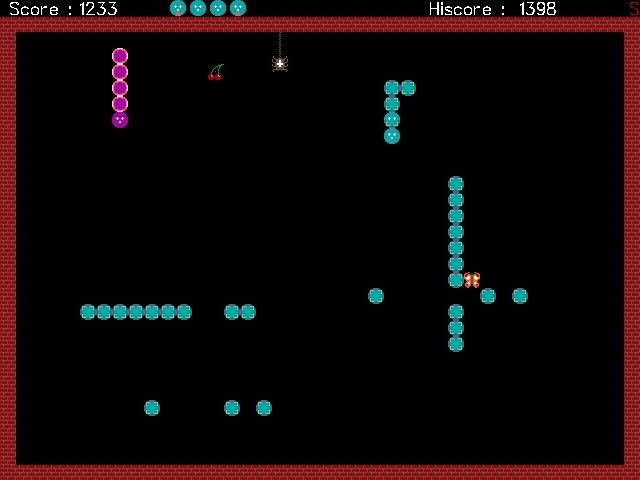
Wurm begins with an immediately readable arcade loop. Wally moves constantly and quickly through a single room, leaving you to guide the worm left and right toward fruit. Every pickup adds points and length, while contact with a wall or Wally’s own tail costs one of five starting lives. That combination gives each turn weight: the longer the worm becomes, the less forgiving the available space feels.
The game does not leave its Snake-inspired setup untouched for long. Once a tail reaches a certain length, it drops away and remains behind as an obstacle that cannot be eaten. This is a smart complication because successful collecting creates its own hazards, forcing you to account for the room’s changing layout rather than merely trace a safe circuit around its edges.
Further threats make the score chase progressively busier. Red worms can wander or pursue fruit, growing and shedding tails of their own; water can wash food away; spiders descend on silk; and flowers add more objects to avoid. Butterflies offer an important counterbalance by restoring a life, even allowing Wally to exceed the initial five. Players who like reactive, increasingly cluttered survival challenges will get the most from its high-score focus.

Graphics
Wurm’s top-down, fixed-screen presentation is built around clarity. The room needs to communicate fruit, Wally’s expanding body, walls, and accumulating dangers at a glance, and its arcade design is centered on that legibility rather than on elaborate visual spectacle.
The changing obstacle mix gives the screen a useful sense of activity. Detached tails, rival worms, water, descending spiders, and flowers are not just decorative additions; they matter because they alter the paths available to you. That direct connection between what appears on screen and the decisions you must make suits the game well.
As the room fills, readability becomes part of the challenge. The visual field is meant to become crowded because the game is deliberately raising the stakes. Anyone seeking rich scenery or a cinematic presentation will find a modest arcade framework here, but the visual design supports the central task of quickly judging danger and opportunity.

Story
Wurm is not a narrative game. Its premise is simply Wally’s pursuit of tasty fruit in a room that grows steadily more hazardous, with points and a high-score-table position serving as the real objective.
That light setup is appropriate for the format. Wally provides a recognizable focal character, while fruit, butterflies, rival worms, and other hazards give the action an easy-to-understand theme without interrupting the pace with story exposition.
The absence of a developed plot means motivation comes from performance: growing larger, preserving lives, surviving the new hazards, and improving your score. If you want character arcs or a scripted journey, Wurm has little to offer; if you want a clean arcade premise that gets out of the way, it is suitably direct.
Overall Experience
Wurm is a focused 1993 DOS arcade game that takes a recognizable formula and gives it more momentum through constant movement and a growing set of room hazards. The basic rules are accessible, but the consequences of growing longer and filling the arena with obstacles create meaningful tension.
Its strongest quality is how it layers complications onto a straightforward goal. Fruit collection, self-avoidance, dropped tails, competing worms, environmental disruptions, and life-restoring butterflies all feed the same score-driven loop. The game is unlikely to appeal to players looking for variety beyond its central arena challenge, yet that concentration is also its identity.
Approach Wurm as a compact high-score contest rather than a sprawling adventure. It is best suited to players who enjoy mastering fast movement, making tight course corrections, and accepting that every successful pickup can make the next few seconds more dangerous. The escalation gives this Snake adaptation enough character to remain engaging beyond its opening simplicity.


Reviews
There are no reviews yet.