 Retro Replay Retro Gaming History, Reviews & Emulation

Retro Replay Review
Gameplay
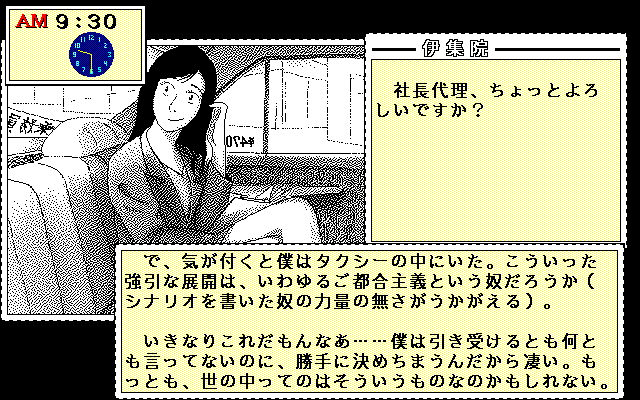
The opening hook is wonderfully specific: instead of saving a kingdom or escaping a locked room, you are a game-loving son suddenly covering for his software-company manager father. That puts you in a position where every conversation has a practical edge. You are not just chatting with employees for flavor; you are trying to understand what the company can make and how to guide it toward a successful release.
This is a marked shift from the verb-and-object adventure format associated with the series. Soft de Hard na Monogatari runs more like a visual novel with light simulation elements, asking you to choose the protagonist’s responses and decisions as in-game time advances. That makes it approachable quickly, but it also means the tension comes from judgment and timing rather than from solving environmental puzzles.
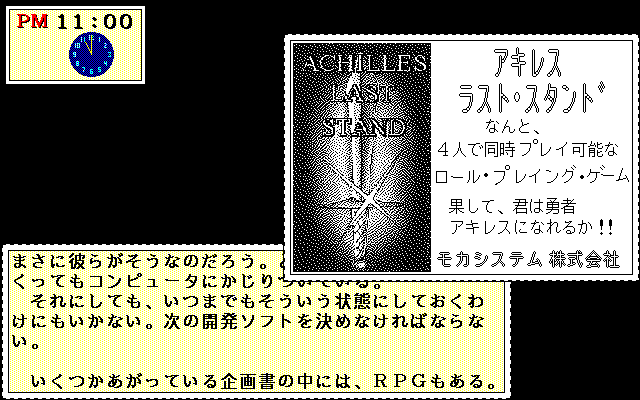
What starts to click is the connection between people, plans, and outcomes. You can speak with employees, inspect planned software releases, and make the calls that matter to both the firm and the hero’s future. The game asks you to role-play a young boss with enthusiasm but limited experience, which is a more interesting constraint than pure wish-fulfillment.
Frustration can set in if you want detailed business management or the tactile puzzle-solving of a traditional adventure. The lighter simulation framework puts the emphasis on choices rather than granular control. Still, that restraint fits the comic premise: you are navigating a hectic creative office, not filling out a ledger.
Graphics
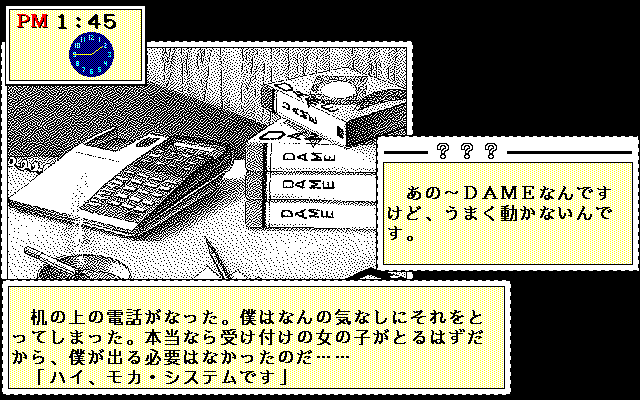
Soft de Hard na Monogatari uses a first-person visual-novel viewpoint, keeping you in the protagonist’s role as he weighs conversations and company decisions. The on-screen focus is tied closely to that choice-driven format rather than to a broad strategic map.
Story
The story earns its charm from taking a modest workplace crisis seriously enough to create stakes, then refusing to treat it solemnly. A young gamer filling in after his father is hospitalized is an easy setup to understand, and the computer-game production setting gives the decisions a pleasingly unusual context.
Its humor matters. The fictional “Nobara Series” DAME, a clear wink toward DOME, tells you that System Sacom is willing to poke at the business and culture surrounding games rather than merely borrow the setting as wallpaper. That self-aware tone should land especially well if you enjoy old game-industry in-jokes.
Because your decisions and the passage of time influence the ending, the narrative has more at stake than a fixed comedy sketch. You are responsible for whether this temporary leader and his company make something of the opportunity. That is a strong fit for a story about creative work, where good intentions do not automatically become a finished success.
Overall Experience
Soft de Hard na Monogatari is a smart detour for the Novel Ware line: less about poking at a world with commands and more about living with the consequences of your calls. Its premise has enough personality to pull you through the first hour, and the workplace angle keeps the decision-making from feeling generic.
The payoff is worth it if you enjoy visual novels that let small choices shape a larger career-and-company outcome. Talking to staff and checking release plans gives the game a purpose beyond selecting dialogue, while the advancing clock adds pressure without turning the experience into a full management sim.
Come to it for a playful, early take on game development and a protagonist who has to learn leadership on the job. Skip it only if you need dense simulation systems or a conventional adventure’s inventory-and-puzzle rhythm. For everyone else, its mix of satire, branching decisions, and modest business pressure makes it a distinctive curiosity with real warmth.


Reviews
There are no reviews yet.