 Retro Replay Retro Replay gaming reviews, news, emulation, geek stuff and more!
Retro Replay Review
Gameplay
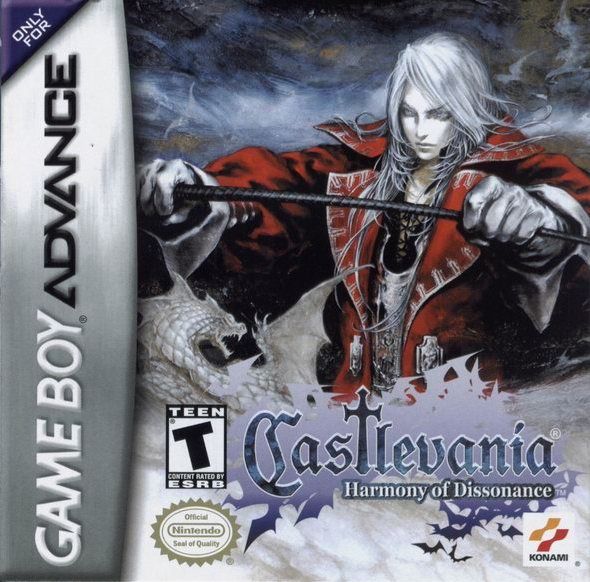
Castlevania: Harmony of Dissonance builds on the action-RPG template established by Symphony of the Night and Circle of the Moon, delivering tight platforming and satisfying combat loops on the Game Boy Advance. You control Juste Belmont, who can dash, double-jump, and wield an array of subweapons—from the humble axe to the versatile holy water. What makes this entry stand out is the tome system: by combining different magic tomes with your subweapons, you gain powerful effects, such as turning holy water into a damaging downpour or creating a protective Bible shield that circles you.
(HEY YOU!! We hope you enjoy! We try not to run ads. So basically, this is a very expensive hobby running this site. Please consider joining us for updates, forums, and more. Network w/ us to make some cash or friends while retro gaming, and you can win some free retro games for posting. Okay, carry on 👍)
Beyond the core combat, the game offers deep customization. You’ll collect armor sets, accessories, and whip tips, each altering your stats or elemental damage. Swapping out your whip tip for a fire-elemental variant can make short work of ice-based enemies, while equipping heavier armor boosts defense at the cost of agility. The balance between offense and defense choices keeps every room in Dracula’s Castle feeling like a new puzzle to optimize for your playstyle.
Harmony of Dissonance also introduces a light side quest involving interior decorating. You’ll find furniture and decorations scattered across the castle that can be placed in Juste’s room. While purely cosmetic, this feature adds a charming diversion and encourages exploration of hidden alcoves. It’s a small but memorable reward for thorough players who enjoy discovering every secret.
Graphics
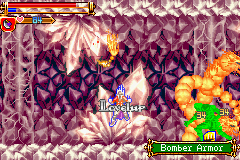
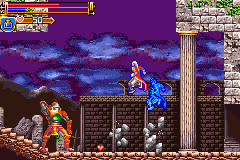
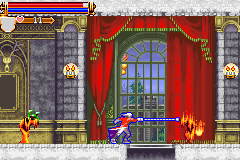
On the GBA’s modest hardware, Harmony of Dissonance manages to present some of the most vibrant and detailed visuals in the Castlevania series to date. The sprite work is crisp, with Juste’s animations—whether swinging his whip or casting a tome-enhanced subweapon—flowing smoothly at a solid framerate. Enemies range from skeletal warriors to grotesque demons, each boasting unique movement patterns and attack animations that bring Dracula’s castle to life.
The game’s use of color palettes is particularly impressive. Each castle area sports its own thematic hues: warm oranges in the cathedral, icy blues in the underground crypts, and ominous purples in the boss chambers. Background layers scroll at different speeds to create a subtle parallax effect, lending a surprising sense of depth to what could have been a flat 2D environment.
While the castle’s overall layout can feel labyrinthine, the world map and area transitions are handled with clean, simple visuals that never confuse the player. Minor stutters or slowdown can occur when many projectiles fill the screen, but these moments are brief and do little to detract from the overall visual experience.
Story
Castlevania: Harmony of Dissonance reunites players with the Belmont legacy, this time following Juste Belmont and his scholar-turned-warrior friend Maxim Kischine. When their mutual friend Lydie is kidnapped and taken to a mysteriously reappearing Dracula’s Castle, the pair venture into its depths—in a narrative twist that forces players to question whether rescuer and rescued roles might reverse.
Storytelling in the Castlevania series often takes a backseat to gameplay, and Harmony of Dissonance is no exception. Cutscenes are sparse, delivered mostly through text boxes and static images. Yet the atmosphere—enriched by moody background music and occasional boss monologues—succeeds in conveying the gothic horror tone that fans love. Interactions between Juste and Maxim hint at deeper character motivations and loyalties, even if the plot doesn’t stray far from series conventions.
The castle itself serves as a narrative device. Its shifting rooms, hidden passages, and ghostly inhabitants reinforce the sense of a living, malevolent fortress. Optional rooms offer scrap bits of lore—such as Maxim’s journal entries—that flesh out his backstory and strengthen the bond between the two protagonists.
Overall Experience
Harmony of Dissonance strikes an excellent balance between accessibility for newcomers and depth for series veterans. The learning curve is gentle: early tomes and subweapons are straightforward, but the deeper you delve into weapon customization, the more strategic combat becomes. Collectibles, secret rooms, and branching paths reward exploration, boosting the game’s replay value long after the first playthrough.
While some players may find the story lightweight compared to more narrative-driven titles, the solid level design, refined controls, and gratifying progression systems ensure the core experience remains engaging. The decorating side quest, though optional and purely aesthetic, adds a warm, personal touch that enhances the game’s charm without padding the playtime unnecessarily.
In the context of Game Boy Advance classics, Castlevania: Harmony of Dissonance stands out as a must-play. Its polished gameplay mechanics, vibrant pixel art, and atmospheric castle exploration combine to create an experience that holds up remarkably well years after release. If you’re seeking a portable action-RPG with rich customization and old-school Castlevania flair, this title should be at the top of your list.


Reviews
There are no reviews yet.