 Retro Replay Retro Replay gaming reviews, news, emulation, geek stuff and more!

Retro Replay Review
Gameplay
The first thing you notice is how little room Tintin: Prisoners of the Sun gives you to brute-force a problem. Tintin cannot attack, so every ordinary stage is about getting from its start to finish by avoiding whatever blocks the route. You dodge rather than dominate, and that makes the game feel more like a sequence of movement tests than a typical licensed action platformer.
That focus can be satisfying. A route that initially looks unfair often becomes manageable once you understand where to move and when to wait, and the game has a clean, immediate goal in every level. The trouble is that the difficulty can turn that clarity into friction. Because success rests on avoidance, a bad run does not have much room for recovery; you are simply sent back to try the obstacle again with better timing.
The ability to move between foreground and background planes is the strongest wrinkle in the standard platforming. It asks you to think beyond a single side-view path and gives some stages a more playful sense of space. A few basic puzzles add a pause from pure dodging, while the two 3D sections automatically carry Tintin forward and ask you to evade oncoming obstacles. They are a welcome change of pace, though they still rely on the same core skill: react quickly and stay out of trouble.
Handheld progress can be uneven because passwords are not available after every level. That makes a difficult patch feel more consequential than it needs to, especially when you are playing in shorter bursts. If you enjoy learning a tough stage through repetition, the structure has a certain old-school bite. If you want steady checkpoints and the freedom to experiment, it can wear on you.

Graphics
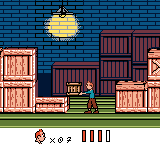
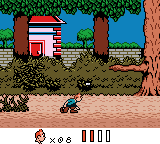
The game uses side-view scrolling stages, with Tintin able to shift between foreground and background paths. That layered movement is easy to understand on the screen and gives the locations on his journey more depth than a single flat lane would.
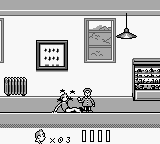
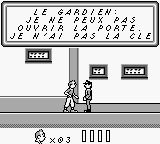
The 3D dodge levels change the camera into a forward-moving view, clearly separating them from the regular platform stages. On both Game Boy and Game Boy Color, the level layouts are largely the same, though some obstacles are switched around.
Story
This is a direct rescue adventure: Professor Cuthbert Calculus has been kidnapped, and Tintin sets out to find him. It is a simple reason to keep moving, but it suits a game built around a string of hazardous stages.
The journey takes Tintin through various locations around the world, giving the game a broader travelogue shape than a platformer confined to one place. You are not asked to untangle a dense plot between levels; the story works as a familiar Tintin-style chase with a clear destination.
That straightforwardness is both its strength and its limit. Fans who mainly want Tintin at the center of a globe-spanning rescue will have enough context to enjoy the trip. Anyone hoping for the story to carry the game through its harder obstacle sequences may find that the platforming has to do most of the heavy lifting.
Overall Experience
Tintin: Prisoners of the Sun is at its best when you accept its terms: careful movement, quick dodges, and persistence after a failed attempt. The no-attack approach gives it a distinctive tension, and the plane switching stops the regular stages from being completely routine.
It is also a noticeably altered handheld take on the larger Prisoners of the Sun game, with different level design, lengths, and difficulty in places, plus three absent stages: The Swim, The Coach, and The Jungle. That does not make this version feel empty, but it does make it a more compact and sometimes harsher interpretation of the adventure.
Give it a chance if you like demanding 2D platformers where observation matters more than combat and you have affection for Tintin. The payoff is modest but real: overcoming a stubborn stretch feels earned. At 6.8, it lands as a solid licensed handheld game with good ideas, held back by uneven difficulty and sparse password access.


Reviews
There are no reviews yet.