 Retro Replay Retro Replay gaming reviews, news, emulation, geek stuff and more!




Retro Replay Review
Gameplay
Odama’s gameplay revolves around a deceptively simple concept: guiding a massive steel orb across a battlefield as if it were a pinball. Using the L and R triggers to control your flippers, you must deftly send the Odama crashing through enemy ranks while avoiding your own troops. A strategic tilt mechanic, handled via the control stick, lets you nudge the battlefield’s incline to alter the ball’s trajectory. This fusion of pinball physics and tactical warfare creates an experience that feels both familiar and entirely new.
(HEY YOU!! We hope you enjoy! We try not to run ads. So basically, this is a very expensive hobby running this site. Please consider joining us for updates, forums, and more. Network w/ us to make some cash or friends while retro gaming, and you can win some free retro games for posting. Okay, carry on 👍)
Adding to the frenetic pinball action is the GameCube microphone feature, which allows you to issue direct orders to your soldiers in real time. With the X button activating the mic, commands like “press forward” or “hold position” become essential tools for protecting your flippers and maximizing enemy casualties. Learning to balance aggressive ball strikes with timely voice directives is crucial—overreliance on the Odama or poor command timing will drain your Morale Bar, causing troops to ignore orders and potentially doom your mission.
Power-ups scattered across the battlefield lend further depth to the gameplay loop. Some items supercharge the Odama, enabling it to convert enemy soldiers into allies on contact, while others restore morale or trigger battlefield hazards. The varied objectives—most commonly guiding the Ninten Bell from one end of the screen to the other before sunset—keep each mission feeling fresh. Although the learning curve can be steep, mastering the interplay of flippers, voice commands, and battlefield tilt leads to a uniquely rewarding and chaotic experience.
Graphics
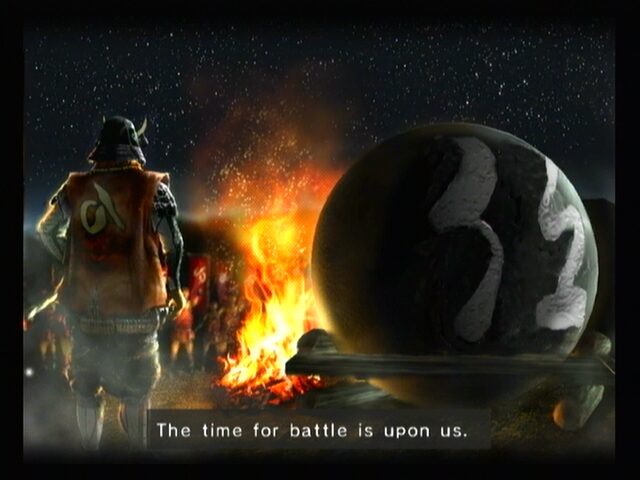
Visually, Odama embraces a stylized interpretation of feudal Japan that blends traditional aesthetics with the limitations of early-2000s hardware. Character models are small but distinct, with samurai and ashigaru troops identifiable by their differing armor and weapon styles. The battlefield itself is rendered in muted earth tones, punctuated by banners, torii gates, and watchtowers that evoke the Sengoku period without overwhelming the eye during fast-paced action.
Special effects shine when the Odama collides with enemy formations. Sparks fly, debris scatters, and the camera briefly highlights the point of impact, which adds dramatic weight to each flipper strike. Tilt-induced camera shifts feel natural, giving you clear feedback on how the battlefield’s incline is affecting the ball’s motion. While textures may lack the refinement of later consoles, the art direction compensates with bold silhouettes and clear visual cues that are vital when dozens of units swarm the screen.
The UI is straightforward, with a Morale meter, remaining Odamas, and time-of-day indicator unobtrusively placed around the playfield. Subtitles for the Japanese narration appear in crisp white text against semi-transparent backdrops, ensuring you never miss crucial story details. Overall, Odama’s graphics strike an admirable balance between functionality and atmosphere, serving the gameplay without distracting from it.
Story
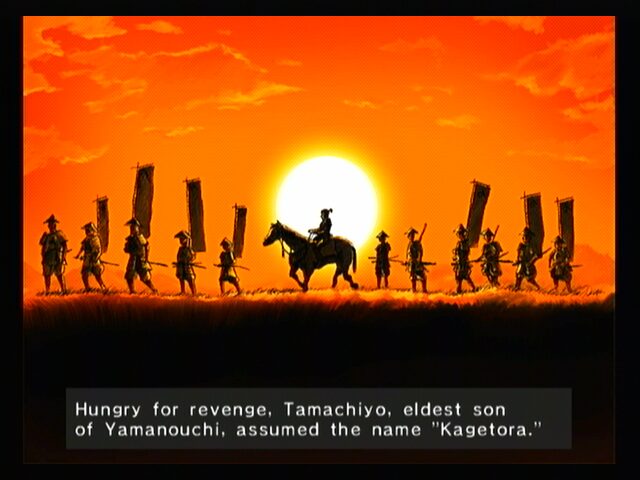
Odama’s narrative sets the stage for its hybrid pinball-warfare mechanics. You assume the role of a commander in the Yamanouchi clan, tasked with escorting two prized treasures: the titular Odama, a gargantuan iron ball, and the sacred Ninten Bell. Your adversary is the treacherous leader of Karasuma Keep, who betrayed the clan’s founder and now threatens your homeland. Each mission represents a step closer to Karasuma’s fortress and the revenge you seek.
The story unfolds through an emotive Japanese narrator, whose dramatic delivery heightens the tension as dawn turns to dusk. English subtitles ensure you catch every plot beat, from declarations of loyalty to the anguished cries of fallen soldiers. While the narrative isn’t the game’s primary focus, it provides context for the battlefield carnage and motivates you to push the bell across increasingly hostile terrain.
Progression through the game also unlocks new voice commands for your troops, blending story advancement with gameplay evolution. As your bond with the soldiers deepens—reflected by expanded command options—so too does the strategic complexity. By the time you reach the climactic sieges near Karasuma Keep, you’ll feel personally invested in the outcome, making each victory all the more satisfying.
Overall Experience
Odama stands out as one of the most daring experiments of the GameCube era. Its seamless integration of pinball mechanics, voice control, and real-time strategy elements creates a gameplay cocktail you won’t find elsewhere. The result is a title that challenges both your reflexes and your tactical instincts, rewarding precision and quick thinking in equal measure.
That said, Odama’s unconventional blend can be polarizing. Newcomers may struggle with the dual demands of microphone commands and battlefield management, and the Morale system can feel punishing when troops momentarily ignore you. However, those willing to learn its rhythms will discover a deeply satisfying groove where ball strikes and troop maneuvers complement one another in beautifully chaotic harmony.
Ultimately, Odama offers an experience that is as novel today as it was at launch. Its historical setting, bouncy pinball thrills, and voice-controlled strategy mechanics coalesce into an unforgettable adventure. If you’re seeking a game that defies genres and delivers unrelenting, fast-paced action, Odama is well worth your time.


Reviews
There are no reviews yet.