 Retro Replay Retro Replay gaming reviews, news, emulation, geek stuff and more!

Retro Replay Review
Gameplay
At its core, OXO offers a deceptively simple yet endlessly engaging take on tic-tac-toe. Players interact with the game by dialing in numeric inputs on the emulated EDSAC interface. The binary choices for player order (human first or computer first) provide immediate control over the challenge, allowing novices and seasoned strategists alike to tailor the experience.
(HEY YOU!! We hope you enjoy! We try not to run ads. So basically, this is a very expensive hobby running this site. Please consider joining us for updates, forums, and more. Network w/ us to make some cash or friends while retro gaming, and you can win some free retro games for posting. Okay, carry on 👍)
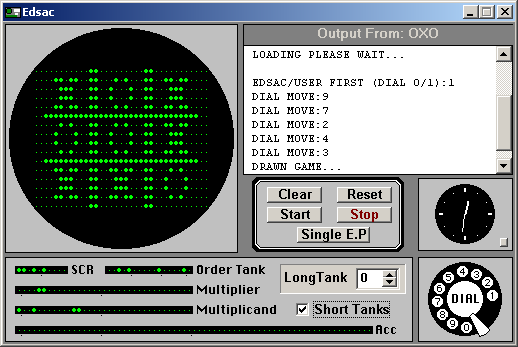
What truly sets the gameplay apart is the computer’s flawless strategy. Powered by the pioneering EDSAC architecture—one of the first practical stored-program electronic computers—OXO never loses. Every match becomes a tactical exercise in forcing a draw, testing your ability to outthink a perfect opponent within the constraints of a 3×3 grid. The tension ramps up as you attempt clever openings and countermoves against an AI that always “knows” the right play.
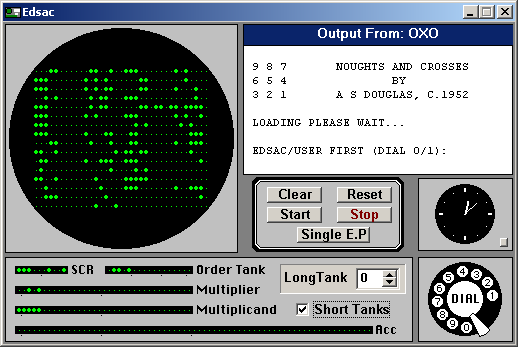
The input system, which uses a horizontally flipped keypad where 9 corresponds to the top-left square and 1 to the bottom-right, adds an authentic retro challenge. Rather than clicking or tapping, you learn to think in EDSAC’s dial-based language, reinforcing the historical context and giving a tangible sense of connection to early computing.
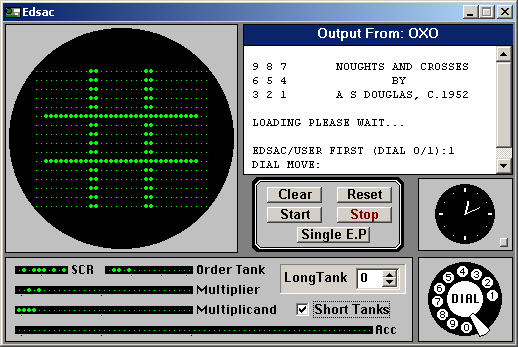
Although the rules of tic-tac-toe are familiar to nearly everyone, the mental shift required by OXO’s interface creates a fresh puzzle. Every move feels deliberate, as you reference the 35×16 cathode-ray screen to track the board state. This slowness encourages reflection and deep strategy, turning quick pencil-and-paper matches into contemplative sessions reminiscent of the dawn of digital gaming.
Graphics
By modern standards, OXO’s visuals are minimalist: a 35×16 CRT display that renders the grid and X’s and O’s in simple, monochrome vectors. Yet it’s precisely this stripped-down aesthetic that holds a unique charm. The flicker of the cathode ray beam and the slight phosphor glow transport you straight back to the University of Cambridge’s Mathematical Laboratory in 1949.
The graphical fidelity may seem crude, but every pixel has purpose. The clean lines of the grid are crisp and instantly readable, while the sparse on-screen presentation keeps focus squarely on strategy. There are no distracting animations or sound effects—just the gentle hum of the EDSAC’s vacuum tubes and the deliberate redraw of each symbol.
Running OXO in an emulator faithfully preserves these visuals, complete with simulated dial clicks and tube-warmup screens. This immersive nostalgia emphasizes OXO’s role as the world’s oldest documented computer game (preceded and out-debated only briefly by Nolan Bushnell’s Tennis for Two and the Nimrod computer). It’s not about dazzling shaders or particle effects, but about celebrating the origins of interactive digital entertainment.
For collectors and retro enthusiasts, the display is a historical artifact. Every frame invites appreciation for the ingenuity required to coax a game out of early electronic hardware. In that sense, OXO’s graphics are not just functional—they’re a museum piece come to life on your modern screen.
Story
While tic-tac-toe requires no narrative scaffolding, OXO’s real story lies in its historical pedigree. Developed in 1952 for the EDSAC—Electronic Delay Storage Automatic Calculator—this program embodies the very first steps of software as we know it. Running its maiden program on May 6, 1949, EDSAC revolutionized computing by storing instructions in memory, and OXO soon followed as a playful proof of concept.
The context enriches every match: you’re not just playing X’s and O’s, but engaging with a piece of computing heritage. EDSAC itself was built at Cambridge’s Mathematical Laboratory, where visionaries like Maurice Wilkes and his team laid the groundwork for modern programming. OXO stands as a whimsical tribute to their breakthroughs, marrying academic rigor with pure fun.
Although there’s no plot in the traditional sense, OXO conveys a compelling narrative through its existence. It bridged the gap between dry calculation and interactive amusement, foreshadowing decades of game development. By acknowledging the debates around its “oldest game” status—with titles like NIMROD (1951) and Tennis for Two (1958) vying for the crown—you appreciate how groundbreaking OXO truly was.
Each session thus becomes a lesson in computing history. Whether you’re a student of computer science or a curious gamer, you’ll find yourself reflecting on how far technology has come—and marveling at how a simple tic-tac-toe program could spark an entire industry.
Overall Experience
Playing OXO today feels like time-traveling into the dawn of the digital age. The deliberate pace, binary inputs, and minimalist display serve not as barriers but as gateways to a deeper appreciation for early computing. It’s a meditative experience, ideally suited for anyone fascinated by retro technology or the history of video games.
While it may lack modern conveniences like undo buttons or online multiplayer, that absence reinforces the authenticity. Every match demands concentration, inviting you to savor each placement and anticipate the computer’s infallible responses. This purity of design is a refreshing contrast to the constant action of contemporary titles.
As a purchase, OXO offers more than just gameplay—it provides an interactive exhibit. Emulating EDSAC’s environment on your own hardware allows you to witness the glowing tubes, the mechanical rhythm of the dial, and the stoic precision of early programming. It’s an invaluable addition for collectors, educators, and anyone seeking to understand where interactive software began.
Ultimately, OXO isn’t about commercial spectacle or blockbuster thrills. It’s a tribute to human ingenuity and the playful spirit that drove the first electronic computers. For those willing to embrace its quirks and historical context, it delivers an unforgettable journey to the roots of gaming—and a profound respect for the pioneers who made it possible.


Reviews
There are no reviews yet.