 Retro Replay Retro Gaming History, Reviews & Emulation
Retro Replay Review
Gameplay
Power Factor on Atari Lynx asks you to do more than run toward the right edge of the screen. Its stages are compact mazes, with bomb components providing the larger objective. Computer terminals can supply a map and enemy information through the Option 2 menu. Exploration has a defined endpoint, though: completed areas cannot be revisited.
Redd Ace’s levitation pack adds a useful resource decision. Tapping up initiates a jump, while holding up lets him fly at the cost of fuel. Both face buttons are used for weapons, so movement and combat take some adjustment. Weapon selection also shares the directional pad with movement, making the control layout a central part of the game’s learning curve.
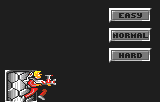
The weapons offer variety, but their limited ammunition encourages restraint, particularly before a boss encounter. Once a pickup’s ammunition runs out, it must be collected again. Three lives and no continues make careless experiments costly; Easy, Normal, and Hard settings at least provide a choice of starting challenge. Readers interested in another blend of Lynx science-fiction combat and exploration can visit our Electrocop review.
Graphics
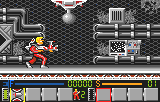
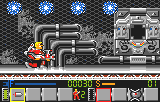
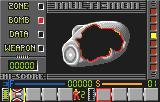
The reactor setting is immediately apparent in the gameplay imagery. Gray pipes, metal panels, and tightly packed machinery fill the backdrop, while Redd’s warmer colors separate him from the industrial surroundings. The effect is recognizably mechanical without needing a long explanation of where the action takes place.
The bottom of the display carries a dense collection of indicators and weapon information. That makes sense for a game tracking both health and flight fuel, alongside several kinds of ammunition, but it also emphasizes how much information fits into the Lynx’s small image. This is a presentation built around equipment as much as scenery.
Visibility is worth considering alongside the detail. In Matt Paprocki’s Power Factor review for Digital Press, the close view and attacks from outside the visible area are major criticisms. It is a useful counterpoint to attractive still images: showing the hero clearly does not necessarily give the player enough warning of the next threat.
Story
Redd Ace faces the Ceegarians, intruders from another dimension whose forces threaten the reactor. The central mission is to assemble a bomb from six components and put an end to their invasion. That gives the movement from stage to stage a concrete purpose beyond simply clearing enemies.
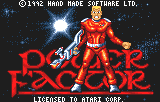
The premise has a second layer: the adventure is presented as a future virtual-reality simulation of Redd’s exploits, experienced on the Atarian Leisure Moon. It is an exuberant piece of science-fiction framing, full of invented names and heroic stakes rather than restrained world-building.
For the player, the practical story remains easy to follow even when the terminology gets elaborate. Find the pieces, survive the machinery and enemies, and face the bosses blocking progress. The simulation concept supplies personality, while the collection objective does the everyday work of directing the adventure.
Overall Experience
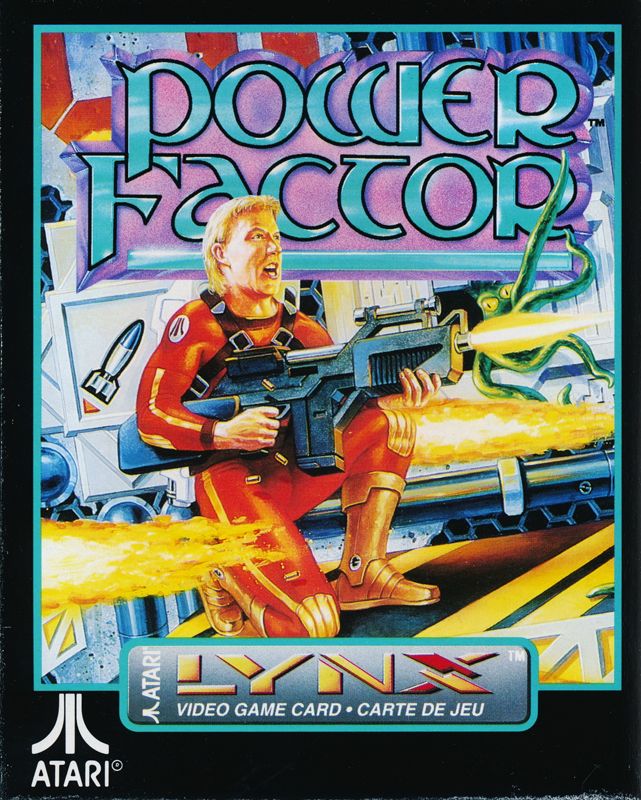
Power Factor has several ideas that give it an identity within the Lynx library. Flight consumes a resource, powerful weapons require ammunition discipline, and terminals reward checking the environment. Those systems suggest a more deliberate approach than charging into every encounter.
The complication is the interface used to manage them. Sharing directional inputs between movement and weapon selection creates an awkward demand, and the absence of continues leaves little room for repeated mistakes. Paprocki’s strongly critical assessment of the controls reinforces the need to approach this game with measured expectations.
Our editorial assessment is 5 out of 10. The reactor mission and equipment choices make Power Factor an interesting game to investigate, especially for Lynx enthusiasts, but its control demands and limited margin for error restrict its appeal. It is easier to appreciate as an ambitious handheld experiment than as an effortless introduction to action platformers.


Reviews
There are no reviews yet.