 Retro Replay Retro Replay gaming reviews, news, emulation, geek stuff and more!
Retro Replay Review
Gameplay
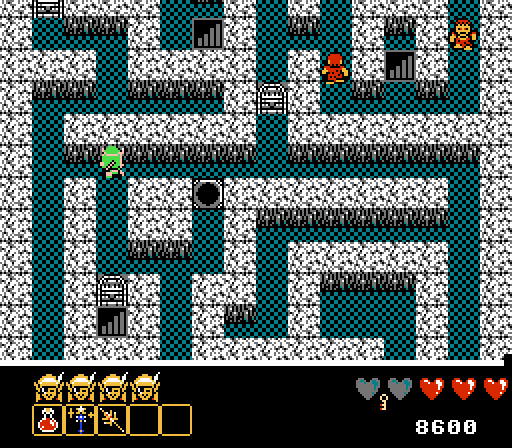
Arkista’s Ring delivers a tightly focused gameplay loop built around precision shooting, puzzle solving, and stage-based progression. Each of the 125 stages presents a carefully crafted challenge: you’ll need to take out waves of enemies, locate hidden keys, and find the correct exit to advance. The linear design means there’s little room for backtracking, which keeps the pacing brisk and the stakes clear at every turn.
(HEY YOU!! We hope you enjoy! We try not to run ads. So basically, this is a very expensive hobby running this site. Please consider joining us for updates, forums, and more. Network w/ us to make some cash or friends while retro gaming, and you can win some free retro games for posting. Okay, carry on 👍)
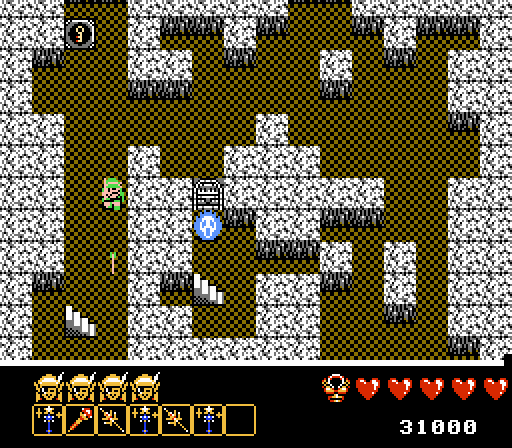
One of the game’s standout features is its blend of action and light puzzle elements. You’ll often find yourself lining up shots to trigger switches, destroying obstacles in a specific order, or baiting enemies into traps. While the core mechanic—firing Christine’s bow—remains constant, enemy variety and level layouts ensure that no two stages feel identical. Randomly dropped bonuses, such as health restores, armor upgrades, and weapon power‐ups, add a welcome layer of unpredictability that can turn the tide in a tough room.
Difficulty ramps up steadily as you progress, culminating in some genuinely tense moments where a single missed arrow can mean starting a stage over. Though the lack of a traditional save system means you’ll need patience (or the occasional use of a game pause trick), the concise 125‐stage structure makes it easy to chip away at the game in short bursts. Veterans of puzzle‐action hybrids and fans of The Legend of Zelda’s early outings will appreciate the balance between reflex‐based combat and spatial reasoning that Arkista’s Ring strikes so well.
Graphics
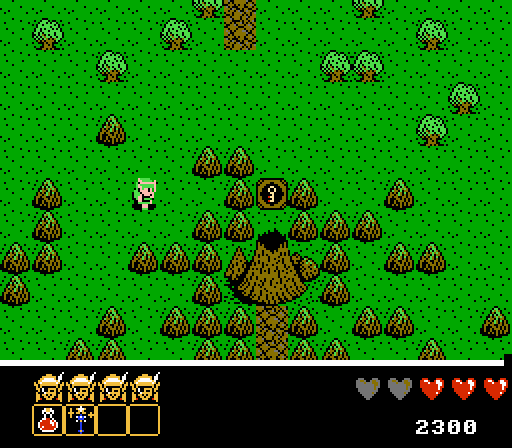
For a late‐80s NES title, Arkista’s Ring boasts surprisingly vibrant visuals that help each stage feel distinct. The color palette leans heavily on greens and browns to evoke a lush, if shadowed, Elven realm, but you’ll also encounter icy caverns, volcanic pits, and subtly animated waterways that break up the monotony. Sprites are crisply defined, and enemy designs range from goblins and trolls to winged demons and animated armor.
Character animation is simple but effective—Christine’s draw‐and‐release motion is communicated in just a few frames, yet it feels responsive. Enemy movements can be a bit jerky by modern standards, but they pack enough personality to stay memorable. Background elements like flickering torches, swaying vines, and gently rolling clouds add a layer of ambiance without overshadowing the foreground action.
Level layouts are rendered with clarity in mind, so it’s always easy to spot secrets and environmental hazards. Though there’s no parallax scrolling or 16‐bit flourishes here, the art direction is cohesive and charming. If you appreciate the nostalgic appeal of NES‐era graphics and want a game that maximizes what the hardware can do, Arkista’s Ring will be a visual treat.
Story
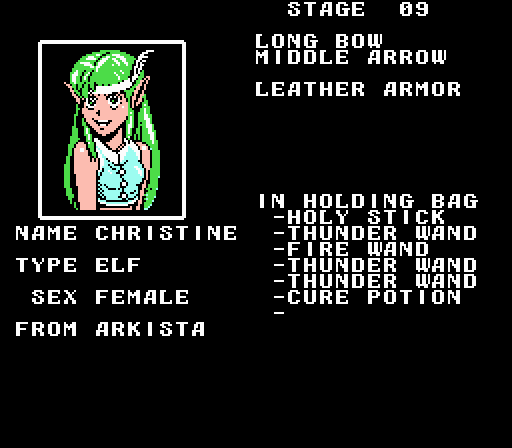
At its core, Arkista’s Ring features a straightforward but compelling narrative: an evil overlord named Shogun has stolen the sacred Elven ring of Arkista, plunging the entire kingdom into darkness. All hope rests with one lone warrior—Christine—whose mission is to reclaim the ring and restore light to her people. This simple premise provides just enough context to motivate each stage without ever slowing the action.
The storytelling is deliberately minimalist. Dialogue is sparse, cutscenes are limited to a handful of brief text sequences, and most of the lore is implied through stage names and a few evocative illustrations. While players seeking a deep, branching narrative might find it lacking, this stripped‐down approach keeps the focus squarely on gameplay. Every arrow you fire feels like a step toward redemption, and the stakes never feel abstract.
Christine herself is not heavily characterized, but her silent determination shines through in every room she clears. The Elven kingdom’s plight is conveyed through environmental cues—broken statues, darkened trees, and deserted villages—painting a picture of a realm in desperate need of salvation. In that sense, the story succeeds by weaving narrative into the level design itself.
Overall Experience
Arkista’s Ring stands as a hidden gem of the NES era, combining tight action, clever puzzles, and a brisk level structure. Its 125 stages offer a satisfying length without overstaying its welcome, and the rising difficulty curve ensures that you’ll feel a genuine sense of accomplishment each time you overcome a particularly thorny challenge. Though the lack of a robust save system might test modern patience, the game’s stage‐by‐stage format makes it easy to tackle in short play sessions.
Visually and aurally, the game delivers an atmospheric take on Elven fantasy that punches well above the NES’s weight class. While the narrative remains simple, it provides just enough context to keep you invested in Christine’s quest. The blend of randomized item drops and meticulously placed secrets enhances replay potential for completionists and speedrunners alike.
Ultimately, Arkista’s Ring is recommended for retro enthusiasts, puzzle‐action fans, and anyone curious about early Zelda‐style games with their own linear twist. It may not redefine the genre, but it refines it neatly into a polished, challenging package that stands the test of time. Whether you’re rediscovering it on original hardware or through an emulation compilation, Christine’s journey to reclaim the ring is one worth embarking on.


Reviews
There are no reviews yet.