 Retro Replay Retro Replay gaming reviews, news, emulation, geek stuff and more!
Retro Replay Review
Gameplay
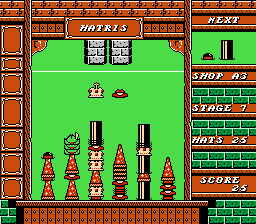
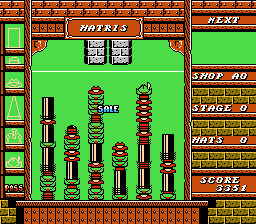
Hatris takes the familiar 2D falling‐block puzzle formula and gives it a charming twist: instead of geometric shapes, you’re sorting and stacking six distinct hat types—top hats, cowboy hats, baseball caps, derbys, party hats and crowns—on a row of six mannequin heads. Hats arrive two at a time from a conveyor belt, and it’s up to you to place them strategically so that you can build uniform piles of five. Once a stack reaches five identical hats, that set automatically drops to the lower belt and nets you a cash bonus, which doubles as your score.
(HEY YOU!! We hope you enjoy! We try not to run ads. So basically, this is a very expensive hobby running this site. Please consider joining us for updates, forums, and more. Network w/ us to make some cash or friends while retro gaming, and you can win some free retro games for posting. Okay, carry on 👍)
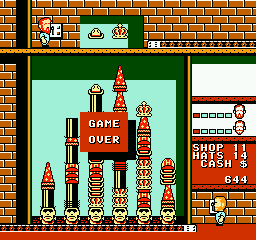
As you clear more hat sets, you’ll earn enough money to advance to the next shop level. But with each level climb, new hat styles join the mix, ramping up the challenge as you juggle more varieties and patterns. A misstep or poorly placed hat risks a stack growing too tall—once any column of hats hits the top of the screen, it’s game over. This tension between planning and quick decision‐making is where Hatris really shines.
The NES version spices things up further with an aid system featuring puzzle legends Alexey Pajitnov and Vladimir Pokhilko. By completing five full sets of hats linked to each avatar, you earn special abilities like column‐switching (Vladimir) or bottom‐row removal (Alexey). You can store multiple aids until you’re ready to deploy them, or even sell them off for extra cash at level’s end. That layer of strategic resource management elevates the puzzle formula beyond mere reflex play.
Graphics
Visually, Hatris embraces a clean, colorful aesthetic that’s instantly readable—even on the original hardware. Each hat type has a clear silhouette and distinct hue, making it easy to tell at a glance what piece you’re working with. The mannequins stand against a factory backdrop, complete with conveyor belts and spinning gears, which adds just enough industrial charm without cluttering the screen.
Animation is simple but effective: hats descend smoothly, and the satisfying jingle and drop animations when a stack clears feel rewarding. On the NES, the palette bursts with vivid reds, blues and yellows, giving each shop level its own character. The Famicom version retains this bright presentation, though it omits some of the bonus animations tied to the aid system.
While you won’t see advanced lighting or 3D effects, Hatris’ pixel art is thoughtfully designed. Background details like passing boxes, pulley arms and even the occasional cat wandering by add life to the factory setting. It’s a testament to the era’s artistry that such modest assets can still be so engaging and functional.
Story
Hatris doesn’t feature an elaborate narrative—its “story” is woven directly into the mechanics. You’re a hat factory operator, sorting and shipping hats to keep production running smoothly. Each cleared stack represents a successful order on its way to a discerning customer, with your earnings charting your progress from one shop to the next.
The game’s subtle progression—from a modest factory floor up through increasingly busy workshops—gives players a sense of growth without a text‐heavy plot. You’re simply striving to manage more hats, more varieties, and more conveyor belts, all under the steady tick of the game’s clock. It’s a pure, unadorned puzzle loop that rewards skill development above all else.
If you’re seeking a deeply woven storyline, Hatris isn’t trying to compete with RPG epics. Instead, it tells its tale through rising tension, evolving challenges and the satisfying “ka‐ching” of each hat shipment. For fans of gameplay‐driven narratives, that minimalist approach hits just the right note.
Overall Experience
Hatris delivers an addictive puzzle experience that balances strategy, speed and a dash of resource management. The core stacking mechanic feels fresh thanks to the hat theme, and the rising difficulty curve keeps you engaged as you chase higher levels and fatter paydays. Whether you’re playing the NES edition with its dual‐avatar aid system or the streamlined Famicom port, you’ll find yourself hooked by the urge to perfect your stacks.
The game’s pick‐up‐and‐play nature makes it ideal for quick sessions, yet its depth invites marathon runs to see how far you can push the factory line. The lack of an in‐game story might feel sparse to some, but the escalating challenge and charming visuals more than make up for it. Each level ends with a satisfying tally of your earnings, reinforcing that sense of progression and mastery.
Ultimately, Hatris stands out as a clever spin on the falling‐block genre. It may not boast modern bells and whistles, but its straightforward design, playful hat theme and strategic layers ensure it remains a delightful puzzle classic. If you’re in the market for a retro‐style brain‐teaser that rewards both quick reflexes and careful planning, Hatris should top your list.


Reviews
There are no reviews yet.