 Retro Replay Retro Replay gaming reviews, news, emulation, geek stuff and more!
Retro Replay Review
Gameplay
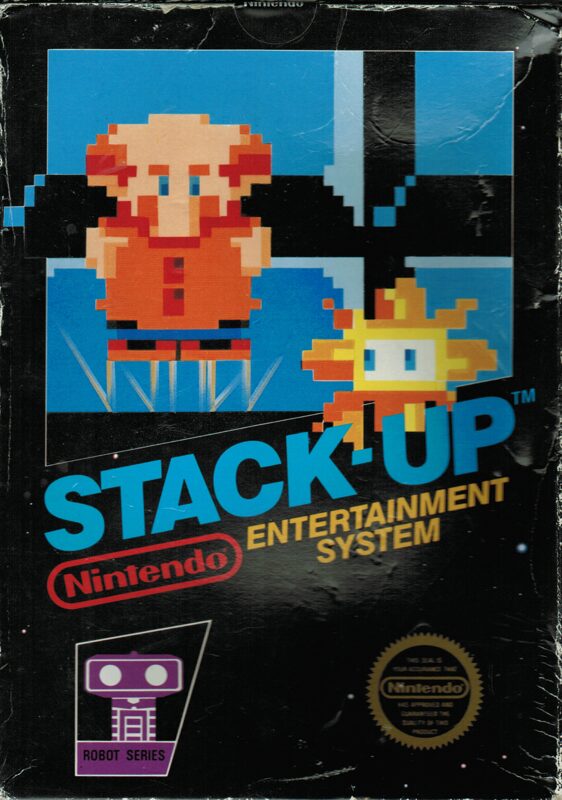
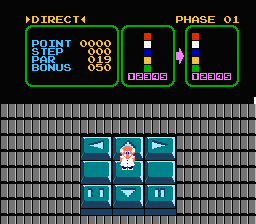
Stack-Up presents a clever twist on traditional puzzle and action elements by having you set up R.O.B., Nintendo’s robotic operating buddy, with colored discs and then issuing commands via an avatar, Professor Hector. Each colored block you hop on corresponds to a command that R.O.B. will execute in sequence, whether that’s picking up a disc, rotating, or moving across the playfield. This command-based structure transforms simple block-hopping into a miniature programming exercise, where you must anticipate how R.O.B. will behave once you “run” your sequence.
(HEY YOU!! We hope you enjoy! We try not to run ads. So basically, this is a very expensive hobby running this site. Please consider joining us for updates, forums, and more. Network w/ us to make some cash or friends while retro gaming, and you can win some free retro games for posting. Okay, carry on 👍)
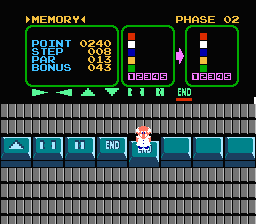
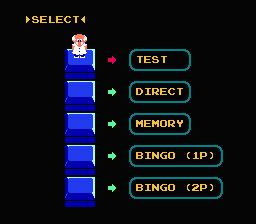
The game offers three distinct modes to keep the experience fresh. In the regular stacking mode, the challenge is immediacy: you must stack the colored discs in a prescribed pattern as quickly as possible, juggling speed and accuracy. Memory mode ramps up the difficulty by requiring you to pre-program an entire set of commands without knowing if your sequence is correct until you press “Run.” This mode tests your foresight and problem-solving under uncertainty. Finally, the bingo mode adds a competitive twist: you and an opponent work simultaneously to align rows or columns to achieve “BINGO,” activating extra commands that can hinder your rival’s progress.
Control-wise, Stack-Up is delightfully intuitive. Professor Hector moves in discrete hops, and each hop corresponds exactly to the command block that will later drive R.O.B. This precision is key when constructing longer sequences in memory mode, where a single misstep can cascade into a failure. The game encourages trial and error in a forgiving way—levels are short, and you can quickly iterate on your command sequences. For puzzle lovers and budding coders alike, the gameplay loop of plan, test, and refine feels both accessible and rewarding.
Graphics
Visually, Stack-Up embraces the NES era’s signature quirks and limitations. The color palette is bright but restricted, with each disc color clearly distinguishable against the simple gray and black background tiles. Professor Hector and R.O.B. themselves are rendered in chunky, pixelated sprites, capturing a nostalgic charm that’s both endearing and functional. There’s no superfluous animation—every movement serves a gameplay purpose.
Despite the low resolution, the graphical design excels at clarity. The command blocks are easily identified by shape and hue, ensuring that even during fast-paced stacking challenges you’re never confused about which command you’ve placed. The UI elements, such as the command queue and the disc inventory, are unobtrusive yet informative, keeping your focus on the puzzle at hand. Occasional flicker and sprite limitations are par for the course on original hardware, though modern re-releases or emulators can smooth these out.
While Stack-Up won’t dazzle you with parallax scrolling or elaborate character portraits, its minimalistic style is a strength rather than a weakness. The game’s graphics communicate information with absolute economy, aligning perfectly with its programming-puzzle ethos. If you appreciate straightforward visual design that puts gameplay first, Stack-Up’s art direction will feel like a breath of fresh air amid flashy but cluttered modern titles.
Story
Stack-Up’s narrative framework is delightfully simple: you play as Professor Hector, an inventive academic tasked with programming R.O.B. to organize colored discs. There’s no sprawling plot or character drama—just a lighthearted premise that contextualizes the puzzles. The “story” emerges through your progression, as each mode and level serves as another lesson in computational thinking and robotics.
Although the stakes remain modest throughout—there’s no villain to vanquish or empire to save—the gentle storytelling is an asset for younger players or anyone new to puzzle programming games. The tongue-in-cheek notion of “activating commands” by physically hopping on blocks adds personality without demanding narrative investment. It’s a playful framing device that keeps the focus squarely on experimentation and discovery.
For those seeking deep lore or emotional arcs, this minimalism may feel underwhelming. However, Stack-Up’s narrative restraint ensures that every element on-screen has a clear purpose. Instead of lengthy cutscenes or dialogue trees, the game teaches its mechanics through tactile interaction—an approach that underscores the educational spirit of the design. In that sense, the “story” is the process of learning itself.
Overall Experience
Stack-Up offers a singular blend of puzzle, programming, and action that remains engaging decades after its original release. Its three distinctive modes cater to a variety of playstyles—speedrunning aficionados will gravitate toward the rapid-fire stacking challenges, while strategy-minded players will relish the quiet satisfaction of debugging a memory-mode sequence. The bingo mode’s head-to-head competition adds an unpredictable, social element that’s perfect for local multiplayer sessions.
Though the graphics and narrative are minimalist, this is by design: every aspect of Stack-Up reinforces its core teaching mechanic. Players learn to think in sequences and anticipate outcomes, skills that translate well to real-world logic and coding exercises. The controls are responsive, the puzzles are challenging without ever feeling unfair, and the game’s brevity makes it easy to pick up for a quick brain workout.
For potential buyers, Stack-Up stands as a shining example of how simple concepts can yield deep, replayable experiences. Whether you’re a nostalgic gamer curious about the NES library or a parent seeking an entertaining way to introduce computational thinking, Stack-Up delivers. It may lack bells and whistles, but its focus on clarity and ingenuity ensures that the hours you spend stacking discs and commanding R.O.B. will be both enjoyable and mentally enriching.


Reviews
There are no reviews yet.