 Retro Replay Retro Replay gaming reviews, news, emulation, geek stuff and more!



Retro Replay Review
Gameplay
Top Gun: The Second Mission picks up the throttle right where its predecessor left off, putting you back in the cockpit of an F-14 Tomcat with a single, explosive objective: destroy everything in sight. The core gameplay loop remains familiar—anti-ship, ground attack, and space combat levels—but the pacing feels brisker thanks to tighter controls and a slightly expanded mission design. You’ll find yourself weaving through waves of enemy fighters, dodging anti-air fire, and lining up precise shots against ships and installations on the fly.
(HEY YOU!! We hope you enjoy! We try not to run ads. So basically, this is a very expensive hobby running this site. Please consider joining us for updates, forums, and more. Network w/ us to make some cash or friends while retro gaming, and you can win some free retro games for posting. Okay, carry on 👍)
What really sets this sequel apart are the two new modes added to the roster. In Ace Combat Mode, you go head-to-head against elite enemy pilots flying high-speed MiG-25 Foxbats, one–on–one. These dogfights demand split-second decision–making and mastery of your missile loadout. Then there’s the two–player split–screen mode, where you and a friend each pilot an F-14 in a head-to-head skirmish. It’s a welcome addition that transforms the game from a solitary arcade rush into a competitive showdown.
Beyond the standard levels and extra modes, the variety of bosses you face keeps the adrenaline pumping. From a towering Tu-160 Blackjack bomber to a heavily armed Mi-24 Hind attack chopper—and even an armed space shuttle—each boss encounter is a test of timing, reflexes, and situational awareness. To top it off, you’ll weave through giant trees, dodge streaks of lightning, and evade neon laser blasts between skirmishes, making each stage feel like a miniature obstacle course as much as an aerial battlefield.
Graphics
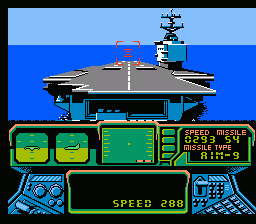
On the NES hardware, Top Gun: The Second Mission delivers crisp sprite work and vibrant, contrasting colors that pop against varied backdrops. Whether you’re flying over a sun-dappled ocean, a shadowy forest, or the endless expanse of space, the environments are distinct enough to keep you oriented while still looking good under pressure. The animation of enemy craft, missiles, and explosions remains smooth even when the screen gets crowded.
The level of detail on key enemies is particularly striking. The Blackjack’s broad fuselage, the Hind’s rotors, and the shuttle’s sleek lines are all recognizable at a glance. The game even sneaks in little touches—flickering lightning in the forest levels, glowing laser beams in space—to remind you that this isn’t just off-the-rack arcade fare but a lovingly crafted sequel.
Split-screen mode surprisingly holds its own graphically, with each player’s viewport remaining clear and readable. You won’t lose track of your jet among the clutter of flak bursts and ground installations, which is crucial in the heat of a dogfight. For an 8-bit title, the balance between visual fidelity and performance is well struck, making every mission feel dynamic without sacrificing frame rate or responsiveness.
Story
Unlike contemporary flight sims with sprawling narratives, Top Gun: The Second Mission keeps its storyline lean and laser-focused: you are the pilot, your mission is to obliterate every hostile target, and you must return to your aircraft carrier at the end of each level. There’s no mention of superpowers or international politics—just straightforward aerial combat against vaguely Eastern-bloc forces. This minimalist approach fits the arcade spirit perfectly.
There’s a certain charm to the game’s “destroy or be destroyed” ethos. You don’t wade through cutscenes or read lengthy mission briefs; the plot is contained entirely within your HUD and the roar of your engines. In a way, this absence of narrative fluff lets the game concentrate on what matters most: pinpoint maneuvers, lock-on missile volleys, and the rush of pulling off a perfect landing on your carrier deck.
Despite—or perhaps because of—its narrative simplicity, the game manages to sustain tension through its mission variety. Whether you’re strafing coastal bunkers, engaging enemy aces in high-altitude dogfights, or battling it out on split-screen, the stakes remain clear and immediate. There’s comfort in knowing exactly what you’re signing up for, and Top Gun: The Second Mission delivers on that promise with unrelenting arcade intensity.
Overall Experience
Top Gun: The Second Mission stands out as a robust yet accessible arcade flight game on the NES. It builds on the solid foundation of the original installment by expanding mission types, adding engaging boss battles, and introducing new competitive and cooperative modes. Whether you’re flying solo through the campaign or dueling a friend in head-to-head combat, you’ll find plenty of replay value and moments of pure aerial mayhem.
The learning curve is gentle but rewarding. Novice pilots can jump in and enjoy the straightforward action, while experienced gamers will appreciate the challenge of mastering dogfights against MiG-25 aces and navigating hazard–filled environments. The split–screen mode is a particular highlight: it transforms a one-player arcade romp into a social showdown that keeps the controller swapping—and bragging rights—hotly contested.
If you’re seeking a high-octane, no-frills flight experience on the NES, Top Gun: The Second Mission delivers in spades. Its blend of satisfying controls, varied level design, and eye-catching graphics ensures that each sortie feels distinct and exciting. Strap in, gunner—this mission won’t come back around for you to have a second try.


Reviews
There are no reviews yet.