 Retro Replay Retro Gaming History, Reviews & Emulation
Retro Replay Review
Gameplay
TMNT understands that a portable action game benefits from momentum. You spend most of your time sprinting across rooftops and other level spaces, hopping from glowing point to glowing point on the way to the finish. The jump system asks you to choose a direction relative to the screen, then handles the actual leap when you pick correctly. That may sound overly simplified, but it gives successful runs a pleasantly fast, choreographed flow.
That flow clicks most when you build jump chains. Moving quickly through several jump points makes the route feel less like a series of isolated prompts and more like a chase sequence. Charging jumps for slides, ropes, and climbs adds a little texture, too. Still, you are following prescribed paths rather than discovering your own approach, and that restriction becomes harder to ignore once the novelty wears off.
Fights break up the running with basic attacks, blocks, stronger moves, regular goons, and boss encounters. Family Bonds, earned by catching up to a fellow Turtle during timed moments, let you call in extra attacks. It is a sensible reward because it ties a little platforming urgency to combat payoff, even if the fighting does not have the depth to carry the game on its own.
Replay value is more substantial than it first appears. Each stage grades your performance on speed, TMNT letter collection, Family Bonds, and jump chains, and gold medals unlock bonuses. Chasing a cleaner run can be genuinely compelling if the directed platforming rhythm agrees with you. The multiplayer races are also a natural fit for the format: getting to the end first is a straightforward way to turn the game’s route-running into a competition.

Graphics
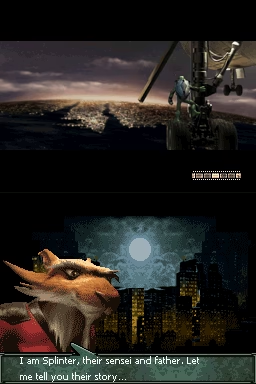
The Nintendo DS game leans into the film’s moody New York flavor with dark water, clustered city buildings, and nighttime backdrops. One scene frames Master Splinter against a moonlit skyline, while the stage map looks like a dense, miniature city floating in black water. The Turtles are small on screen, but their bright green coloring helps them stand out from the grimy surroundings.
Its 3D city imagery has a rough, chunky handheld look, with buildings packed tightly together and a lot of murky brown, gray, and olive tones. That fits the Ninja Turtles well enough, though it lacks the crisp detail that would make the locations feel especially lively.
Story
The setup is familiar but effective for TMNT: the four brothers have drifted apart, and a threat to New York forces them back together. Rather than trying to build a separate continuity, the game loosely follows the 2007 animated movie. That makes it easy to jump into if you know the film, and simple enough to follow if you do not.
Each stage assigns you a particular Turtle, which keeps the reunion theme present even while the game is mostly focused on reaching the next endpoint and clearing fights. The Family Bond system is the clearest gameplay expression of that idea. Helping a brother during a run can directly fuel a team attack later, so the licensed theme is not just sitting in the cutscenes.
Between levels, the PSP version uses film images and clips, while the DS version tells its version of the movie-based story without that extra video material. On DS, the story works best as quick motivation between action sequences rather than as a reason to linger. Fans looking for a detailed retelling may find it thin, but it keeps the pace from stalling.
Overall Experience
TMNT is at its best when you accept it as a guided sprint rather than a traditional precision platformer. The jump-point system removes a lot of frustration from handheld traversal and lets you focus on choosing the right route quickly. For a younger player, or a Turtles fan who wants something easy to pick up for short sessions, that can be a real strength.
For everyone else, the limitation is equally clear. The platforming has a narrow range of expression, and the combat, while useful as a change of pace, is not strong enough to make every encounter memorable. Replaying for medals offers a better reason to return than the basic campaign alone, especially if shaving time off a run appeals to you.
It is a respectable movie tie-in with a few thoughtful ideas about how to translate rooftop acrobatics to the DS. You will probably enjoy it more if you value forward momentum, score chasing, and the Turtles’ reunion story than if you want open-ended levels or a deep brawler. The payoff is modest, but the best runs have enough snap to make it worth a look for the right fan.

Reviews
There are no reviews yet.