 Retro Replay Retro Gaming History, Reviews & Emulation
Retro Replay Review
Gameplay
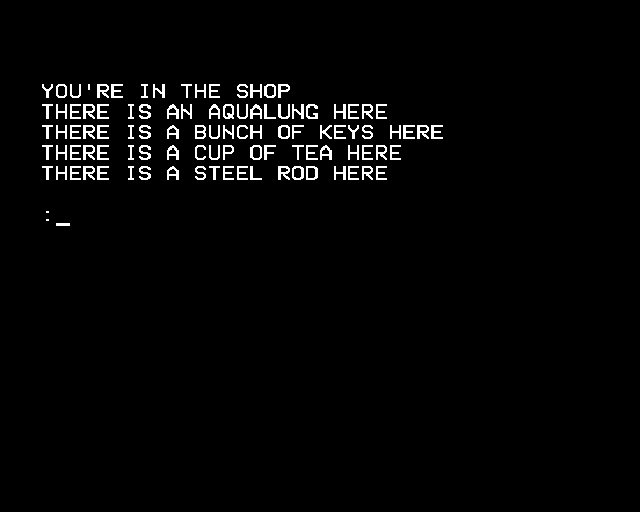
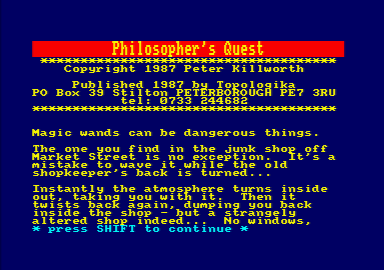
The first stretch gets its hook from uncertainty. You begin by choosing a few objects from a junk shop, wave a wand on impulse, and suddenly have to pay for that mistake by recovering treasures from an unfamiliar underground realm. That opening choice matters more than it initially seems: useful equipment is limited, your inventory cannot hold everything, and a casually discarded item can become tomorrow’s headache.
Once you settle into the one- and two-word command style, Philosopher’s Quest becomes a game about building a mental map as much as solving individual riddles. You move, examine, take, manipulate, and experiment, but the strongest habit to bring is organization. Note where you leave objects, keep track of dangerous routes, and treat your light source as a real resource rather than background flavor. Caves, mazes, seas, and hazardous chambers make progress feel earned when your notes finally connect.
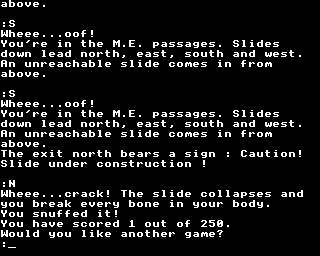
The puzzle design is where the game will either win you over or wear you down. Some obstacles ask for familiar inventory logic or magic words; others lean into wordplay, lateral thought, and commands that express abstract ideas. That range gives the adventure a playful intelligence, yet it also means you can spend a long time testing interpretations that seem perfectly reasonable. Death, traps, hostile creatures, and choices that can make completion impossible turn regular saving into essential self-defense, not mere caution.
Graphics
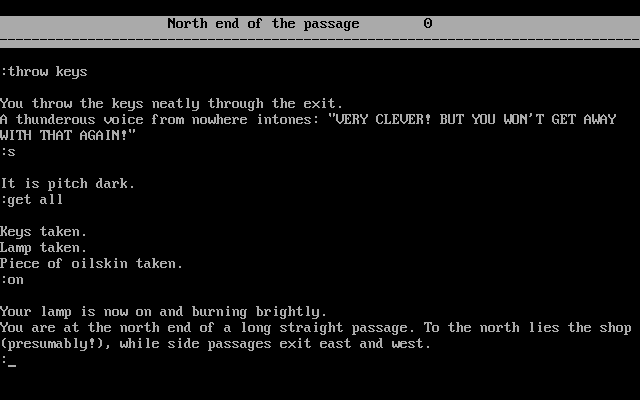
This is a text adventure, so the places and creatures arrive through written description and your own imagination rather than drawn characters or animated scenery. That suits a world capable of jumping from underground passages to the interior of a whale: the words leave plenty of room for the game’s stranger ideas to land in your head.
Story
The story is thin in the useful way many classic adventures are thin: it gives you a clear debt, a bizarre destination, and permission to wander. A bodiless voice demands compensation for misuse of the wand, instructing you to recover treasures and return them to the shop. You always know the broad purpose, even when the route toward it becomes gloriously odd.
What gives the journey character is its grab bag of references. You may run into the serpent from the Garden of Eden, the Ancient Mariner, an elderly woman looking for her dog, and locations drawn from equally unlikely territory. Literature, mythology, mathematics, and philosophy collide without needing to become a solemn lecture, and that off-kilter mixture is the game’s most memorable quality.
Do not expect a tightly paced narrative with escalating character drama. The story works as connective tissue for exploration and riddles, with treasures serving as milestones and optional finds offering extra reward. If you enjoy discovering what the next strange reference is doing in a puzzle, the loose structure feels inviting. If you need plot momentum to carry you through difficult stretches, it may not be enough.
Overall Experience
Philosopher’s Quest is a stubborn, imaginative piece of interactive fiction that asks you to meet it halfway. It rewards the player who enjoys drawing maps, maintaining notes, revisiting a baffling clue later, and accepting that failure may teach more than immediate progress. Finding a treasure after untangling a difficult chain of locations and objects should feel satisfying precisely because the game has made you work for it.
Its harsh edges are real. Limited light, inventory pressure, lethal hazards, and permanently damaging decisions can turn a clever adventure into a restart if you are careless or simply fail to parse the intended idea. Save frequently, take detailed notes, and do not be embarrassed to step away when a wordplay puzzle starts feeling opaque. This is not a game that consistently protects your time.
Still, there is something appealingly unruly about its willingness to put philosophy, mythology, and old adventure-game cruelty in the same underground toy box. Give it a chance if you want a historically minded text adventure with a surreal sense of humor and tolerance for frustration. Skip it if you want polished guidance or forgiving puzzle design; the payoff is real, but it belongs to persistence more than comfort.



Reviews
There are no reviews yet.