Retro Replay Retro Gaming History, Reviews & Emulation
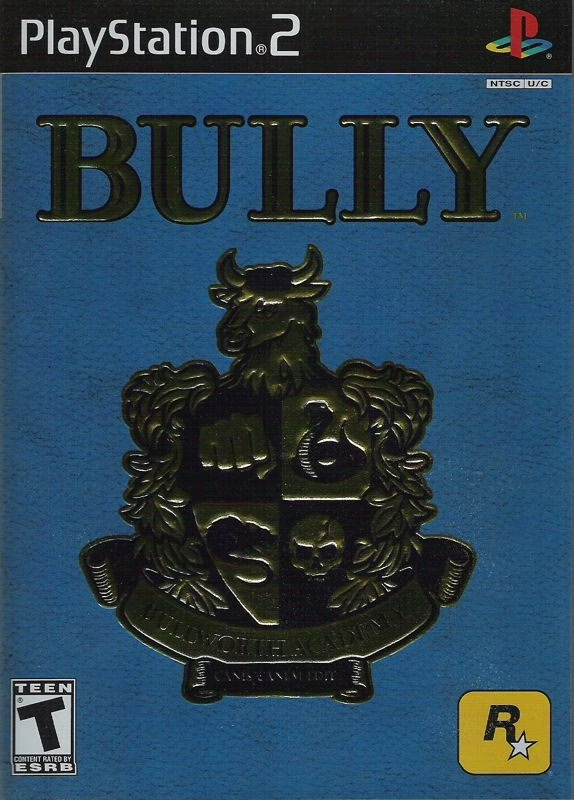
Twenty years ago, Rockstar proved you didn’t need carjackings and organized crime to create an entire world of trouble. Sometimes a boarding school was enough.
On 17 October 2006, Rockstar Games released Bully for the PlayStation 2, trading the criminal underworld of Grand Theft Auto for the equally treacherous hallways of Bullworth Academy.
I’ll admit, I wasn’t sold on Bully at first.
I’d enjoyed Rockstar’s previous open-world games, particularly Grand Theft Auto, but a game about a troublemaking teenager at a boarding school? I wasn’t convinced the concept could deliver the same kind of experience.
And when I first started playing, I didn’t really connect with any of the characters, either.
But the story? That was another matter.
There was something about the rivalries, the schemes, and the ridiculous situations Jimmy kept finding himself in that made me want to see what happened next. Even if I wasn’t particularly attached to the characters, I was invested in finding out where they were going.
And before I knew it, I was hooked.
The more I played, the more I appreciated everything else Rockstar had packed into Bullworth Academy. The capers, the minigames, the classes, the exploration, and all the opportunities to cause a little harmless trouble.
It took so many of the things that worked in Grand Theft Auto, scaled them down for the classroom, and created something that felt familiar but completely different.
I went into Bully wondering whether the premise could carry an entire game. The story kept me playing, and everything else made the experience memorable.
Welcome to Bullworth Academy
Developed by Rockstar Vancouver, Bully follows 15-year-old Jimmy Hopkins, a troublemaking teenager who’s been kicked out of more schools than most people have attended.
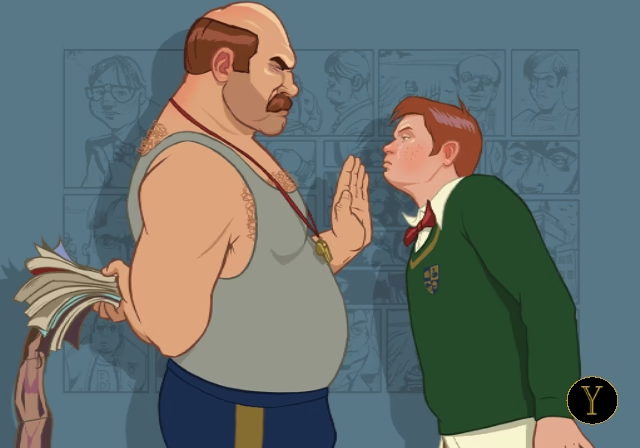
His mother and new stepfather abandon him at Bullworth Academy while they head off on an extended honeymoon, leaving Jimmy to navigate a boarding school populated by bullies, nerds, jocks, preppies, greasers, and an assortment of teachers and administrators who probably shouldn’t be allowed anywhere near children.
Jimmy quickly discovers that Bullworth has its own social hierarchy, and just about everyone is fighting for a place at the top.
Naturally, the new kid gets caught in the middle.
The characters were one of the things that really sold me on the game. Jimmy was a great protagonist, sarcastic and rough around the edges, but not necessarily the villain that the game’s title might suggest. And the supporting cast was filled with exaggerated personalities that wouldn’t have been out of place in an 1980s teen comedy.
What impressed me most was how Rockstar adapted its familiar open-world formula to such a different setting.
There were rivalries, friendships, betrayals, romantic complications, and enough juvenile nonsense to make you wonder how Bullworth Academy managed to remain open.
In other words, it was a Rockstar game.
Grand Theft Auto: Detention Edition
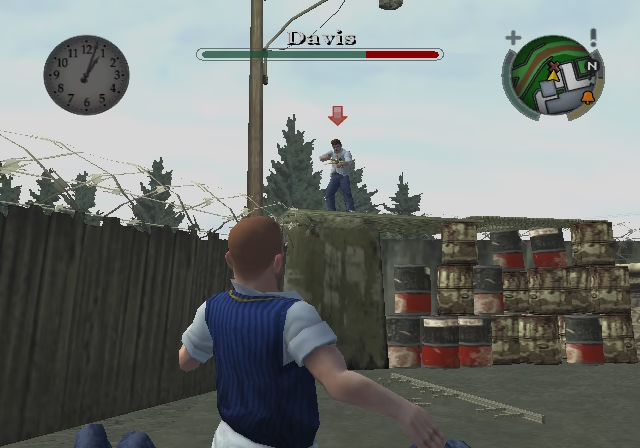
Instead of stealing cars, you rode bicycles and skateboards. Instead of gunfights with rival gangs, you got into schoolyard brawls with the jocks and greasers. Your arsenal consisted of slingshots, stink bombs, firecrackers, itching powder, and other wonderfully juvenile instruments of destruction.
And instead of dodging the police, you were dodging prefects and trying not to get caught skipping class.
Although there were still police to contend with once you ventured into town.
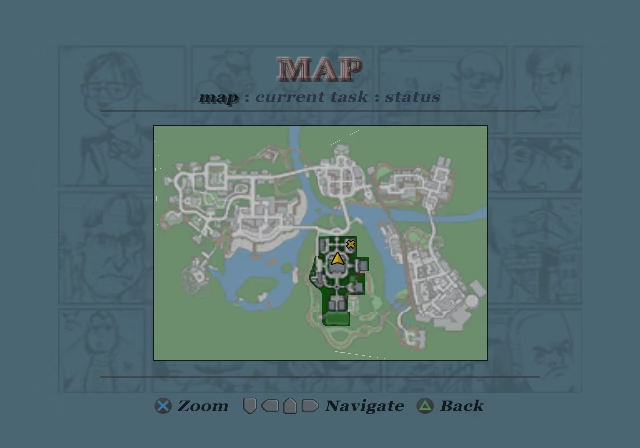
The world was considerably smaller than the sprawling cities of Grand Theft Auto, but that didn’t make it feel empty. If anything, the smaller setting helped give Bullworth more personality.
There was always something happening. Students argued and fought, teachers wandered the halls, and the different cliques occupied their own corners of the school.
And beyond the academy itself, there was an entire town to explore, complete with shops, neighborhoods, an amusement park, and more opportunities to get into trouble.
I think that’s one of the reasons I enjoyed Bully as much as I did. Rockstar didn’t simply shrink a GTA map and populate it with teenagers. They built an environment around the setting and filled it with activities that made sense within that world.
Well, as much sense as anything in a Rockstar game ever makes.
Class Is in Session. Unfortunately.
One of my favorite aspects of Bully was the sheer variety of activities.
You actually had to attend classes, although you could skip them if you didn’t mind dealing with the consequences. Each subject was presented as a minigame, and doing well rewarded you with new abilities or useful bonuses.
English class involved making words from a selection of letters. Chemistry required timed button presses. Gym featured wrestling and dodgeball. Art borrowed its gameplay from the classic arcade game Qix.
And shop class let you work on bicycles.
For the record: Attending classes wasn’t just busywork. Completing them could unlock new fighting moves, improve your ability to talk your way out of trouble, or provide other useful rewards.
It was a clever way to incorporate character progression without relying on the usual RPG experience points.
But classes were only a small part of the experience.
You could run errands, deliver newspapers, mow lawns, race bicycles, play arcade games, visit the carnival, collect hidden items, and pursue all sorts of optional objectives.
Then there were the story missions.
Some involved elaborate pranks, others had you sneaking around campus or helping one clique get the better of another. There was a wonderful variety to the objectives, and the game’s mischievous sense of humor helped keep things entertaining.
It had that same Grand Theft Auto quality where you could sit down intending to complete a couple of missions and wind up spending hours getting distracted by everything else.
Except now you had homework.
The Controversy Before the Bell
Of course, this wouldn’t be a Rockstar release without a little controversy.
Even before Bully arrived in stores, critics were raising concerns about the game’s subject matter. Anti-video-game activist Jack Thompson was among its most vocal opponents, arguing that the game encouraged bullying and school violence.
Some critics characterized it as a dangerous schoolyard violence simulator.
The actual game turned out to be considerably less sinister than those descriptions suggested.
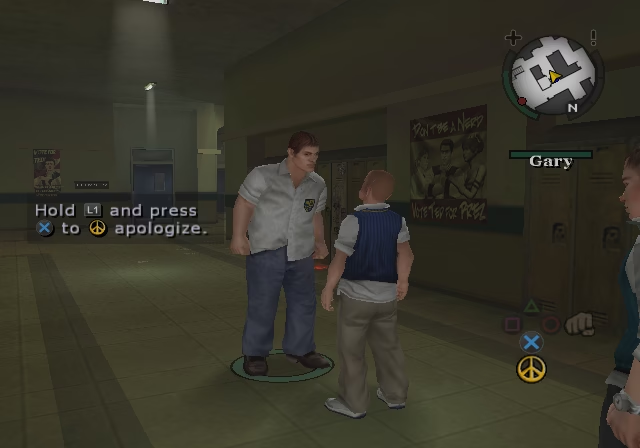
Rather than encouraging indiscriminate violence, Bully told the story of a teenager navigating a dysfunctional school where intimidation, social divisions, and corrupt authority figures were everyday problems.
Jimmy could certainly be a troublemaker, but he couldalso stand up for weaker students and challenge the school’s established bullies.
And despite the controversy, the game received a T for Teen rating from the ESRB.
It was still full of Rockstar’s trademark irreverence and crude humor, but it wasn’t simply Grand Theft Auto with children.
It had its own identity.
A Little More Time at Bullworth
The original PS2 game received strong reviews, and Rockstar eventually brought it to additional platforms.
In 2008, Bully: Scholarship Edition arrived on Xbox 360 and Wii, with a PC version following later that year. The expanded edition introduced additional missions, classes, characters, and other content.
The game also found its way onto mobile devices with Bully: Anniversary Edition in 2016.
Yet despite its popularity and the continued interest from fans, Bullworth Academy has never received a proper sequel.
And that’s a shame.
Rockstar has created some enormous, incredibly detailed open worlds over the years, but there’s something to be said for a smaller game that concentrates on personality, atmosphere, and entertaining things to do.
Bully was proof that an open-world game didn’t need to be about saving the world, building a criminal empire, or defeating some enormous threat.
Sometimes all you needed was a slingshot, a skateboard, and an afternoon free from detention.
Twenty Years Later, Class Is Still in Session
Twenty years later, what I remember most is how a game I wasn’t particularly sold on managed to pull me in with its story, then kept me entertained with everything else Bullworth Academy had to offer.
The characters were memorable, the stories were entertaining, the activities were varied, and the world was packed with that wonderfully sarcastic Rockstar personality.
It took everything I enjoyed about the Grand Theft Auto formula and put it in a setting I never would have expected to work so well.
And sometimes that’s exactly what makes a game memorable.
Is Bully the Rockstar franchise most deserving of a sequel? Or would you rather see the studio bring back something else from its catalog?