 Retro Replay Retro Gaming History, Reviews & Emulation
Retro Replay Review
Gameplay
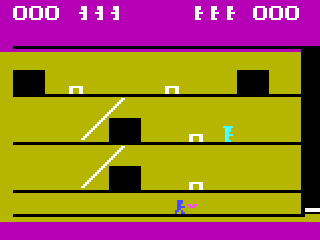
The first hour of Chez Maxime is built around a pleasingly immediate kind of stress. Customers enter through four doors, take seats across the restaurant’s three floors, and expect Maxime to keep food moving. Your route runs through an elevator shaft, where you need to grab a meal from the dumb-waiter as it passes your floor, then get that tray to the right waiting customer. There is no long setup before the pressure starts: you are quickly watching several tables, tracking the food, and deciding whose patience matters most.
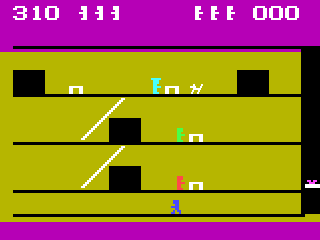
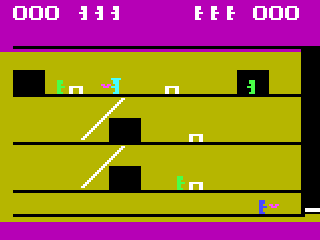
What makes the routine work is the visible temper system. A customer begins green, turns red as the wait drags on, and eventually jumps in place in open fury. Serving them restores calm and sends them on their way, while letting furious diners leave counts toward the four-customer limit that ends the game. That clear chain of cause and effect gives every delay weight. You can understand exactly why a run is going wrong, which makes a failed attempt feel more like a challenge to clean up than random punishment.
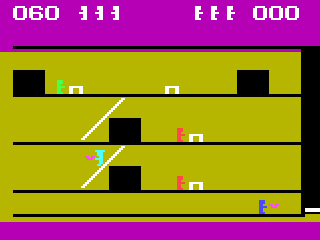
The dog is where a manageable work pattern can become a scramble. With empty hands, Maxime can kick it out. With a tray, the dog bites his legs, knocks him down, and steals the tray. It is a compact complication, but a nasty one because it turns the obvious goal—carry food immediately—into a risk calculation. Chez Maxime asks for alertness more than elaborate strategy, and its best moments come when you barely preserve the restaurant’s rhythm after a disruption.
Frustration will set in if you want room to recover from mistakes. Three floors, the moving dumb-waiter, impatient tables, and the dog can combine into a very strict workload, and four unserved departures is not much forgiveness. Still, the rules are clean enough that persistence has a point. This is a worthwhile diversion if you like old arcade-style time management where mastery means anticipating trouble a few seconds before it becomes disastrous.
Graphics
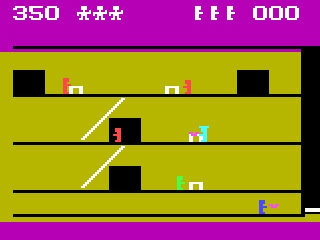
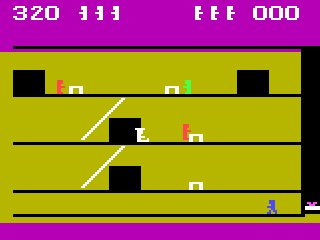
The side-view restaurant is organized around its three floors, with one table on the first floor, one on the second, and three on the top. Customer anger is communicated in direct, useful terms: calm diners are green, waiting diners turn red, and the angriest customers jump in place. That makes the urgent tables easy to spot while Maxime moves through the elevator shaft.
Story
Chez Maxime keeps its story to a clear workplace predicament: Maxime is a waiter who must keep customers served or lose his job. It is not a tale with character development or twists, but it does give the action a sensible stake. Every tray matters because you are trying to keep Maxime employed, not merely chase a number.
The restaurant itself supplies the drama. Customers arrive, sit, wait, cool down when served, and leave if Maxime fails them at their angriest. That repeated cycle gives the game a tiny service-industry narrative: a shift begins under control, then demand piles up and one missed responsibility can snowball.
The dog adds a touch of slapstick to the otherwise stern job-pressure setup. It is not just an obstacle drifting around the screen; it specifically targets Maxime’s tray, turning a bad encounter into a dropped meal and a setback. The result is a light premise that fits the action neatly without pretending to be more than it is.
Overall Experience
Chez Maxime is at its strongest when you accept it as a focused arcade challenge rather than a full restaurant simulation. Its small set of rules generates a respectable amount of tension: food has to be intercepted, customers have to be prioritized, and carrying a tray can make the dog a genuine threat. The game finds a lot of pressure in that narrow space.
You will get the most out of it if you enjoy repeating a concise scenario until your movement and priorities become automatic. The satisfaction is not in seeing new locations or uncovering a bigger plot; it is in turning an overrun dining room back into a functioning one, then trying to survive longer the next time. The strict game-over condition gives that improvement a tangible edge.
It is also undeniably a lean experience, and its demands can feel severe when several problems converge. But Chez Maxime has the key virtue of a good early action game: you always know what you should have done differently. Give it a chance if you have patience for brisk, unforgiving score-chasing and enjoy a game that can turn a waiter, a tray, and a badly timed dog into a proper crisis.


Reviews
There are no reviews yet.