 Retro Replay Retro Gaming History, Reviews & Emulation


Game Overview
Gameplay
Air Ranger starts with a clear, immediately appealing idea: fly a rescue helicopter under pressure, then prove you can be careful when the ground is crowded and the person waiting below cannot afford delays. Each assignment is timed, and the scoring punishes slow rescues, dead victims, and contact with buildings. That gives even a straightforward pickup-and-delivery job some real nerves. You have to treat the approach as seriously as the flight there.
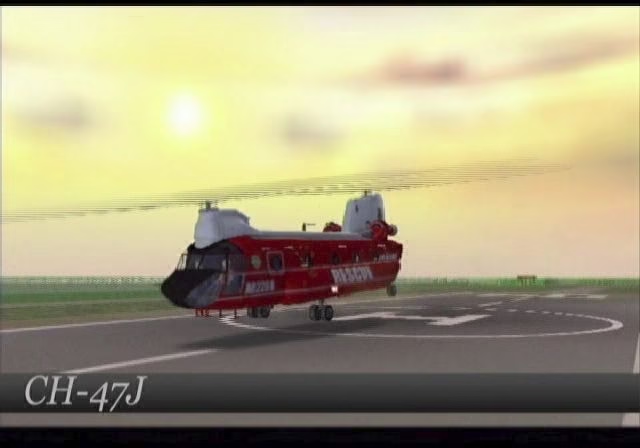
The game is at its strongest when you settle into that rhythm. A free-flight option and an unusually thorough training section let you spend time with the aircraft before committing to the rescue work, while the training material explains both controls and helicopter operation. The available helicopters, from the compact OH-6D to the recognizable CH-47J Chinook, give the game more flavor than a one-machine challenge would have. Progression also matters, since later work and aircraft must be earned by clearing earlier missions.
Frustration is built into the deal. Serious building collisions can end an attempt outright, and the point penalties mean a technically completed rescue may still feel sloppy. There are three difficulty levels for each mission, so committed players have room to revisit the scenarios, but the core campaign is still a compact set of eight timed jobs. If you want a relaxed arcade flyer, its strictness may wear thin. If you enjoy rehearsing an approach until you finally make it clean, that pressure is the reason to play.
Graphics
The city rescue scenes have the blocky, low-detail look of early PS2 3D: tall dark office buildings, broad streets, boxy traffic, and a helicopter that can look very small against the skyline. That rough geometry actually helps sell the danger of squeezing a rotorcraft through an urban corridor.
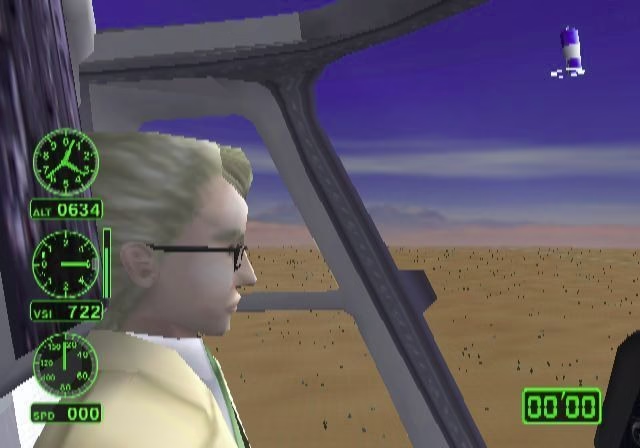
The aircraft are the visual highlight. The red-and-gray Chinook has a convincing bulky silhouette on the helipad, while the cockpit view puts a pilot model in the foreground against a stark, sandy horizon and deep purple sky. It is dated imagery, but the helicopters are easier to appreciate than the scenery around them.

In addition to this there’s some audio guidance from mission control
Story
There is no sprawling plot to carry Air Ranger. Its story is the work: an accident has happened, somebody needs help, and you are sent out to get them to safety. Mission control guidance and briefing material establish enough urgency to make each rescue feel like an assignment rather than an empty time trial.
That simplicity fits the game. The focus stays on the practical drama of arrival time, safe landing, and avoiding a costly mistake. A victim’s health is not just background flavor, because waiting too long directly hurts your result.
Do not come looking for character arcs or a campaign full of twists. Air Ranger treats rescue work as its own premise, and it relies on the tension of that responsibility rather than on elaborate storytelling. For this kind of focused simulation, that is the right priority.

Overall Experience
Air Ranger: Rescue Helicopter is a modest game with a sharper edge than its rescue theme first suggests. The combination of time pressure and collision failure turns careful flying into the central challenge, while the training and free-flight material show more respect for the subject than a disposable vehicle-action game would.
Its limits are hard to ignore. Eight missions is not much, and repeated attempts can feel punishing when a bad collision erases a run.
Still, the payoff is real if you like specialized PS2 oddities and can enjoy improving a route through practice. Give it a chance if you want a deliberately paced helicopter rescue challenge where safe flying matters as much as speed. Skip it if you need a long campaign, forgiving missions, or a more polished action-game feel.


Reviews
There are no reviews yet.