 Retro Replay Retro Gaming History, Reviews & Emulation


Game Overview
Gameplay
The Division starts with a clean, immediately understandable loop: move through a ruined city, snap into cover, pick off hostile groups, and collect gear that nudges your agent forward. Third-person firefights reward patience more than reckless rushing. You are often shifting between solid objects, watching enemy positions, and looking for a safe opening rather than simply charging down a hallway.
The RPG layer is what gives that shooting a longer tail. Weapons, skills, and talents improve as you gain experience and unlock more of the home base’s Medical, Security, and Tech wings. That progression makes the campaign feel like more than a string of gunfights, because each return to base can point toward a stronger build or another useful option in combat.
The Dark Zone is still the game’s strongest hook. This open area mixes computer-controlled enemies with other players hunting enhanced loot, and no extraction is truly comfortable when anyone nearby could turn rogue. Since death costs you the loot you are carrying and can affect rank and level, a helicopter pickup becomes a real pressure point. It is a terrific idea for gamers who enjoy uncertainty and betrayal, though it can become aggravating if you want a relaxed, consequence-free co-op session.
You can play solo, but this is a game that gets more interesting when other agents are part of the equation. Cooperative missions give the campaign a natural social side, while the Dark Zone creates the kind of uneasy teamwork that ordinary multiplayer shooters rarely manage. If you enjoy improving a character over time and can accept an online-only game built around repeatable combat, there is a lot to dig into.
Graphics
Manhattan looks convincingly battered and winterbound. Snow covers the streets around abandoned vehicles and debris, while the mission-complete scene pairs a cold, gray street with a bright orange vertical marker that stands out against the slush. The third-person camera keeps your bundled agent and their bulky gear in clear view as they move between cover.
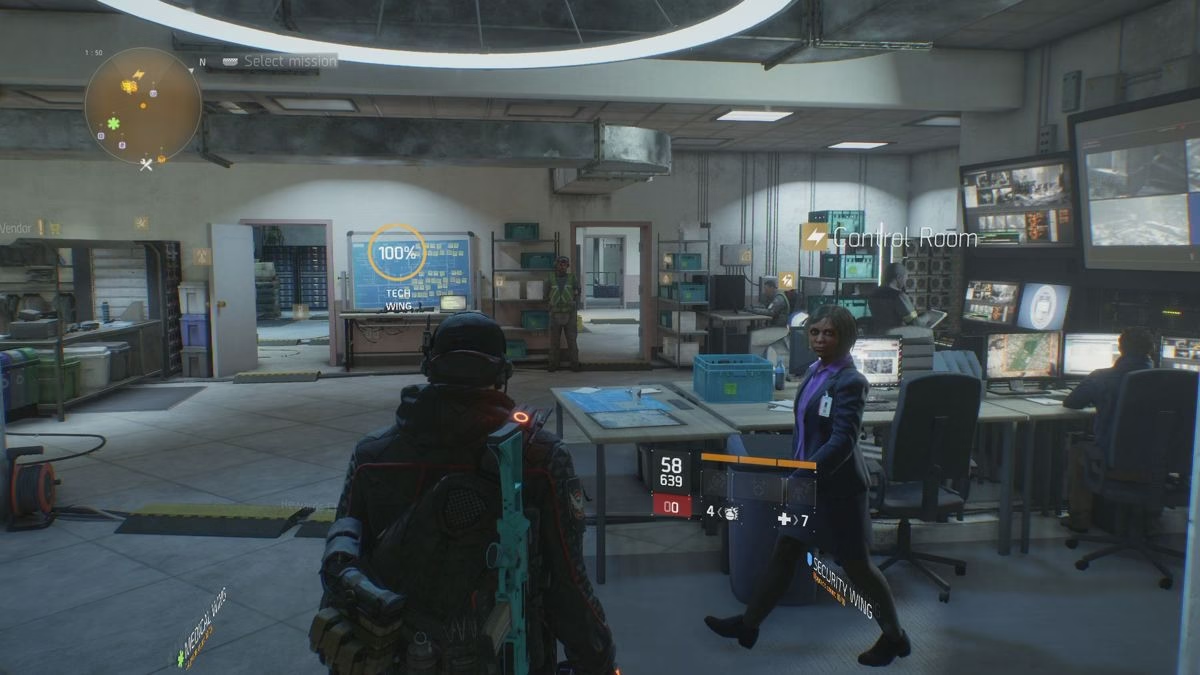
Indoor locations have a more utilitarian look, but they suit the setting. The New York Police Academy’s pale lobby, framed wall displays, tiled floor, and scattered equipment feel like a civic building repurposed for a crisis, while the Tech wing’s workstations and exposed damaged ceiling make the base feel actively rebuilt rather than pristine.

Story
You play an agent of The Division, an elite government agency activated after a virus outbreak brings Manhattan to its knees. The setup is direct and effective: the city is in trouble, its systems are failing, and your job is to help investigate the outbreak while restoring a foothold for the people trying to survive it.
The campaign is divided across Medical, Security, and Tech missions, which gives the recovery effort a practical shape. Instead of framing the crisis as one vague apocalypse, it asks you to push different pieces of a damaged city back into working order. That fits the grounded Tom Clancy tone better than a more fantastical end-of-the-world story would.
Still, the story is mainly there to carry you from operation to operation and give your upgrades context. The emotional payoff comes less from intricate drama than from seeing New York shift from a place of panic into one where your agent can make a difference. Go in for a tense disaster-zone mission framework, not a character-driven narrative epic.

Overall Experience
The Division earns its reputation on atmosphere and tension. Cover shooting, gear progression, and a snow-choked New York are individually familiar, but they fit together well enough to make the next mission or loot run hard to resist. The moment-to-moment action is purposeful, and the steady climb in power gives the game a satisfying sense of momentum.
The Dark Zone is the deciding factor. If the thought of carrying hard-won loot toward an extraction point while wondering whether nearby agents will help or kill you sounds exciting, it can produce the game’s most memorable sessions. If you dislike PvP interfering with your progress, that same tension can feel like a tax on your time.
At its best, this is a smart hybrid for gamers who want a shooter with persistence, co-op possibilities, and a dangerous multiplayer space that creates stories on its own. The mandatory connection and emphasis on upgrades ask for commitment, and repetition can set in when you are chasing better gear. Even so, the central loop is strong enough to make the payoff worthwhile for anyone who enjoys tactical firefights with real stakes.


Reviews
There are no reviews yet.