 Retro Replay Retro Gaming History, Reviews & Emulation
Retro Replay Review
Gameplay
Dandara starts by making you unlearn platform-game muscle memory. Its heroine cannot stroll, sprint, or make a conventional jump. Instead, you point toward a valid marked surface and fling her across the room, attaching to floors, walls, and ceilings alike. That single rule turns every chamber into a compact navigation problem. A ceiling is not scenery above you. It is often the next piece of ground.
The first stretch is intentionally awkward. You can see a route but still miss it because your chosen landing spot is out of reach or because you have not yet internalized the room’s orientation. That is where frustration can set in, especially if you want the immediate freedom of a standard side-scroller. Stick with it long enough for the aiming to become instinctive, though, and the limitations stop feeling arbitrary. You begin scanning for chains of surfaces, anticipating where a launch will leave you, and treating a reoriented room as an invitation rather than a disruption.
Combat runs on the same directional logic. Dandara’s charged, three-pronged opening attack fires in the direction of her movement, so positioning and offense are tightly connected. Upgrades and additional weapons widen both your combat options and your access through Salt, giving the exploration a familiar ability-gated Metroidvania rhythm without making it feel like a copy of anything else. The closest useful touchstone is Super Metroid: both reward curiosity in an interconnected world, but Dandara replaces Samus’s conventional traversal with a much stranger spatial language.
That difference is the whole reason to play it. The game asks for patience, and its restricted landing choices can make a bad read feel harsher than a missed normal jump. But when a difficult route finally clicks, you are not merely executing a sequence of inputs. You are seeing the room correctly for the first time. For a game built around exploration, that is a powerful payoff.
Graphics
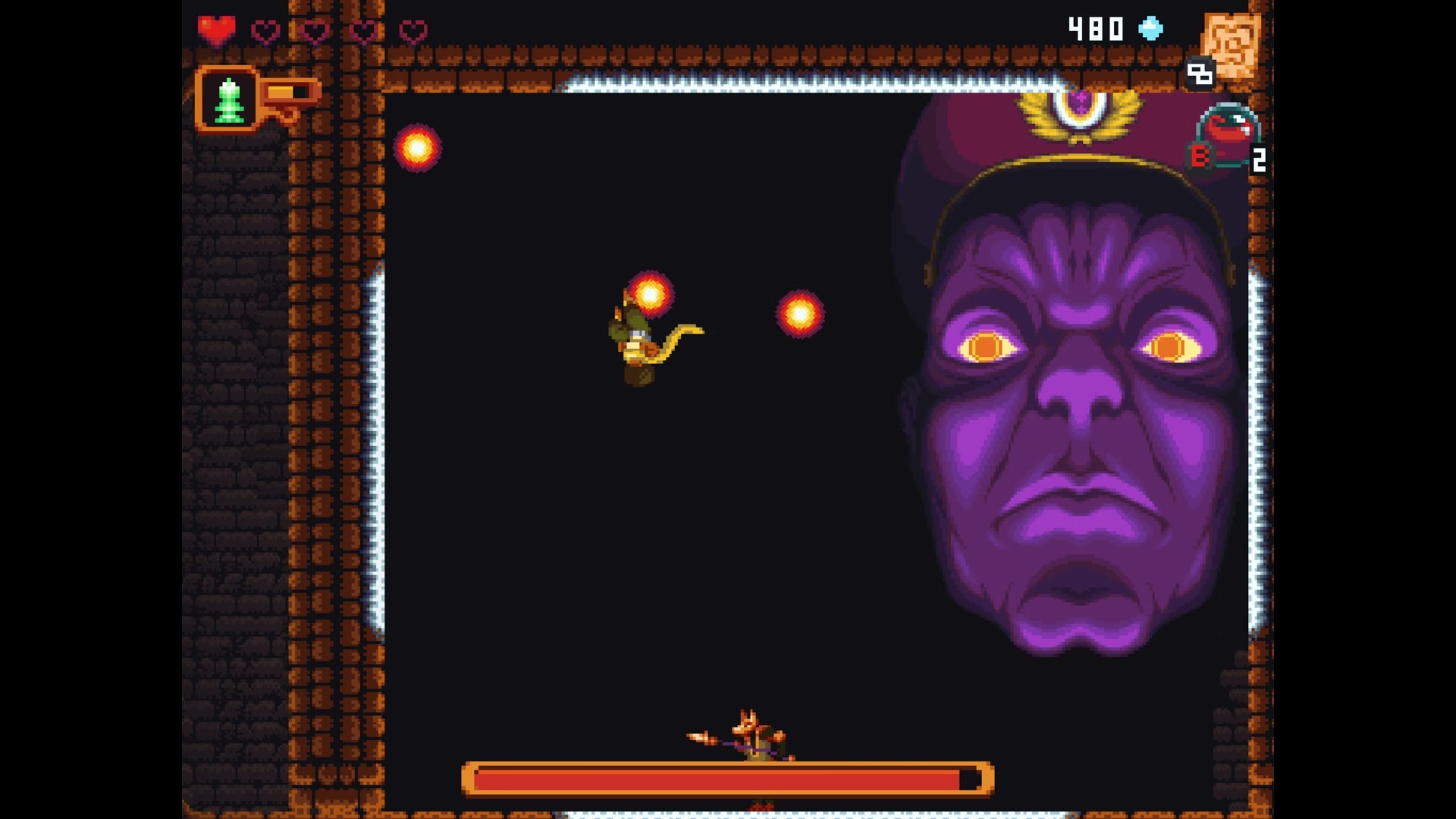
The 2D pixel art looks strongest in its dark, roomy boss spaces. Dandara is a tiny dark-haired figure with a long yellow scarf, leaping between dark brick surfaces while a huge purple face with glowing yellow eyes looms nearby. Orange fireballs and bright white hazards cut through the darkness cleanly, and the purple-and-orange contrast makes the danger and the boss’s scale easy to read.
Story
Salt is a surreal fantasy world under the thumb of the Eldarian Army, and Dandara enters it as a heroine born from the Crib of Creation. The setup gives her journey a clear sense of resistance without pinning the game to a literal historical account. Her inspiration comes from the Afro-Brazilian figure Dandara, but this is its own fantastical interpretation.
The story’s main strength is how naturally its strange setting fits the movement. A world where walls and ceilings become routes feels appropriately dislocated, so the unusual traversal does not come off as a detached gimmick. Salt is a place where ordinary bearings are already unreliable.
Do not go in expecting the narrative to be the primary draw. The conflict gives your exploration purpose, but the memorable part is inhabiting this odd world through Dandara’s physical rules. For more about the developers’ early framing of Salt, Dandara’s movement, and her starting attack, Long Hat House’s original Dandara introduction is useful context.
Overall Experience
Dandara is a confident piece of design because it refuses to soften its central idea into ordinary platforming. You may bounce off its opening if you fight the controls, but that is also why the game has a chance to stay with you. It asks you to develop a different sense of space, then rewards that effort with routes that would be impossible in a more conventional Metroidvania.
Its rough edge is real. Limited places to land can turn experimentation into irritation, and the game does not suit anyone looking for smooth running and casual momentum. The challenge comes less from speed than from correctly reading where you can go and lining up an attack while doing it.
For patient exploration fans, the payoff is worth the early discomfort. Give it a little time before deciding whether the movement is broken for you. If that first awkward hour becomes a moment when walls and ceilings suddenly look like paths, you will find a distinctive, satisfying adventure. If it never does, no amount of genre affection will make its core restriction feel comfortable.


Reviews
There are no reviews yet.