 Retro Replay Retro Gaming History, Reviews & Emulation
Game Overview
Gameplay
The first few turns invite a dangerous kind of confidence. You have regiments and divisions, a map to cross, and the historical momentum of the early German campaigns behind you. Then the game starts asking the questions that simpler wargames often wave away: Can this attack be supplied? Is the headquarters holding the formation together? Will replacements reach the troops that need them? That friction is where Decisive Campaigns earns its name.
Its best moments come when several ordinary decisions line up into a convincing operation. Positioning units for combined-arms and concentric attacks feels far more satisfying than throwing whatever is nearby at an enemy line. Strategic decisions made before a campaign and historical general cards can also shape the front, so the war is not reduced to a sterile puzzle with one correct opening. Scenario options that alter starting dispositions further encourage you to think through the situation instead of memorizing a route.
The price of that depth is mental overhead. Supply, replacements, cohesion, headquarters, unit placement, and campaign-level choices all matter at once, and the map can fill with counters quickly. You need to enjoy stopping, checking a developing front, and accepting that a force may need to pause before it can strike effectively. Anyone wanting quick arcade-style momentum will hit a wall. Give it the patience you would give a serious board wargame, though, and its systems begin to connect into a sharp operational challenge.
The campaign structure is especially strong because losses carry forward. A costly success does not vanish when the next scenario begins, which gives each offensive a lingering consequence. The game covers Poland in 1939 and France in 1940, then offers a conditional Sea Lion campaign as an alternate-history branch rather than pretending Britain was actually invaded. It also supports historical-design PBEM play for teams of up to nine, a fitting option for gamers who want to divide the burden of command.
Graphics
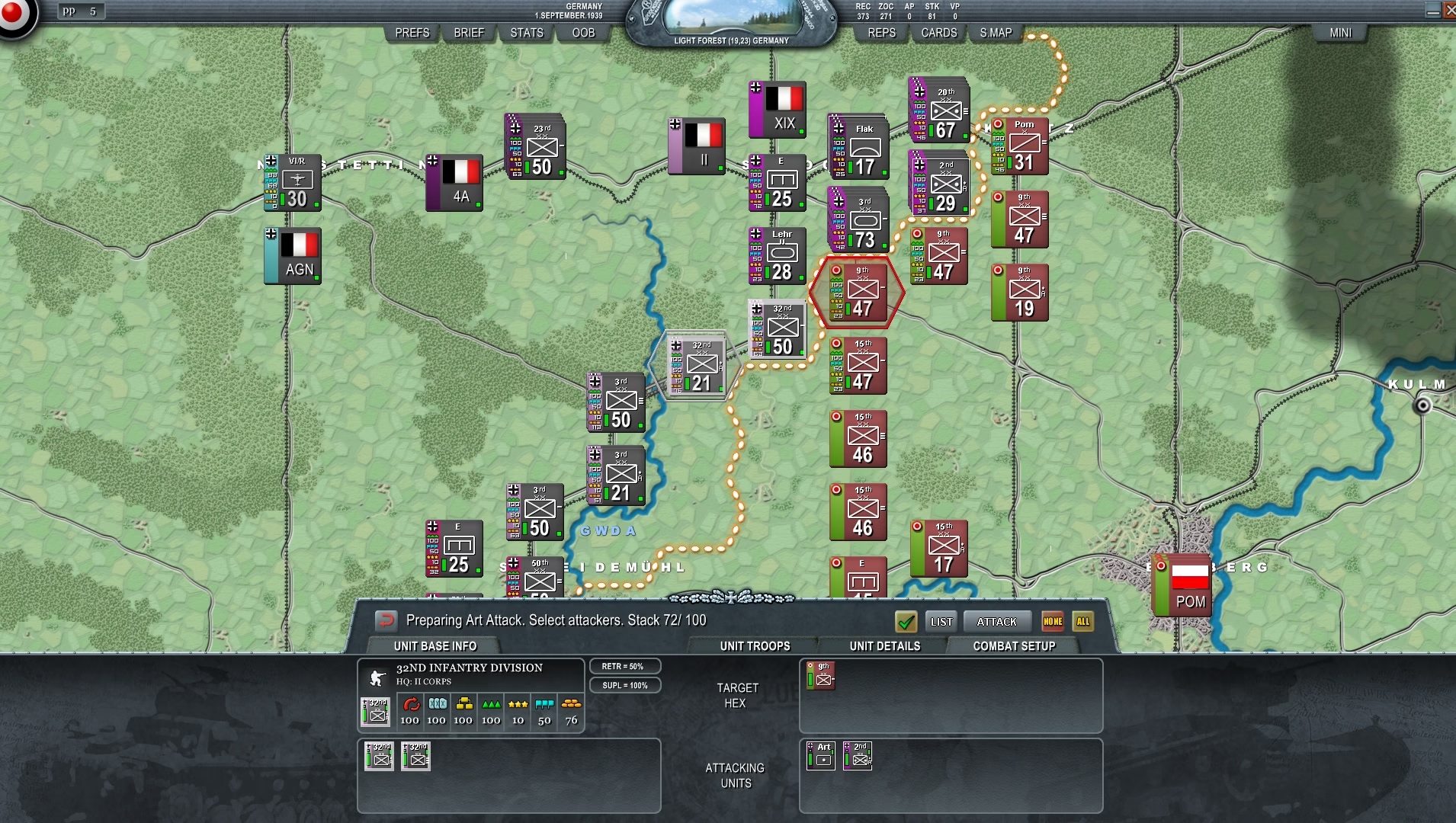
The battlefield is a clean top-down board: pale-green hex countryside cut by winding blue rivers, dense green forests, thin black rail lines, gray roads, and compact gray towns. It is plainly functional rather than lavish, but that restraint works when you are tracing routes and judging terrain.
Gray-purple and brown-green counters sit sharply against the land, with white infantry and tank symbols, national flags, and narrow bright edges helping formations stand out. Dense stacks can clutter the view and hide the countryside beneath them, yet the counter-heavy look suits a game concerned with armies and logistics rather than cinematic combat.
Story
There is no character-driven war story here. The narrative comes from the historical campaign context: Germany’s invasion of Poland, the drive into France, and the changing military problems each front creates. Your story is written in depleted formations, delayed advances, and the consequences that survive into later operations.
That approach gives the game a sober tone. It does not need a named hero or scripted plot twist when a supply shortfall can change the shape of an offensive. The historical framing keeps the campaigns grounded, while the pre-campaign choices and variable initial dispositions leave room for a different account of familiar events.
The Sea Lion material is the clearest departure from history, and it is treated as a hypothetical continuation. That makes it a useful reward for gamers who enjoy testing what might have followed Germany’s early victories, not a substitute for the actual record of the war.
Overall Experience
Decisive Campaigns: The Blitzkrieg from Warsaw to Paris is rewarding because it refuses to let a successful attack be the end of the thought process. You must consider whether the force can continue, whether its command structure is holding, and what the next campaign will inherit. That longer view gives victories weight and makes losses sting in a way many lighter turn-based wargames cannot match.
It is not a breezy entry point into WWII strategy. The mass of interlocking details can be frustrating before you learn which pressures deserve attention on a given turn. Still, the game has a clear purpose: it wants you to understand an offensive as a chain of supply, command, preparation, and force preservation, not just a series of battles.
Recommended for wargamers ready to trade immediacy for operational substance. If you enjoy the genre but want a campaign where logistics and headquarters matter as much as the attack itself, this is a worthwhile step up. For historical release context, see the Matrix Games launch announcement.


Reviews
There are no reviews yet.