 Retro Replay Retro Gaming History, Reviews & Emulation

Retro Replay Review
Gameplay
The first few deals make Fairway Solitaire feel almost frictionless. You scan the exposed cards, spot a sequence, and start clicking: 8 to 7 to 6 to 5, hoping the run keeps going. Because suits do not matter and Aces connect to both Kings and 2s, the rules are easy to absorb. The tension arrives when you have two legal choices and only one keeps a valuable column or buried card within reach.
That is where the game earns its golf theme. A run of six or more cards counts as a long drive and raises your multiplier, so simply making any move is not always enough. You want to stretch a chain without burning cards that would open up the rest of the layout. Turning over another card from the deck can rescue a stalled board, but it also feels like spending a limited chance to keep your round alive. The mix of planning and the next card’s uncertainty is simple, but it is a strong little loop.
Later hazards give the deals sharper edges. Sand traps cannot be touched until you uncover a sand wedge, while water hazards block access to a column until they are cleared. These obstacles make card order matter more, and a careless sequence can leave the exact card you needed sitting behind a blockage. Golf irons, saved in your bag and used to replace the active card, offer a welcome way to bend the odds rather than merely accept a dead end.
Wild shots add a properly risky wrinkle. You can take a two-card penalty and drop one, or stop a flickering selection and live with whatever it produces. That choice is more interesting than it sounds because it asks whether your current position is secure enough to gamble. The shop upgrades also give money a practical purpose: unlocking another course is one goal, but an extra mulligan from clothing or advance knowledge of the next deck card from x-ray sunglasses can change how confidently you play a hole.
Graphics
The screen is built around the cards: a face-down deck and active face-up card sit at the bottom, with the dealt layout above them. It is a straightforward setup for a mouse-driven card game, and the golf elements arrive through recognizable cards and hazards rather than cluttering the board with unnecessary detail.
Wild shots briefly switch to a window of flickering images before you stop on a result. It gives one of the game’s chance-based decisions a little extra anticipation.

Story
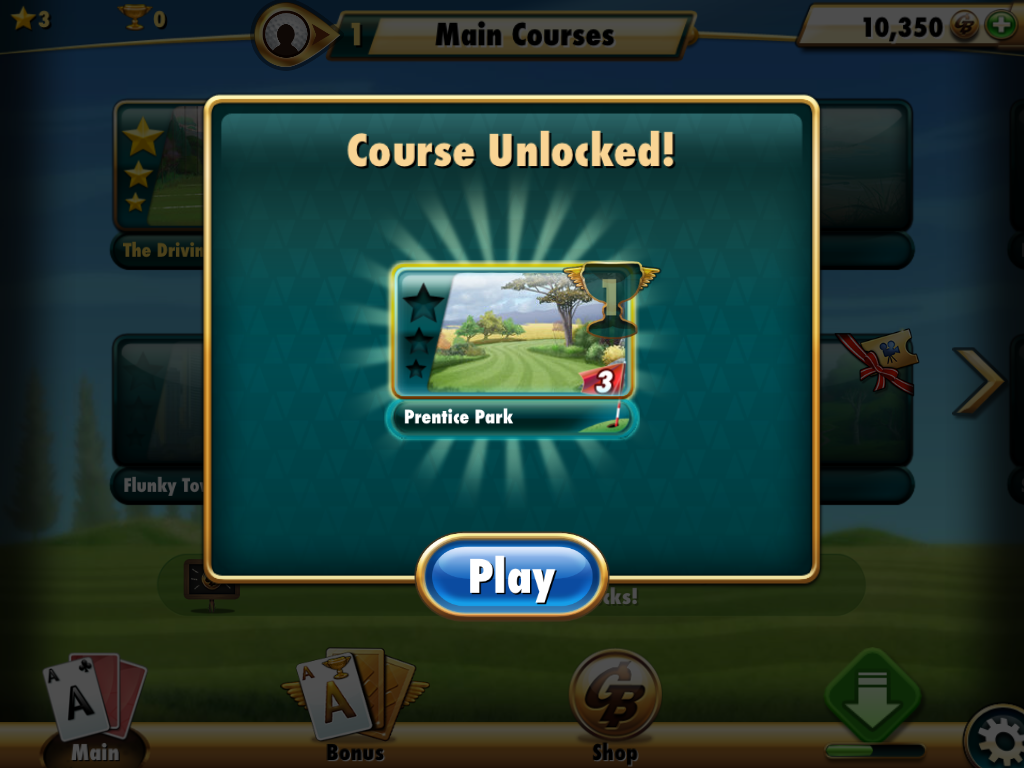
Fairway Solitaire frames its progression as moving through golf courses rather than telling a character-driven tale. The motivating thread is practical and immediate: clear deals, earn money, and open the next course.
That light framing suits the game’s rhythm. Each hole creates its own small drama when a long run develops, a hazard blocks the cards you need, or a fresh deck card either saves the layout or leaves you stranded.
The shop adds a sense of carrying progress forward. Buying an extra mulligan or x-ray sunglasses makes the next course feel connected to the money you earned before it, even though the real narrative is the changing run of good decisions, bad draws, and narrow recoveries.
Overall Experience
Fairway Solitaire understands why a good solitaire variant is hard to put down: every board offers an immediate possibility, and every promising chain makes you believe the next click could turn into something huge. It does not bury that pleasure under complicated rules. Instead, it lets the complications arrive after you already understand why clearing one more card matters.
Frustration can set in when a useful card is buried behind water or locked in a sand trap and the deck will not cooperate. That randomness is part of the game’s personality, though, and the irons, mulligans, wild shots, and shop purchases give you more agency than a bare-bones draw-and-click card game. You still need luck, but you are not completely at its mercy.
Give it a chance if you enjoy solitaire with a little forward planning and like the idea of converting a clean card sequence into a golf-style long drive. The payoff is not a grand finale; it is the repeated satisfaction of turning an awkward spread into a flowing chain, then using your earnings and tools to take on the next course with a better hand.


Reviews
There are no reviews yet.