Retro Replay Retro Gaming History, Reviews & Emulation
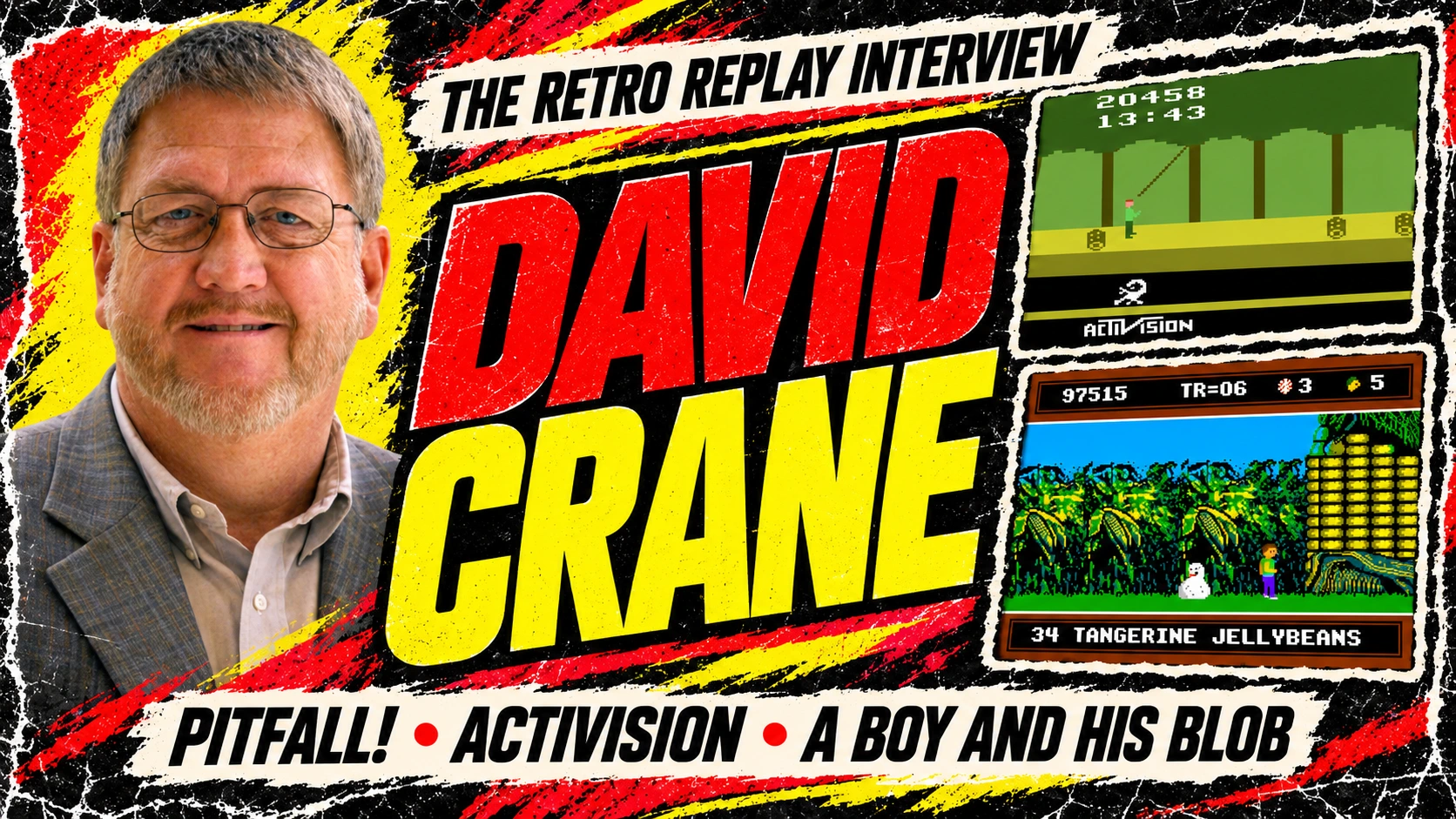
To get Pitfall Harry running properly, David Crane tried the movements himself. He would walk around the lab, stop in a pose, and sketch the position of his leg. Then came the awkward part: making that pose look like a person when the figure was only eight pixels wide.
Years later, describing those experiments to Game Informer, Crane could trace Harry back through several projects. He would work on the little runner, put him aside, finish something else, and return for another try. There was a game in there somewhere. He just hadn’t found it yet.
When it finally came, the idea took about ten minutes to sketch. A man, a path, a jungle, some treasure. The next thousand hours were considerably less cooperative.
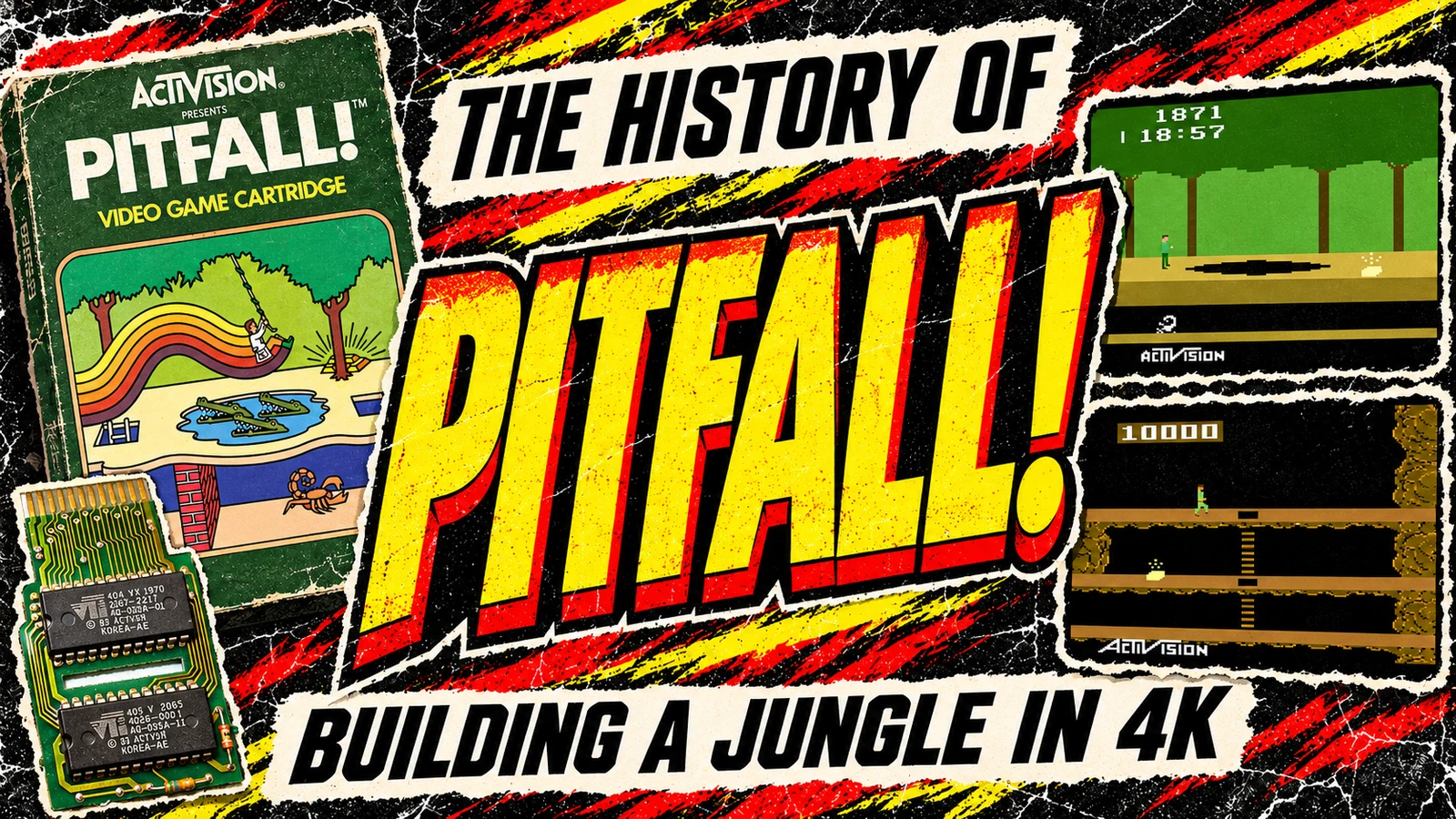
Released in 1982, Pitfall! sent that runner into a place big enough to get lost in, on a cartridge small enough to make its programmer agonize over individual bytes. Harry could swing over a swamp, drop into a tunnel, and emerge farther along the same jungle. You could spend an evening learning to survive, then another learning where you actually ought to be going.
For the sequel, Crane would go further still. If the aging Atari 2600 couldn’t comfortably handle the adventure he wanted to make, he could put some help inside the cartridge. First, though, he had to give his runner somewhere to run.
Explore the history of Pitfall! (click to expand)
- Before Harry: Atari, tennis, and a new company (1977-1980)
- The runner finds his jungle
- Making room for the adventure (1982)
- The jungle beyond the edge of the screen
- One more try at the crocodiles
- Down the ladder, past the scorpion
- Harry, you’re going the wrong way
- A photograph for the Explorers’ Club (1982-1983)
- Pitfall II: Lost Caverns (1984): Harry learns to swim
- Crane opens up the cartridge
- The music knows you’ve made a mess of it
- An extra cavern on the Atari
- A fresh pair of legs
Before Harry: Atari, tennis, and a new company (1977-1980)
A game-programming career wasn’t what Crane had originally signed up for. He was designing integrated circuits at National Semiconductor when his tennis partner Alan Miller mentioned an opening at Atari. Miller was already making games there, and had been asked to help find more programmers.
Crane liked the sound of it. In his interview with Tristan Donovan for Replay, he recalled preparing a résumé after tennis, interviewing the following morning, and getting the job that afternoon. By the fall of 1977, he was working at the company whose new Video Computer System was just reaching living rooms.

The VCS, later better known as the Atari 2600, was a wonderful machine to own and an awkward one to write for. A television picture had to be coaxed out of it a line at a time. The programmer was responsible for getting the right instructions to the display hardware before the television reached the next part of the image. Being one instruction late could spoil something you had spent days getting right.
Crane was comfortable thinking about the circuitry beneath his code. He liked finding something the machine could be persuaded to do, then wondering whether it might make a good game. The technique behind a large, colorful object could suggest an Indy-style racing car. That car could become Grand Prix.
Getting a game to work was one thing. Getting credit for it proved harder. Crane and fellow programmers Alan Miller, Bob Whitehead, and Larry Kaplan grew dissatisfied with their treatment at Atari, particularly over recognition and compensation. In 1979, they left to help establish Activision, with Jim Levy leading the business.
They knew how to make games for the console already sitting in people’s homes. They didn’t see why they had to be employed by its manufacturer to keep doing so. Activision began selling its own cartridges, and put the designers’ names and faces in front of the customers buying them.
That last part was personal. If you enjoyed a David Crane game, you could look for his name on another box. Dragster, Fishing Derby, Laser Blast, and Freeway helped build that relationship. By the time Harry was ready, Crane already had players who were interested in what he might do next.
The runner finds his jungle
Harry’s first job was to look alive. There wasn’t much room for subtlety in an eight-pixel-wide figure, but a leg in the right position could make the difference between a running man and an unfortunate arrangement of sticks.
“Creating the little running man (that became Pitfall Harry) began as a technical and artistic challenge. How can I make a recognizable human figure using 8 pixels?”
David Crane, speaking to Retro Replay.
Watch him travel along a clear stretch of path and the appeal is still there. The arms and legs fall into a readable stride. He looks as though he’s going somewhere, and when you press the button he throws himself into the jump. Before you’ve collected anything, it feels good to move him around.
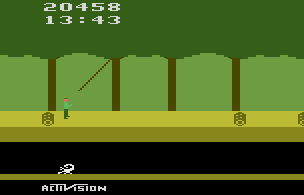
Crane had been experimenting with that figure roughly two years before Pitfall! came out. Human characters were hardly new to games, but this was a runner he liked, on hardware that made the achievement satisfying. What kept escaping him was something worth doing with the animation.
After finishing another game, he sat down with a sheet of paper and brought the man out again. A runner needed a path. A path could go through a jungle. Put obstacles in his way and treasure ahead of him, and suddenly there was a reason to keep moving. A vine gave him something to grab, and a swamp made grabbing it seem sensible.
In our interview with Crane, he remembers that game flow falling into place in ten minutes. It is a lovely origin for something that would occupy so many evenings: after all that work on the character, a few pencil marks finally gave him an adventure.
Crane’s estimate for turning the sketch into a finished game is about a thousand hours. The drawing didn’t have to worry about when Harry touched the vine, where he landed, or how much time the television gave the program to draw any of it. Now every part had to work together, every time somebody pressed reset.
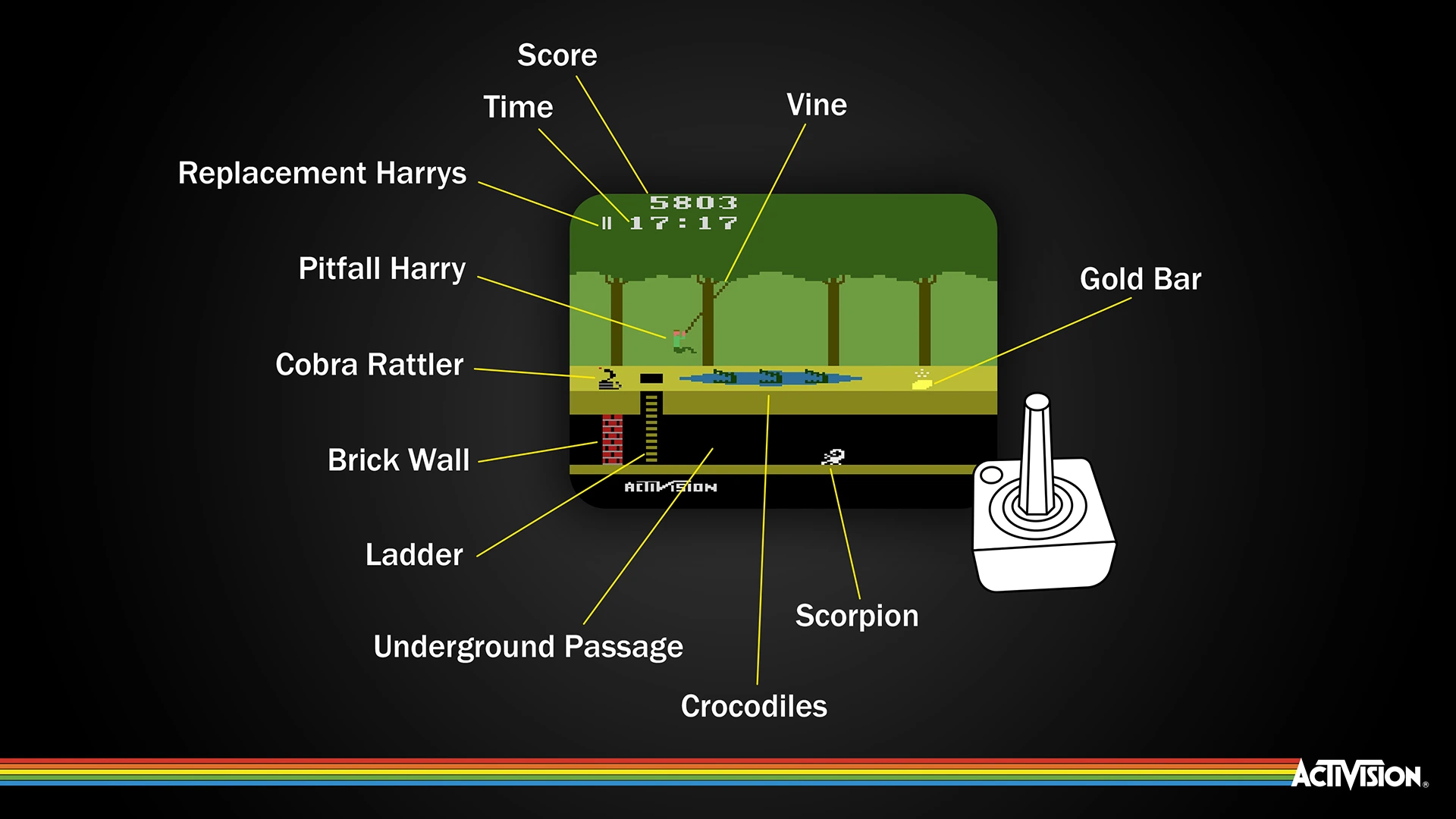
The jungle began to acquire its familiar residents. Logs rolled across the path. Cobras occupied places a runner would prefer to use. Crocodiles offered what looked suspiciously like stepping stones. Harry had plenty to keep him busy, and Crane had to fit the lot into four kilobytes.
Making room for the adventure (1982)
Four kilobytes meant 4,096 bytes for the entire cartridge: game logic, pictures, sounds, and the information needed to lay out the world. Cost made that a firm limit for Pitfall! A brilliant idea that needed another cartridge’s worth of storage wasn’t going to help.
By the time Crane was squeezing the program down to size, the game had already been played and tested for months. He didn’t want to throw away something people enjoyed just because the latest version was too big. So he went back through working code, looking for a shorter way to get the same result.
Sometimes the saving was tiny. A processor register might already contain the number the next routine needed. Leave it there and skip loading it again. A few instructions were gone, and Harry could carry on doing precisely what he’d done before.
Of course, that meant the second routine was now relying on the first. Change what the earlier code left behind and something farther along could suddenly misbehave. In our interview, Crane calls it a terrible way to program, even with thorough comments. He also remembers it being necessary. There were bytes to find, and precious few places left to find them.
He kept rewriting rather than stripping out favorite features. The hours went into making an already playable game smaller without breaking it. Somewhere in that process, an instruction that did nothing new could still feel like a very good afternoon’s work.
But the jungle was too big to rescue a byte at a time. Pitfall! had 255 scenes. Store a separate description for each one and the cartridge would fill up with places Harry couldn’t visit, because there would be no room left for the program that moved him.
Crane needed a way to work out the next clearing when Harry arrived there.
The jungle beyond the edge of the screen
Harry runs out of one clearing and into the next. There might be a ladder, a pit, a different arrangement of trees. Turn him around and the last clearing is still there. You can go back for something you missed, or retreat from something you wish you hadn’t found.
Crane made those places from a sequence of numbers. The current number told the game which objects and hazards to use, along with details of the scenery. A short piece of code could produce the next number, and therefore the next screen, without keeping a long list of individually stored locations.

The particularly clever part was making the sequence work backward. Harry could travel in either direction, so the program had to recover the previous scene as reliably as it produced the next one. Otherwise the jungle would rearrange itself every time a player changed his mind.
Thomas Jentzsch’s later annotated disassembly describes the machinery as a reversible linear-feedback shift register, or LFSR. Its eight-bit state runs through 255 nonzero values before returning to the beginning. Follow the whole surface route and Harry comes home again.
You can see the economy in the finished game. There is a recognizable collection of scenery and hazards, recombined along the journey. The surprise is in what the next screen puts together, and whether the place you need to reach is just beyond it. A familiar ladder becomes important when you realize where it leads.
The same route appears on the next attempt. A treasure you remember is worth looking for, and a map you started last time is worth finishing. Crane had saved the space needed to describe a large world without taking away the pleasure of getting to know it.
Crane walks through the game in his 2011 GDC postmortem below. Seeing the familiar screens beside the man explaining how he made them is a good excuse to lose an hour, particularly if you’ve ever wondered how that vine got onto the television.
One more try at the crocodiles
The first few trips through Pitfall! tend to establish a modest ambition: get across this screen without doing something embarrassing. Never mind all the treasure. There is a log coming, and the last jump wasn’t quite good enough.
Harry can run and jump, climb ladders, and catch a swinging vine. He has no weapon to make a troublesome animal go away. If a cobra is occupying the path, you have to clear it. If the crocodiles are opening their mouths, you have to pay attention.
Jump onto a closed head and it makes a perfectly serviceable foothold. Stay in the wrong place as the jaws open and the arrangement becomes much less friendly. Learning the timing is deliciously tense. You can wait for a comfortable opening, but there is a clock at the top of the screen, quietly reminding you that the rest of the jungle hasn’t gone anywhere.
A vine feels wonderful when you catch it. Harry rises over the swamp, hangs there for a moment, then drops onto safe ground when you release him properly. For a few seconds, the explorer on the box is doing exactly what he promised.
Crane drew that vine using the console’s hardware ball object. By shifting its position as successive lines of the picture were drawn, he could make a sloping length of rope out of a resource intended for something much simpler. The player only had to worry about catching it. Crane had already done the worrying about getting it there.
A missed jump isn’t always the end of a life. Rolling logs take points away, and dropping through a hole costs score even if Harry survives the fall. That can be quite reassuring while you’re learning. Later, when a good run is slipping away one careless collision at a time, it becomes infuriating.
You start with 2,000 points. There are 32 treasures to collect, and a perfect trip finishes at 114,000. Harry has twenty minutes and three lives to do it. The score gives a practiced player something exacting to chase long after the early excitement of reaching a new clearing has worn off.
Three lives was a compromise. Crane originally wanted one.
As he recalled to Atari Compendium, his colleagues spent the final month arguing against that decision. He had become good enough at his own game to think the harsher version would appeal to skilled players. The people around him could see how frustrating it might be for everyone else.
They eventually wore him down. He added spare Harrys at the top of the screen, with a new one dropping from the trees when the previous explorer came to grief. It is hard to imagine the game’s enormous audience being quite so patient with the version that sent everyone home after a single bad crocodile.

Down the ladder, past the scorpion
After enough trips along the path, the tunnel starts to look like the sensible option. Fewer logs. No swamp immediately in front of you. A nice, direct passage beneath all that unpleasantness.
Then you meet the scorpion.

Its jump is a nasty one, with little room for a sloppy approach. Crane meant it that way. He had put the fastest route through the jungle beside the creature most likely to punish you for trying to hurry.
“I set the game’s time limit so that you couldn’t reach all of the treasures in the allotted time if you stayed on the surface. The underground passages were shortcuts to make it possible to complete the game, but they were not free. The scorpions were intentionally the hardest enemy to jump over. You had to brave the scorpions to complete the quest.”
David Crane, speaking to Retro Replay.
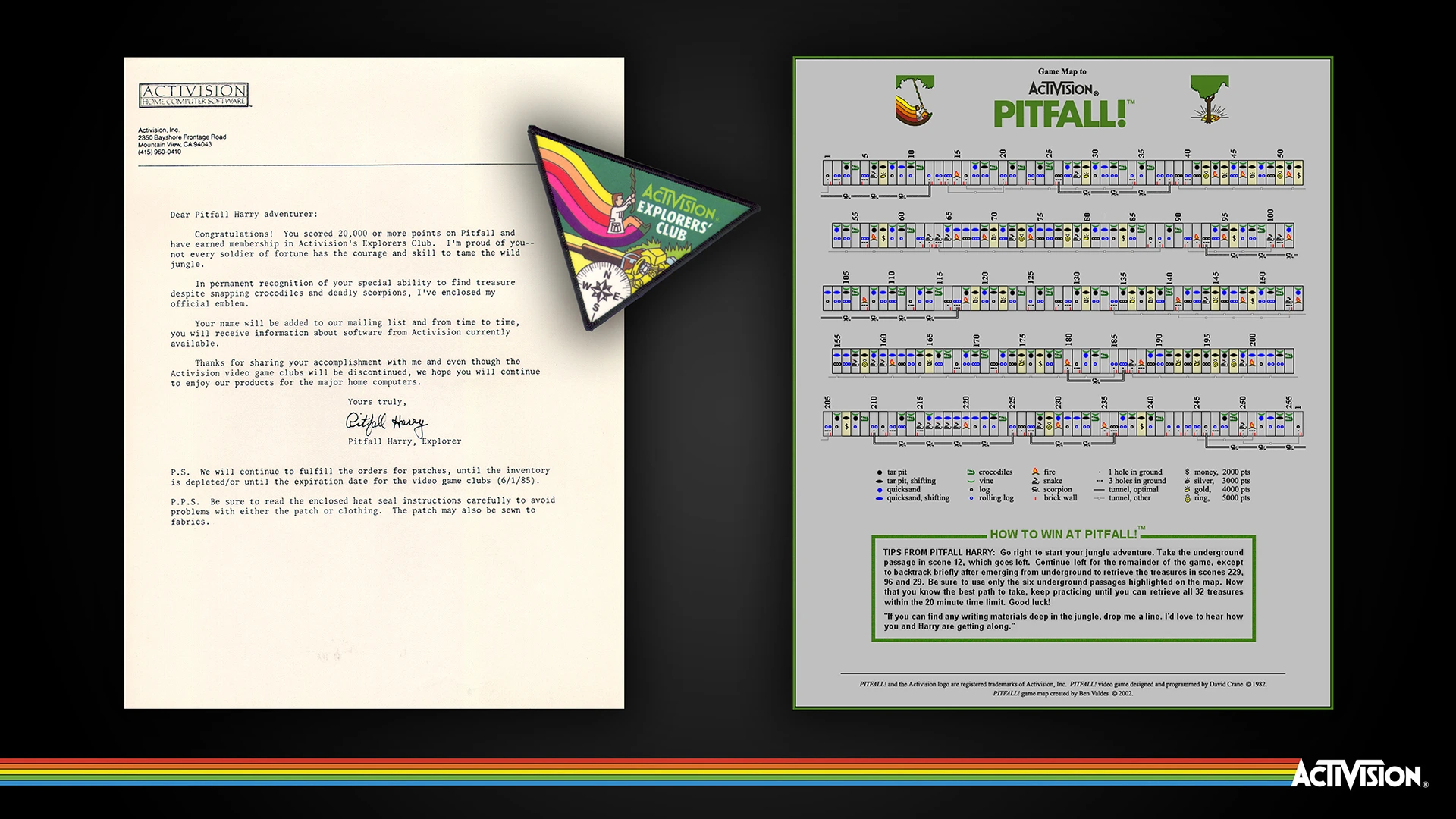
Each screen crossed underground carries Harry three surface screens along the route. A useful stretch of tunnel can save a lot of running. A badly chosen one can take you past the treasure you needed, or leave you staring at a brick wall while you reconsider your expertise.
A ladder you passed without much interest earlier can suddenly look useful. Perhaps it comes out near the next treasure, or cuts out a stretch you’d rather not cross again. You head back, climb down, and try to remember whether this is the passage with the wall.
This is where Pitfall! can take over a perfectly good piece of paper. Mark the treasures. Mark the ladders. Try the tunnel, discover the wall, and correct the line you were rather pleased with a minute ago. The next attempt begins with fewer guesses.
Eventually, a clearing that once looked like another collection of hazards becomes a place you recognize. You know when to leave the path, when to come back up, and which apparently convenient descent will cost more time than it saves. Then you mistime the scorpion jump anyway, which is a good deal harder to blame on the map.
Harry, you’re going the wrong way
Crane expected players to run from left to right. Harry could go either way, but that was the direction the designer had in mind. Then players started doing what players do: finding a better way through somebody else’s carefully tested game.
A replacement Harry always arrives on the left side of the screen. When you’re heading right, a fatal mistake leaves the obstacle ahead of you, ready for another attempt. Going left can put the new Harry beyond the thing that killed him. An unfortunate encounter has at least bought you some progress.
The logs also travel left. Run in the same direction and you aren’t constantly meeting another one coming toward you. Once you’ve noticed both advantages, starting an expedition by turning around seems perfectly reasonable.
In our interview, Crane jokes about having held the world record in every game he made, right up until he released it. Give a large audience enough time with a game and someone will find a way to play it that its author hadn’t expected.
The original instruction booklet had already passed the leftward advice on to buyers. Its tips suggest practicing to the right, then traveling left to cut down on repeated hazards. Whatever the precise moment when Crane first noticed the advantage, you could find it in the package. Reading the manual had its rewards.
A helpful direction still couldn’t carry Harry across a swamp for you. But it was exactly the sort of discovery that made a fresh attempt appealing. Same jungle, same little man, and suddenly a route that had been giving you trouble looked worth another go.
A photograph for the Explorers’ Club (1982-1983)
Reach 20,000 points and Activision wanted to hear from you. Take a photograph of the television, send it in, and the company would reward your efforts with an Explorers’ Club patch. Harry had found a way to get you involved in another expedition, this time to the mailbox.
The target was well short of a perfect score. A player still learning the route could have something to aim for, and something to show off when it arrived. Getting a clear photograph of the screen was its own little concern. There wasn’t a capture button waiting on the controller.
By then, Harry had acquired a name, a title, and that splendid green box. He swings across its front above three crocodiles, while a scorpion waits in the tunnel below. It is a cheerful picture of a place that will spend most of the evening trying to kill him.
During development he had been Jungle Runner. Activision also considered Zulu Gold before settling on Pitfall! The final name was short enough to remember and easy to associate with the thing you had just fallen into.
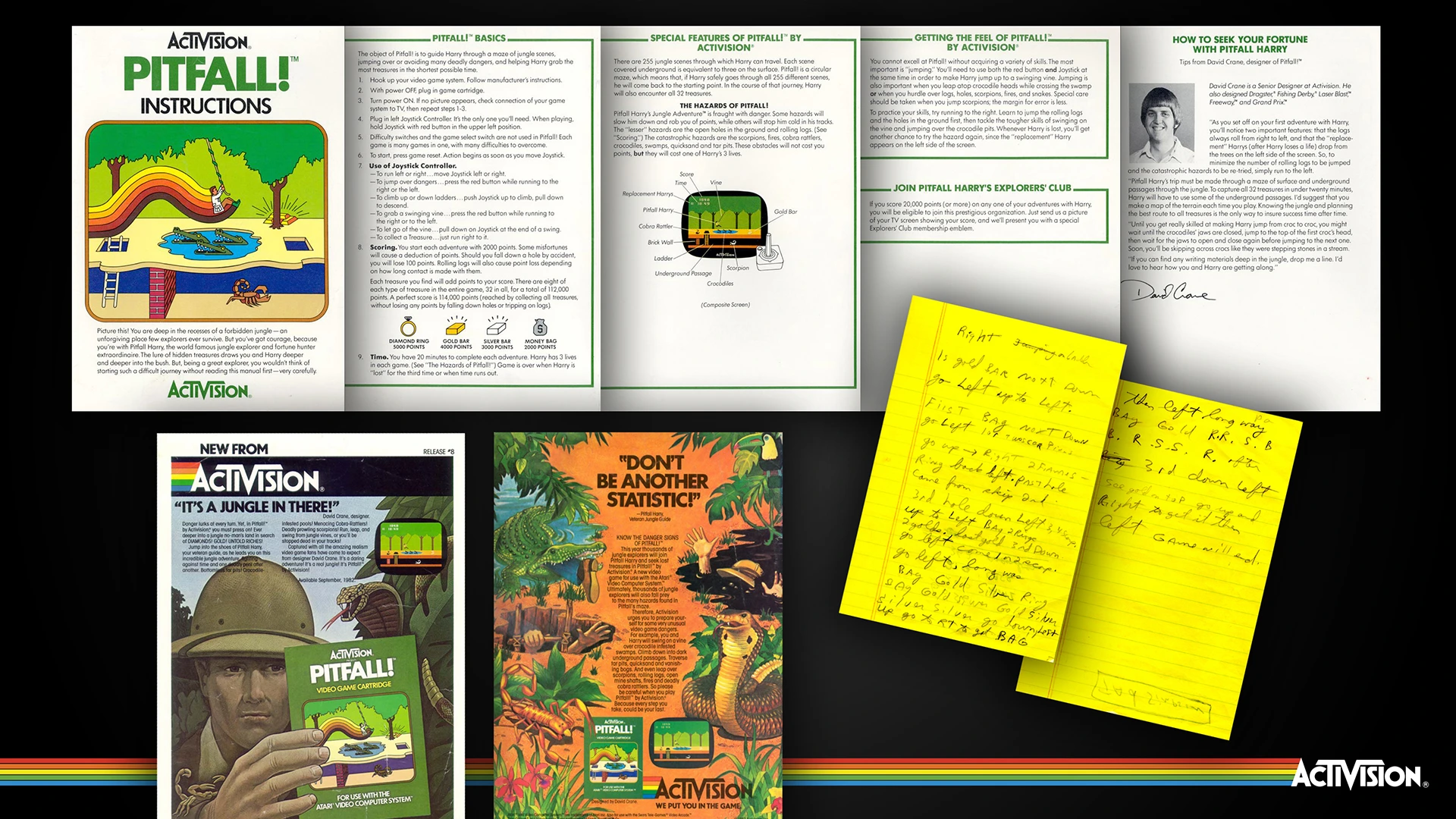
The material in Activision’s archive brings back the work around the release: instructions assembled for print, advertising, handwritten completion notes, congratulatory letters. Somebody had to turn Crane’s cartridge into a product people would notice, explain how to play it, and answer when the photographs came in.
People certainly noticed. Pitfall! went on to sell more than four million Atari 2600 copies, becoming one of the great successes of the cartridge boom. Harry was suddenly familiar to an audience far larger than the programmers who might appreciate how neatly he had been drawn.
Television followed. An animated Pitfall series gave him two companions, Rhonda and Quickclaw, and supplied another place for the adventure to continue. The runner Crane had put aside while looking for a game now had a cast.
Those companions would be waiting in the next cartridge, although Harry would have quite a journey ahead of him before he could reach them.
Pitfall II: Lost Caverns (1984): Harry learns to swim
One of the nicest surprises in Pitfall II: Lost Caverns comes when Harry enters the water. After all those attempts to keep him out of swamps, here he is swimming through a river. You can move along it, look for a way out, and worry about the eel coming toward you instead.
Crane’s 1984 sequel takes the expedition underground, into caverns beneath Peru. Rhonda and Quickclaw have disappeared, and there is a Raj diamond to recover. Find all three and Harry’s journey is complete. The gold bars and cave rat give a more ambitious explorer extra business on the way.

The cave goes down a long way. Follow a ladder and the view moves with Harry, opening up ledges and passages below the place you just left. Drop farther and there is more to explore. The original game’s little underground strip now seems rather modest.
It is a satisfying place to nose around. You can see something you want across a gap, but reaching it might mean going down, working around, and coming back from another direction. A short distance on the screen can become a surprisingly long trip.

Then a balloon comes drifting up a shaft, and the trip gets stranger. Jump to catch it and Harry can float past levels he couldn’t reach on foot. You can steer across the shaft and adjust the ascent, watching for the ledge you need.
Getting off is the awkward part. A bat has to burst the balloon. Ideally, it hits the balloon while leaving Harry out of the arrangement, which requires a little more care than he might have expected when he grabbed hold. An explorer can have an entirely reasonable destination and still arrive by ridiculous means.
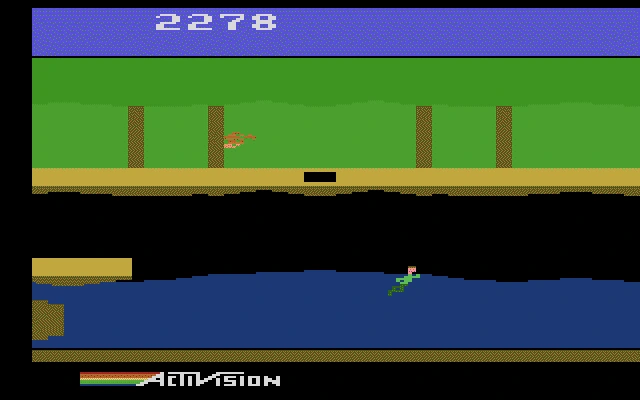
You have time to work these things out. Lost Caverns drops the twenty-minute limit, so you can hesitate at a shaft or investigate a route without sacrificing the whole attempt. The three-life limit has gone too. Red crosses scattered through the cavern give Harry places to return after an encounter goes badly.
They are worth touching. Get hit a long way from the last cross and Harry makes an exasperating journey backward while points drain away. You can watch him undo a stretch of hard-earned progress and remember the perfectly accessible checkpoint you hurried past.
It is a gentler arrangement than being sent to the beginning after three mistakes, and a very good fit for this bigger cave. You can keep worrying at a difficult stretch until you get through. A high score still asks for a tidy expedition, but finishing the journey no longer belongs only to the player who can get everything right in one short sitting.
Harry was swimming, floating, descending, and exploring to a tune. Meanwhile, the box under the television was the same old Atari. Crane had given it some assistance.
Crane opens up the cartridge
Inside a Pitfall II cartridge, below the ROM chip, sits the part that helped make the sequel possible: Crane’s Display Processor Chip. DPC also happens to be the initials of David Patrick Crane. He had found somewhere quite appropriate to leave his name.
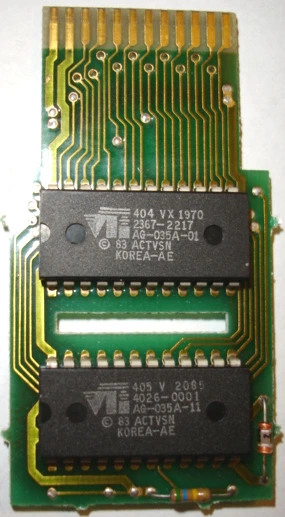
Crane had never lost his interest in hardware. Even after taking the Atari job, he found opportunities to make equipment for game development and EPROM programming. Designing a circuit for the new game was a familiar sort of problem, just one that would end up in the customer’s cartridge.
The problem was time. The 2600’s processor still had to deliver graphics data to the Television Interface Adapter, or TIA, as each television line was drawn. Finding the right data and preparing the next piece used instructions that were already in short supply.
The DPC took over some of that fetching. Its data fetchers could step through stored graphics information as the processor read it, saving work that the program would otherwise have had to do for itself. Crane could get more detail into the picture without making the processor handle every small chore along the way.
Harry still appeared through the Atari’s own display hardware. The new circuit helped feed it. It was an ingenious way to improve the game on a console the customer already owned: the extra part arrived with the adventure that needed it.
There was more storage as well. Stella’s DPC implementation documents two 4K banks for the program and another 2K for display data. The first Pitfall!’s single 4K budget had given way to a more elaborate cartridge, with more room for Crane to work.
He filed his video-memory patent in January 1984. Granted in 1987, it describes the data-fetching arrangement behind this unlikely upgrade. Long before the paperwork was finished, players could plug it into an ordinary 2600 and head down into the cave.
Crane hoped the DPC could help extend the console’s life. Unfortunately, the extra circuitry cost money just as the North American cartridge business was falling apart. Among the original commercial releases, only Pitfall II used it.
The 2600 carried on, but Activision never built the hoped-for succession of games around Crane’s chip. It remained inside this one adventure, doing its work while Harry tried to reach the next ledge.
The music knows you’ve made a mess of it
The tune in Lost Caverns is wonderfully jaunty company until you get hit. Then Harry starts his retreat, the points begin disappearing, and the music changes to suit his diminished circumstances. Even the soundtrack has noticed.
“While I was at it I added a music generator with 3 part polyphony (4 part if you used the second 2600 sound channel as a snare drum).”
David Crane, speaking to Retro Replay.
That was another job for the DPC. Alongside its help with graphics, the chip could supply musical parts that worked with the console’s own audio hardware. Harry could have a proper tune following him through the adventure while the program kept the cave moving around him.
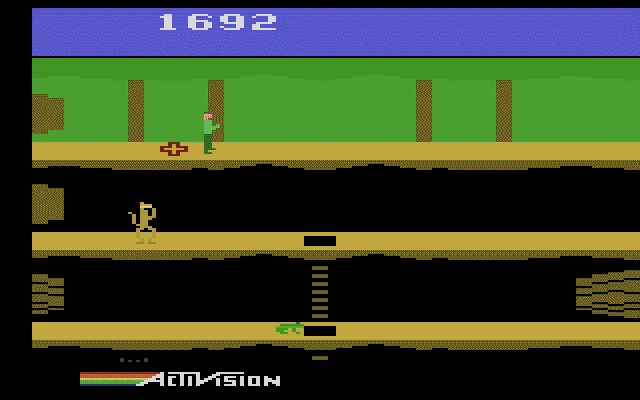
The melody came from the animated Pitfall series. As Crane explained to Atari Compendium, he made an upbeat arrangement for play and a minor-key version for the aftermath of a hit. Rhonda and Quickclaw had already crossed over from television. Now the theme came with them.
It is easy to remember the melody fondly and forget quite how often the game finds a reason to play its unhappy version. A bat can catch you near the end of a careful climb. A scorpion can turn a promising landing into another trip back. The score gives you a running account of the damage, with musical accompaniment.
Still, you can have another go without losing the whole cave. That makes Lost Caverns a lovely game to settle into. The route slowly becomes familiar, the awkward jump finally works, and the gold bar that seemed impossibly placed is suddenly within reach. Harry pockets it, and the expedition sounds cheerful again.
An extra cavern on the Atari
As Harry traveled to other machines, other programmers had to find their own ways to get him moving. Different hardware could offer more color or different scenery, but somebody still had to make the jumps feel right.

For the computer versions of Pitfall II, Mike Lorenzen and Tim Shotter took different approaches. Lorenzen, working on the Atari conversion, kept Crane’s game logic and replaced the code that dealt with the machine’s display and other hardware. Shotter, on the Commodore 64, used the 2600 game as a model and wrote his own version.
In Crane’s recollection, they reached beta at about the same time. Then the difference showed. Lorenzen had started with game logic that had already been debugged. Shotter had a new program to test. While that work continued, Lorenzen found himself with time to add something.
He built another cavern.
The Atari computer and 5200 releases became the Adventurer’s Edition, with a second adventure waiting beyond the familiar one. A player could finish the journey they thought they’d bought and discover there was considerably more to do.
Lorenzen returns to the story in his 2026 ANTIC interview with Kay Savetz. In his mind, that extra world had been Pitfall 3. It is a wonderful thing to find inside a conversion, and a good reason to be particular about which version you’re loading.

The later games carried Harry farther from the original cartridge. Super Pitfall brought a cave-and-rescue adventure to the NES. In 1994, Pitfall: The Mayan Adventure sent Harry’s son through a lushly illustrated jungle. By Pitfall 3D and The Lost Expedition, the family was running around in three-dimensional scenery.

A fresh pair of legs
Crane is still making games for the 2600. With Garry and Dan Kitchen at Audacity Games, he has returned to the console that made him count instructions and search working code for a few more bytes. In our interview, he describes the satisfaction of finishing a good game on such a demanding machine. He hasn’t run out of things he’d like to make it do.
If you’d like another trip through his first jungle, Stella handles Atari 2600 emulation, including Pitfall II’s DPC. Its official guide covers setup and supported cartridge types; you’ll need to supply the game image separately.
The original is particularly good at exposing a rusty memory. You can remember the vine, the crocodiles, even the route you meant to take, and still get the first proper jump horribly wrong. Then the replacement Harry drops out of the trees and gives you another chance.
It was kind of Crane’s colleagues to insist on that.
More from Retro Replay
- David Crane on Pitfall!, Activision, and Programming the Atari 2600
- The Complete History of the Nintendo Power Hotline: Game Counselors, Secret Maps, and the Call That Saved Your Game
- The Complete History of the Atari Jaguar
Sources and further reading
- David Crane interview, Retro Replay. His firsthand answers about the running figure, ten-minute sketch, ROM limits, shortcuts, player discoveries, DPC hardware, and current Atari 2600 work.
- Pitfall! original instruction booklet, Activision. The 255-scene loop, scoring, underground ratio, designer tips, and original recommendation to travel left. Preserved by AtariAge.
- Pitfall II original instruction booklet, Activision. Objectives, river and balloon movement, return points, scoring, and the absence of a time limit. Preserved by AtariAge.
- Classic Game Postmortem: Pitfall!, GDC 2011. Crane’s illustrated account of the animation, design, and implementation. The publisher-linked video is embedded in the article.
- The Replay Interviews: David Crane, Tristan Donovan. Crane recalls joining Atari, founding Activision, the running-man experiment, and the work following the initial sketch. Interview conducted in July 2009 and published in 2011.
- The Pitfalls of Atari Development, Ben Reeves, Game Informer. A 2013 interview with Crane on posing for animation, using the display’s ball object for the vine, and the game’s commercial success. Its claim to be the first platformer is not adopted here.
- RetroVision: Happy 37th Birthday, Pitfall Harry!, Activision. Packaging, original materials, working titles, player rewards, and the publisher’s archival photographs and explanatory illustration. Its 256-screen summary conflicts with the original manual and disassembly; this article uses 255.
- RetroVision: Pitfall! Prototypes, Activision. The publisher’s preserved examples of early versions, later variants, and clones. These are distinguished from the released original.
- Pitfall! annotated disassembly, Thomas Jentzsch. The reversible scene-generation sequence, bit assignments, and original 2600 display work. A later analytical disassembly, not a claim that Activision released the original source publicly.
- David Crane interview, Scott Stilphen, Atari Compendium. Crane’s account of the one-life version, colleagues’ feedback, the television-theme arrangements, and differing approaches to the computer conversions.
- Video memory system, David P. Crane, US Patent 4,644,495. The January 4, 1984 filing and February 17, 1987 grant, with the data-fetching arrangement described in the patent. The grant date is not the game’s release date.
- Pitfall II cartridge implementation, Stella team. The emulator’s documentation of the DPC, two 4K program banks, and separate 2K display-data bank.
- The longevity of the Atari VCS, Atari Compendium. The cartridge-board photograph and context for expansion hardware. Technical claims here are checked against Crane’s interview, the patent, and Stella’s implementation.
- Mike Lorenzen, ANTIC interview 459, Kay Savetz. Lorenzen’s 2026 account of the Atari conversion and additional cavern. This is a machine-generated transcript; fine wording should be checked against the linked recording before quotation. No direct quotation is taken from it here.
- Pitfall II Atari 5200 instructions, Activision. Contemporary instructions for the distinct Atari 5200 release, preserved by AtariAge.
- Stella official documentation. The Atari 2600 emulator’s setup and supported cartridge types. Game images are separate.
- David Crane’s personal website. The portrait near his introduction. Photographer not identified.
- Pitfall! and Pitfall II Gamebase platform entries. Platform-specific game links appear in each screenshot caption. Images were visually checked because the older shared galleries mix captures from different machines.