 Retro Replay Retro Gaming History, Reviews & Emulation
The monster on the television had you beaten. Your friends had run out of ideas. The magazine on your bedroom floor covered the wrong game. Somewhere in Washington, though, there was a person whose job was to know what you should do next. All you needed was permission to use the phone.
For a generation of Nintendo players, that was a real arrangement. You could call Nintendo, describe the room that had swallowed your afternoon, and talk to a Game Play Counselor. An adult would listen carefully while you explained the problem with the little guy, the locked door and the thing that kept shooting at you. They understood. They might even have hated that room themselves.
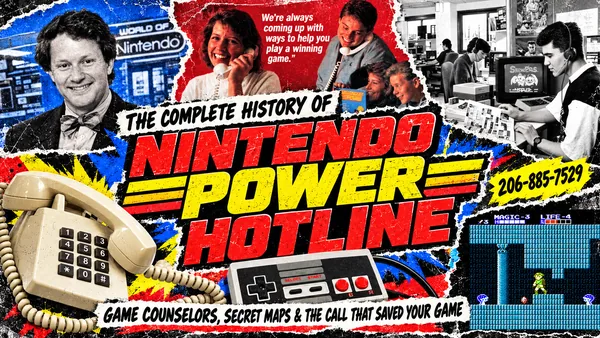
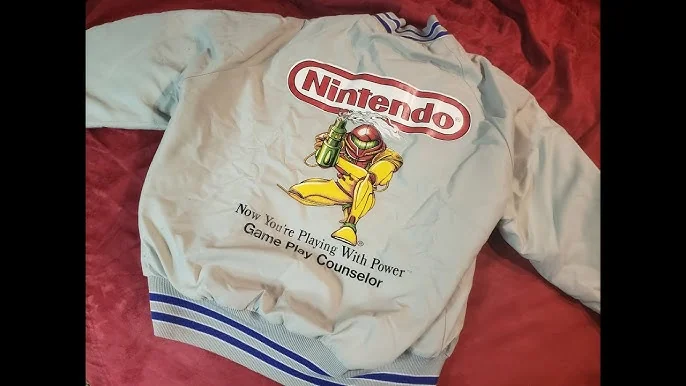
The Nintendo Power Hotline became one of the strangest, most beloved services in gaming: a company full of people paid to help children beat its games. Its story runs through the NES explosion, the rise of Nintendo Power, expensive phone calls, office friendships, genuinely useful advice and the Internet quietly making the whole operation obsolete.
Before the magazine, there were questions
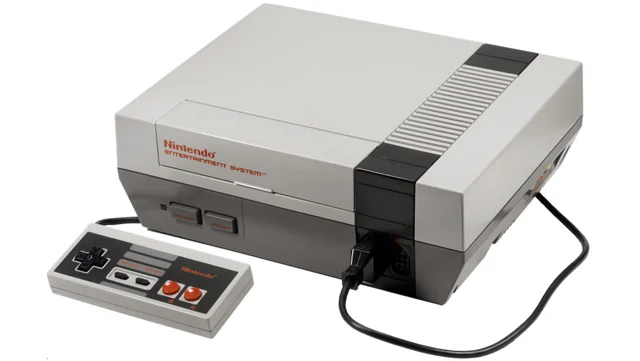
Start with an NES controller. Two red buttons, a directional pad and a game that seemed perfectly straightforward until it wasn’t.
You could learn to clear the first few screens of a platformer by watching and trying again. An adventure was another matter. A hidden passage might look exactly like the solid walls beside it. A useful item could be sitting behind a task you had not realized was a task. Being good with the controller did not necessarily help you understand what the game was asking.
Nintendo of America needed those players to stick around. Its new console was arriving in American homes after the video-game market had suffered a spectacular crash. Selling the machine was the beginning of a relationship. Getting a family to buy the next cartridge meant keeping the first one from becoming an expensive mystery.
Howard Phillips was unusually well placed to help. He had joined Nintendo in 1981 to handle warehouse and shipping work, then became its conspicuous game expert: the friendly face in the bow tie who could actually play the things Nintendo was selling. In a 2012 interview, Phillips explained that Nintendo initially fielded gameplay questions through a toll-free number. Demand grew beyond what that approach could comfortably handle. Publishing common answers offered a way to reach many children at once.
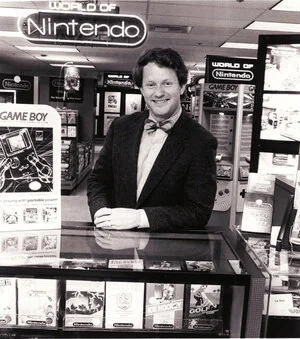
That became Nintendo Fun Club News, the newsletter that preceded Nintendo Power. Phone help and printed help grew together. A map in the mail could solve the same problem for thousands of players; a counselor could find out why one particular child was still lost.
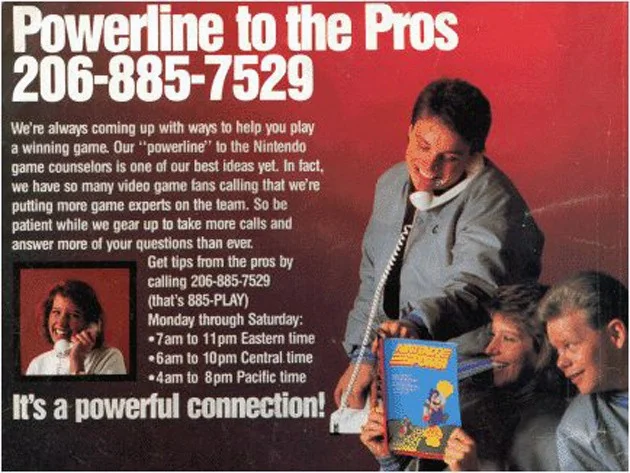
The early dates get muddled in later accounts. Contemporary reporting counts Nintendo’s information and service calls from 1986; a later oral history dates the familiar hotline to 1987. The fall 1987 newsletter gives us something firmer than a remembered anniversary: a phone number, photographs and counselors already describing their work.
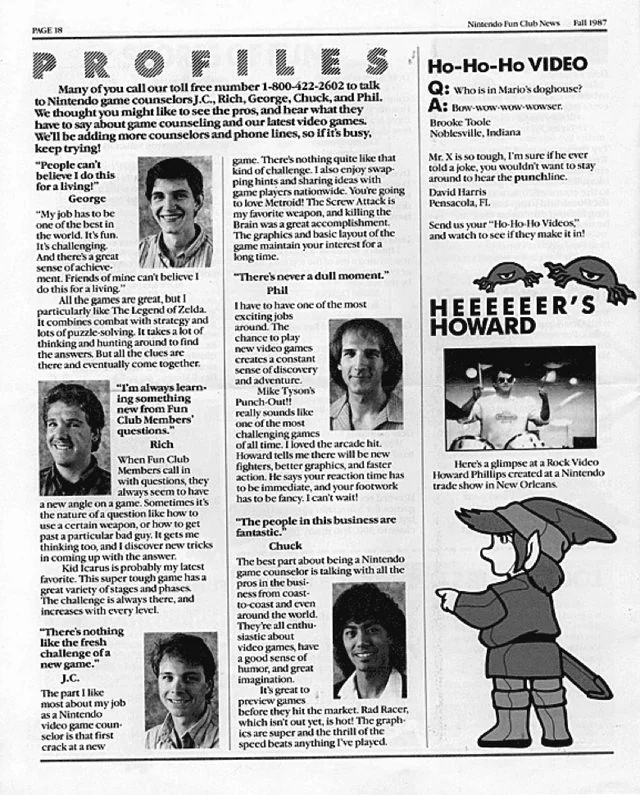
Under the heading “POWERLINES,” those counselors discussed discovering secrets, helping callers and the pleasure of playing new games. One of them, George, offered a line that might have been written by every Nintendo-obsessed child looking at the page: People can’t believe I do this for a living!
The same page warned that Nintendo was adding counselors and lines, and asked readers to keep trying if the number was busy.
Already, the dream job had a queue.
The magazine put faces to the voices
When Nintendo Power arrived in July/August 1988, it gave the whole relationship a bigger, brighter stage. Maps, strategies and previews filled the magazine; Counselor’s Corner made the experts seem like people a reader could get to know. You could see their faces, read about their favorite games and admire an accomplishment that sounded ridiculous until you remembered where they worked.
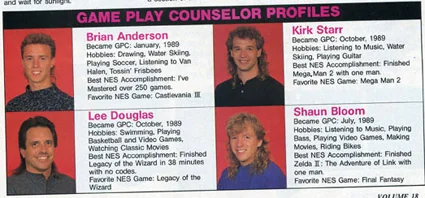
Kirk Starr entered that world in 1989. He initially worked in Nintendo’s mail room, but the maps he had drawn of Mega Man 2 impressed a supervisor enough to get him considered for counselor training. A hobby that could have looked like doodling to somebody else became evidence that he belonged on the phones. Starr recalled the move in his Morning Toast interview.
The profile page did some clever work for Nintendo. It promised expertise without making the company feel remote. These were people with hobbies and haircuts. Some had extremely committed haircuts. If one of them could finish a game that was making your weekend miserable, perhaps the number beneath the picture was worth a try.
It was also an advertisement for a possible future. Children were being shown a workplace where knowing a difficult game counted as a skill. The counselor in the cubicle could become a bigger celebrity in a young reader’s mind than anybody in Nintendo’s executive offices.
Hollywood knew the number, too
The Wizard, the 1989 road movie remembered for its Nintendo competition and Power Glove salesmanship, also found room for the hotline. A counselor surrounded by reference material helps the young travelers. A former employee later told Morning Toast that the cramped, binder-filled cubicle resembled the real thing.
That scene made a familiar fantasy visible: somewhere behind the number in the magazine, Nintendo really did have people who knew how to help. The company could look almost impossibly far away from a child’s living room. Picking up a telephone made it reachable.
My dad, Dark Link and the phone
Around 1989 or 1990, my dad and I were stuck on Dark Link in Zelda II: The Adventure of Link. I cannot pin it to an exact year now, but I remember the frustration. Getting to him took so much effort, only for us to die there. Then we’d reach him again and lose again. Over and over. Eventually, we had to call the Nintendo hotline to figure out how to beat him.
There could hardly have been a more appropriate customer for the service. By the time you reached Dark Link, Zelda II had demanded that you survive its towns, caves, palaces and sword fights. After the Great Palace and Thunderbird, it put your own shadow in the way. The last opponent looked like you, moved like you and had no interest in rewarding the effort it had taken to reach him.

By then, we wanted to see the ending we’d worked so hard to reach. Dark Link kept saying no. The phone gave us somebody to ask for help—and, for once, a reason to think the next attempt might go differently.
Zelda II kept the counselors busy long before its final fight. In a 2011 interview, a former counselor remembered five consecutive calls asking where its hammer was. The hammer opens routes through Hyrule, but finding it means surviving Death Mountain’s maze of caves. That is the sort of obstacle that stops a player from seeing the rest of a game they have already paid for.

A useful tip did not make the game play itself. You still had to get through the cave, handle the enemies and keep enough life to make it back. Knowing where to go could simply turn an evening of wandering into an evening with a fighting chance. For a child with one new cartridge and no money for another, that was a considerable improvement.
The job was learning how to listen
The games were part of the entrance exam. A 1990 report described recruits having to finish Zelda within three days.
Erich Waas joined the counselors in early 1990 after his father spotted a recruitment notice. His recollections show the thought behind that friendly voice.
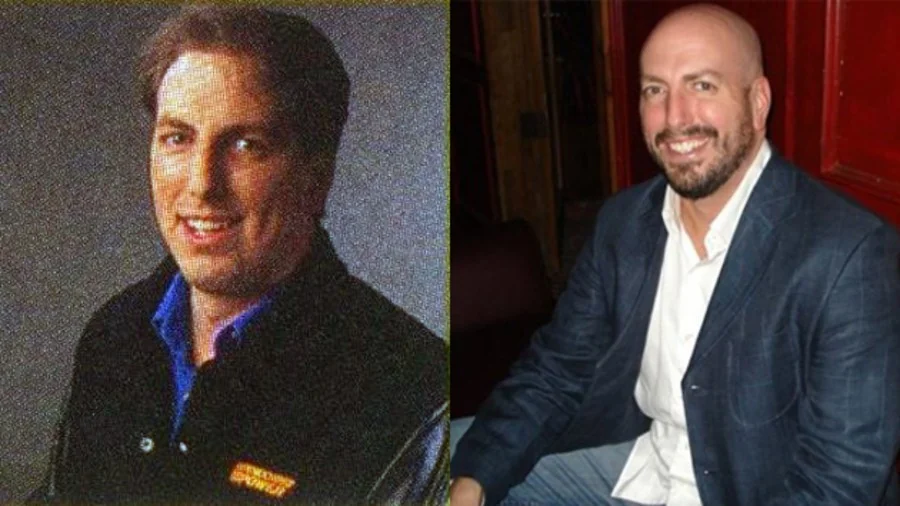
The aim was to help callers discover answers, rather than simply reveal them. Counselors said “defeat” instead of “kill.” A sword fight might be happening on the television, but Nintendo’s representative kept the conversation friendly.
That required more than memorizing a map. Someone might know exactly which dungeon they were in. Someone else might describe every enemy as a monster and every item as a thing. Before the counselor could give directions, they had to establish where the caller was, what they had already done and whether they were even trying to solve the right problem.
In one Willow call, Waas investigated a player’s strangely weak equipment. A miscopied password had sent them far ahead with inadequate gear. He had to establish that the problem really existed before he could help.
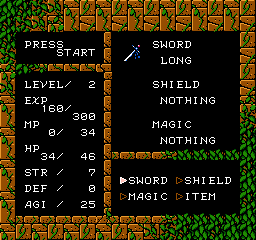
Passwords were wonderfully economical until you misread one. A tiny block of characters could preserve hours of progress; a tiny mistake could leave you arguing with someone who understandably thought your story was impossible. The hotline had to cope with the games as families actually experienced them, including handwritten passwords and imperfect descriptions.
The secret library behind the headset
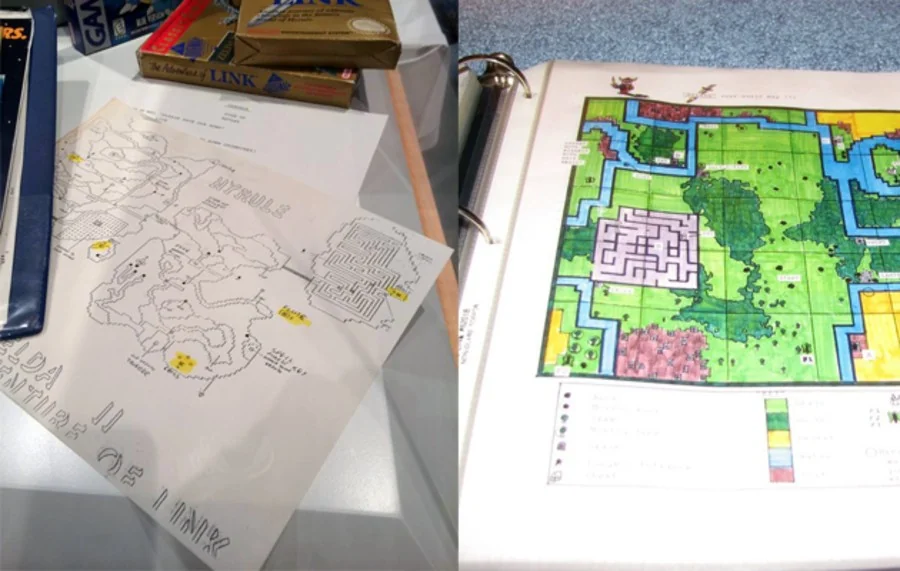
The maps were real. So were the binders. Before an answer appeared in a magazine or a computer database, somebody had often played the game, worked out its routes and written down what mattered.
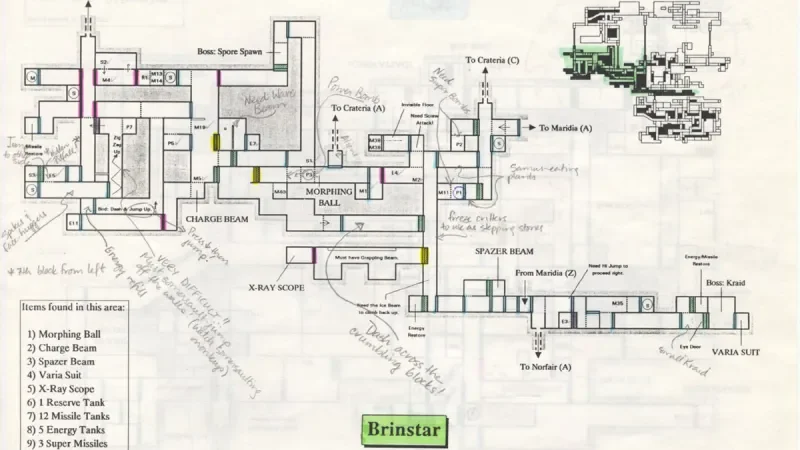
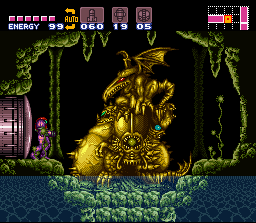
The preserved Super Metroid counselor maps carry handwritten annotations. Zebes was a place the player explored alone; inside Nintendo, it became shared working knowledge.
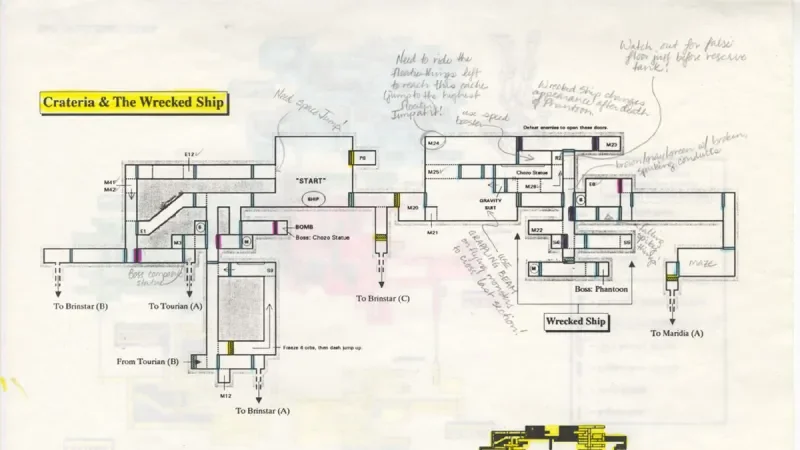
That knowledge had to be usable while a person waited. You could not spend half an hour admiring the precision of a map when the caller needed to know which door to take. Labels, route descriptions and notes about awkward jumps turned a large adventure into a set of answers somebody could find quickly.
Eventually the binders gained an electronic companion: ELMO, the Electronic Manual Organizer. A former counselor who helped write its walkthroughs described it as a primitive GameFAQs built by counselors. He also remembered the cost of growth: as Nintendo’s libraries expanded, nobody could personally know every game. Employees leaned harder on the database, and sometimes gave an answer that brought an unhappy caller back.
There is something reassuringly ordinary about that admission. The hotline was staffed by people, including people doing their best with unfamiliar games. A confident voice and a Nintendo paycheck did not grant supernatural knowledge of every cartridge.
The scale changed the work. A counselor might know a short code without touching a binder. A puzzle could occupy the next several minutes. An adventure could require untangling a mistaken assumption before anyone could talk about a destination. Those are different problems, even when they all arrive through the same headset.
Lolo could make an expert sweat
Adventures of Lolo looks gentler than most things capable of ruining your afternoon. Its little blue hero collects hearts and pushes blocks around compact rooms. The danger lies in the order. Push something to the wrong place, expose yourself to the wrong enemy or use an opportunity too soon, and the tidy little room becomes a trap.
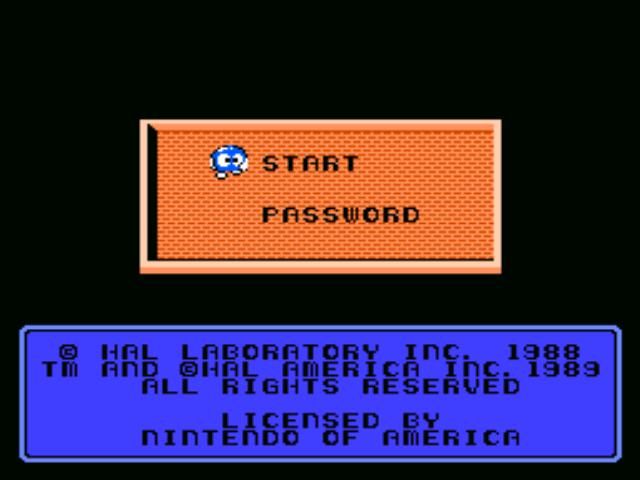
A counselor hired in 1997 told GameSpot that hearing “Lolo” could mean a twenty-minute call. Even with computerized solutions, the team still cross-referenced hand-drawn maps. Guiding a person through a precise sequence over the telephone is a different skill from completing it yourself. You cannot see their screen. You cannot point at the block. You have to trust that “left” means the same thing to both of you.
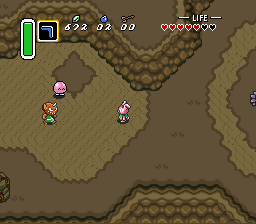
The same interview describes callers in A Link to the Past who thought they needed the hammer when their immediate problem called for the Moon Pearl. A player can be perfectly clear about what they want and mistaken about what will help them. The best counselor had to recognize the difference without making the caller feel foolish.
These games remain terrific, but their mysteries were easier to love when you had somebody to consult. We remember discovering the answer. It is easy to forget the hours before that, when the answer seemed to be hiding behind every wall except the one we had already checked.
Paid to play, expected to work
Minoru Arakawa, Nintendo of America’s president, emphasized patient service. Former counselors remembered opportunities to move into other departments. The 2022 oral history follows counselors who went into testing, events and technical work.
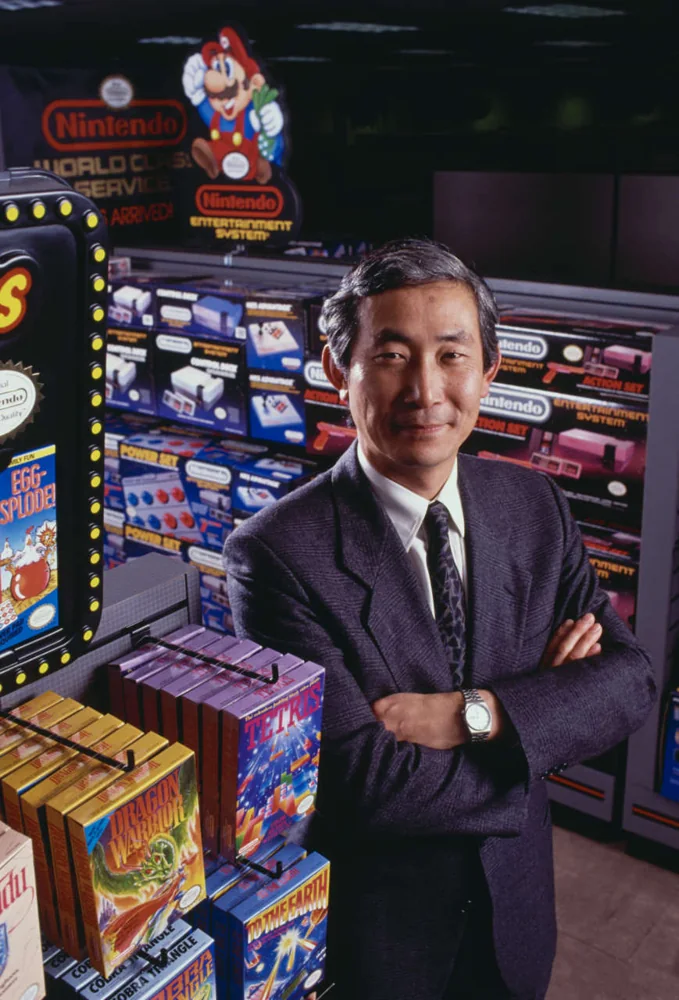
A job with a television on the desk was still a job. Nintendo’s Christmas rush earned the nickname “Hell Week.” Waiting-call displays put the backlog in full view, according to the same oral history.
Some of the glamour wore differently from inside the cubicle. The counselor in the 2011 Morning Toast interview remembered extra training that qualified employees to handle gameplay, customer-service and magazine-subscription calls. Nintendo called the fully trained employees “Super Agents.” He remembered it more practically as a way to earn an extra dollar an hour.
That is a wonderfully deflating detail. From a bedroom, the job looked like admission to a secret kingdom. From the desk, it also involved shifts, supervisors, pay rates and the next person waiting.

The tip was helpful. The bill could hurt.
The old Redmond number did not carry a special per-minute counselor fee, but “free advice” and “free phone call” were not interchangeable. A family outside the local calling area could still pay long-distance charges. Later, Nintendo charged for live counseling through a 900 number. The cost changed with the period, which is why people remember different prices.
WIRED’s July 1995 visit described a roughly dollar-a-minute counselor line. It also reported nearly 44 million information and service calls since 1986. That total included the broader operation, not just children asking for game secrets.
By the time Ridge Racer 64 shipped in 2000, its instruction booklet neatly separated the options. Recorded tips and news were available at 1-425-885-7529, with possible long-distance charges. A live counselor cost $1.50 per minute at 1-900-288-0707 in the United States. The Canadian counselor line was 1-900-451-4400, listed at $2.00 per minute. The booklet also told callers under eighteen to get parental permission.

Ten minutes at the U.S. rate came to fifteen dollars. A confused explanation, a few follow-up questions and an answer that needed careful walking through could become a surprisingly expensive conversation. The live service gave you something a recorded message could not: somebody who could respond to your actual predicament. The phone bill put a price on that flexibility.
“My mom got upset when she saw the bill.”
NeoGAF member entremet, remembering a call about Link’s Awakening in a 2013 discussion of counselor binders.
A tip could rescue your evening and still cause trouble a month later. The warning about asking permission was familiar enough to blend into the small print. The amount on the bill had a way of making itself noticed.
For the price of a stamp
There was another route into Nintendo. You could write.
The wait was much longer. A letter could not help you finish the boss before bedtime. But it could put an answer in your hands without asking your parents to approve a long-distance or premium-rate call. You could keep it, read it beside the television and try the instructions as many times as necessary.
Starr remembered preferring correspondence work, particularly because it reached children who could not afford the call or whose parents would not allow it. He tried to personalize his answers, including congratulating a player on something they had already accomplished before explaining what came next. His interview captures the pleasure of that slower side of the job.
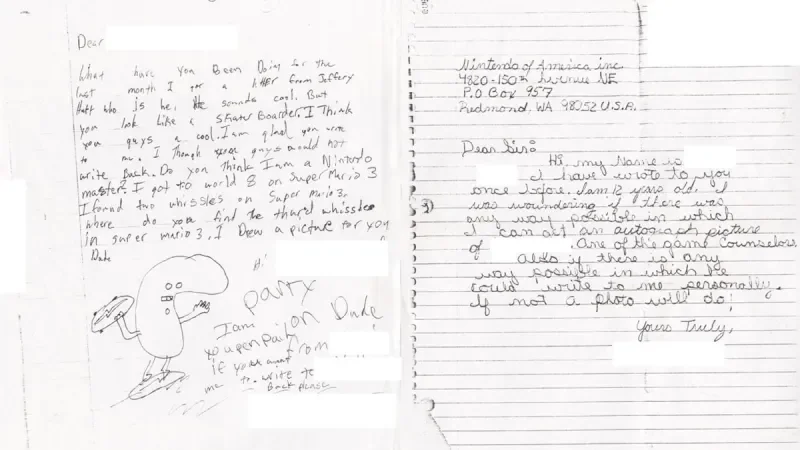
For the child receiving it, a letter from Nintendo was a small event. Your question had entered the company and returned with an answer. The paper made the exchange tangible in a way that a few spoken minutes could not. Years later, saved letters helped former callers reconnect with the people who had answered them.
The same Morning Toast interview series makes clear that the letters were work, too: shared explanations avoided writing out complicated routes repeatedly, while research and personalization made them useful to the individual reader. It was a good compromise between helping efficiently and sounding as though an actual person had read what you sent.
Across the Atlantic, the light stayed red
Keith Pullin joined the British hotline team in December 1990; it went live in January 1991. His memoir describes his workstation: an NES, a small television, a beige telephone and an ashtray.
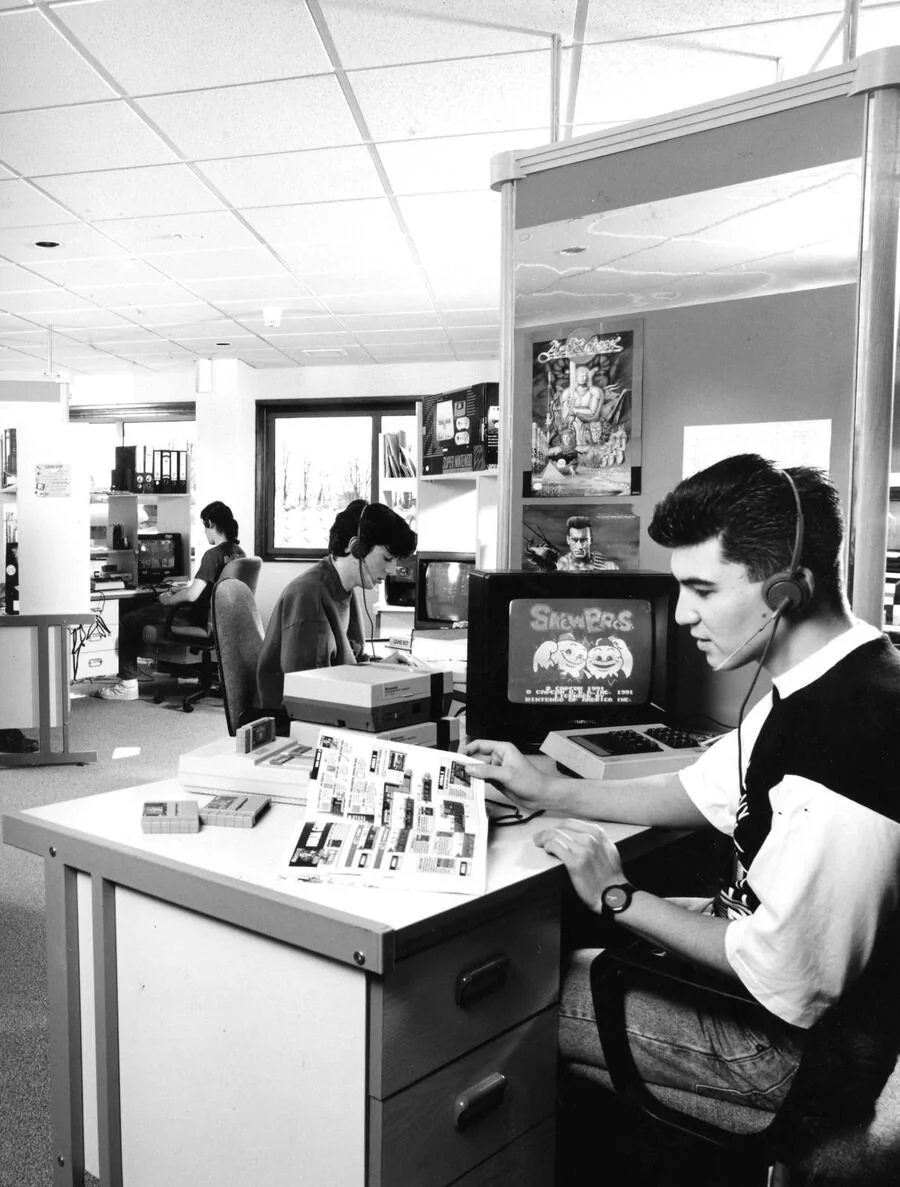
Six people handled a hundred calls on the first day. Adding the SNES to NES and Game Boy duties gave them more games to learn and more callers needing help.
Supervisor Ben Gunstone recalled a two-minute average-call target, a traffic-light queue display and burnout that went unsupported because people assumed this was a dream job. The photographs are affectionate. The recollections explain how tiring it could be.
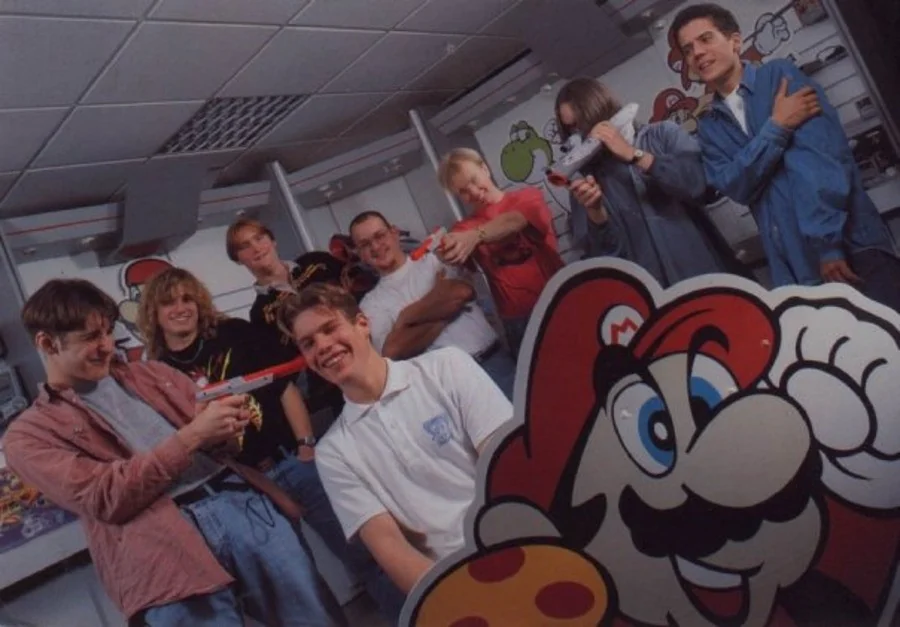
The British operation’s ending is easy to oversimplify. Pullin’s own chapter closes with the 1995 shutdown of the office he knew. Later interviews with British staff trace the service through a change in Nintendo’s distribution arrangements and on to its final closure in late 2000. Some staff moved into other parts of the industry. The institution could continue after the particular group that had made it memorable broke apart.
That is one reason there is no single universal hotline story. A caller in Britain, Canada or the United States might remember different numbers, different prices and a different ending. The shared experience was explaining a game to a stranger who knew enough to help.
The Internet took the next call
By the late 1990s, the counselor’s toolkit was already recognizably close to what players would soon find online. Search for a game, locate a walkthrough, narrow down the troublesome room. The database did some of the remembering. The person did the listening.
The counselor hired in 1997 emphasized clear speech and finding information quickly. Hard questions could prompt researched, free callbacks. New consoles never erased the old cartridges in somebody’s cupboard.

Meanwhile, a player who could get online had alternatives that did not tick away at a per-minute price. Walkthroughs could be searched, printed and shared. Forums offered several people’s experience instead of one employee’s. Some advice was bad, some was wonderful, and a few debates could last longer than the game. But the volume of readily available help kept growing.
You no longer needed permission to call Washington. You needed access to a computer and enough patience to find the relevant section of a guide.
The staffed American counselor service ended in 2005, according to the oral history. Telephone tips did not vanish immediately. Nintendo’s own 2005 Nintendogs manual points players first toward its website and forums, then offers recorded Power Line tips for those without web access.
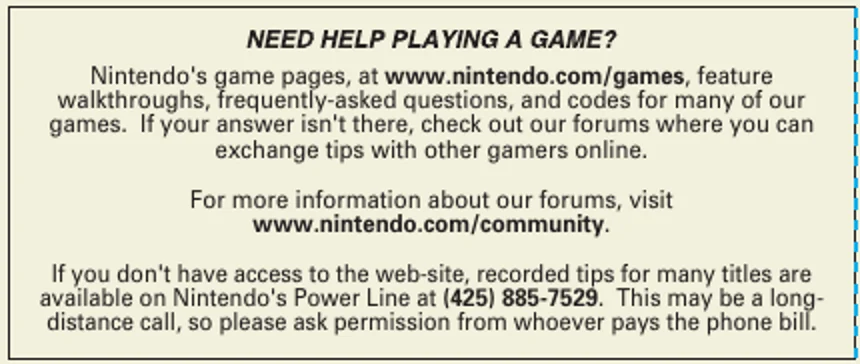
The page is a miniature handover. The web gets the first recommendation; the phone is there for people who cannot use it. In 2011, Nintendo confirmed that the Power Line had closed in June 2010. That later date describes the telephone service’s final closure, rather than another five years of the old live-counselor arrangement.
One more weekend with the Power Line
In November 2016, Nintendo brought the number back for the NES Classic Edition launch. For three days, November 11–13, 425-885-7529 offered recorded tips and memories from original counselors. It was a short promotional revival, rather than a new staffed service.
It was also an unusually perceptive piece of nostalgia. The NES Classic put old games back under the television. Reviving the Power Line acknowledged how people had managed to get through those games in the first place. The cartridge was only part of the memory. Around it were magazines, friends, handwritten notes and sometimes a parent willing to help make a call.

The preserved binders now attract the sort of attention once reserved for rare cartridges. In the 2013 NeoGAF thread, member rrs wrote: Those hand drawn maps are just awesome.
They are. They preserve the labor behind a service that could sound effortless to a child.
There is no need to pretend phone help was better at everything. It cost time and sometimes money. An employee could misunderstand you. A written walkthrough could answer several questions before you even knew you had them. Today, a video can show a tricky jump with a clarity no telephone description could match.
But the hotline gave young players an experience that still holds up: somebody taking their game seriously. You could be stuck, annoyed and bad at explaining yourself, and there was a person prepared to listen. That was good customer service. It could also feel like having a friend inside Nintendo.
For my dad and me, around 1989 or 1990, that person was somewhere beyond the telephone while Dark Link waited on the screen. We needed help. Nintendo answered.
Keep reading on Retro Replay
- The complete history of the Power Glove — another Nintendo-era dream made famous by The Wizard.
- The secret history of the Konami Code — the sequence that could shorten a counselor’s next call.
- Nintendo’s licensing rules and lockouts — the harder edge of the company behind the friendly headset.
- The history of emulation — how players built new ways to keep old games alive.
Sources and further reading
The reporting draws on period Nintendo documents and published interviews with former employees. Their recollections are attributed in the story; the Dark Link memory is a personal recollection from Retro Replay’s owner.
- Nintendo Fun Club News, fall 1987, page 18, preserved by Trivia Happy.
- Howard Phillips interview, Nintendo Life, 2012.
- Kirk Starr interview, Morning Toast, originally 2007; Paul Reed interview, originally 2009; Matthew Glidden interview, originally 2011.
- Erich Waas interview, Nintendo Life, 2016.
- Flashback NES, GameSpot, 2006, including its former-counselor interview.
- Play Games! Get Paid!, WIRED, July 1995.
- Inside the Nintendo Power Hotline, Game Informer, 2022.
- Keith Pullin’s British hotline memoir, Nintendo Life; the later UK oral history, Time Extension, 2026.
- Ridge Racer 64 U.S. instruction booklet, 2000; Nintendo’s Nintendogs manual, 2005.
- Nintendo’s confirmation of the June 2010 closure, reported in 2011; the 2016 revival announcement, Siliconera.
- Counselor binders and player recollections, NeoGAF, 2013.