Retro Replay Retro Replay gaming reviews, news, emulation, geek stuff and more!
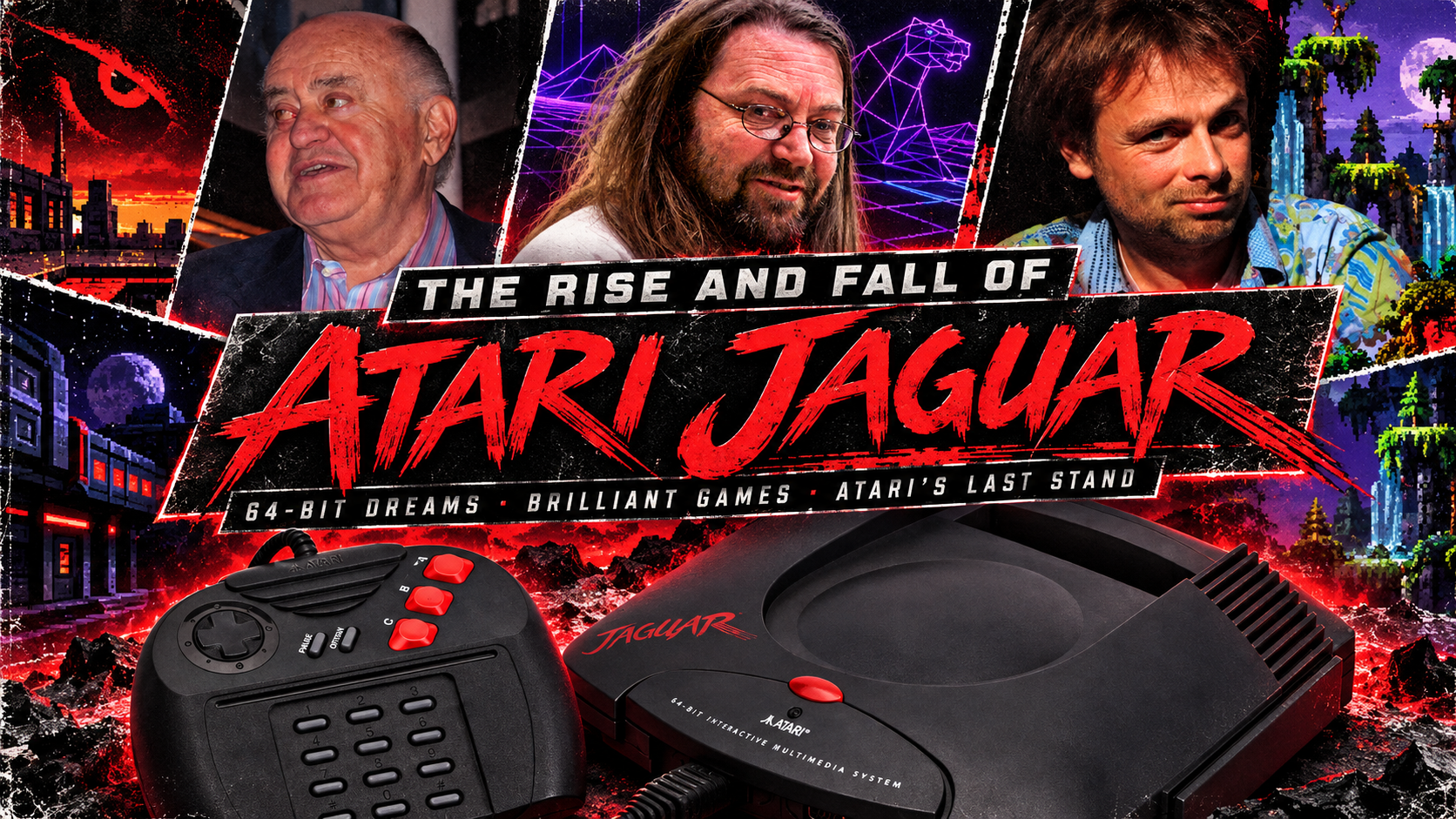
It had a feline shell, a telephone-sized controller, a two-word challenge to its rivals, and an almost impossible job: make Atari matter again.
Imagine walking into a game store in late 1993. The Super Nintendo and Genesis own the shelves. A 3DO costs an eye-watering amount. The PlayStation is still a rumor from across the Pacific. Then you see a black machine with a red Jaguar badge and a box that insists it is the world’s first 64-bit interactive multimedia system. Atari, the company that had once been synonymous with home video games, seems to be back from the dead.
The Jaguar is an irresistible story because both halves are true. Its hardware was genuinely unusual and sometimes startling. Tempest 2000 could turn a spare arcade idea into a hypnotic assault. Alien vs Predator could make a console feel claustrophobic and dangerous. Rayman carried lavish animation from a small platform into a huge franchise. Yet Atari also sold the machine with a number that told shoppers remarkably little about how games would play. Its launch library was thin, its development path was difficult, its CD add-on arrived late, and its corporate lifeline ended in a merger with a hard-drive company.
This is the full rise and fall: the people and business behind the hardware, the promise and trap of “64-bit,” the games that earned the Jaguar its cult, the marketing and retail struggle, and the afterlife that has kept the cat prowling long after Atari stopped selling it.
Jaguar in one minute
Atari introduced the cartridge-based Jaguar in limited US markets in November 1993 for $249.99, then widened distribution in 1994. The machine combined a Motorola 68000 with custom chips nicknamed Tom and Jerry, 2 MB of main RAM, and a controller with a numeric keypad. A CD drive followed in 1995. Atari’s own 1995 annual filing says it had sold approximately 125,000 Jaguar units through the end of that year and still held about 100,000 in inventory. The often-repeated quarter-million lifetime total is an estimate, not that filing’s verified sell-through figure. Read Atari’s SEC filing.
Atari before the cat
To understand why the Jaguar mattered, start with a name that had become larger than any single company. Atari helped put arcade games in the public imagination and the 2600 in American living rooms. But the corporation selling the Jaguar was not simply the same enterprise sailing smoothly from one triumph to the next. The early-1980s crash, a change of ownership, and an industry rebuilt around Nintendo had scattered the old advantage. By the time the Jaguar was being planned, Atari’s brand still meant something; its control of the console market did not.
Meet Jack Tramiel. He built Commodore into a home-computer powerhouse, then acquired Atari’s consumer business in 1984. The Atari ST gave the new Atari Corporation a real computer story, especially in Europe and among musicians. But the game-console business was another matter. The 7800 had arrived in a world where Nintendo had reset the standard for software, retail relationships, and household trust. The Lynx was a capable color handheld with a difficult fight against a cheaper, longer-lived Game Boy. A new living-room machine had to do more than display technical ambition. It had to make stores, studios, and customers believe Atari could sustain another platform.

The ST also shaped Atari’s habits. Tramiel’s company knew how to fight on price and how to find value in clever hardware. It had fewer resources than the companies that would dominate the next generation. That made a machine built around custom chips attractive: if Atari could deliver a visible leap before its rivals, it might win attention without spending like Nintendo or Sega. The risk was that custom power is only useful when developers can turn it into finished games on a predictable schedule.
Atari was not alone in chasing the next generation. Sega and Nintendo still had enormous 16-bit audiences. The 3DO was pitching CD-based, high-end home entertainment. Japanese studios were looking beyond sprites toward textured worlds and optical media. Atari’s window was narrow. It needed to arrive early enough that “next generation” was its own territory, but complete enough that the first owners did not become unpaid beta testers for a grand idea.
A British engine under an American badge
The Jaguar’s ancestry is a detour through British computer engineering. A group of former Sinclair Research engineers formed Flare Technology and worked on ambitious graphics hardware in the late 1980s. Some of that thinking fed the unreleased Konix Multi-System. Atari then worked with the Flare team on two possible successors: a 32-bit machine code-named Panther and the more ambitious Jaguar. The faster-moving Jaguar project won. Atari abandoned Panther in 1991, leaving a trail of demonstrations and what-ifs instead of a retail product. The Flare team’s retrospective interviews are valuable here because they show that this was not an overnight American brainstorm. The hardware carried years of British design history into Atari’s last console campaign.
That origin helps explain why the Jaguar feels unlike its rivals. It was not organized around one big central chip that programmers could treat as a familiar brain. The Motorola 68000 handled bootstrapping and general coordination. Tom contained graphics-related machinery: a graphics processor, blitter, and an object processor that assembled the display. Jerry handled sound, input, and a digital signal processor. The chips shared memory and a bus. When a game used them well, the result could be impressive. When a team leaned on familiar 68000 habits or hit awkward transfers, the “64-bit” label did nothing to rescue the frame rate.
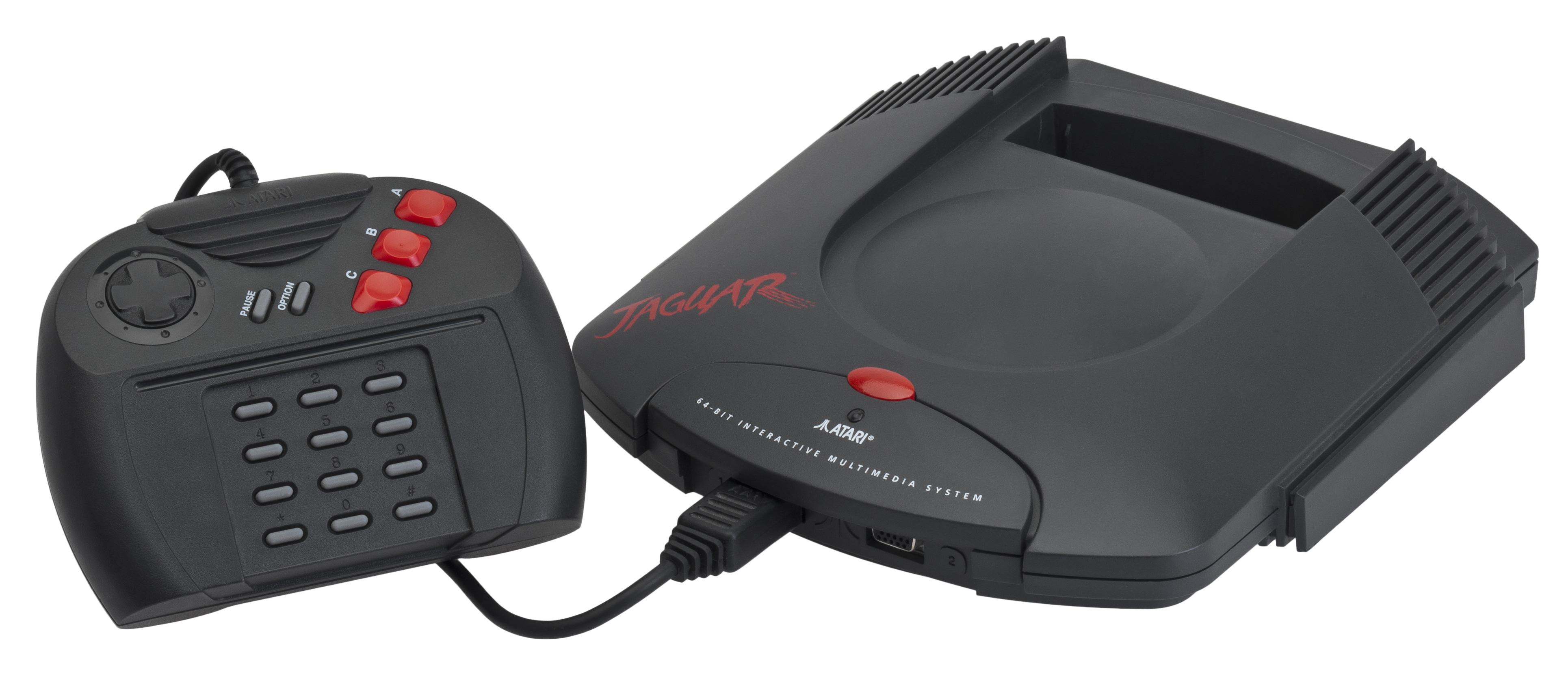
The distinction between a 64-bit data path and a 64-bit general-purpose CPU became the system’s permanent argument. Atari had a genuine 64-bit external bus and 64-bit transfers in parts of its custom architecture. The GPU and DSP were 32-bit RISC processors, while the 68000 was a 16/32-bit design. Calling the Jaguar “64-bit” was not a random number pulled from a hat. Presenting the number as a simple, direct measure of a game machine’s superiority was marketing, not an engineering lesson. Atari’s technical reference manual is a better guide to what the parts actually did.
So was it really 64-bit?
Parts of its data system were 64 bits wide. Its key programmable processors were not all 64-bit CPUs. A game did not become faster because the box printed “64.” The answer that matters to players is concrete: what could a team draw, animate, sound, and control with the available chips, memory, tools, and time?
The 2 MB of main RAM was another hard boundary. The object processor could combine sprites and bitmaps with unusual flexibility, and the blitter could move pixels quickly, but every effect still had to fit in memory and cross shared hardware without getting in another chip’s way. A strong Jaguar game often looks like a team chose one feature to make sing. A weak one looks like several promising subsystems waiting politely for a developer who never had enough time to master them.
“Do the Math” meets the shop floor
Atari announced the Jaguar in 1993 with an aggressive price and an aggressive comparison. Its August 1993 press release positioned a $249.99 Jaguar against the much more expensive 3DO and named IBM’s Charlotte, North Carolina, facility as manufacturer. That manufacturing agreement was a headline in its own right. It made a small Atari look serious: if IBM could build the machine, perhaps the comeback could be real.
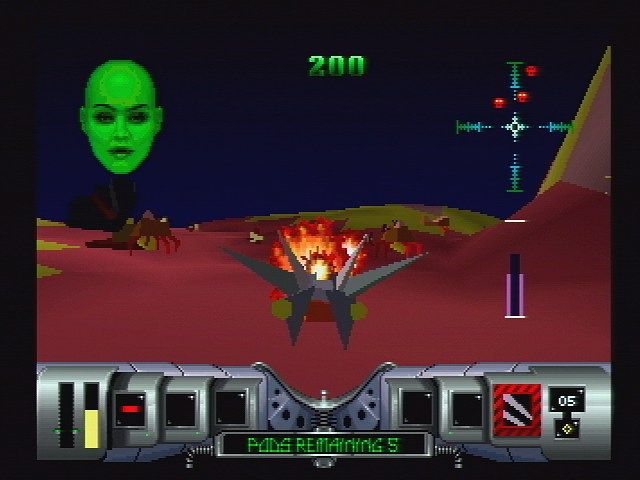
The retail launch was deliberately limited to New York and San Francisco in November 1993. A test-market rollout could conserve stock and concentrate promotion, but it also meant the national audience was hearing about a new console it often could not buy. The pack-in, Cybermorph, showed off free-roaming polygonal terrain and a talking companion. It could feel like the future if your comparison was a flat 16-bit landscape. It could feel strangely empty if you expected the endless possibilities promised by the box. The other early titles, including Trevor McFur in the Crescent Galaxy and Raiden, were a thin answer to a large claim.
Atari’s “Do the Math” campaign made the mismatch sharper. The commercials told viewers that 16 plus 16 did not equal 64, mocking the established consoles for being stuck in an old era. It was memorable, combative advertising. It also turned every less-than-stunning Jaguar screenshot into evidence for the prosecution. A shopper did not need to understand bus widths to ask why a game from a supposedly superior machine looked rough next to the best Super Nintendo or Genesis releases. The slogan had made a technical label into a visual promise.
The commercial was doing several jobs at once. Atari could not outspend its rivals across every magazine page and television break, so it needed a claim that traveled by word of mouth. “64-bit” was short enough for a child to repeat and sharp enough for a parent to understand as “more.” The problem is that videogame history had already shown how unreliable a single number could be. A convincing game depends on memory, software tools, art, audio, controls, and what the hardware can sustain in motion. Atari put the largest number on the shelf at the exact moment game buyers were learning to judge a console from moving footage, not specifications. The slogan won attention; it also trained the audience to look for the proof Atari had the least time to provide.
There was a second gap between national advertising and a limited launch. A magazine could create desire in a town whose store had no Jag for sale. Developers, meanwhile, could not build for the promise of a future nationwide audience; they had to budget against the machines already in homes. A small test market can be a sensible way to learn. It is a hazardous way to claim you have already won the next generation. Atari’s early publicity sounded like a victory speech while the platform was still trying to build its first reliable software calendar.
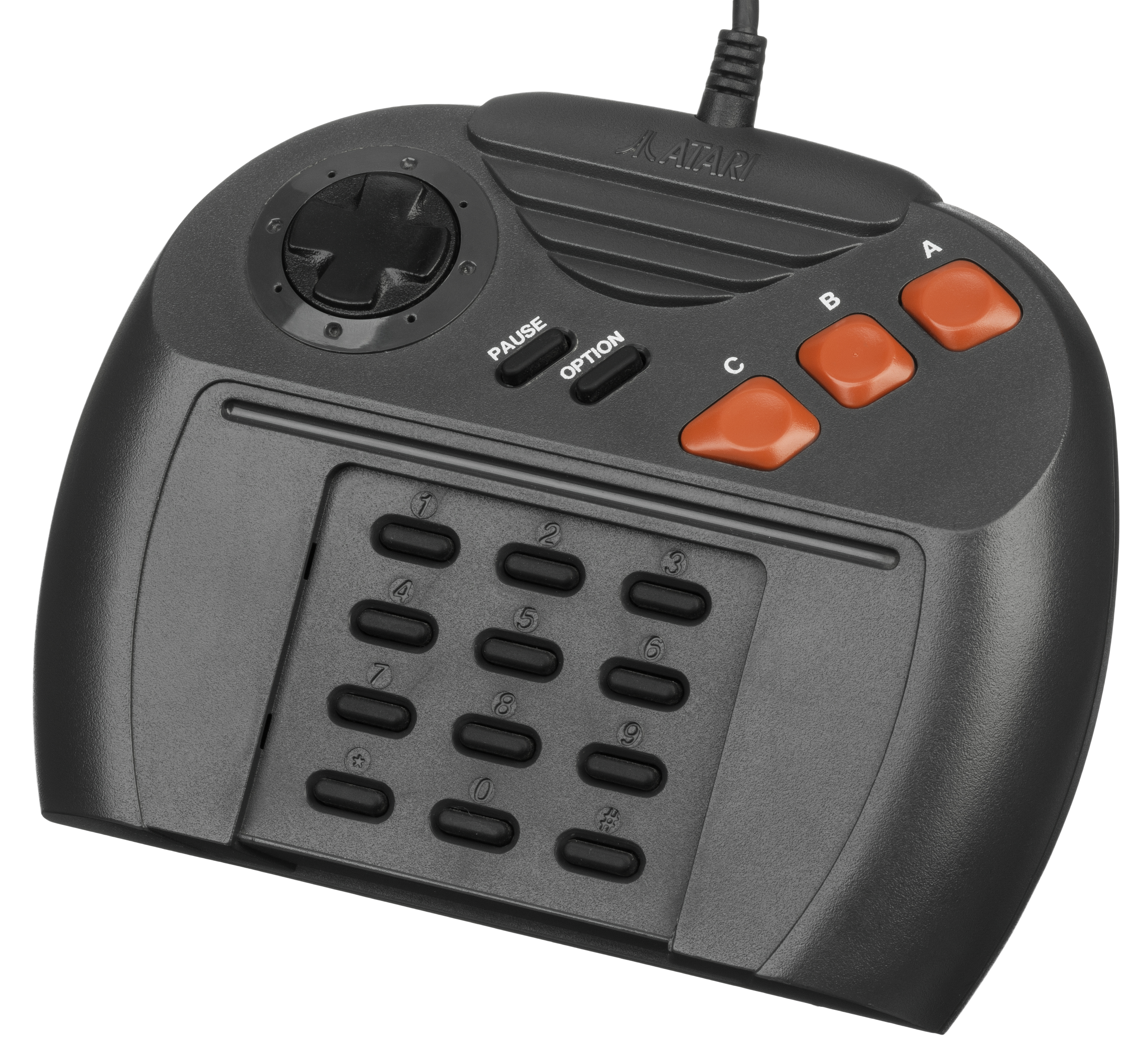
The controller made an equally immediate impression. Its broad body held a directional pad, three face buttons, and a 12-key number pad designed for game-specific overlays. The keypad made sense for switching weapons, choosing commands, or giving simulation games more inputs than a normal pad could carry. It could also feel like a telephone had invaded game night. The problem was not simply that it looked odd. As action games moved toward more face buttons and shoulder controls, the original Jaguar pad felt oriented toward a different imagined future. Atari later released a ProController with more conventional buttons, but the first impression had already hardened.
The brilliant exception: Tempest 2000
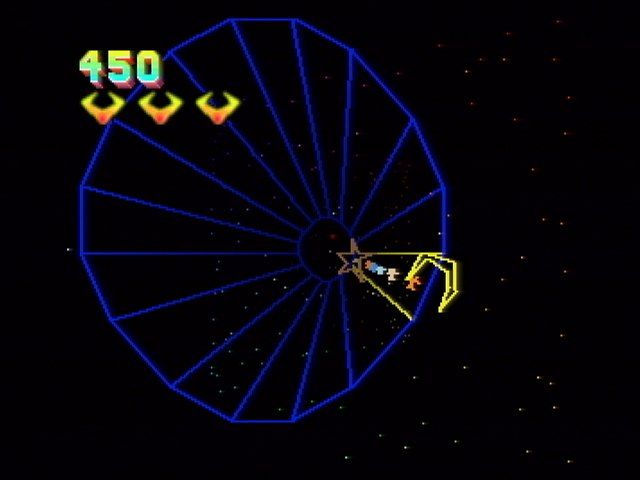
Then the Jaguar made an argument no commercial needed to explain. Tempest 2000 took a 1981 arcade game about defending a geometric web and transformed it into a neon storm of motion, power-ups, visual jokes, and pounding electronic music. There was no need to stare at its box and count bits. You could pick up the controller, circle the rim, survive a wave, and feel why this machine existed.
Meet Jeff Minter. The British independent developer had built a career around fast arcade action, psychedelic imagery, and an affection for games that feel slightly out of control in the best way. At an early Jaguar developers’ meeting, Atari listed classics it wanted updated; Minter said he volunteered when Tempest came up. In his retrospective interview, that choice sounds less like a corporate assignment than a lifelong player getting the keys to a favorite arcade cabinet.

The game is not a demonstration reel stapled to an old design. It constantly gives the player things to do: sweep lanes, grab power-ups, use the jump to escape a collapsing situation, and keep one eye on enemies climbing from the far end of the web. The screen can look chaotic, but its rules are legible once your hands learn the rhythm. The Jaguar’s graphics machinery creates the fireworks around a solid arcade center. That balance is why Tempest 2000 outlived the argument about its host machine.
It also understood what a good pack-in candidate should do, even though it was not the original pack-in: make a complicated machine feel immediate. The 1981 Tempest was already a clever exercise in moving around the edge of danger. The Jaguar update layers modes, bonus rounds, an aggressive soundtrack, and audiovisual feedback onto that spine. The added spectacle never asks the player to stop being alert. You do not wait for the game to demonstrate its processor; you survive one more wave and then realize your hands have been moving for an hour. That is a more persuasive technical demonstration than a lecture about word sizes.
There was a human sting in its later life. Minter has said he was upset to learn that the PlayStation adaptation, Tempest X3, changed enough of the design that he did not receive the royalties he expected from a direct port. That is his account, not a claim we can settle from a contract we have not seen. It nevertheless captures a recurring Jaguar irony: a small machine gave an independent creator room to make a defining work, while the commercial afterlife of that work belonged to a much larger industry.
A monster in the corridors: Alien vs Predator
If Tempest 2000 proved the Jaguar could make old-school action feel new, Alien vs Predator showed how it could build a mood. The 1994 first-person game from Britain’s Rebellion gave players three different roles: a human Marine trapped in an alien-infested base, a Predator hunting with specialized vision, and an Alien moving through a hostile world as the monster. That structure was more than a license trick. It changed what each corridor meant. As a Marine, a sound ahead could mean panic. As the Predator, it could mean prey.
The game is slower and rougher than a modern shooter, and that can be part of its force. Its spaces are labyrinths, its enemies threatening, its objectives less eager to hold your hand. With no smooth contemporary tutorial to rescue you, survival depends on learning the building. It is one of the Jaguar titles that makes the hardware’s limitations feel like atmosphere: dim corridors and abrupt encounters serve horror rather than simply hiding a low polygon budget.
The three campaigns also let Rebellion recycle a place without recycling a player’s relationship to it. A hallway that feels safe when you are a towering hunter becomes a liability when you are a lightly armed human trying to save ammunition. The Alien’s route changes the fantasy again, making walls and vents part of the creature’s domain. This is the sort of structural ambition missing from the claim that Jaguar games were simply tech demos. The first-person presentation mattered, but the design made the license playable from three angles. On a system struggling to prove its value, that was a rare and important piece of substance.
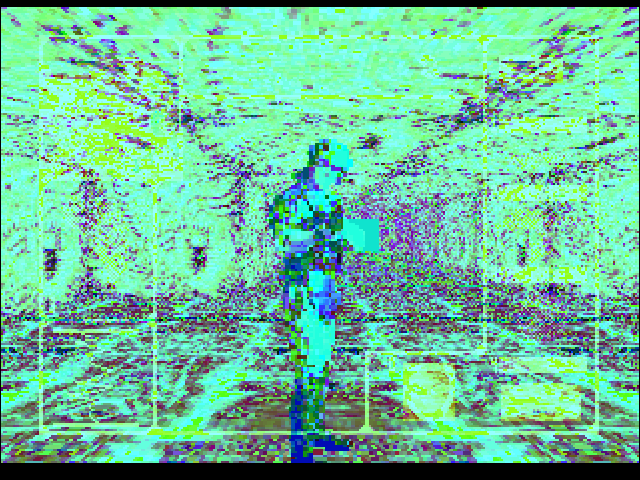
For Atari, it was a desperately useful exclusive. A strong licensed game could draw people who had no emotional attachment to the Atari name. For Rebellion, it was an early step toward a larger future in games. The studio’s later Aliens versus Predator releases did not simply repeat the Jaguar game, but the first-person three-species idea had already found a compelling home here. The Jaguar had produced something critics could point to without adding “for a Jaguar game” at the end.
The rest of the good shelf
The cult canon does not stop at two cartridges. Iron Soldier gave the Jaguar a giant robot, destructible city blocks, and the thrill of looming over a battlefield rather than running through it. The controls ask for patience, but the scale is memorable. Wolfenstein 3D and Doom offered fast, substantial first-person action, with differences in music, levels, and presentation that made the Jaguar versions their own historical objects. Retro Replay’s Jaguar Wolfenstein feature is a useful companion if you want to linger on that port.
The two id-style shooters are particularly revealing. Wolfenstein 3D is a game of speed, doors, and immediate combat; its Jaguar conversion can feel unusually fluid for a contemporary console shooter. Doom asks much more of the machine: textured environments, enemies in depth, and a famous atmosphere partly carried by sound. The Jaguar version changed maps and omitted in-game music, so it is not a one-to-one replacement for a PC copy. It is still a serious early console adaptation. Put those games beside one another and the Jaguar stops looking like a simple binary of “can run 3D” or “cannot.” It could deliver striking action, but each port had to make specific compromises.


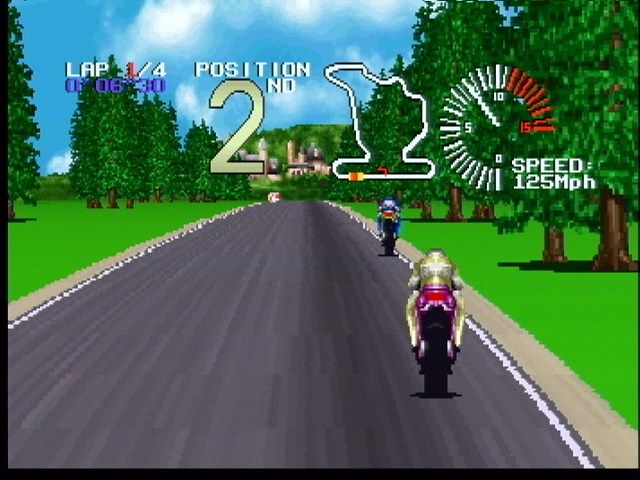
Raiden delivered familiar arcade shooting. Super Burnout found speed in a motorcycle racer. Atari Karts attempted a colorful answer to the kart craze, if not a game-changing one. Power Drive Rally and NBA Jam: Tournament Edition broadened the shelf. BattleSphere, arriving after Atari had effectively left the stage, became proof that dedicated developers could still coax unusual ambition from the hardware. These titles do not all belong in the same quality tier. Together they show that the Jaguar’s reputation as “nothing but bad games” is as lazy as the old claim that its 64 bits made every game superior.
There is a useful counterexample in Super Burnout. Nothing about a crisp, speedy 2D motorcycle racer was fashionable in a year when new consoles were announcing 3D worlds. That is exactly why it works as evidence. The Jaguar could handle bold sprites and fast scrolling; a developer who embraced that strength could make something enjoyable without pretending every game needed to be a polygon showcase. In the 1990s, this sounded like a smaller ambition. With decades of hindsight, it looks like one of the platform’s saner choices.
The other half of the shelf was the problem. Too many releases were undistinguished conversions, rough experiments, or games that seemed to belong to yesterday’s market. A new console needs a dependable cadence of reasons to visit the store. On the Jaguar, weeks without compelling new software made the hardware look lonely. A developer weighing several platforms could see the same thing a shopper saw: a small installed base, a complicated machine, and increasingly fierce competition for attention.
Collectors sometimes tell the catalog backward from its later gems, as though buyers in 1993 could have seen them in the future. They could not. A family considering a new console saw what was on the shelf that day and the release dates printed in magazines. Tempest 2000 and Alien vs Predator helped in 1994. Rayman and the CD drive arrived as rival systems were creating entirely new expectations in 1995. The Jaguar’s best library is spread across its short life; its hardest retail moments came whenever that library had not yet arrived. This gap between a modern “best of” list and the contemporary buying decision is central to understanding its failure fairly.
The system’s European life deserves its own sentence in that chronology. The Atari ST had left a loyal audience across Europe, and British studios had a particular reason to understand the Flare lineage. But distribution and timing varied by country, and the machine never acquired a single global launch moment comparable to the marketing image Americans saw. An American test-market success could not simply be multiplied into Europe; each territory required stock, local promotion, retailer confidence, and a supply of games worth importing or publishing. The Jaguar’s small scale made every regional delay more consequential.
Rayman and the road not taken
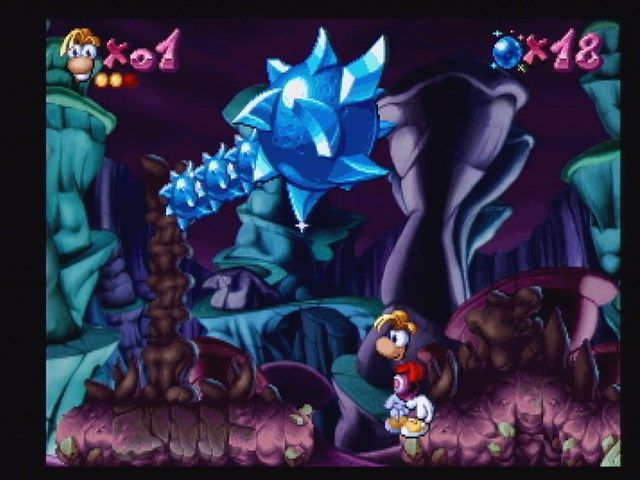
The Jaguar also helped nurture a game that would become far more famous elsewhere. Rayman was developed with the Jaguar in mind before versions reached the PlayStation, Saturn, and computers. Its painterly backgrounds and exceptionally fluid character animation made it look different from both the system’s polygonal demos and the grittier 1990s games competing for the same shelf. On Atari’s machine, it was a glimpse of a future the company could not keep exclusive.
Meet Michel Ancel. The French designer imagined a limbless hero who could punch, leap, and glide through a world that felt like an animated illustration. Ancel’s path to Rayman passed through earlier hardware ideas before settling on the Jaguar project. A firsthand interview with the game’s programming team describes the original Jaguar focus. The design mattered because it offered a third answer to Atari’s hardware question. The Jaguar did not have to be a 3D demo or a dark licensed shooter. It could make 2D art move with remarkable richness.

There is a timing correction worth making. The Jaguar was an early development target and an important version, but a game being conceived for a platform is not the same thing as that platform owning its history. The PlayStation release reached a vastly larger audience. For many players, the first encounter with Rayman has no Atari logo attached. That is part of the Jaguar’s bittersweet legacy: it could host good ideas without possessing the market power to make itself inseparable from them.
Why developers struggled
“Hard to program” can sound like an excuse retro fans repeat whenever an unusual console loses. On the Jaguar, it describes a real production cost. A team had to divide work among the 68000, the GPU, the DSP, the blitter, and the object processor while sharing limited RAM and a bus. The fast local memory available to the custom processors was small. Bugs and documentation issues could turn a clever theoretical pipeline into nights spent chasing timing and transfer problems. Atari’s own developer manual reads less like a magic spell than an invitation to learn a new machine from the inside out.
The business made that learning curve harder to justify. A large platform can afford difficult tools because a hit has millions of possible buyers. A small platform must make development cheap, predictable, and well-supported to compensate. Atari needed developers to invest in custom code before the audience existed; developers needed a growing audience before investing that code. This circular problem followed the Jaguar from launch to liquidation.
Atari’s game lineup was also caught between two eras. A cartridge machine could start quickly and avoid a CD drive’s cost, but the market was turning toward optical storage for larger games, audio, and cheaper production. A 16-bit style conversion could arrive in the short term, but it would not sell a new generation. A bespoke 3D title could show ambition, but it demanded expertise in the Jaguar’s peculiar architecture. The games that worked best usually had a focused answer to that conflict. Tempest 2000 pursued responsive arcade spectacle. Alien vs Predator pursued atmosphere. Rayman pursued lavish 2D animation. The slogan could not choose those priorities for anyone.
Nor could Atari solve this by merely announcing more licenses. A planned game and a game in a customer’s hands are two different assets. Publishers could show a logo, reserve a title, and decide much later whether a small Jaguar market justified finishing the work. The moment a PlayStation version looked likely to sell many more copies, production attention naturally shifted. Exclusives such as Alien vs Predator were especially valuable because they gave the Jaguar a reason to exist independently of ports. But a handful of exclusives cannot carry a platform if the rest of the schedule arrives slowly or with uneven quality.
CD, VR, and the future that missed its cue
The base Jaguar used cartridges, but Atari had promised a CD-ROM add-on from early in the campaign. It finally reached buyers in 1995, attaching to the top of the console in a configuration that looked like a little black tower. The drive could play audio discs as well as games. Its built-in Virtual Light Machine turned music into shifting abstract visuals, a perfect example of the Jaguar’s eccentric charm. The idea was delightful; the timing was brutal. By then, optical drives were standard equipment in the PlayStation and Saturn, machines with larger software plans and more momentum.
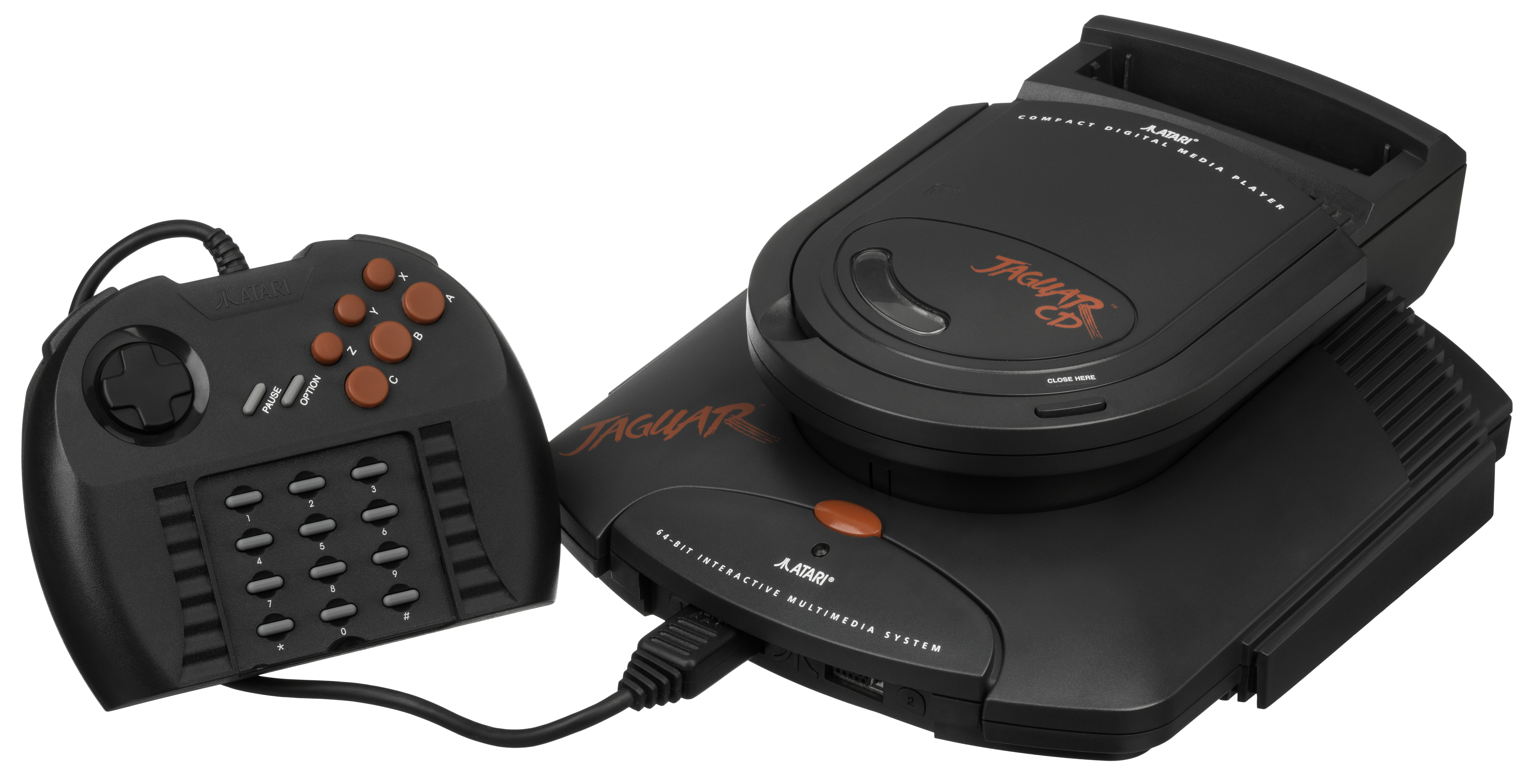
The CD library was too small to transform the platform. There were curiosities and worthwhile releases, including Iron Soldier 2 and the interactive oddity Highlander: The Last of the MacLeods, but no steady flood of discs that made the accessory compulsory. The cost of a Jaguar plus its drive also weakened the old price argument. What began as a cheaper path to the next generation risked becoming an expensive stack beside a PlayStation that already spun discs.
The hardware itself had a personality beyond the library. The Virtual Light Machine responded to a music CD with moving patterns, making the tower useful when no game was inserted. It anticipated a kind of living-room audiovisual toy that still feels charming today. But it also underlines the mismatch in Atari’s pitch. The company needed a game that would make someone buy a Jaguar and then buy a CD drive. A music visualizer was a welcome bonus for someone who already owned both. It could not carry the economics of the add-on alone.
Other futures remained prototypes. Atari worked with Virtuality on a Jaguar VR headset and showed the concept publicly, but it never reached normal retail sale. Networking and other peripherals were discussed or produced in limited forms. These projects are fascinating evidence of how widely Atari was searching for an edge. They also reveal a hard resource question. Every new promise asked developers and customers to wait for a future product while the existing Jaguar still needed more finished games.
Three Atari futures, one shrinking runway
Cartridges: fast, familiar, and expensive to manufacture at scale. Jaguar CD: more storage and music, but an add-on arriving in the PlayStation era. Jaguar VR: an arresting prototype without a retail ecosystem. The problem was not a lack of imagination. It was time, software, and money.
The business story gets ugly
Atari’s public filings give this part of the tale a precision that nostalgia often lacks. The company reported about 100,000 Jaguars sold by the end of 1994 and roughly 125,000 from launch through the end of 1995. That is incremental progress across a year in which a healthy platform needed acceleration. At the end of 1995, Atari still had about 100,000 units in inventory. The company had reduced the original $249.99 suggested price to $149.99 early that year, then to $99.99. Those were not victory-lap discounts. They were attempts to move hardware in a market increasingly dominated by newer rivals.
The same 1995 filing records $12.6 million in inventory write-downs primarily related to Jaguar products, accelerated game-development write-offs, and a $49.6 million net loss. Atari eliminated its internal Jaguar development teams in the fourth quarter of 1995. That is the point at which “the Jaguar failed” stops being a retrospective insult and becomes a documented corporate decision. Atari did not merely lose an argument on the playground about bits. It lost the ability to keep funding its own software pipeline.
There was also a surprising financial subplot. Atari and Sega had been adversaries in a patent dispute, yet a 1994 settlement brought Atari a substantial gain and Sega purchased Atari shares. Atari’s filing reports a $29.8 million gain after legal fees and a separate $40 million share purchase by Sega. It is hard to invent a better image of the era’s tangled console war: one rival’s money helped a struggling company continue pursuing a machine that still had to compete for the same shoppers. The settlement was a lifeline, not evidence that the Jaguar business had found its footing.
By 1996, Atari’s future no longer revolved around selling a new game console. It combined with JTS, a hard-drive manufacturer. The Atari name and catalog would move through further owners in the years that followed. The Jaguar was left with an odd ending: some games and hardware continued circulating, but the company that had promised a 64-bit comeback was exiting the fight. There is no single dramatic button pressed on one day. There is a price cut, a warehouse, a write-down, canceled teams, and a merger.
Atari sold a number. Its best developers sold a feeling. The gap between those two pitches is the Jaguar’s whole story.
Was it a failure? Yes. Was it only a failure? No.
Commercially, the Jaguar did not build the audience or software economy Atari needed. The 125,000-through-1995 figure comes from Atari itself; later lifetime estimates vary because they may count liquidation stock and later sales differently. The popular “250,000 sold” claim should never be presented as though it came directly from the 1995 filing. The direction is unambiguous even without a perfectly reconciled final number: Atari had not turned its head start into a mass-market platform.
As a game machine, though, it resists a one-word verdict. It brought together unusual hardware, daring independent work, a genuinely tense licensed shooter, strong ports, and a distinctive version of a future platforming star. Its worst games were not magically better because Tom and Jerry shared a wide bus. Its best games were not accidents that happened despite the machine. They are what talented teams could do when a strange system and a strong design finally met.
The Jaguar’s afterlife is unusually literal. In 1999, Hasbro Interactive announced that it was releasing whatever rights it held to the Jaguar hardware platform, opening the door for enthusiasts to make software without a conventional Atari license. That did not place every commercial game’s characters, music, and code in the public domain. It did help sustain homebrew development, preservation work, new cartridge releases, and a collector community that kept testing the machine’s limits after its original business case had disappeared. Retro Replay’s report on the modern Wings of Death Jaguar port shows that the story is still being written.
BattleSphere is a fitting bridge between the original era and that afterlife. Its space combat, multiplayer ambitions, and complicated path to release made it a legend among collectors precisely because it appeared when the normal retail machine was gone. It is not evidence that a hidden blockbuster could have saved Atari in 1994. It is evidence that the platform remained interesting to people willing to do the hard work without a mass-market guarantee. In the same spirit, modern homebrew authors have made new platformers, shooters, tools, and ports. Their projects do not retroactively erase Atari’s losses; they reveal the difference between a failed business and an exhausted piece of technology.

Try the games, then judge the cat
If you never owned a Jaguar, do not start with a screenshot of a bad launch game and call the case closed. Try the focused works: Tempest 2000 for reflex and spectacle, Alien vs Predator for atmosphere, Iron Soldier for scale, and Cybermorph to understand the original promise and its limits. Add Rayman to see the other path: lavish art and animation on a machine remembered mostly for polygon claims.
Retro Replay’s BigPEmu emulator entry is a practical starting point for playing Jaguar software on a modern computer. The emulator’s official page describes its broad retail-library compatibility and current features. Use games you own or are otherwise authorized to use; the emulator is a way to explore the hardware, not a license to download commercial games. For the wider preservation story, see Retro Replay’s history of emulation.
The last roar
The Jaguar’s saddest image is not a bad review. It is the warehouse number: about 100,000 unsold machines at the end of 1995, beside a company that had already eliminated its internal development teams. The bold box, the IBM manufacturing agreement, the 64-bit slogan, the CD tower, and the VR dream had all been attempts to make the Atari name feel inevitable again. None could substitute for a deep, steady game library and the money to support it.
But the happiest image is also real: a bright web pulsing under your ship in Tempest 2000, a motion tracker warning you in Alien vs Predator, or a hand-drawn hero leaping across Rayman‘s dreamlike world. For a few minutes, the argument over bits falls away. Atari’s last great console gamble was messy, overpromised, and financially doomed. It was also capable of moments that still make someone pick up that odd keypad controller and grin. The Jaguar did not save Atari. It gave retro gaming one more fascinating machine to keep alive.
Further reading and source notes
The business figures and shutdown chronology come from Atari Corporation’s 1995 Form 10-K. Atari’s 1993 launch press release documents its original positioning; the Jaguar technical manual describes the chips. Firsthand accounts from the Flare engineering team, Minter, and the Rayman team add production context. Hasbro’s 1999 Jaguar platform statement explains the open-platform afterlife. Sales figures elsewhere may use different end dates or count liquidation inventory; the article labels the measure whenever it gives a number.