Retro Replay Retro Replay gaming reviews, news, emulation, geek stuff and more!
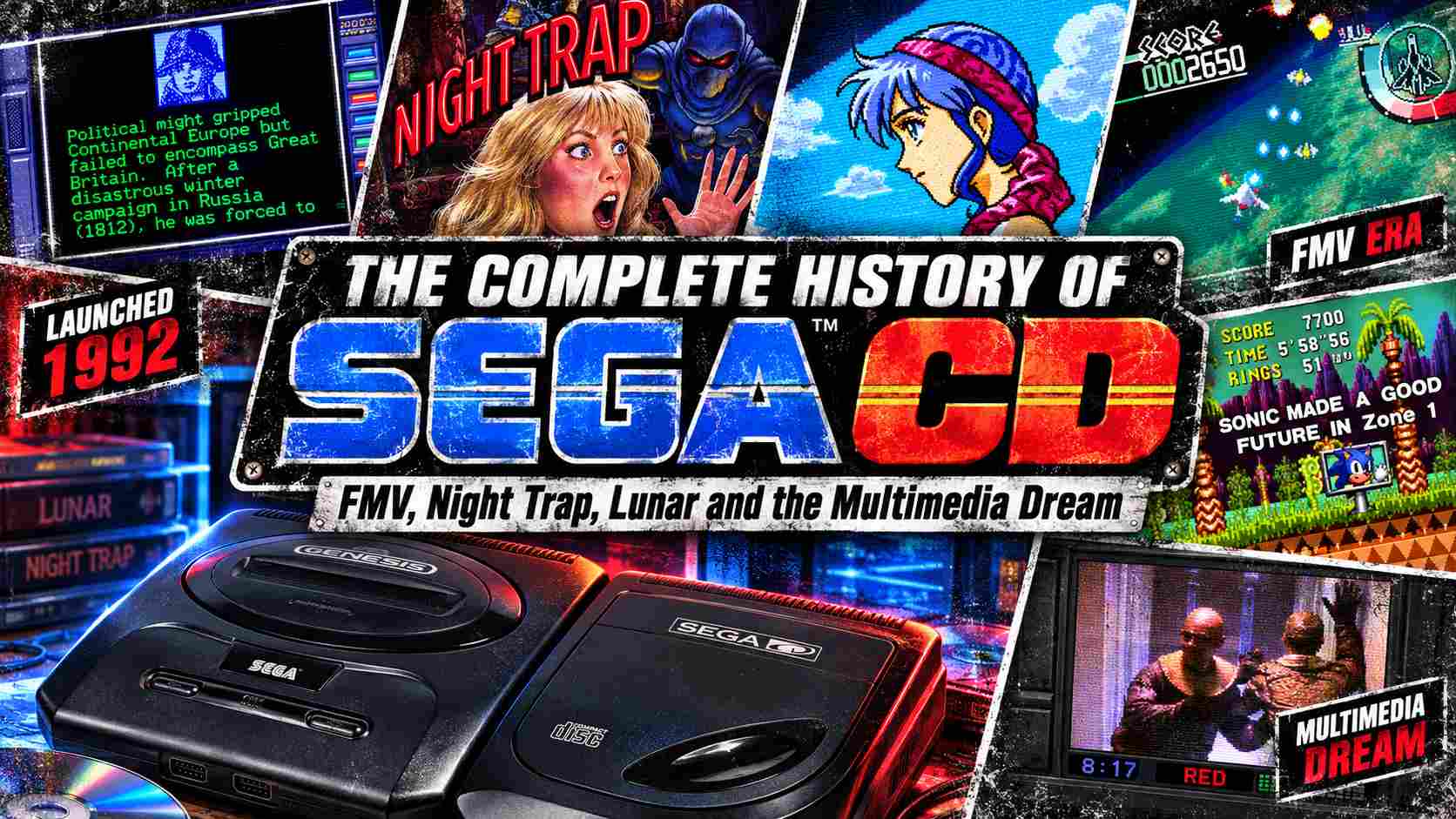
In 1992, Sega asked players to bolt the future onto the machine they already owned. The future arrived with a disc tray, a second power brick, a $299 price tag, and a question the company could never quite answer: what should a CD game actually be?
Picture a living room at the end of 1992. The Genesis is already there, its controller cable stretched across the carpet. Sonic has made Sega feel young, loud, and impossible to ignore. Now another black box slides beneath the console. Its motor whirs. A disc spins. The television shows actors, voices, and an introductory sequence that a cartridge could scarcely hold. It looks, for a moment, as though games have crossed a border into another medium.
That promise was the Sega CD. In Japan and Europe it was the Mega-CD, but the pitch traveled well: compact discs could make the familiar 16-bit console bigger, richer, and more cinematic. Sega had reason to believe it. Its American business, led by Tom Kalinske, had turned the Genesis into Nintendo’s loudest rival. A new storage format could keep that momentum going and get ahead of the next hardware generation.
The results were gloriously uneven. Night Trap made a small, campy game into a Washington talking point. Sewer Shark introduced millions of viewers to the sight of grainy video on a television. Sonic CD treated the disc as a playground of music, animation, and alternate worlds. Lunar used it to make a role-playing adventure feel intimate and theatrical. Snatcher brought a Japanese cyberpunk detective story into English when almost no one expected such a thing. Between them sat arcade conversions, experimental hybrids, dazzling openings, thin ports, strange peripherals, and a stack of business decisions that would come back to haunt Sega.
This is the complete story of that machine: where it came from, what it could really do, why live-action video became its public face, how Congress got involved, and why the games that survived in memory are often the ones that looked beyond the FMV dream.
The quick orientation
Japan: Mega-CD, December 1991. North America: Sega CD, October 1992. Europe: Mega-CD, 1993. It was an add-on for the Mega Drive/Genesis, not a standalone successor. It supplied a CD drive, a second 68000 processor, extra memory, custom scaling and rotation hardware, and additional audio capabilities. A Genesis still produced the final picture and remained necessary for ordinary add-on models. Sega’s hardware archive and its 1991 hardware manual document the design.
Before the disc: Sega’s 16-bit ascent
It is easy to tell this story backward, as an add-on that failed to replace cartridges. In 1990, the situation looked different. The Mega Drive had launched in Japan in 1988 and the Genesis in North America in 1989. Nintendo still held extraordinary influence over the American console business, but Sega had a sharp machine, a growing arcade reputation, and a chance to define itself as the alternative. Sega’s own company timeline places the Genesis breakthrough alongside the 1991 arrival of Sonic the Hedgehog.
Tom Kalinske entered that moment with experience selling toys, especially at Mattel. As Sega of America’s chief executive, he backed a lower Genesis price, a Sonic pack-in, aggressive advertising, and a willingness to challenge Nintendo in public. Those moves did not originate every part of the Genesis turnaround, but they gave Sega a distinct American voice. It sounded fast, cheeky, and less parental. Sega’s 1993 retailer catalog bragged about its market share, marketing spend, and the coming CD business in the same breath. The company was not merely selling hardware; it was selling momentum. Read the period catalog.
Meanwhile, the larger electronics world was becoming obsessed with the compact disc. CD audio had taught consumers that a silver disc meant clean sound and modernity. Computers were acquiring CD-ROM drives, and NEC’s PC Engine/TurboGrafx family had already shown that optical media could support games. The format’s obvious advantage was capacity. A typical early-1990s cartridge held only a fraction of what a CD could store. Pressing a disc also offered very different manufacturing economics from making a chip-heavy cartridge, although discs brought slower access, drive costs, and new engineering headaches.
Sega was not choosing between a finished future and an obsolete past. It was trying to extend a successful machine while the ground moved under the entire industry. A cartridge player could buy a CD drive and enter the multimedia age without discarding the Genesis. For Sega, the installed base was the appeal. For the buyer, that same dependency would later become part of the problem: the new hardware was expensive, but its games still had to work through the old console’s video system.
Building a second machine under the first
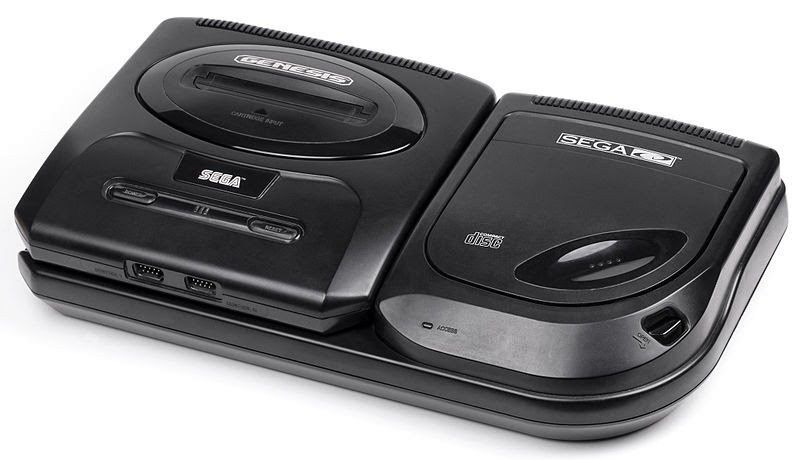
The Mega-CD was much more than a passive disc reader. Sega and its hardware partner JVC designed a substantial companion to the Mega Drive. A second Motorola 68000 ran alongside the Genesis CPU. The unit added program RAM, a large buffer for graphics called Word RAM, backup memory for saves, PCM sample playback, and dedicated circuitry that could scale and rotate images before sending them through the Genesis display hardware. Sega’s hardware manual is an unusually direct look at the parts developers had to coordinate.
That architecture created both opportunity and friction. The disc could hold voices, video frames, and CD-quality music, but the console could not simply display an entire movie frame at modern resolution. Developers had to move data from the disc into limited memory, decompress or arrange it, and fit it through the Genesis color and display constraints. The drive was far slower to seek than a cartridge. Programs split work between processors and memory banks. The most impressive Sega CD games are often impressive because their teams built around these bottlenecks, not because the CD erased them.
The extra graphics hardware also explains why the platform should never be reduced to FMV. Rotation and scaling could make roads swing toward the viewer, send sprites twisting across the screen, or help simulate effects associated with more specialized arcade boards. Batman Returns used its driving stages to show off that motion. Silpheed combined pre-rendered backgrounds and fast action into a spectacle that felt beyond an ordinary Genesis cart. The disc’s storage and sound could serve a conventional action game just as effectively as a live-action one.
What “more space” did not mean
A CD could hold hundreds of megabytes. It did not give the Genesis hundreds of megabytes of working memory or unlimited colors. The drive fed data into a small, tightly managed system. FMV looked revolutionary in advertisements partly because it compressed the future into a single visible trick; in play, the image was usually small, heavily compressed, and surrounded by interface graphics.
There was an industrial gamble in all this. Sega needed studios to learn new tools and design for a combined machine, while also supporting the enormous cartridge market. Its technical bulletins from 1992 and 1993 reveal an active process of clarifications and fixes rather than a magically settled platform. The developer bulletins are a useful reminder that a retail “multimedia” product required very unglamorous coordination behind the scenes.
1991 in Japan: a costly doorway
The Mega-CD reached Japan in December 1991. Its original design sat beneath a first-model Mega Drive and loaded discs through a motorized tray. It looked like a serious hi-fi component, and it cost like one. Contemporary price listings put the Japanese launch at ¥49,800, more than twice the Mega Drive’s original ¥21,000 list price. Sega’s own hardware archive confirms the December 1991 launch and the design; the price comparison is a useful measure of how large an additional purchase Sega was asking families to make.
The early library could not instantly justify that price. A new format needs games that make the format feel inevitable, and it needs them before the novelty of the drive fades. Sega instead faced the classic chicken-and-egg problem of peripheral hardware. Studios had to invest in an audience that did not yet exist; buyers wanted proof that studios would commit. Japan’s Mega Drive audience was smaller than Sega’s American one, adding another limit to the Japanese launch.
Yet the first year also brought a game that would become a central argument for the system. Game Arts released Lunar: The Silver Star for Mega-CD in June 1992, according to its product archive. It did not try to turn a role-playing game into a film. It gave a familiar kind of adventure more expressive scenes, music, and voices. That distinction matters. Sega’s marketing often implied the disc would replace games with movie-like experiences. Lunar suggested the better possibility: a game could remain a game and borrow cinema’s emotional reach.
October 1992: the American sales pitch
North America received the Sega CD in October 1992 at $299. A household without a Genesis first needed that console as well. The box was a showcase object: its opening animation, tray, audio player, and glossy packaging all made the act of loading a game feel ceremonial. Sega of America had learned how to turn a product launch into a cultural event, and its 1993 trade catalog boasted that the machine had made a spectacular early retail entrance.
The American pitch put “TruVideo” and interactive movies near the front. That made sense on a store television. A screenshot from a platform game might look like a nicer Genesis title; an actor speaking from a CD looked unmistakably new. Digital Pictures’ Sewer Shark became a pack-in for many buyers. It sent players down branching tunnels while a recorded cast barked commands. The shooting was simple, the footage grainy, and the fiction knowingly absurd. As a demonstration, though, it was instantly legible: a game machine was showing filmed performances.
There was a marketing paradox here. FMV was Sega CD’s easiest feature to show and one of its hardest features to make consistently satisfying. Storage could provide minutes of footage, but it could not provide limitless branches. A developer filming every possible response faced an explosive production problem; a developer filming only a few responses risked making the player feel like a passenger. The player could recognize a face, a set, a camera move, and a voice. Then, after the novelty wore off, they could also recognize how little agency they had.
Sega sold the box during a high-water mark for the Genesis. Sonic the Hedgehog 2 arrived in November 1992, and Sega’s marketing engine was in full stride. The CD add-on borrowed that energy, but it could not automatically borrow the entire Genesis audience. A parent could buy a new cartridge for the machine already in the home. A Sega CD asked for another hardware purchase, another power outlet, a new software shelf, and patience while the disc loaded.
That American timing also reshaped the machine’s personality. In Japan, Game Arts’ Lunar had already signaled a strong home for animation-rich RPGs. In North America, the first impression was far more likely to be the filmed shooter packaged with the unit and the startling promise of Night Trap. The same technology could be presented as a storyteller’s canvas or an interactive television. Sega of America chose the argument a customer could grasp from ten feet away in a store.
Across the Atlantic, the Mega-CD arrived in a different market in 1993. The Mega Drive had a strong European audience, but the accessory faced the same conversion problem and a different set of prices, distributors, and television standards. PAL releases sometimes required adaptation of timing and presentation. The machine’s name stayed closer to Japan’s “Mega-CD,” while the American “Sega CD” label tied it directly to the Genesis brand. It is useful to remember these were related markets, not one homogeneous global launch. Software dates, box art, soundtracks, and even the balance of what felt like a flagship title could differ by region.
Digital Pictures before Sega: the ghost of NEMO
The most famous Sega CD game was born before the Sega CD existed. In the mid-1980s, Atari veteran Rob Fulop, Jim Riley, Tom Zito, and collaborators explored interactive video for a proposed VHS-based game system usually called NEMO, later associated with Hasbro’s Control-Vision project. The idea was not to stream a new scene on demand. VHS could not jump freely. The team designed multiple synchronized video tracks and gameplay built around choosing what to watch and when. Fulop later described the experimental Scene of the Crime as the path toward Night Trap in a firsthand interview.
Hasbro abandoned the machine. The filmed material did not disappear. Zito acquired the projects and built Digital Pictures around the prospect that CD hardware could finally carry them to market. In a later interview, he traced the company, the canceled videotape console, and the second life of Night Trap. This origin explains why the game can feel both ahead of its time and oddly restricted. Its design was shaped by the mechanics of videotape before it was squeezed onto a compact disc.
Night Trap casts the player as a surveillance operator watching several rooms in a house. Young guests are threatened by intruders called Augers. The player switches cameras, watches for attacks, and triggers traps at the right moment. The multiple feeds were the point: events continued elsewhere while you watched one room, so attention became the resource. It was not simply “watch a movie and press a button.” It was a time-management game wrapped around filmed performances, and it could be infuriating because important information was so easy to miss.
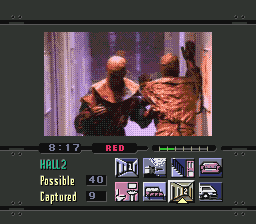
The production looked like a low-budget television thriller. That was part of its period charm and part of its vulnerability. Still images stripped from the play context could suggest a game about stalking women, when the player’s objective was to rescue the guests from the intruders. Saying so does not make the game beyond criticism. Its use of imperiled young women was a deliberate genre hook. But the later public argument often treated footage as if watching it were the whole game, and treated the player as if the goal were the opposite of the actual rules.
The mechanics are best understood as a deliberately cruel editing room. Switch to the kitchen, and you may miss a clue in the bedroom. Stay with an actor’s dialogue, and an Auger may enter another camera’s frame. Once you understand the sequence, you can perform the correct actions; before that, trial and error is almost unavoidable. In a film, an editor chooses the revealing shot for the audience. In Night Trap, the player is the editor and can choose disastrously. That is the game’s cleverest idea, even though its execution is rough.
It also explains why the project survived the death of its original hardware. The NEMO design needed a medium that could sustain several streams of filmed action. CD-ROM was imperfect, with compression and access constraints of its own, but it was a consumer format arriving at the right moment. Digital Pictures did not simply chase a fashion after Sega announced a drive. It brought an older, stranded production into a new distribution window. The industry’s FMV craze was partly a story of companies discovering that new discs could rescue ideas that earlier machines could not sell.
Digital Pictures made more than Night Trap. Sewer Shark was the loud introduction; Double Switch revisited the surveillance-and-traps formula; Ground Zero Texas expanded the filmed shooter idea; Corpse Killer leaned into camp horror. The studio became shorthand for FMV, but its catalog also shows just how many designs could be built around one recurring production method. The problem was finding a play loop deep enough to survive repeated exposure to the same footage.
The Sega CD’s defining argument was hiding in plain sight: a disc could store an extraordinary amount, but games still needed to make every moment of play matter.
1993: Sonic’s answer to the movie game
Then came Sonic CD. If the marketing department wanted a simple image of the future, the developers offered a much stranger one. Little Planet appears over Never Lake. Sonic runs through zones with past, present, and future states, building enough speed to travel in time. Changing the past can change the future. The CD holds alternate arrangements, music, and animated scenes, but the point is not the amount of content. The point is that the content supports a rule the player can explore.
Naoto Ohshima, who helped create Sonic’s original visual identity, led the Japanese team while another Sonic sequel was being made in the United States. In a 2009 Game Developer interview, Ohshima described Sonic CD as closer to a CD version of the first game than to Sonic 2. That helps explain its curious identity. It is not merely the next sequel with a disc attached. It is a parallel experiment in what a Sonic world could be.
The different eras reward looking around in a series famous for running fast. The future can be polluted and mechanical or bright and restored, depending on what Sonic does in the past. Players who simply sprint to the goal see one side of the game; players who investigate its machinery find another. Its intro animation, associated with Toei Animation, provides the theatrical flourish. The playable stages make the disc’s larger world meaningful. The North American soundtrack also became a separate cultural artifact, different from the Japanese and European music. The platform’s extra audio capacity made that regional split especially vivid.
That split tells another production story. Music for a cartridge game had to be expressed through the console’s sound hardware and storage budget. On CD, a team could stream recorded tracks and produce region-specific versions with an ease that changed the relationship between game design and record production. Sega of America’s soundtrack was not a tiny text change or a palette adjustment; it changed the emotional texture of familiar stages. For some players the American music is Sonic CD, while others hear the Japanese and European score as essential. A history that names only one soundtrack silently erases half the audience’s memory.
Readers who want the game itself can visit Retro Replay’s Sonic CD entry. For the platform’s history, its importance is larger than one hit. It proved that a CD game could feel unmistakably like a game from the first second to the last. The animated opener was an invitation, not a substitute.

Lunar and the role-playing road Sega almost missed
Where Sonic CD found a new structure for a platformer, Lunar: The Silver Star found a new presentation for a role-playing story. Game Arts and Studio Alex followed a young adventurer, Alex, from an isolated hometown into a larger fantasy world. The ingredients were recognizable: companions, dungeons, battles, a legendary hero, and the discovery that the world is more complicated than childhood stories suggest. The CD made those ingredients feel closer. Music could breathe. Characters could speak. Animated scenes could turn a plot revelation into a performance.
The story’s American life depended on Working Designs. Victor Ireland’s company had already worked with CD-based Japanese games on the TurboGrafx platform. Bringing Lunar to Sega CD was both an editorial and commercial wager: a text-heavy Japanese RPG on an expensive American add-on was not the most obvious mass-market bet. Ireland’s later interview captures the company’s conviction that these games had an audience worth serving.

Working Designs’ localizations were influential and divisive. Its English scripts often traded literal fidelity for jokes, contemporary references, and a distinct house voice. The packaging also treated the game as an event: colorful manuals, elaborate artwork, and multiple disc-label variants turned ownership into part of the experience. Some players loved the warmth and personality; others came to question changes to tone, difficulty, or dialogue. Both reactions belong in the record. The publisher helped make Lunar visible to English-speaking fans, and its style is part of what those fans remember.
The company’s work also exposes the invisible labor behind a “CD miracle.” Extra space makes recorded dialogue possible; it does not translate Japanese dialogue, direct English performers, edit jokes for another audience, test a long RPG, or persuade stores to stock it. Every disc with a voiced scene represents actors, writers, engineers, translators, and producers making choices that an ordinary screenshot cannot show. The hardware’s cultural importance lies partly in the work it invited from those people, not just in the number of megabytes printed on a box.
Lunar: Eternal Blue pushed the approach further, arriving in Japan in 1994 and later in North America. A second large RPG on the platform showed that the first was not a one-off. Retro Replay’s history of The Silver Star and Eternal Blue follows both games, their later remakes, and Working Designs’ role in bringing them west. Alongside Vay, Popful Mail, Dark Wizard, and other story-heavy games, they made Sega CD an unexpectedly important home for players who wanted worlds rather than video clips. Retro Replay’s Dark Wizard feature is one nearby example from that side of the library.
The irony is that RPGs often used the CD more persuasively than games that advertised the disc most loudly. A long adventure made extra music and speech feel like a natural expansion. Players spent hours learning characters and places, so a voiced scene could pay off something they already cared about. Lunar did not need every minute to look like a movie. It needed the occasional moment to feel larger than a cartridge could comfortably make it.
The library beyond the famous five
A history built only from Night Trap, Sonic CD, and Lunar would reproduce the same narrow picture that has followed the system for decades. Sega CD’s catalog was messy because it supported several competing ideas at once. Some games were Genesis titles with new music and video introductions. Some were arcade conversions trying to exploit extra memory and audio. Others were long-form adventures, strategy games, shooters, experiments in 3D illusion, or attempts to sell the living-room television as a window into cinema.
Final Fight CD is a useful example of a CD game whose ambition was not mainly cinematic. Sega’s machine could bring Capcom’s arcade brawler home with two-player play and material that the earlier Super Nintendo version had cut. It did not make a radical new genre. It made a familiar one feel more complete. Robo Aleste, from Compile, offered a large, intense shooting game whose stages and soundtrack rewarded the added storage. Keio Flying Squadron mixed colorful anime comedy with shooting action. Earthworm Jim: Special Edition used the format for an expanded version of a game many players already knew. These titles complicate any easy claim that the format was only a delivery system for bad movies.
Silpheed deserves a closer look. Game Arts used pre-rendered, rapidly streaming backgrounds beneath a conventional shooting game. On a store display, the result could suggest a vast three-dimensional battlefield. In the hand, the player still dodged and fired with the precision of an arcade shooter. The illusion worked because the active layer and the spectacular layer had distinct jobs. It was a clever answer to a hard problem: how do you make the storage capacity visible without demanding that the entire moving world be calculated in real time?

The same principle sits behind the striking driving stages of Batman Returns. The Sega CD’s scaling and rotation circuitry could make a roadway seem to rush under the player. Whether those stages were enjoyable to everyone is a different question; their historical value is that they exposed the hardware’s actual strengths. The system was not waiting for full-screen video to do something unusual. Its additional processor and graphics path could already change how a 16-bit game moved.
And then there are the hybrids that resist a tidy verdict. Ecco the Dolphin and its sequel gained CD soundtracks and enhanced presentation. The Terminator became a notable action title partly because its music made the machine sound expensive. Road Avenger turned animation into a fast reaction test, a different branch of the interactive-movie tree from Digital Pictures’ live action. Dragon’s Lair and Space Ace connected the new disc accessory to the older laserdisc-arcade dream. Star Wars: Rebel Assault brought a contemporary computer-CD spectacle into Sega’s living room. Taken together, these games show a format in conversation with arcade machines, home computers, anime, and television at the same time.
Five different answers to “why CD?”
Sonic CD: alternate worlds and audio. Lunar: voices and emotional scenes. Silpheed: streamed spectacle behind active play. Final Fight CD: a more complete arcade adaptation. Night Trap: filmed performances as the central system. The hardware had no single destiny; developers chose which advantage mattered.
Washington, December 1993
By late 1993, Sega’s public personality had become a liability as well as an asset. Its American advertising had spent years insisting that games could be sharper, faster, and more grown-up than Nintendo’s family image. The Genesis version of Mortal Kombat kept the arcade game’s blood behind a code while Nintendo’s Super Nintendo version removed it. Night Trap, meanwhile, placed live-action teenagers and horror imagery on a game box in a marketplace still commonly described as children’s entertainment.
Senators Joseph Lieberman and Herb Kohl called hearings on violence in video games. On December 9, 1993, Sega and Nintendo representatives appeared before Senate subcommittees. Night Trap and Mortal Kombat became central props in the argument. The most useful account of the room comes from the ESRB’s oral history, which includes recollections from Tom Kalinske, Nintendo’s Howard Lincoln, Electronic Arts’ Jack Heistand, and others. It also makes clear how competitive the hearing remained: two rivals were defending their business while trying to distinguish their own conduct from the other’s.
Sega had a ratings system of its own, the Videogame Rating Council. That was a real attempt to label content, but it was a Sega system for Sega platforms. It could not solve the broader problem of a parent facing different labels across competing shelves. Nintendo emphasized its stricter standards. Sega emphasized choice and information. Both companies had incentives to use the argument to advance their market positions. To legislators and retailers, the conflict looked like an industry unable to speak with one voice.

The hearing often survives online as a short morality play: senators misunderstand a game, the industry invents ratings, and the story ends. The process was longer and more contingent. The first hearing raised pressure. Retailers reacted; the ESRB oral history says Toys “R” Us stopped selling Night Trap shortly afterward. Industry figures then had to build a cross-platform system under a deadline. A further hearing followed on March 4, 1994. The ESRB’s account of the second stage shows how much negotiation stood between an angry hearing and a working rating board. The ESRB dates its founding to 1994.
Night Trap was not solely responsible for the ESRB, and the hearings did not simply ban the game. Concerns over Mortal Kombat, retail practice, parental information, and the console makers’ rivalry all mattered. Still, the game supplied a potent visual symbol. Congress could show a clip of actors in a house more easily than it could explain an arcade fighting game’s mechanics. The Sega CD’s promise of recognizable people on screen had become its political exposure.
For a closer account of the hearings and their aftermath, Retro Replay already has Sega CD, Night Trap, and the Birth of the Ratings Era. The wider historical lesson here is the collision of three expectations. Sega sold the device as more mature entertainment. Retailers sold it beside children’s games. Lawmakers judged selected footage through the lens of television and film. A new medium had arrived without a shared language for explaining its audience or its rules.
The great hardware shuffle
Sega revised the basic add-on quickly. The first Model 1 Sega CD sat beneath the original Genesis and used a front-loading motorized tray. Model 2 was a simpler, top-loading unit that sat beside the console, physically suited to the smaller second-model Genesis as well as compatible with the first. The redesign reduced some of the visual grandeur, but it made the product less like a piece of stereo equipment and more like an affordable game accessory. Sega’s hardware archive records the family, while contemporary hardware photographs show just how differently the two configurations occupied a shelf.
The variations then multiplied. Sega’s compact CDX, called Multi-Mega in Europe, combined the Genesis and CD hardware in a small unit that could also function as a portable music-CD player with the right accessories. JVC’s Wondermega and North American X’Eye combined the machines in a more substantial multimedia design. Japan also saw unusual licensed combinations, including an Aiwa stereo unit and the Pioneer LaserActive’s Mega LD module. Sega’s peripheral archive documents some of this ecosystem. Each machine expressed a different answer to the same question: was the CD drive a game accessory, an audio appliance, or the center of a new entertainment system?
The CDX is especially revealing. Its small shape looks, in retrospect, like a sensible simplification: put the cartridge slot and disc drive together, reduce the physical sprawl, and let the buyer treat both media as one library. But it arrived after the separate add-on had already defined the public image of the format. The clever redesign could improve a machine’s elegance; it could not rewind the launch, the price, or the looming generational change. The later variations are fascinating partly because they show Sega and its partners continuing to solve engineering and industrial-design problems after the broader strategy had begun to expire.
For consumers, the family could become bewildering. A Genesis, a Sega CD, a 32X, power adapters, joining plates, and cables could turn Sega’s future into a physical stack. The 32X, released in North America in late 1994, added another cartridge-based upgrade path while the Saturn was approaching. A small number of games required both Sega CD and 32X. To a collector today, that tower is an amusing monument to experimentation. To a parent in a store, it could look like a company asking for one more purchase before the next purchase.
This complexity was not merely a public-relations problem. Each additional configuration narrowed the number of households a developer could confidently target. The base Genesis was the common ground. A CD game reached only CD owners. A CD-plus-32X title reached the overlap of two already limited audiences. The math made grand productions harder to justify, especially as game teams watched the Saturn and PlayStation approach with built-in optical drives.
Snatcher: the unlikely English-language arrival
In 1994, near the point when the format’s commercial future was becoming uncertain, the Sega CD received one of its most remarkable Western releases. Hideo Kojima’s Snatcher had begun on Japanese computers in 1988 and later reached the PC Engine CD. Its world is a rain-soaked cyberpunk future of artificial humans, memory loss, police investigation, and knowing film references. It is a text-and-image adventure whose strengths are atmosphere, dialogue, sound, and the slow assembling of a mystery. The Sega CD version gave it an English-language release in North America and Europe.
That route was not inevitable. Konami producer Michael Blaustein later explained that the company expected more from the Sega CD’s American launch than from the TurboGrafx CD market, making the Sega platform a more attractive bet for a Western version. His 1999 interview also discusses the adaptation and its connection to Konami’s Justifier light gun. The localization credits deserve care: Scott Hards handled translation work, and Jeremy Blaustein supervised the English script; Jeremy later described the project as an early landmark in his career in an interview. Simplifying the job to one name erases a small but important production story.
Snatcher also reveals the Sega CD’s perverse timing. It is the sort of sophisticated, adult-oriented narrative game the “multimedia” sales pitch suggested might flourish. It uses voices, music, and visual presentation to deepen an interactive investigation rather than to cover the lack of one. Yet it arrived when Sega was shifting attention toward newer hardware. Its small initial audience and long afterlife as a sought-after release make it seem, in hindsight, like a message sent to the wrong market at precisely the wrong moment.

The game was not the only late proof of possibility. Lunar: Eternal Blue, Popful Mail, Keio Flying Squadron, and other releases continued to argue for the machine after its reputation had hardened. The most compelling games often appeared just as buyers were being told to look ahead. That is one of the Sega CD’s persistent frustrations: the hardware did not run out of ideas at the same moment Sega ran out of runway.
Sales, expectations, and the word “failure”
How many Sega CD and Mega-CD units sold worldwide? The tidy numbers repeated online deserve caution. Different sources mix regional totals, shipments, retail sales, and different reporting dates. A widely repeated lifetime figure is around 2.24 million, while other compilations give higher totals. Sega’s accessible annual reports do not offer a simple, independently auditable lifetime line for this add-on comparable to a modern platform dashboard. The safest conclusion is directional: it sold in the low millions worldwide, far below the tens of millions of Mega Drive/Genesis consoles that might have hosted it. Any precise figure should be read with its date and measurement method attached.
That gap was the business failure. A large installed Genesis base made the add-on concept tempting, but only a minority converted. The original $299 American price was a formidable additional purchase. Some early releases looked more impressive in advertisements than during a long evening of play. Developers had to master a complicated combined machine and sell to a small subset of console owners. Then Sega introduced the 32X and prepared the Saturn, making the question of long-term support harder to answer.
None of this means every Sega CD buyer was disappointed, or that the platform was a complete commercial collapse from day one. Sega’s 1993 sales literature celebrated the initial launch and put the machine at the center of its multimedia ambition. There were years of releases, substantial regional interest, and games that found committed audiences. “Failure” here describes the gap between the grand strategic promise and the actual reach of the add-on. It is not a verdict on the people who loved Lunar, mastered Sonic CD, or discovered Snatcher.
Nor can the Sega CD alone explain Sega’s later hardware troubles. Saturn’s launch, competitive pricing, development architecture, management disagreements, and the arrival of Sony’s PlayStation each have their own histories. The add-on did, however, contribute to a pattern of confusing messages. Customers were asked to trust Sega’s current box while Sega was already preparing another. Developers were asked to invest in an optional platform whose successor would make CD playback standard. An experiment that should have been a bridge became one more moving plank under the audience’s feet.
Sega’s urge to extend the Genesis did not stop at the disc drive. The Sega Channel explored cable delivery. The 32X added another processing path. These were not identical projects, and each had its own logic. Together, though, they made a consumer-facing puzzle. Was Sega’s future a disc, a cartridge upgrade, a network, or the Saturn? A company can explore several possibilities in a lab. It has a harder time asking families and software teams to buy into all of them at once.
How to read the sales numbers
Look for four labels before repeating a total: region, date, hardware variants included, and whether the figure means shipments or consumer purchases. The often-cited 2.24 million worldwide figure is useful as an order-of-magnitude estimate; it should not be presented as a precise, fully reconciled Sega-issued lifetime total.
What the Sega CD actually changed
The easiest retrospective joke is that the future looked like a postage-stamp movie and needed two wall sockets. It is funny because there is truth in it. Yet the device also put several future habits in plain view. Games would grow beyond the physical limits of cartridge memory. Music, speech, video, and animation would become ordinary parts of console production. Publishers would build international versions with different soundtracks and scripts. Retailers and parents would demand consistent content labels. A niche game could become important long after its original platform disappeared.
The Sega CD did not invent those developments. NEC’s CD systems, computer CD-ROM games, laserdisc arcades, and other experiments were already pushing similar ideas. Its distinctive role was to force those ideas into the middle of a heated American console war, attached to one of the most popular machines of the era. That made the victories visible and the weaknesses impossible to hide. It created an unusually clear record of a medium negotiating with film, music, television, arcade design, and regulation all at once.
Its best games also teach a design lesson that remains current. More storage is a means, not a form. Sonic CD used it for a world with multiple states. Lunar used it to let characters live in the player’s memory. Silpheed used it to stage a moving illusion around tight shooting. Snatcher used it to make an investigation feel inhabited. Night Trap, for all its clumsiness, used it to make divided attention the central act of play. The least interesting CD games treated capacity as a substitute for a reason to keep playing.
There is a preservation problem in the afterlife, too. Optical drives age. Discs can be damaged. Regional versions differ, sometimes substantially. The original North American and Japanese Sonic CD soundtracks are part of the historical object, as are the particular voices, translations, and timings of Sega CD RPGs. Modern rereleases can make individual games available, but they do not automatically preserve the surrounding hardware experience or every version of the work. Retro Replay’s history of emulation explores the larger effort to keep games playable after their machines fade from ordinary use.
The last spin of the disc
By the middle of the 1990s, the answer to Sega’s original question had changed. The next generation would use optical media as a normal feature, not a tower built beside an older console. A CD drive by itself no longer looked like the future. The PlayStation and Saturn could combine disc storage with new base hardware, new 3D ambitions, and a clean message to developers. The Sega CD’s era as a current platform was ending.
What remains is more interesting than the failure story. The Sega CD is a machine full of alternate futures. One future is the interactive movie: actors, branching footage, the promise that television might listen to the player. Another is the expanded 16-bit game: better music, voices, animation, and more space for worlds already worth exploring. A third is the industry’s public coming-of-age, when content ratings and the question of who games were for became impossible to avoid. Those futures did not arrive in the form Sega predicted, but pieces of each became ordinary.
The black box beneath the Genesis was awkward, costly, sometimes brilliant, and often sold with the wrong example on the screen. That is why it still deserves a full history. The Sega CD was the moment a company at the height of its confidence tried to attach tomorrow to yesterday. Sometimes the seam showed. Sometimes, when the music began and a world opened wider than a cartridge could hold, the seam disappeared.
Further reading and source notes
For contemporary evidence, start with Sega’s 1993 retailer catalog, the Mega-CD hardware manual, and technical bulletins. Sega’s hardware archive covers the hardware family. Game Arts maintains a 1992 Lunar product record. The ESRB oral history and official timeline explain the ratings dispute. Firsthand interviews with Rob Fulop, Victor Ireland, and Michael Blaustein supply production context. Where recollections differ from contemporary documents, dates and hardware claims above follow the contemporary or official records.