Retro Replay Retro Gaming History, Reviews & Emulation
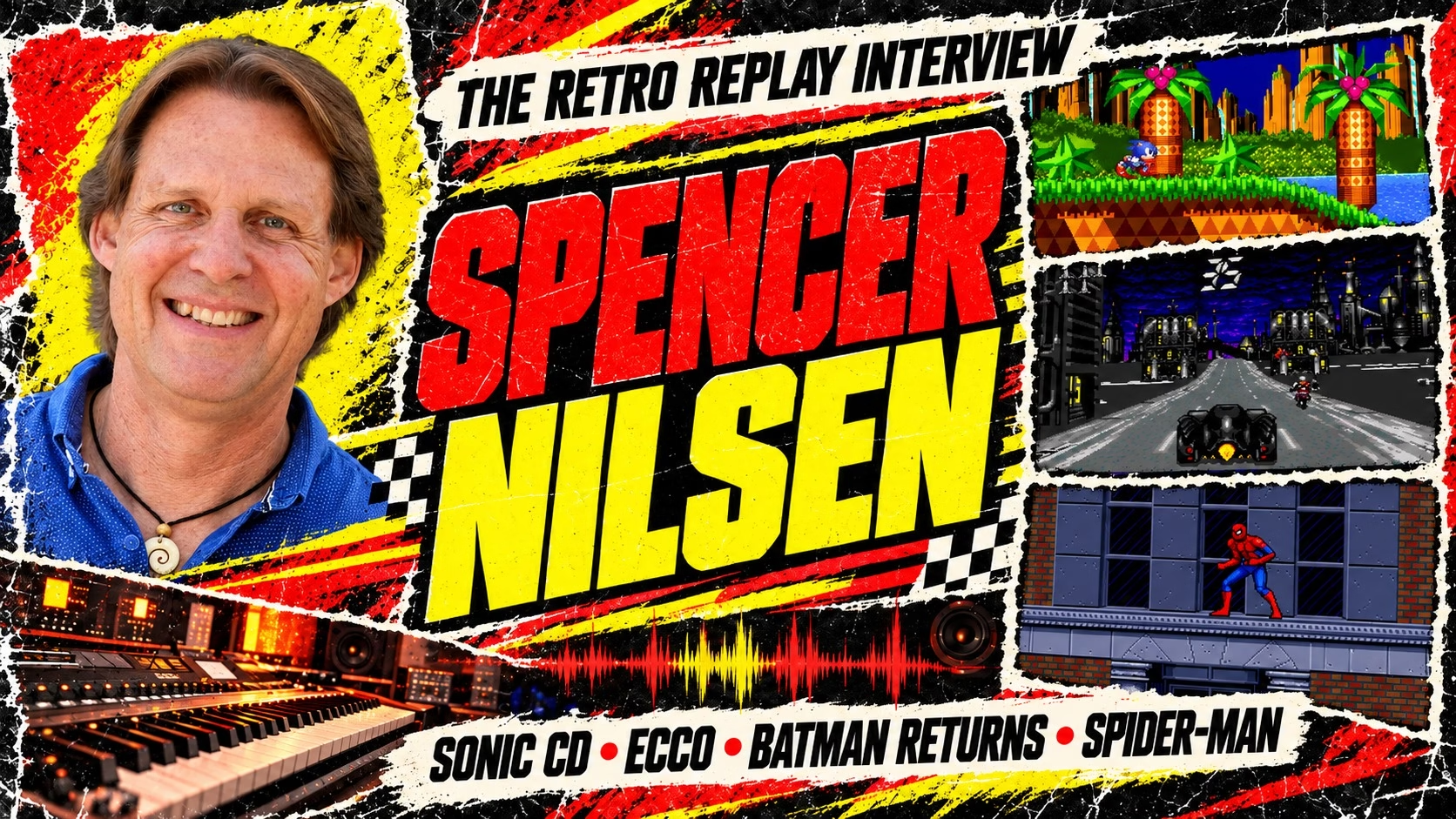
At 2 a.m., Spencer Nilsen, David Young, and the singers of Pastiche were sitting in a circle on the studio floor, working out lyrics and harmonies for “Sonic Boom.” Nobody was complaining about the hour. Good ideas stayed, weaker ones went, and the song that would greet North American Sonic CD players was coming together between jokes.
Nilsen arrived at Sega with years of recording experience and very little experience playing games. He wanted drums, guitars, keyboards, performers, and a room where he could put them to work. The Sega CD gave him a place to use that experience, from the hard-driving action of Batman Returns to the strange underwater textures of Ecco the Dolphin.
In this interview, he revisits those sessions, the people who made them work, and the creative freedom he found inside Sega. He also talks about teaching, recent recording projects, and returning to Ecco with some of the very sounds used on the original score. His memories also feature in our complete history of Ecco the Dolphin, which follows the series from its first underwater adventure to the original team’s return.
For the hardware and games surrounding those recordings, read our complete history of the Sega CD.

New music, young musicians, and Never Give Up
Retro Replay: Before I drag you back to Sega in the early 1990s, what are you doing creatively these days? Between music, education, mentoring young artists, and everything else, what part of your work excites you the most right now?
Spencer Nilsen: I’m actually more inspired than ever to be composing new music of my own, producing projects for others, and especially trying to inspire the next generation of musicians and composers. With the onset of AI I feel it’s one of the most important things I can do! I worked on a very unique and humbling project over the summer with a young man from San Diego. My cousin, Dr. Ryan Taft, who is a world renowned genetic scientist focusing on rare and undiagnosed diseases, asked if I would consider working with one of his long term patients, Alex Yiu. He had been treating Alex for over a decade, since Alex was about five or six and first started showing signs of a debilitating neurological condition. Alex’s condition is untreatable and has worsened over the years to where he can now only blink his eyes – can’t breathe, eat, or move on his own. Yet, he has a deep passion for music and with the help of his saintly mother, Alex has been “composing” musical ideas by blinking once for “yes” and twice for “no” while his mother sits by his hospital bed, plunking out chords and melodies on guitar. It was painstaking but very therapeutic for them both, and over the years they had collected chords and lyrics for about four songs.
I pulled together all the disparate ideas, phone recordings, scraps of lyrics, etc. then worked out arrangements, played most of the instruments, then recorded and produced a four-song EP appropriately titled “Never Give Up” (Spotify that was released on Alex’s 21st birthday in July. For one of the tracks I worked with the amazing folks at MAVERiCK Studio on the campus of UC San Diego to capture Alex’s brain waves and convert those to MIDI while he “jammed” with other musicians in realtime – Amazing! Unfortunately, Alex was back in the ICU soon after and wasn’t able to attend his own birthday/fundraiser/release party, but that’s been his life for nearly 15 years. The project is being used to raise awareness and money for rare disease research and treatment.
I’m passionate about finding ways to incorporate music and art into health and rehabilitation programs and have been putting a lot of time into trying to innovate in that arena. The future looks bright!
Retro Replay: You now spend a lot of time teaching and mentoring younger creators. Has explaining music, production, and media to students changed the way you understand your own career or the work you did at Sega?
Spencer Nilsen: Very much! I’m reminded of how much more constrained and time consuming it all was back then! Even though the phones in our pockets are infinitely more powerful than the most high-end studios of that era, and we have virtually unlimited track space and data memory, I try to instill the value of preproduction, planning, and avoiding the temptation to keep adding instruments and sounds just because you can. I’m constantly putting the spotlight on the value of good ideas vs. tech, and reminding students that good art has NEVER been about the gear used to make it. It’s always been about fresh ideas executed with passion and intention.
Finding his feet at Sega
Retro Replay: You came into games from professional music, recording, concerts, television, and film rather than from game development. When you first arrived at Sega, what struck you as the strangest thing about creating music for an interactive medium?
Spencer Nilsen: First, I was just focused on simply trying to understand the vernacular of the industry. I had never had to worry about sharing memory or disc seek times or dev builds, etc. so it was like jumping into a roiling sea with no life preserver and just keeping my head above water. But once we started discussing and producing music, I was in my happy place. Of course, there are plenty of similarities between writing for games and composing for films, TV, records, etc. so it wasn’t completely foreign territory, but I was definitely an “outsider” and had to prove myself…quickly! One of the biggest roadblocks was that I hadn’t and didn’t regularly play games – I was already 32 years old, a married father of one with another on the way, and sometimes I felt like the only adult in the room (haha). But that also made it super fresh and exciting and I quickly got up to speed and felt comfortable in my role.
Retro Replay: When you joined Sega, game audio was still fighting to be treated as something more than an afterthought. Do you remember a moment when management began to understand that music could actually help sell the identity of a game or even a piece of hardware?
Spencer Nilsen: Yes, it was probably when I was composing and producing the score for Batman Returns, one of my first for Sega. I was writing for a big drum sound, ripping electric guitars, while lacing in orchestral instruments and fat synth textures.That got a lot of people’s attention within the company and I think they finally were realizing that the music could be a powerful emotional glue that held the games together – almost like another character. Also, from day one I tried to instill the idea that, like with movies, the music could serve as a strong promotional tool and eventually yield a complete other standalone “product” and long term experience on its own. I knew in my gut that game music would someday be a super popular component of the overall experience, it just happened a lot sooner than even I imagined.
Retro Replay: You have described Sega’s early audio setup as basically starting with your own equipment in a cubicle and eventually growing into major studio facilities. What did that evolution feel like from the inside? Was there a moment when you looked around and realized, “They are actually taking this seriously now”?
Spencer Nilsen: I remember the meeting I had with my dear friend and mentor, Joe Miller (VP Product Dev) after the soundtracks to the Ecco series, Sonic CD and others had hit a critical mass of industry recognition and popularity. We were still working out of the Redwood City campus and it felt like a world away from San Francisco, the cultural hub of the Bay Area. We knew we had to up our game so I pitched the idea of relocating the music division to San Francisco, finding a large space and building studios uniquely designed to accommodate our production pipeline. Another concept we had was to find young, talented artists and bands that we could develop and eventually “break” to the world through our games. Joe liked the concept and got it approved by the higher-ups in Japan, and we began a multiyear journey of building world class facilities and finding artists. We eventually signed the band Bygone Dogs who ended up writing songs for Cyber Speedway. Unfortunately, on the eve of releasing their debut album, SegaSoft imploded and the whole concept went up in flames.
Retro Replay: How much freedom did Sega give you musically? Were producers generally telling you exactly what they wanted, or were you often looking at a game and deciding for yourself what its musical identity should be?
Spencer Nilsen: I was never told what to write! From day-one I was given complete creative freedom to follow my gut. That doesn’t mean that every piece was accepted first time, every time, every time and that changes weren’t necessary, but for the most part I was able to be myself musically and write what came naturally to me. I think that’s a big reason why so much of it worked! I tell my students all the time to trust their instincts and if they love what they’ve created and can listen to it over and over again with little to no “cringe” factor, then it’s likely going to resonate with others.
A studio musician meets the Sega CD
Retro Replay: The Sega CD suddenly allowed you to use full recorded audio instead of squeezing everything through a console sound chip. Did that feel completely liberating, or did you discover that chip-based music actually had advantages that prerecorded CD audio did not?
Spencer Nilsen: Since I was never expected to produce a lot of music on the chip initially, there really wasn’t an evolution for me. I had been producing “full bandwidth” music for many years at that point, and I’m pretty sure the idea all along was for me to help guide the transition to redbook. Even though I did compose music for the cartridge games when I first arrived on the scene, most of the heavy lifting of making the compositions sound good was done by the programmer in America and Japan. I would basically deliver the MIDI files with notes, and they would make sure it worked in the game. I was hired to produce high quality music for future platforms and that was where I put most of my energy. It was the area that was most lacking at the time.
Retro Replay: With Redbook audio, you could suddenly use real performers, large synthesizer setups, guitars, percussion, vocals, and studio production. Did you ever worry that game music might become too much like conventional album music and lose something uniquely “video game” about it?
Spencer Nilsen: No, I never gave that a thought since I wasn’t saddled with trying to preserve the past incarnation of video games. I also compared it to the evolution of film sound and music – once they figured out how to get the audio synched to the picture, silent films became a thing of the past. I knew there was no going back so why not make something completely fresh and break some new ground along the way? I mean we were still going to be using more traditional recording equipment and methods so it was important to really stretch with the compositions, sounds, textures, arrangements, etc.
Retro Replay: On the other side of that, did the limitations of the Genesis sound hardware ever force composers into musical decisions that you now think actually made the music stronger?
Spencer Nilsen: Probably, but again I had so little experience with 8- and 16-bit cartridge-based music that I naively could only see it as a hindrance at the time. Give me a room with a stack of keyboards, amps, guitars, drums, mics, etc. and let me do my thing! 🙂
Retro Replay: When you were mixing these elaborate Sega CD scores, how conscious were you that many kids were going to hear them through tiny television speakers rather than a studio monitor or proper stereo system?
Spencer Nilsen: We were always conscientious about how the music was going to be consumed/experienced. We constantly checked our mixes in mono, since that was still how the majority of people would hear the music and sound design. But consumer tech was changing fast and we wanted to stay out in front of that, so I was always fighting for more disc space, better equipment, consistent mastering, etc.
Sonic CD and a soundtrack made under pressure
Retro Replay: Sonic CD is obviously the project people will always bring up. When Sega asked you to create a new North American soundtrack on such a short schedule, what was the emotional reaction before the musical one? Excitement? Pressure? Confusion? All of the above?
Spencer Nilsen: All of the above! I knew it was going to be a big lift for everyone but I also had a feeling that, if we did it right, the opportunity would be a game changer, not only for me and the music team but for the American division as a whole. It allowed Sega Of America to have their own unique product and the U.S. audience to experience something completely original and new.
Retro Replay: By the time you began working on Sonic CD, how much exposure did you actually have to the Japanese soundtrack? Did you study what Naofumi Hataya and Masafumi Ogata had done, or did you intentionally approach the game from a different direction?
Spencer Nilsen: I think I might have listened to their tracks once or twice at the very beginning as a reference, but that was it and I never compared one against the other. I really wanted to take a completely fresh approach to the music because I felt there was so much room to innovate and we could stretch ideas much further, using female voices, live instruments, lots of talented musicians collaborating, etc. I love what those composers did and felt it was probably appropriate for their audience, but I also felt strongly that I didn’t want to just recreate a high-tempo, synthy score for our market. We had A LOT to accomplish in a short period of time and I knew it would only get done if I was openly collaborating and trusting the ideas of others. Of course, there needed to be someone to say “no” when necessary, but that was rare and everyone got along famously during those tumultuous weeks, and I think that comes through in the music.
Retro Replay: Something I find fascinating is that the Past music remained from the original soundtrack while your Present and Future music surrounded it. Did having those existing Past tracks influence how you approached any of your own compositions, or were you essentially creating a separate musical language around them?
Spencer Nilsen: All these years later it’s really hard to know. But like I said, we felt comfortable keeping our stuff stylistically separate, especially since the levels were literally supposed to represent a different time in space. So no, I don’t think we were really influenced by those tracks one way or another.
Retro Replay: Each Sonic CD zone can exist in the Present, Good Future, and Bad Future. How did you think about those relationships musically? Were the Good and Bad Futures variations on one underlying idea, or did you treat them more like separate emotional interpretations of the same place? Is there a Sonic CD track where the relationship between the Present, Good Future, and Bad Future came together exactly the way you hoped?
Spencer Nilsen: It depended on which level we were approaching. Sometimes it was as simple as creating a “darker” arrangement for the Bad Future or switching from major to minor scale, but we still tried to create a new experience for each new level, Past, Present, or Future. Some of my personal favorites are Tidal Tempest, Quartz Quadrant, and Stardust Speedway. I think those pieces really work well at capturing the mood and reflecting the art and overall feel of the levels. And they were fun to write and record!

Retro Replay: Conversely, is there a Sonic CD piece you hear today and immediately think, “If I had another week, I would have done something completely different with that”?
Spencer Nilsen: No. not really.
Retro Replay: Fans have been arguing about the American and Japanese Sonic CD soundtracks for more than 30 years. You have been very gracious about that debate in the past. At this point, is it mostly amusing to you that people are STILL arguing about it?
Spencer Nilsen: I love it! It means we did our job and made a difference, and that people – the fans – are equally passionate about and protective of their experience. That’s what I love about art – everyone can have their own uniquely personal experience.
Retro Replay: Do you think the two soundtracks actually demonstrate something interesting about game music, because the exact same level can feel surprisingly different depending on what music is underneath it?
Spencer Nilsen: I do. You also have to consider the cultural context. Music is often a reflection of the composer’s personal and cultural experiences, so it makes total sense that someone from Northern California is going to bring a different set of creative tools and experiences to bear than someone from Tokyo. Even though the images, goals, and action are the same, the music can ground the player in a cultural landscape that feels completely different and possibly more comfortable, simply by hearing sounds, instruments, rhythms, melodies, etc. that feel familiar. I think both soundtracks worked extremely well for their markets or there would be no debate, right?
Sonic Boom, Pastiche, and David Young
Retro Replay: “Sonic Boom” has probably outlived any expectations anyone had for a song written for a 1993 Sega CD game. When did you first realize that the song itself had taken on a life beyond the original game?
Spencer Nilsen: I think we knew we had something special right from the start. It’s one of those songs that came to me really quickly. I can clearly remember all of us (Pastiche, Dave Young, and me) sitting in a circle on the floor of the studio at 2am working on lyrics and harmonies, and it was pure magic. No one complained about the long hours, everyone supported good ideas and easily jettisoned the weaker ones with no egos attached, laughing and joking. It was one of those exceptional experiences that I’ll remember forever – genuine artistic bonding at the highest level!
Retro Replay: What did Pastiche bring to Sonic CD that you could not have achieved with a conventional solo vocalist?
Spencer Nilsen: They brought lush harmonies, a depth of personal connection and all-important experience. All of them were seasoned pros, not only comfortable but able to thrive in the pressure cooker environment of the studio. They were just really smart, sweet, and funny collaborators who kept it light and we had a blast working together, no matter how exhausting it was.
Retro Replay: David Young was an important collaborator on a lot of this work. What did he bring to the creative process that complemented the way you worked?
Spencer Nilsen: I cannot imagine getting through any of those projects without Dave by my side. Incredible keyboardist, performer, and musician, a detail oriented engineer and the closest of friends. He was the Goose to my Maverick – as dependable a wingman as there ever was. He was so humble – the music always came first – and he NEVER left the building before I did. If I stayed late, he stayed late and both of our personal lives paid the price more than once. Devastatingly, Dave passed away in July of 2025 from a rare and fast-moving strain of stomach cancer and I miss him every day. I’m still very close with his family and saw his son recently at a music conference. David, Jr. is following in his dad’s footsteps, blossoming as a remarkable musician in his own rite.
Retro Replay: You spoke so warmly about David Young and how important he was to your Sega work. When you revisit Sonic CD, Ecco, and those old sessions today, do you hear his personality in the music in a way that fans probably wouldn’t recognize? Is there a particular track or moment that feels especially “Dave” to you?
Spencer Nilsen: Most definitely, especially Spider-Man vs. The Kingpin. I think of our time in his basement during that freezing Cleveland January, and how much fun we had writing those tracks. He was a monster keyboard player and many of the best performances on that score were his. We had very similar senses of humor, too, so laughter was always a huge asset to us when grinding through the long hours – we never really got on each other’s nerves. I miss that depth of collaboration and genuine friendship today.
Retro Replay: Do any original Sonic CD multitracks, master tapes, DATs, session notes, alternate mixes, or unused recordings still exist somewhere? I am always fascinated by how much original game audio history survives and how much quietly disappears.
Spencer Nilsen: I have no idea but those archives must be somewhere! And I’d love to get my hands on them someday (haha).
Building an underwater sound for Ecco
Retro Replay: Ecco the Dolphin seems like almost the opposite musical problem from Sonic. Ed Annunziata famously wanted something that did not feel human. Beyond simply choosing unusual synthesizer sounds, how do you actually write music that feels as though it belongs to an underwater world rather than to people looking at an underwater world?
Spencer Nilsen: Ed and I became friends almost immediately when I joined Sega. I’ve always been inspired by his creative energy and love of storytelling. When he has a project that he’s passionate about, watch out! He’s like a dog on a bone and won’t sleep until he realizes his vision, and he had a clear, fully-baked vision of what Ecco would be. One of the first challenges for the music team was building a deep palette of unique “instruments” that I could then use to create the music, trying to stay away from anything that remotely sounded like traditional western instruments. Dave Young and Jennifer Hruska focused on creating original samples for the Kurzweil system, of which they were both experts. They spent weeks if not months sampling, programming, and arranging new instruments into banks that I could access while composing. Then I had my friend, trumpeter, composer, and performer Mitch Manker join us for several recording sessions to create eerie textures, soaring leads, and otherworldly melodies on the EWI valve controller, triggering the samples that Dave and Jennifer had created. He could perform arpeggios and multi-octave runs that were impossible to do on any other instrument. Drummer and percussionist, Brad Kaiser dug deep and pulled out all the stops to build tracks that were rich and organic, providing a rhythmic base on which to construct the pieces. It was a dream team of amazingly talented musicians and to this day I attribute the success of that soundtrack to these phenomenal individuals and their dedication to the project.
Retro Replay: Was there a moment while scoring Ecco when the combination of the imagery, sound design, and music suddenly clicked and you realized you had found the musical identity of that world?
Spencer Nilsen: I think we knew early on that this was going to be a very special project – visually, aurally, and gameplay-wise – so we went the extra mile on everything we did. I still listen to those tracks today and smile, knowing that together we accomplished something unique and greater than the sum of the people or parts. But I don’t think any of us could have imagined the impact it would have on the players or the industry at large.
Retro Replay: Ecco: The Tides of Time gave you another opportunity to work in that universe. How do you write a sequel score without simply making “more Ecco”? What did you want the second soundtrack to do differently?
Spencer Nilsen: Being a synthesist and keyboardist, I’ve always enjoyed lush, unidentifiable sounds and I’m really comfortable writing and producing music in the “atmospheric” style, so compositions come fairly quickly. And when you know what has worked you can relax and trust your gut. Because the palette of sound is nearly infinite, it becomes more about crafting pieces that are easy to “live in” for extended periods of time and creating textures that change and morph, giving the player an “atmosphere” in which they can languish for as long as they need or want, in order to get through the level. On Tides of Time, we also had higher quality studio equipment on which to mix and master the music, so that was a big step up.
Batman, Spider-Man, and live players
Retro Replay: Batman Returns has some incredibly energetic music, especially during the driving sequences. Did scoring Batman give you permission to lean harder into rhythm, rock, and cinematic action than something like Ecco did?
Spencer Nilsen: Absolutely! I knew I wanted to use a more rockin’ approach to that score, so again I involved a rock guitarist in Greg Strong and a drummer very capable of hitting hard, Brad Kaiser. But I wanted it to be a hybrid of electronics and traditional instruments, so we used a lot of orchestral samples and synths to create the darker textures. I was/am a big fan of Danny Elfman who was working on the film at the time but I knew that with our limited gear and budget, we were never going to achieve a true orchestral sound, so we didn’t even try. I really like the energy of that score, especially the driving levels and it’s fun to play it loud!

Retro Replay: Spider-Man vs. The Kingpin gave you another chance to bring conventional musicians and vocals into a game soundtrack, including “Swing Time” with Eric Martin. Did projects like that make Sega feel less like a game company and occasionally more like a record label that happened to make games?
Spencer Nilsen: Spider-Man vs. The Kingpin was a blast to work on. Dave Young hadn’t joined the team yet in Redwood City and was living outside of Cleveland Ohio, but I knew I wanted to work with him on the project. So I traveled to Cleveland for a couple of weeks and we hunkered down in his basement studio to write and record demos for the game. Then we moved the operation back to California and started tracking the live instruments, with Brad Kaiser on drums and Erik Frikman on guitar. I think Erik might have just graduated high school and had been recommended by singer/songwriter/producer, Gary Cirimelli who was working with Mariah Carey at the time. I remember meeting Erik, liking his vibe and laying a lot, and loading him and his gear into my car and driving back to Sega to start working. It was a fast paced project and we didn’t have a lot of time to question things – we had to trust our gut instincts and just go! Then I met Eric Martin whose band Mr. Big was riding high with a number one single. Turns out he is a HUGE Spider-Man fan so we made arrangements to work together on a theme song, something that really wasn’t done in games at the time. Mr. Big was working on a new album at Fantasy Studios in Berkeley, CA so I showed up with the master tapes and while the band took a break, Eric sang the lead vocal then he and I recorded harmonies. It was a blast and felt very rock n’ roll, which I think we captured on the track.

Inside Sega’s multimedia studio
Retro Replay: Sega’s multimedia operation was experimenting with things like surround techniques, CD audio, major recording facilities, and outside musicians at a time when the rest of the industry was still figuring out what game audio could become. Did it feel internally like you were inventing the rules as you went?
Spencer Nilsen: Yes, I think it was a reflection of the diversity of talent and experience we had in the multimedia studio. Again, I had NO experience in games when I joined so I just instinctively did things a little differently, more along the lines of what I had been doing in my previous career/life, which was records and films. And it made sense to want to take full advantage of what the technology had to offer, so we just said, “screw it! Let’s do it!” (to steal a line from Richard Branson) and started pushing the envelope right away. We were also extremely lucky to have execs and managers who were willing to trust us and make sure we had the resources to fulfill our vision. That doesn’t mean we had unlimited funds or time, but if we made a good argument for something they typically supported us. That gave us a lot of confidence to go for it!
Retro Replay: Scot Bayless has told a great story about bringing Michael Jackson into the Sega studio and watching him suddenly become fascinated once he started talking with you about the music technology. What do you remember about meeting Michael and showing him what Sega was doing with audio?
Spencer Nilsen: I remember it like it was yesterday. Mr. Jackson arrived in a Ford Explorer with three other people, one being convicted inside trader, Michael Milken (haha) – no entourage or body guards or managers. He was totally chill and yes, once he got into the multimedia studio and we started chatting, he relaxed and just wanted to talk about music. I think I was working on the first Ecco at the time and he and I just sat next to each other at the mixing console while I played him some of the new tracks. His whole body started to sway and bop to the music and he peppered me with questions about my writing process and how I came up with certain ideas and sounds, etc. It was a really nice visit and I think because we both had been musicians from a very young age and spoke the language of music, we bonded to some degree. A few weeks later I received a really sweet note and a signed copy of his album, Dangerous.
Lie the rest of the world, we were all devastated when he passed and I often think about all the music he never got to write.
Retro Replay: Sega in that period had a very particular personality. From your corner of the company, what did the early 1990s Sega culture actually feel like? Was it as chaotic and experimental as it sometimes appears from the outside?
Spencer Nilsen: Yes, it was! It really felt like we had discovered a secret sauce and there was a freedom that came with being the David to Nintendo’s Galiath. We were always trying new s*** with very little interest in what other companies were doing, at least in my sphere. Again, the creative freedom afforded by the company was a game changer and I think that reverberated throughout the studio.
Unreleased music and a return to Ecco
Retro Replay: Was there a soundtrack, demo, experiment, or Sega project that you worked on that was never released and that you still wish people could hear?
Spencer Nilsen: There were dozens of pieces that never saw the light of day but I try not to pine too much about that kind of stuff. From very early in my career I have been composing and producing music for other mediums besides just music for music’s sake, so I’m used to writing things that don’t get used. But just the process of creating something is rewarding enough, so I try not to take it personally…most of the time 🙂 I feel like those opportunities were truly gifts and I feel privileged to have been invited to the party!
Retro Replay: Finally, what would you like me to point readers toward today? Current music, educational work, projects, websites, social accounts, or anything else you would especially like people to know about?
Spencer Nilsen: I produced an album of original songs, Here and Gone during the pandemic that was influenced by the tragic passing of our son-in-law in 2020, but not all the songs are downers. I also recently released a vinyl version of my 1990 album, Architects of Change, which was the record that got me hired at Sega, I was told. I’m currently working on new music for a possible release early in 2027 while I’ve been remixing Ecco tracks, leading up to a completely new Ecco game with Ed Annunziata and Brian Coburn that we hope will also hit next year, but more likely 2028. Stay tuned! People can check out my website at: spencernilsen.com.
Retro Replay: You mentioned that you’re remixing Ecco tracks while working toward a completely new Ecco game with Ed Annunziata and Brian Coburn. After more than 30 years, what does it feel like returning to that world creatively, and are you trying to recapture the atmosphere of the original games or deliberately push the music somewhere new?
Spencer Nilsen: I think I’ll be doing a lot of both! There is a bunch of new musical territory I’m excited to explore, but I will definitely maintain the overall essence of the original games’ sonic experience. When I visited David Young, Jr. this summer he gifted me the original Kurzweil K2 sampler keyboard we used on Ecco, and he had found and restored most of the original samples, so I definitely plan to have those textures and sounds make a cameo in the new game soundtrack.
More from Retro Replay
- The Complete History of Ecco the Dolphin. Follow Ed Annunziata, Novotrade, the games, and the music from the Genesis debut through Dreamcast and the returning original team.
Thank you, Spencer
Thank you, Spencer, for sharing the stories behind these recordings and the musicians who helped bring them to life. We look forward to hearing where your next projects take you.
Follow Spencer’s music
Visit Spencer Nilsen’s official website for music and current projects, including Here and Gone. Alex Yiu’s music is available on Spotify.