Retro Replay Retro Gaming History, Reviews & Emulation
The Empire has decided you are somebody else’s problem. A one-way trip through a magical portal deposits your party underground, where the food is largely fungal and the neighbors include things that would quite like to eat you. There is no welcoming speech about being the chosen one. Finding a safe place to sleep would be a perfectly respectable first achievement.
Exile could make a few square tiles feel like a very long way from home. Its towns were little patches of security in a cavern system full of hostile creatures, powerful wizards, awkward politics, and passages you probably should have left until your party was better equipped. A conversation in one settlement could send you off with a new destination, a useful rumor, and the suspicion that the Empire had discarded some remarkably interesting people.
Jeff Vogel began making that world in 1994, while studying mathematics and looking for a role-playing game to play on his new Mac. Exile: Escape From the Pit reached players in January 1995. Two sequels took its prisoners through invasion and back toward the surface. Blades of Exile then handed the tools to players, who proved perfectly capable of inventing fresh trouble without waiting for the original author.
The caves did not close when the trilogy ended. Vogel rebuilt them as Avernum, then returned for another round of remakes. Meanwhile, Blades players were still making their own adventures. Buying the newest version was no guarantee that you had seen everything the older one could do.
Our interview with Jeff Vogel supplies a few firsthand turns in that story. The games themselves supply the caves, the quarrels, and the distressingly regular need to buy more supplies.
Explore the complete history of Exile
- A PowerMac and an unfinished degree (1994-1995)
- Escape From the Pit (1995): making a home in a punishment
- Six people, one narrow passage: learning to play Exile
- Exile II: Crystal Souls (1995-1996): the prison fights back
- Exile III: Ruined World (1997): sunlight, at last
- A job board and a hit game (1997): life beyond the main quest
- Blades of Exile (1997-1998): the next adventure comes with tools
- The scenario makers (1998 onward): other people take the pen
- Avernum (2000-2004): the same prison, seen from another angle
- The source code leaves home (2007): keeping the scenarios playable
- Back into the pit (2011-2018): remaking the remakes
- Another generation of adventurers (2025-2026)
A PowerMac and an unfinished degree (1994-1995)
Vogel bought a PowerMac 6100 in 1994 and went looking for an RPG. He loved the genre, had finally acquired a computer he was excited about, and wanted something substantial to play. He did not find it. So, alongside graduate work in mathematics, he began writing one.

There is a useful wrinkle in his account. Mac owners were not actually living in a world without shareware RPGs. Realmz, made by Fantasoft, already existed. Vogel simply did not discover it until his own game was almost ready. In our interview, he wondered how different his life might have become if the search had gone a little better.
It is a wonderfully unglamorous origin for a long career: a player wanted an RPG and became the programmer willing to try making it. As Vogel tells it, finding Realmz earlier might have sent the whole undertaking in another direction.
His official biography traces the game-making impulse back much further, to childhood experiments after discovering Eamon on an Apple II+. But Exile was a commercial undertaking. The gap between writing something for yourself and asking strangers to pay for it involved a great deal of work that did not appear in a screenshot.
Vogel remembers serious hours during those early years, with graduate study competing for the same days. In our interview, he described working every day except Christmas. He also remembers enjoying his life around the work. The work left room for friends and time away from the keyboard.
Spiderweb Software was founded in 1994 in Seattle. A company name did not automatically supply an audience, and Vogel was not expecting to become the head of a large studio. He hoped the game might make some extra money. Finding people who wanted to buy a Mac shareware RPG was a separate problem from finishing one.
Then the people behind the game he had missed became involved.
“Fantasoft, the Realmz people, found me and offered to publish me. Without that, my business would probably never have gotten off the ground.”
Jeff Vogel, speaking to Retro Replay.
Fantasoft had experience reaching the very audience Vogel needed. Its involvement helped turn a finished project into something people might actually find.
Exile: Escape From the Pit went on sale in January 1995, first on Macintosh. Vogel later left graduate school as selling games became a viable living. His mathematical training had not led to the career he expected, although the new job did contain a formidable number of things to count.
Escape From the Pit (1995): making a home in a punishment
The first Exile begins with an act of disposal. The Empire rules the surface and has found a convenient destination for people it does not want around. Criminals, troublesome thinkers, misfits, and assorted other inconvenient inhabitants can be sent below, with little expectation that they will return.
Your party arrives among the people who have survived that policy. They have built towns, organized defenses, learned to grow what will grow, and continued having disagreements. Exile is a prison from the surface’s point of view. For the people living there, it is also the place where the shops, families, rivalries, and ordinary work of staying alive now exist.
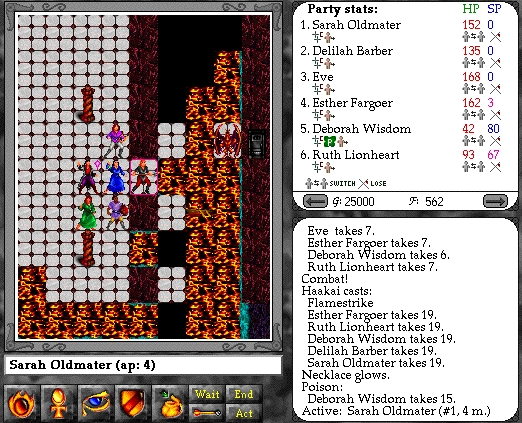
You are new, underpowered, and in need of local knowledge. Talking to people is part of getting established. A name mentioned in one room can become somebody worth seeking in another town. The geography gradually stops being a hostile blank and starts acquiring connections.
Fortifications and settlements make the distances matter. Going out is a decision about what you can carry, how much strength the party has left, and whether the next encounter is likely to be survivable. Coming back can feel like an accomplishment before anyone has awarded a grand quest reward. A shopkeeper selling something useful is an excellent character when your current weapon is plainly inadequate.
The surface is not the only source of danger. Goblins, bandits, and more substantial threats occupy the caves. The Slithzerikai, reptilian inhabitants with their own civilization, are not simply another illustration on a bestiary page. The feline Nephilim add another population to a world that was never an empty hole awaiting the Empire’s unwanted guests.
There are powerful individuals below, too. Erika, the formidable wizard, is one of the people whose presence makes the Empire’s policy look shortsighted. Sending talented, angry people to the same place does have the potential to create a future administrative difficulty.
The first game offered several major ambitions rather than one mandatory route to a single victory screen. You could work toward escape, confront the demon Grah-Hoth, or pursue revenge against Emperor Hawthorne. These were substantial undertakings, reached through exploration and growing familiarity with the world. They did not prevent you from becoming interested in a smaller problem on the way.
Vogel’s original sales description emphasized that openness, alongside a large collection of towns and dungeons. Its enthusiasm about the graphics now reads like a particularly charming surviving piece of shareware optimism. But the promise of a great deal to explore was quite real.
The pictures were modest, and the writing had to do work the sprites could not. A small figure in a room became somebody with opinions through dialogue. A plain passage could acquire a history through a description. Exile did not need to animate every unhappy citizen if it could give you a reason to remember what one of them said.
The cave setting helped that economy. Darkness and isolation were built into the premise. A small settlement could seem precarious without an expensive scene showing its population in distress. You could see how little stood between a place with a name and the dangerous space around it.
For all the harshness of its setup, Exile also had room for absurdity, eccentric inhabitants, and the familiar RPG pleasure of rummaging somewhere you had not been invited to rummage. It could be an adventure about banishment and still understand that players would spend an impressive amount of time investigating a cupboard.
Six people, one narrow passage: learning to play Exile
Before a party could challenge an emperor, it needed to get through ordinary fights without leaving the wrong person at the front. Exile let you create six adventurers, with names, appearances, and skills to arrange. The question was not simply which impressive class sounded best. Its skill-based system allowed characters to be shaped around the work you wanted them to do.
A durable fighter could protect someone whose contribution depended on casting spells. A character with useful practical skills might earn their place by helping the group through obstacles rather than delivering the largest blow. You were building a little traveling organization, and a badly planned one could make every expedition unnecessarily difficult.
Exploration and combat used different scales of attention. On the larger map, the party traveled through the cavern network and entered settlements. Inside a town or dungeon, individual details and conversations mattered. In a fight, the six people separated into a tactical problem involving movement, reach, spells, and who could afford to take another hit.
The turn-based system gave you time to consider a mistake before completing it. A bottleneck could be useful until an enemy kept your fighter occupied while something worse reached the people behind. A spell could deal with a cluster, but using magic now also affected what would be available later. Taking a group into a confined space made its arrangement suddenly more interesting than the character-creation screen had suggested.
Mage and priest magic supplied different kinds of help. There were ways to damage enemies, protect the party, heal injuries, and deal with the practical business of exploring a dangerous place. Magic was equipment, firepower, and a partial answer to the fact that six people could get into trouble in six different ways.
The original interface was not always elegant by modern standards. Small buttons and lists asked you to learn the arrangement, and some actions involved more housekeeping than their later replacements. A new player could spend time finding out how to make an obvious intention happen. Once the layout became familiar, though, it made room for a surprising amount of information on a modest screen.
Dialogue also asked for attention. Names, jobs, and topics could lead toward useful details. A casual remark was worth following because the game did not isolate every possible lead into a brightly labeled quest menu. The pleasure was partly in recognizing a connection yourself, and partly in realizing that the person you had dismissed as local color knew something you needed.
Shareware gave players time to learn that rhythm before paying. The original Windows description offered a large free portion of the game and asked $25 for registration. Vogel was selling an adventure substantial enough to make that price attractive, even without the presentation of a major boxed production.
A demo this generous could become part of someone’s regular gaming life. It might arrive through a magazine disk, a shareware collection, or an online service, then occupy far more evenings than its small download suggested. When a player finally wanted to cross the registration boundary, the sales pitch already had several hours of practical evidence behind it.
The game could also keep sending someone back after an unsuccessful expedition. You knew where a town was, remembered an unresolved conversation, and had a better idea of which route had been a bad idea. The map was becoming familiar. Somewhere farther down it was a place you had not yet found.
Exile II: Crystal Souls (1995-1996): the prison fights back
The Empire did not respond to the first game’s events by reconsidering its treatment of political undesirables. Its emperor had been killed, and an inconvenient population underground had demonstrated that it could reach beyond its prison. The answer was an invasion.
Exile II: Crystal Souls, first released on Mac in 1995 and followed by a Windows version in 1996, put a new party inside the consequences. Imperial soldiers were appearing below in numbers that the people of Exile could not comfortably resist. The country that had emerged from banishment was now being attacked by the power that had created it.
Vogel had a familiar world to revisit, which let the sequel begin somewhere other than explaining every mushroom and local grievance. Places already carried associations for returning players. A threat to them could feel less like another red mark on a quest list and more like somebody interfering with territory you knew.
The enemy was not the only thing dividing that territory. Strange magical barriers were appearing across the caves, cutting routes and creating another problem for an already hard-pressed population. Their source led toward the Vahnatai, a civilization living still farther below.
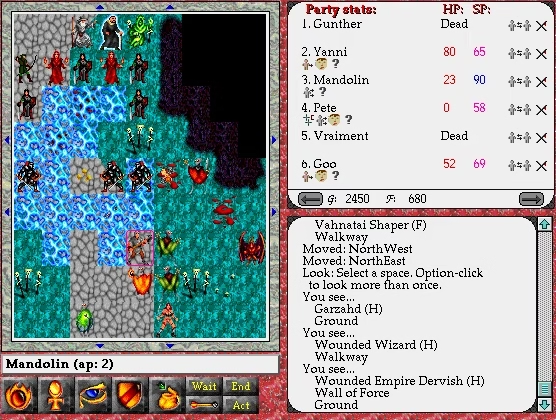
The Vahnatai were a particularly good use of a setting that had seemed thoroughly explored. The first game had taken the player beneath the surface and made a world there. The sequel suggested that the people of Exile had only found one layer of it. Their prison was somebody else’s upstairs.
Reaching that deeper world involved an unsettling journey through unfamiliar waterways and ruins. The party could not simply treat the new territory as another shopping circuit with different enemies. Travel carried it away from the known settlements and toward people whose language and customs needed to be learned.
The Crystal Souls of the title were central to that encounter. These were revered Vahnatai elders whose minds survived in crystal, not ordinary valuables that happened to sparkle attractively in a dungeon. Their loss was a profound injury to the civilization, and recovering them gave diplomacy a much more specific purpose than finding a powerful ally who might lend you some troops.
In play, that meant the war could not be handled entirely by improving the front fighter’s equipment. You needed to understand what had happened, gain trust, and navigate tests and conversations alongside the fighting. The official hint book even organizes part of the journey around learning the Vahnatai’s language and customs. You could be strong enough to survive a battle and still be a visitor who did not understand the room.
The sequel also let players create Nephil and Slith characters, bringing familiar inhabitants of the caves into the party rather than leaving every difference on the other side of a conversation. Traits supplied further ways to shape the adventurers. The six-person group could have more personality before it had taken its first trip out.
Vogel told us he regarded the first game’s story as fairly bare-bones and the second as much more developed. By the second game, the caves held places a returning player could recognize and people whose survival was worth worrying about.
Exile III: Ruined World (1997): sunlight, at last
After two games underground, a patch of ordinary outdoor terrain could feel extravagant. Grass, roads, settlements beneath an open sky: Exile III: Ruined World made the surface worth reaching before beginning the business of making it dangerous.
The 1997 game sent another party out from Fort Emergence to investigate whether the exiles could return above. The Empire still existed. An exploratory mission was safer than sending an entire population toward an uncertain welcome, and it gave the player a wonderfully practical excuse to look around.

Valorim, the surface region you explored, was not in a condition to offer anyone a pleasant homecoming. Plagues of unnatural creatures were threatening its settlements. Slimes were an early problem, with more serious trouble waiting farther afield. The nation that had once seemed capable of imposing itself on everyone was now failing to protect parts of its own territory.
The party’s position became rather awkward. You represented people the Empire had rejected, yet the people in front of you were in trouble. Helping them did not require forgetting the previous games. It placed the desire to return home beside the visible condition of the place you hoped to rejoin.
Exile III had a much broader view than the original escape story. Its road network, jobs, towns, and optional excursions could make the main investigation feel like one strand in a long journey. It was easy to acquire a destination, then find another reason to stop before reaching it.
The creature outbreaks also had different characters. Slimes made an immediate, comprehensible nuisance. Giant cockroaches were an excellent way to suggest that a region’s difficulties had become thoroughly unpleasant. Larger enemies and more elaborate dungeons asked the party to keep developing rather than repeating its opening solution indefinitely.
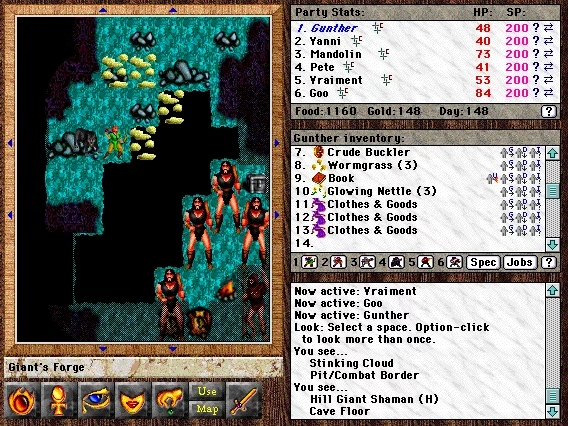
Its changing world gave wandering a little more bite. Some settlements could suffer further damage as time passed, and people did not all remain safely suspended until the player chose to deal with them. This was not a limitless simulation in which every citizen invented a new life. It was a set of designed changes strong enough to make delay feel like something happening in the world rather than only on your own calendar.
The freedom could produce a useful little tension. You wanted to explore. You also knew that the latest problem might become worse while you were investigating some fascinating distraction. The game let those impulses coexist without reducing the entire adventure to one enormous countdown.
Its more elaborate locations were worth getting lost in. The Filth Factory had a name that did very little to exaggerate the appeal of visiting it. Other dungeons offered machinery, barriers, puzzles, and routes that could make the automap a better friend than anyone currently asking you to take another dangerous job.

There was humor in the ordinary business around the disasters, too. People still wanted services performed, goods delivered, and local difficulties removed. The world might be in danger, but someone still needed a competent person to bring something across the map. A six-person party carrying weapons was apparently close enough to a reliable delivery service.
A job board and a hit game (1997): life beyond the main quest
The job board in Exile III was an excellent place to discover that an epic hero might need some temporary employment. Bounties and deliveries gave the party reasons to travel that were smaller than saving a continent and sometimes more immediately useful to its finances.

Those activities helped the surface feel inhabited. A destination was not only the place where the plot needed you next. It could be somewhere you had business, somewhere you had heard about, or somewhere that happened to lie near another promising excursion. The party could develop a little routine inside the much larger disaster.
There was considerable charm in that unhurried side of the game. A conversation could lead into a local story that did not need to become the central mystery. A useful purchase could feel like a small victory. Exploring somebody’s home, with or without a respectable reason, remained a surprisingly dependable source of interest.
The breadth also made the rough edges more visible. A large game contains more opportunities to miss a clue, forget a destination, or spend too long looking for the way a puzzle expects to be solved. The interface had acquired conveniences, including a journal, but it could not eliminate the need to pay attention.
Vogel’s own hint book was refreshingly relaxed about people needing help. It treated being stuck as an interruption to enjoyment, not a character test. The book existed to get the player moving again. A developer could build difficult places and still have some sympathy for the person who had been staring at one of them for an hour.
The game became Spiderweb’s major early hit. In our interview, Vogel singled out Exile III as the point at which he could have hired employees and expanded into a more conventional studio. A successful third game had created an opportunity to change the business around it.
“I had enough money to get employees and become a real company. I didn’t do it. I chose a humble, fun, relaxing life instead.”
Jeff Vogel, speaking to Retro Replay.
His joke about becoming a real company should not obscure the work involved in keeping the existing one running. Mariann Krizsan became a crucial part of Spiderweb’s small operation as its business manager. Her own account of the job includes customer support, testing, website work, and assorted design tasks. Games arriving through the Internet still needed people answering questions at the other end.
The compact team also worked with freelance artists. This was never literally a finished game emerging from one person without anybody else contributing. Vogel did most of the game-making, while a small network of other work kept the releases presentable, supported, and available to buy.
Staying small meant that the next release still mattered. There was no vast back office to absorb an unsuccessful experiment, and a hit did not remove the need to make another sale. With the trilogy finished, Vogel tried a different proposition: sell players a way to keep making adventures themselves.
Blades of Exile (1997-1998): the next adventure comes with tools
A valley is dying, and the people living there would appreciate somebody finding out why. The Valley of Dying Things gave Blades of Exile a familiar sort of opening job, then led the party toward an abandoned magical school with a deeply unpleasant legacy.
It was one of three supplied scenarios in the new release, which reached Macintosh in December 1997, with Windows following afterward. Instead of another single, enormous campaign, Vogel offered a system for playing shorter adventures and an editor for making them. Exile III’s engine became the foundation for other people’s worlds.
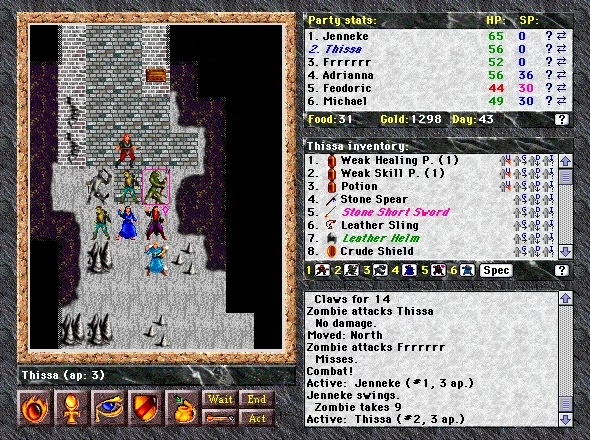
The three original scenarios had different jobs. The Valley of Dying Things began with an investigation and developed into a substantial dungeon expedition. A Small Rebellion put the party to work for the Empire against insurgents, then made the assignment less comfortable as more of the situation emerged. The Za-Khazi Run sent urgently needed supplies through a dangerous cave network, with a fortress depending on their arrival.
That was a useful demonstration of the kit’s range. It could accommodate an unfolding mystery, a political choice, or a journey made tense by time. The same six-person party and familiar combat did not require every author to begin with another entire continent in peril.
A Small Rebellion was especially pointed after three games about people punished by the Empire. Here, the Empire could be your employer. Finding out more about the rebels did not necessarily make every decision easy, but it complicated the simple instruction you had arrived to carry out.
The original announcement sold Blades as a role-playing system, with the scenario editor central to the proposition. Custom monsters, graphics, conversations, and encounters could be combined into an adventure that did not need to take place in Vogel’s own setting. The title still said Exile, but the editor was not a request to imitate the trilogy forever.
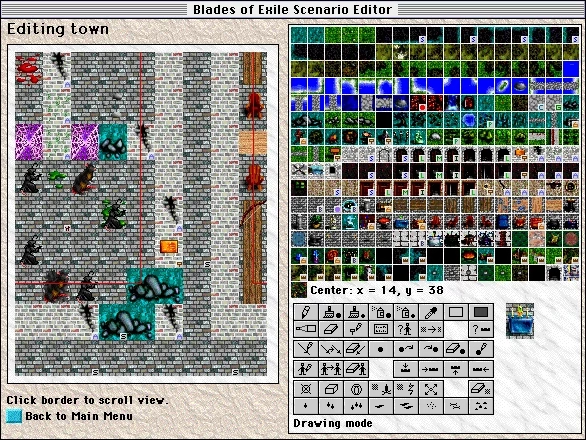
Making a town looked invitingly direct. There was terrain to place, a layout to arrange, and a collection of objects that could turn blank space into somewhere an adventurer might visit. A map could look convincing well before it did anything interesting.
Then the real work arrived. A character needed something useful to say. A route needed to remain passable after the player had done the unexpected thing. A special encounter needed to trigger at the right moment, leave the right consequences behind, and avoid happening again when it should already be over.
The editor let authors connect actions and conditions without having to write a full game engine. That did not make the resulting adventure automatic. A creator still had to think through what a player might do, what information they needed, and how to recover when the intended sequence went astray.

Spiderweb’s workshop pages accumulated explanations, answers, examples, and bug notes. One surviving warning concerns dialogue that fit on Windows but was cut off on Macintosh. A scenario could have a fine conversation and still fail because the text had reached the wrong edge of a window.
A finished map was a satisfying beginning. Getting somebody else’s party through it without a broken conversation or a dead end could take rather longer.
The scenario makers (1998 onward): other people take the pen
Spiderweb’s scenario contest offered a small but very tangible reward for building something people enjoyed. First prize was $500, awarded to Tarl Roger Kudrick for Tatterdemalion. The company’s results page praised a design that took the familiar framework somewhere new.
Tatterdemalion began with a monster threatening Triane and offered multiple routes through its adventure. It was a strong advertisement for what the editor could support in patient hands. A player could buy the kit for Vogel’s three scenarios, then find somebody else’s substantial project waiting on the website.
Second prize went to Brett Bixler’s Quest of the Spheres, following his earlier Riddle of the Spheres. Spiderweb highlighted its puzzles and distinct world. Ben Frank’s Trouble in Mendor took third, concentrating its action inside a large city. These were different preferences expressed through the same basic tools, rather than a queue of interchangeable extra dungeons.
Bixler also built Alexandria, an organized scenario resource linked from Spiderweb’s own pages. The Lyceum supplied another gathering place for creators and players. Around the game grew the less glamorous but indispensable work of cataloging files, recommending adventures, helping newcomers, and explaining why somebody’s carefully constructed special encounter was not behaving.
The publisher’s download tables made that social activity visible. Scenarios had descriptions, suggested party strength, content ratings, and player scores. Newly submitted work occupied a different table from established recommendations. A first effort could receive advice, while an ambitious release could become the reason someone reinstalled Blades.
Later lists included Alcritas’ Falling Stars, Redemption, and Of Good and Evil, among many other authors’ projects. Some releases stayed close to the established world. Others built a separate setting or tried a different tone. The engine had become familiar enough that a designer could spend less effort explaining how to walk and more effort deciding what the walk should lead into.
Files were small enough to circulate easily, but their extra pieces could still cause trouble. Custom artwork needed to travel with the scenario. Mac resource forks and Windows bitmap files made the same adventure look different behind the scenes. The official installation instructions are a little museum of the practical business of sharing creative work across those two platforms.

Vogel was not sitting at the center playing every new scenario. When we asked him about the community’s work, he reminded us that finishing Blades had started the financial clock on making another release. Admiring what the tools made possible and having time to explore every result were quite different arrangements.
The players did not need to wait for that attention. They had one another, the tools, and an increasingly large collection of files to argue about. The original trilogy had been a journey through one author’s world. Blades could turn an evening into a visit to somebody entirely different.
Avernum (2000-2004): the same prison, seen from another angle
The first time you see the old cavern world in Avernum, the floor has tilted. Walls have visible sides, the party stands in an isometric space, and familiar places are presented through a different arrangement of art and controls. A reader who knows only the modern releases might not immediately recognize how much of Exile is standing underneath them.
The technology behind that change had a stop elsewhere first. In 1998, Vogel released Nethergate, an RPG set in a supernatural version of Roman Britain. It gave him another world to write and a different visual approach. The cavern stories were then rebuilt as the original Avernum, released in 2000.

The new game was a retelling, not an adventure taking place after Exile III. The Empire’s rejects were back at the beginning, trying to survive their arrival below. The route to escape, the powerful people in the caves, and the broader struggle belonged to the original story.
But the party had shrunk from six adventurers to four, and the rules and interface had been rebuilt. A fight no longer involved exactly the same group arranged in the same flat space. The different viewpoint gave rooms more apparent depth, while the smaller party changed how players divided the useful jobs among their characters.
New material and altered details made the rewrite more than a replacement set of pictures. Even so, the attraction was strongly tied to returning. Someone who remembered the old towns could enjoy finding them again. Someone who had never played Exile could meet the same underlying adventure through a less austere presentation.
Phil Foglio’s illustrations helped give this generation of Spiderweb games a recognizable visual identity. The drawn figures, character portraits, and illustrated story passages supplied a kind of warmth that the older tile maps had often left the prose to provide.

The first Avernum trilogy rebuilt Exile’s three main stories across 2000-2002. Avernum 2 revisited the war and the Vahnatai. Avernum 3 took another party toward the troubled surface. The new name could make the catalog look as though it contained another entirely different saga, but those first three games were reworkings of the old one.
In 2004, Blades of Avernum followed the construction-kit idea into the newer technology. Its more elaborate scripting gave designers further possibilities, though an Exile scenario was not simply interchangeable with an Avernum one. The creators who had learned one set of tools now had another substantial system to learn.

The Exile community did not empty out merely because the viewpoint had changed. Familiar controls, particular rules, and years of scenarios gave the older game an appeal of its own. Vogel’s later writing about the resistance to changes makes the split quite clear: an improvement from the author’s point of view did not oblige every customer to stop loving the earlier version.
Meanwhile, Avernum continued beyond the remade trilogy into new stories. Those sequels belong to the larger life of the setting. For Exile’s original adventures, another problem was becoming increasingly urgent: the operating systems beneath them were changing too.
The source code leaves home (2007): keeping the scenarios playable
A player could have a folder full of Blades adventures and no convenient way to run them. The programs had been written for older versions of Mac OS and Windows. As those environments receded, a collection of perfectly good scenario files could become awkward to visit.
Spiderweb’s answer was unusually generous. In 2007, it released the Blades of Exile source code and supporting material so that other programmers could maintain and adapt the game. Its workshop announcement is dated May 9. The company explicitly connected the release to the amount of work players had invested in their adventures.
The original source page also contains a very Vogel-like warning about the old implementation. He had written it early in his career, it was clunky in places, and doing useful things with it would take skill. The gift did not arrive with a promise that somebody could rebuild the whole program in an afternoon.
Opening the code was a different step from supplying an editor. Scenario authors had already been able to arrange encounters inside the rules. Programmers could now work on the machinery beneath them: drawing the screen, handling input, fixing bugs, and making the application function on systems it had never originally targeted.
The source page preserves traces of the project’s licensing history, with older Common Public License wording and a later note identifying GPL version 2. The useful present-day distinction is straightforward: Blades had become an open-source community project, not merely an old commercial download waiting for its original developer to find some spare time.
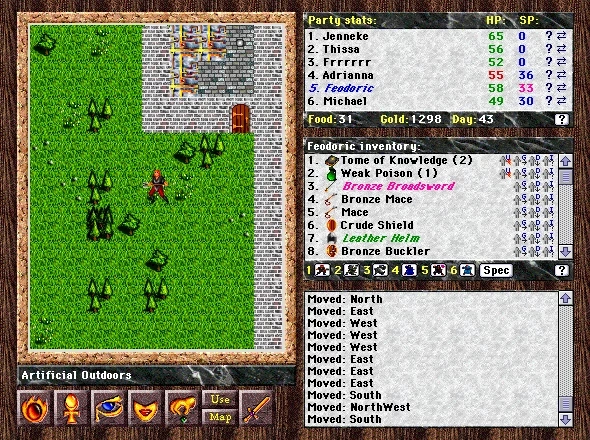
The trilogy itself also became free to download from Spiderweb. That removed the old registration payment, but not the practical age of the programs. A Windows 3.x game does not become a current Windows application just because its price has changed. The original Mac versions have their own requirements.
The people maintaining Blades were taking on a particularly fussy task. Improving an engine could change behavior that a scenario depended on. An adventure might contain a clever workaround for an old limitation, or quietly rely on a detail that looked like a bug to somebody fixing the program.
Keeping that history functioning involved more than increasing the screen resolution. A designer’s carefully timed event still needed to happen. A conversation still needed to leave the right flag set. A party still needed to be able to reach the ending the author had built, even if the application was now running on a machine that had not existed when the file was made.
Back into the pit (2011-2018): remaking the remakes
Vogel was also looking at the old world through the practical eyes of someone who could now rebuild it better. The first Avernum trilogy had aged along with the operating systems around it. Its stories remained useful, while its technology and interfaces had become another set of things that needed attention.
Avernum: Escape From the Pit arrived on Mac in late 2011, followed by Windows and iPad versions in 2012. It was the second major rewrite of the first Exile, after the 2000 Avernum. That is an impressive number of times to be sentenced to the same prison.
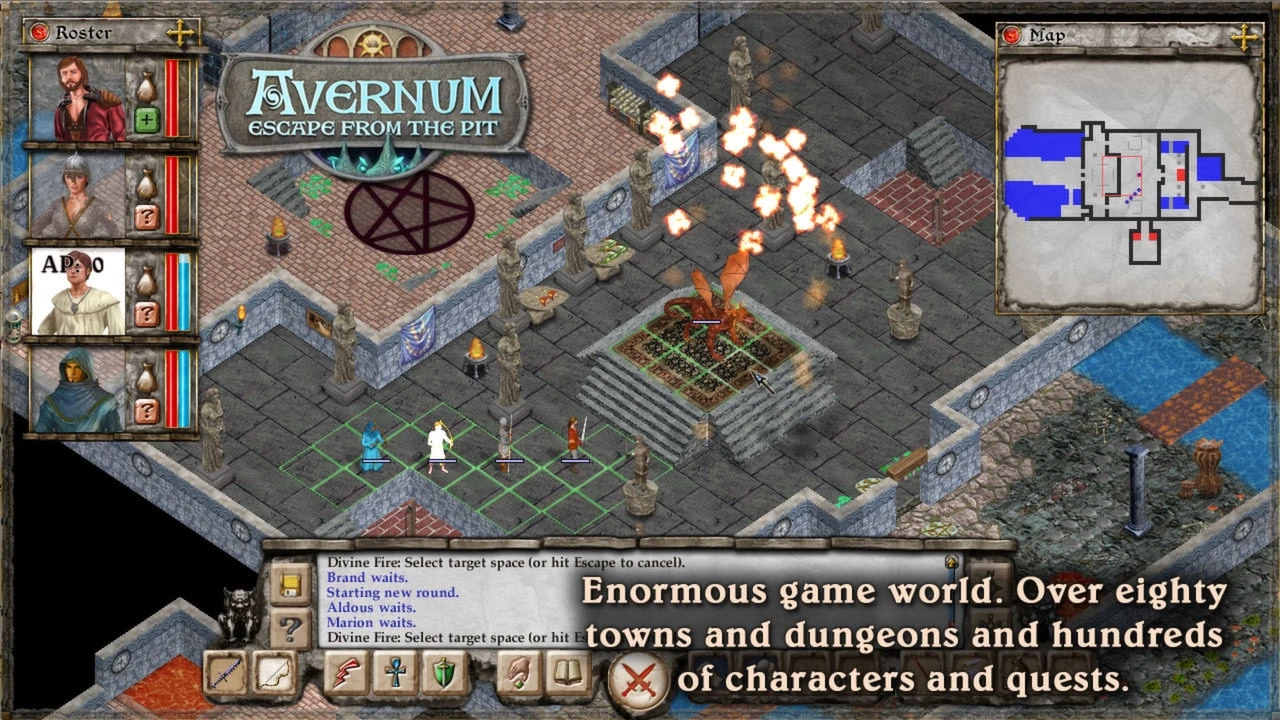
The new version used a revised game system, a redesigned interface, and additional material. The publisher’s development FAQ described changes intended to make it harder to build a party too weak to continue, alongside a new starter area, quests, and other additions. Foglio’s artwork remained part of the visual family, refreshed for its new home.
The practical effect was that another generation could enter the old setting without first learning every habit of its oldest interface. Larger displays, different devices, and more recent expectations about character advancement had all changed the circumstances in which the story was being played.
The original adventure’s appeal was still recognizable. The Empire had discarded the wrong people. The caves were dangerous. Powerful personalities had built lives below and were not especially interested in spending the rest of those lives accepting their sentence. A player could arrive through the new version and still develop an affection for places other people had first explored in the 1990s.
In our interview, Vogel was strikingly protective of the younger developer behind those places. He did not describe revisiting the games as an opportunity to scold his earlier self.
“I have learned to show maximal respect to my early self. All the changes I make are to showcase my early self’s great ideas as much as possible.”
Jeff Vogel, speaking to Retro Replay.
Avernum 2: Crystal Souls followed in 2015, returning to the invasion and the deeper civilization whose help could change it. Avernum 3: Ruined World arrived in 2018, taking the surface expedition through its second extensive reconstruction. Both retained their Exile subtitles, making the connection easier to spot than it had been with the first generation of Avernum names.

The names still reward a small amount of sorting:
| The original story | First Avernum version | Later rewrite |
|---|---|---|
| Exile: Escape From the Pit (1995) | Avernum (2000) | Avernum: Escape From the Pit (2011-2012) |
| Exile II: Crystal Souls (1995-1996) | Avernum 2 (2000-2001) | Avernum 2: Crystal Souls (2015) |
| Exile III: Ruined World (1997) | Avernum 3 (2002) | Avernum 3: Ruined World (2018) |
The ranges reflect Mac and Windows releases arriving at different times. The later Avernum sequels add new stories; they are not a hidden fourth, fifth, and sixth installment of the original Exile trilogy.

The economics were part of the decision, too. Vogel has never been particularly interested in disguising the need to sell his work. The remakes could earn money, reach players who had missed the earlier versions, and give ideas he valued another useful life. His 2012 interview with IndieGraph described Steam and the iPad market making a substantial difference to the business.
Yet the older versions did not become worthless because another one was easier to buy. Their larger parties, different combat details, and flat visual style were still part of what some players liked. The remakes widened the route into the stories. They did not erase every reason somebody might want the route they had taken before.
Another generation of adventurers (2025-2026)
In May 2025, a new community release offered another way to play Blades of Exile. Nat Quayle Nelson’s Itch Edition, built from the Open Blades of Exile project, brought the old adventure system to current Windows and macOS machines. A signed Apple Silicon build followed in February 2026.

It is a community effort, separate from Spiderweb’s own releases, and its page remains candid about ongoing work. The three built-in adventures are supported, while compatibility with archived scenarios and work on the editor continue.
The project’s older GitHub repository was archived in 2026, but that did not mean the work had stopped. Its notice directs visitors to the Codeberg repository. Following that link is a better way to find the current project than assuming that a read-only archive is the end of the story.
The original trilogy remains available free from Spiderweb’s Exile, Exile II, and Exile III pages, with warnings about modern operating systems. These are the older applications, not newly rebuilt native editions. A suitable classic-system setup is part of taking that route.
For the original Macintosh trilogy, Basilisk II offers a route through classic Mac emulation, with a suitable Macintosh ROM and Mac OS installation supplied separately. Our Basilisk II history explains where that emulator came from. The community Blades port is a separate option for Blades scenarios; it does not run the original three Exile campaigns.
For a simpler introduction to the underlying stories on current hardware, the later Avernum rewrites are the straightforward starting points. Choose Escape From the Pit for the original arrival underground, Crystal Souls for the invasion, or Ruined World for the surface adventure. They are designed as playable individual games, although knowing the earlier stories gives some later encounters a little more weight.
The appeal of the originals is more particular. Six characters make for a different party to organize. The little flat maps have their own clarity. A remembered sound, a familiar window, or the precise look of a town can be part of the pleasure without needing to win an argument about which edition is objectively best.
Somewhere in the caves, there is still a passage your party is not quite ready for. The sensible course is to go back, sell what you found, learn another spell, and try again when the fighter has stopped looking so fragile.
Of course, the passage is right there.
More from Retro Replay
- Jeff Vogel on Exile, Avernum, Geneforge, and 32 Years of Independent RPGs
- The History of Basilisk II: ShapeShifter, UAE, and the Portable Macintosh
- The History of Text Adventures: From Colossal Cave to Infocom
Sources and further reading
- Jeff Vogel interview, Retro Replay. Firsthand answers about the Mac origins, Fantasoft, Exile III, Blades, staying small, and remaking the early games.
- Jeff Vogel’s official biography. Early game-making, Eamon, mathematics, and the move into selling RPGs.
- Spiderweb Software company profile. The company’s Seattle founding and small-team structure.
- Mariann Krizsan’s account of her work. Business management, testing, support, website work, and design contributions.
- Exile: Escape From the Pit, original publisher page. The original game’s premise and current free Windows download. Its Macintosh screenshot is identified separately in the caption.
- The original Exile sales description. The shareware offer, registration price, skill-based characters, and major quests.
- Exile II: Crystal Souls, original publisher page. The second game and its original Windows edition.
- Exile II original sales description. The invasion premise and original feature list.
- Exile II hint book, Jeff Vogel. The Dark Waters journey, Vahnatai customs, Crystal Souls, and campaign structure. The publisher hosts the preserved text with an introductory restoration note.
- Exile III: Ruined World, original publisher page. The surface adventure and current original-game download.
- Exile III original sales description. Changing settlements, optional work, and the scale of the surface campaign.
- Exile III hint book, Jeff Vogel. Fort Emergence, the creature outbreaks, major locations, and the author’s approach to helping stuck players.
- Exile III official screenshot gallery. Authentic Macintosh captures of the surface, giants, jobs, and Filth Factory.
- Blades of Exile original announcement. December 1997 Macintosh release, the planned Windows follow-up, included scenarios, and editing tools.
- Blades of Exile official hints. The three supplied adventures and their different premises. Contains extensive spoilers.
- Blades of Exile scenario workshop. Author resources, compatibility notes, and the dated May 9, 2007 source-release announcement.
- Blades of Exile scenario tables. Ratings, installation instructions, and the division between new and established scenarios.
- The 1998 scenario contest results. Tarl Roger Kudrick, Brett Bixler, Ben Frank, their winning adventures, and the cash prizes.
- Recommended community scenarios. The publisher’s preserved descriptions of Tatterdemalion and later adventures, including Alcritas’ work. Some outbound legacy links may no longer work.
- Blades of Exile source release. The original code release, supporting files, and the source page’s licensing history.
- Why Nobody Should Ever Change Anything, Jeff Vogel. Vogel’s account of the January 1995 beginning, changing presentation, and player resistance to revisions.
- Avernum 2 original publisher page. The first-generation sequel and Phil Foglio’s artwork.
- Avernum development FAQ. The later Escape From the Pit rewrite, revised character building, additions, and updated artwork.
- Avernum: Escape From the Pit, official support history. The Macintosh version history dates version 1.0 to December 2011, before the Windows release.
- Avernum 2: Crystal Souls manual. The 2015 game’s rules, credits, and retrospective dating of the original Avernum 2.
- Jeff Vogel interview, IndieGraph, April 2012. A contemporary account of returning to Avernum, its new platforms, and the early business.
- Jeff Vogel interview, GeekWire, 2018. The studio’s small operation and the Ruined World rewrite. Also the source of Vogel’s supplied portrait.
- Failing to Fail: The Spiderweb Software Way, GDC 2018. Vogel’s talk about running a long-lived independent RPG business. Embedded beside the Exile III business discussion.
- Avernum: Escape From the Pit, official store. The 2012 Windows release and publisher imagery. The original Mac release preceded it in 2011.
- Avernum 2: Crystal Souls, official store. January 14, 2015 release and publisher screenshots.
- Avernum 3: Ruined World, official store. January 31, 2018 release and publisher screenshots.
- Blades of Exile community port, Nat Quayle Nelson. Current builds, development status, the May 2025 beta, and the February 2026 Apple Silicon announcement.
- OpenBoE source repository. The current project home after the previous GitHub repository was archived.
- Basilisk II official project. Classic 68k Macintosh emulation. A suitable ROM and Mac OS setup are required separately.