Retro Replay Retro Gaming History, Reviews & Emulation

Christian Bauer took his Amiga 4000 to a meetup of Mac users and showed them text scrolling in an editor. It was running inside ShapeShifter. The reaction, he remembers, was considerable. An Amiga running Mac software was not necessarily the slow curiosity people expected.
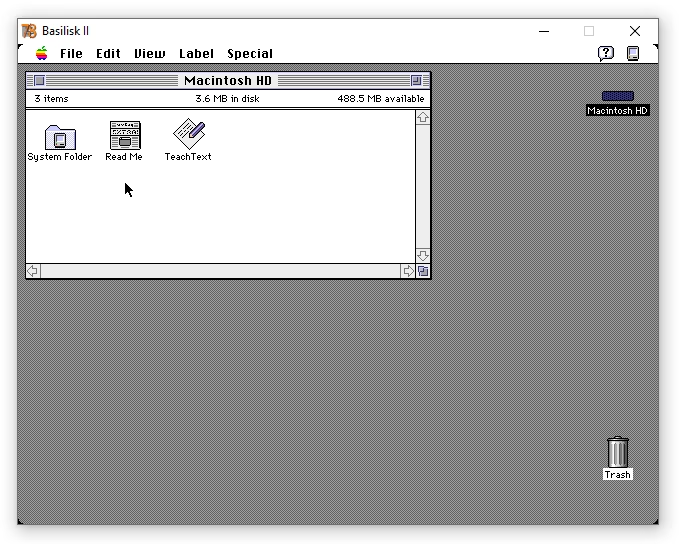
Basilisk II grew out of that earlier work, but by 1999 its job included hosts without a real 68000-family processor. The Mac desktop could move again, this time with help from code written to emulate an Amiga.
Our Christian Bauer interview follows those decisions from his side of the keyboard. The story begins before the “II,” with the shared processor that made an apparently unlikely experiment practical.
Explore the history
ShapeShifter (1995): the Mac code already knows this processor
The Amiga and the classic Macintosh shared a useful piece of machinery: Motorola’s 68000-family CPU. Their operating systems and surrounding hardware were very different, but much of the software’s processor work did not need translating instruction by instruction.
Bauer wondered whether he could run Mac software on his Amiga. A few weeks of experimentation later, he recalls, it was working. ShapeShifter adapted parts of Mac OS so that its requests for display, disk, sound, and input reached AmigaOS instead.
Strictly speaking, ShapeShifter isn’t an emulator – it’s paravirtualization.
Christian Bauer, Retro Replay interview.
That distinction explains the speed. It also explains why ShapeShifter belongs beside Frodo in Bauer’s biography without being the same sort of program. Frodo modeled another machine’s hardware. ShapeShifter let the real CPU execute the guest’s code while intervening where the environment needed changing.
By July 1995, Karl Stenerud had assembled a substantial ShapeShifter FAQ covering registration, ROMs, installation, sound, graphics cards, and crashes. It describes a real program with users trying to make it work on their particular machines. Bauer’s later demonstration of scrolling text showed how misleading the assumption of inevitable slowness could be.

1996: Basilisk follows the author to BeOS
Bauer did not stay with the Amiga as his main workstation. He moved to a BeBox, attracted by its two processors and the ambition of a small company building new hardware and a new operating system. The old applications still offered an obvious reason to keep experimenting.
His October 14, 1996 news entry added Basilisk, a Mac Classic environment for the BeBox. That original Basilisk is easy to lose between the better-known ShapeShifter and Basilisk II. Its name and date are worth keeping separate.
It was another step in carrying familiar software into a desktop that had not been built for it. Getting a Mac environment to start was only the beginning. A useful desktop had to read files, draw windows, accept input, and continue working while the host system did other things.

January 1999: Basilisk II’s first alpha
The project changelog dates Basilisk II’s first alpha to January 23, 1999. Bauer’s website added the project on March 14. The often-repeated March date is therefore not the earliest alpha milestone preserved by the project itself.
This time, portability was a central problem. ShapeShifter had been written in assembly. Bauer describes Basilisk II as written in C, with a different arrangement for handling privileged instructions on a real 68k host and the option of using a software CPU on other machines.
That meant a Mac environment could survive the user’s departure from 68k hardware. It also meant that the CPU emulation underneath had to cope with instructions, exceptions, and edge cases that ordinary application code might expose only after considerable use.
The first-alpha label matters. This was software being worked on, not a promise that every Mac application and peripheral would behave perfectly. The project’s early changes include ROM testing, display formats, serial support, Ethernet, and differences between hosts.
UAE supplies the processor work
Bauer used UAE’s 68k CPU emulation rather than starting that part again. In our interview, he is blunt about the workload he avoided: the instruction set was complicated, tests were necessary, performance mattered, and he did not think he could build it himself in a reasonable amount of time.
So why reinvent the wheel?
Christian Bauer, Retro Replay interview.
The reused code came from a project associated with a different computer. Bernd Schmidt’s UAE was reconstructing an Amiga. Basilisk II needed a Mac environment, but its guest CPU belonged to the same broader family. The processor work could serve both.
That connection makes the Macintosh story part of our larger history of UAE. The screen did not have to show Workbench for UAE’s code to be doing useful work underneath it.
Native execution remained possible on appropriate 68k hosts. “Basilisk II” therefore did not describe one identical route through the software on every machine. The host determined whether the processor work could happen directly or needed emulation.
2000–2002: ports, faster CPU code, and ordinary files
Getting a desktop onto more systems required contributors who understood those hosts. Basilisk II’s acknowledgments credit Lauri Pesonen with the Windows NT port and Nigel Pearson with the Mac OS X port. Bernd Schmidt is credited for the UAE CPU emulation.
A project notice dated October 15, 2000 introduced test work by Gwenolé Beauchesne on dynamic recompilation for Unix on x86. Translating blocks of guest instructions could reduce the cost of repeatedly interpreting them. That was another route toward making old applications pleasant to use.
Bauer announced version 0.9 on May 31, 2001. His October 2002 news archive linked a Mac OS X version. The expanding set of hosts was the work of a project with multiple contributors, not a single release frozen around the original author’s computer.
The ordinary tasks still counted. Moving a file between the host and guest could determine whether an old application was useful or merely interesting to watch. Basilisk II’s shared host-directory facility gave Mac software a way to reach files outside its disk image. Display and networking work were similarly practical investments.
Later repairs: a black window is still a broken Mac
A source port can fail somewhere far less glamorous than the CPU. Contributor Doug Brown’s account of fixing the Windows black-screen bug revisits work he did in 2013. A machine might appear to start yet leave the user staring at an unusable window.
That kind of repair belongs in the history alongside the first alpha. The earliest breakthrough gets the Mac to appear. Later contributors keep it appearing after operating systems, compilers, and graphics behavior change around it.
The kanjitalk755 macemu fork documents newer build arrangements, including SDL2 and both x86-64 and arm64 hosts. Its notes distinguish configurations with and without JIT support. A newer processor does not automatically mean every older optimization carries across unchanged.
For current downloads and setup information, the official Basilisk II page points readers toward E-Maculation’s community. The guest remains a 68k Macintosh environment. SheepShaver’s PowerPC target is a related but separate choice.
Bauer had started by showing Mac users fast-scrolling text on his Amiga. The later project let that desktop move beyond the shared processor which first made the experiment attractive.
More from Retro Replay
- Christian Bauer interview
- Christian Bauer’s biography and timeline entries
- Frodo: from SID music to the portable C64
- SheepShaver: the Mac inside BeOS and beyond
- The history of UAE
- The complete emulation history
Sources and further reading
- Christian Bauer’s Retro Replay interview: firsthand recollections, October 2026.
- Bauer’s dated news archive: release notices, ports, and project milestones.
- ShapeShifter’s official page: the earlier Amiga Mac environment.
- Original Basilisk II changelog: January 23, 1999 first-alpha entry.
- Basilisk II documentation and acknowledgments: architecture, platform contributors, and guest requirements.
- October 2000 JIT notice: Beauchesne’s dynamic recompilation work.
- Doug Brown’s black-screen account: a contributor revisits his 2013 Windows fix.
- Later macemu fork: newer build arrangements.