 Retro Replay Retro Gaming History, Reviews & Emulation
Christian Bauer created Frodo, the Commodore 64 emulator, and the Macintosh projects ShapeShifter, Basilisk II, and SheepShaver. His work began with the computers he used himself: a C64 he received as a child, an Amiga 4000, and later a dual-processor BeBox running BeOS.

Paper programs and department-store computers
Bauer told Retro Replay that he was writing programs before owning his first computer. He learned BASIC and assembly from magazines, worked on programs at home on paper, then tried them on machines displayed in department stores after school. A few commands could make a fractal or play music. His parents later gave him a Commodore 64.
Games remained part of that interest. He names Elite as the game he played most and lists Paradroid, Archon, and Spindizzy among his favorites.

Frodo starts with SID music
On his Amiga 4000, Bauer wanted to hear C64 music without switching on the original machine. He built a Zorro II card carrying a real SID chip and wrote software to reproduce the 6510 processor’s behavior. That music player grew into Frodo during 1994. Bauer checked his records for an October 27, 2026 follow-up to Retro Replay and identified V0.4, released on January 5, 1995, as the first public version.
The difficult work soon extended to the C64’s graphics. Games and demos used the VIC-II chip in ways that demanded more than displaying a plausible picture. Bauer’s VIC-II article drew on experiments and community knowledge to document the behavior programmers were actually using.
He continued revisiting the sound too. In his 2026 interview, he describes measuring real SID chips at a hacker meetup after the demo Edge of Disgrace exposed problems in Frodo’s filters. A mistaken function call first produced noise; correcting the parameters the following morning finally let him hear the improvement.
The Amiga versions, through V2.x, had no built-in SID emulation. They used Bauer’s SID card or third-party sound libraries from the commercial A64 emulator or the PlaySID utility. Frodo V3.0 for BeOS was the first version with built-in sound.
Frodo was also the first program in which Bauer used C. Working with Matt Dillon’s DICE compiler, he rewrote the virtual 1541 file-system handling after that part became unwieldy in 68k assembly. This was the host-file-system implementation, rather than processor-level emulation of the drive. Bauer says a few lines of that first C code still survive in Frodo.
ShapeShifter and the Mac inside an Amiga
The shared Motorola processor family suggested another experiment. Instead of modeling a C64’s hardware, Bauer could adapt parts of Mac OS to AmigaOS and allow much of the Mac code to execute on the real CPU. ShapeShifter was circulating publicly in 1995.
Bauer calls that method paravirtualization. He remembers demonstrating fast text scrolling on an Amiga 4000 to surprised Mac users. It helps explain why he preferred describing the later SheepShaver as a runtime environment: the word emulator often made people expect something slow.
BeOS, Basilisk II, and SheepShaver
After Commodore’s collapse, Bauer moved his main work to a BeBox. The original Basilisk appears in his October 1996 news archive as a Mac Classic environment for that machine. SheepShaver followed commercially for BeOS in 1998, targeting a PowerPC Mac environment.
Basilisk II’s first alpha is dated January 23, 1999 in its project changelog. It offered a portable development of the earlier Mac work, using UAE’s 68k CPU emulation when the host did not have a suitable real processor. Bauer credits that reuse with making the project practical.
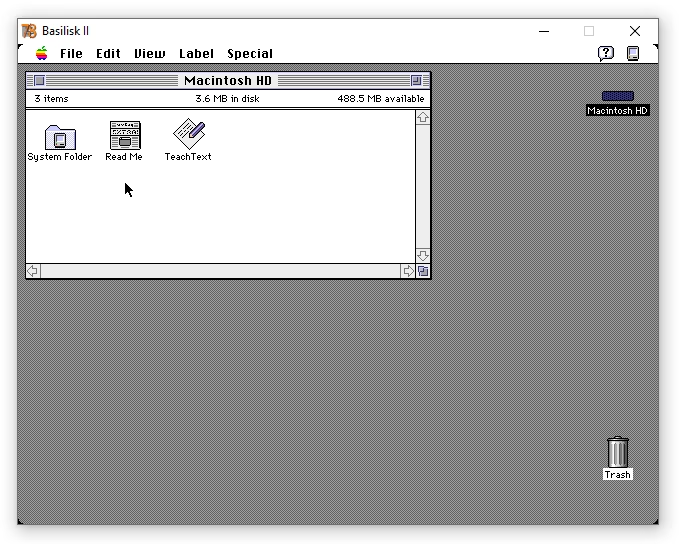
Other developers carried the projects onto additional systems and improved them. SheepShaver became freeware in 2001 and was re-released under the GPL in 2002. Those are separate changes. Its modern versions can include PowerPC CPU emulation, while the original PowerPC-hosted environment could execute the guest code natively.
Still working with old machines
Frodo returned to active releases in 2024, with versions 4.3, 4.4, and 4.5 recorded in Bauer’s news archive. His interests also include game-data tools and my8008, which connects a real Intel 8008 to modern support hardware. The latter uses an actual vintage processor rather than replacing it with CPU emulation.
His official homepage describes his scientific work. In his interview, he says he contributes to the CIMR Earth-observation mission through a supplier.
Christian Bauer in the History of Video Game Emulation
- January 5, 1995: Frodo V0.4 reaches the public
- 1995: ShapeShifter brings Macintosh software to the Amiga
- 1998–1999: SheepShaver launches for BeOS, followed by Basilisk II’s first alpha
Project histories and interview
Retro Replay’s written interview with Christian Bauer and companion histories of Frodo, Basilisk II, and SheepShaver are in preparation. The project links below lead to his official sites.
Sources and further reading
- Christian Bauer’s written interview with Retro Replay, October 2026, currently in preparation.
- Official homepage and dated news archive.
- Original Frodo manual and current source repository.
- Basilisk II changelog: January 23, 1999 alpha entry.
- SheepShaver FAQ: commercial, freeware-era context, and GPL history.
- July 1995 ShapeShifter FAQ.
- Christian Bauer, written follow-up to Retro Replay, October 27, 2026: Frodo’s first public release, early sound support, first C code, and the photograph credit.