Retro Replay Retro Gaming History, Reviews & Emulation
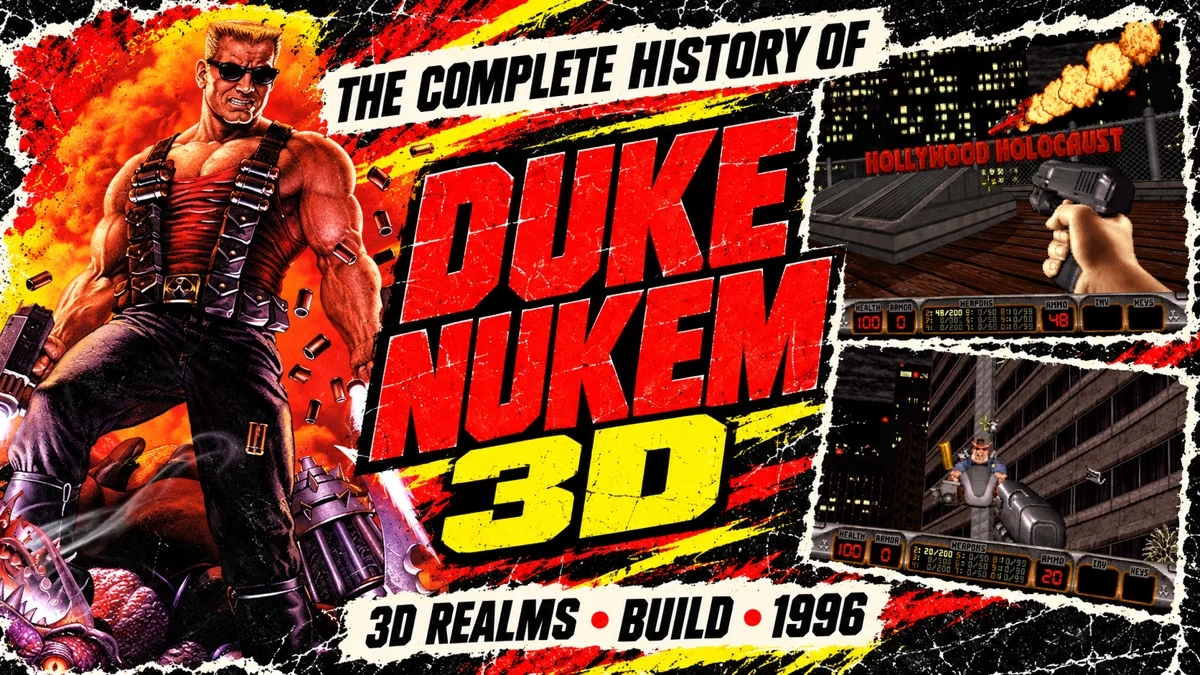
You have landed on a Los Angeles rooftop, your ride is burning, and somebody below has a shotgun. Within minutes, you can be in a movie theater, checking a bathroom, poking around behind the screen, and discovering that the city has rather more entrances than its architect probably intended. There is an alien invasion to deal with. First, though, this light switch appears to work.
Duke Nukem 3D arrived in 1996 with a hero who sounded as though he had swallowed an entire action-movie shelf. He wore sunglasses, carried an unreasonable amount of ammunition, and rarely let a successful explosion pass without comment. Yet the best reason to return is often something quieter: the shape of a street, a window overlooking somewhere you have already been, or a shortcut that turns a confusing building into a place you understand.
3D Realms had not invented the first-person shooter. Its developers had played Doom, admired it, and then spent a great deal of time finding other things a player might enjoy doing between gunfights. Their game let you swim, fly, crawl, break things, and make a nuisance of yourself in rooms that looked as if they had been used by people before the monsters arrived.
Behind that city were two programmers doing different jobs, level designers squeezing surprising possibilities out of a new editor, artists giving the invasion its unpleasant faces, and a voice actor finding a career in a few gravelly syllables. Getting all of them to work together took considerably more effort than Duke’s effortless confidence suggests.
Explore the history of Duke Nukem 3D
- Part I: Before the rooftop, there were floppy disks (1991 to 1993)
- Part II: A new engine, a growing team, and a game still changing (1993 to 1995)
- Part III: Duke finds his voice, and Los Angeles finds its monsters (1995 to 1996)
- Part IV: Hollywood Holocaust sells the game (January 1996)
- Part V: Lunar Apocalypse, Shrapnel City, and an arsenal worth sharing (1996)
- Part VI: DukeMatch, modem trouble, and a box that kept growing (1996 to 1997)
- Part VII: Build leaves the office, and the players move in (1996 onward)
- Part VIII: Three consoles, three different ways through the city (1997)
- Part IX: The source comes out, and the old city gets new streets (2000 to today)
Part I: Before the rooftop, there were floppy disks (1991 to 1993)
The fellow in the pink shirt
The first Duke Nukem, released by Apogee in 1991, does not look much like the man most people remember. He is a small, brightly colored figure running sideways through levels, collecting bonuses and shooting robots. There are platforms to reach and doors to open. His enemies have not yet taken over a cinema.

Programmer Todd Replogle and artist Allen H. Blum III made that original adventure with Apogee founder Scott Miller. Replogle supplied the code, Blum the pictures and level work, and Miller the publishing operation through which a small PC game could reach a very large number of desks. Their names would still be around when Duke acquired a third dimension.
Apogee’s offer was easy to understand. Take the first episode, play it, and pass it to somebody else. If you wanted the rest, pay for the registered game. A complete stretch of play did the selling. The person recommending it might be a magazine editor, a friend with a disk, or someone running a bulletin board from a computer connected to a telephone line.
That arrangement suited an action game particularly well. Nobody needed to believe an advertisement about how enjoyable Duke was. They could find out, then reach the point at which the rest of his adventure required an order. The free episode had to be good enough to make that next step tempting.
Miller’s recollections and the company’s early history are preserved among the documents accompanying Rene Patnode’s 2001 study of Duke Nukem 3D. The scale is striking beside the later game: a handful of people, small files, and a character whose personality had to survive inside a few pixels.
Duke Nukem II meets a rather inconvenient neighbor
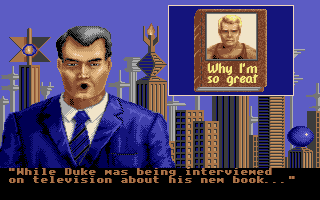
Duke Nukem II followed in December 1993. Its brighter VGA artwork gave the hero more definition, and its opening already enjoyed the joke of Duke being very impressed with Duke. The first game’s robot trouble had become a larger science-fiction production, but you still watched him run and jump from the side.
Then Doom arrived that same month. A PC action game could put you inside the corridors, let you charge around them at a startling pace, and connect you to somebody else’s computer for a fight. A character built for platforms now had a rather attractive place to go.
Apogee knew id Software well. It had published Commander Keen and Wolfenstein 3D. These were not strangers watching a distant revolution through a shop window. Miller’s business had helped those earlier games reach players, and George Broussard, his partner at Apogee, was an enthusiastic player as well as a developer.
The 3D Realms name emerged as the company’s banner for three-dimensional games in 1994. It did not mean that Apogee suddenly vanished or that Duke had been sold to a different studio. It gave the new work a name that said what the company wanted to make.
Replogle and Blum began moving Duke into first person. There would be other developers, another artist’s approach to building levels, and a much larger tool kit. Some of that tool kit was being written far from Texas, by a programmer who had recently been making his own answer to Wolfenstein.
Part II: A new engine, a growing team, and a game still changing (1993 to 1995)
Ken Silverman builds the room
Ken Silverman had already written Ken’s Labyrinth when Apogee hired him in 1993. His next engine would let designers escape the tidy grid of a Wolfenstein-style maze. Walls could meet at more interesting angles. Floors and ceilings could sit at different heights. A building could begin to resemble somewhere you might actually have visited.

Silverman’s own development chronology records early experiments in 1993, the move to sector-based maps around the end of that year, and a contract that protected his education. Build was developing while he was enrolled at Brown University, although the work eventually accompanied a leave of absence. Much of his engine programming happened at home in Rhode Island, with trips to the 3D Realms office in Texas.
Silverman supplied Build’s engine and tools. Replogle wrote the game that used them. Blum and the other designers could then turn a set of rendering routines into a cinema, a train, or a room with an extremely suspicious wall.
That division could produce some wonderful surprises. In our interview, Silverman gives Replogle and Blum credit for pushing the machinery themselves:
“While they took some ideas from Ken-Build, Todd and Allen were able to figure out a lot on their own. Their system of putting extra sprites in a sector was quite novel and powerful at the time. I believe they were the first team to do that. Note how I never did this in Ken-Build.”
Ken Silverman, speaking to Retro Replay
A pretty humble response. Most of us still credit Ken for a great deal of the hard work. Those extra markers could tell the game how a section of the world should behave. The engine made a moving piece of architecture possible; the game code and map supplied its particular job. A station needed more than a train-shaped picture if somebody was going to ride the thing.
There is no finished Duke hiding inside the first prototype
The game that emerged over 1994 and 1995 changed substantially along the way. The early prototype later released as LameDuke contains familiar ideas mixed with enemies, artwork, and spaces that did not survive in the same form. It is a fascinating building site, rather than a secret complete edition that the public somehow missed.
Broussard’s 2015 account of production describes a team beginning with Doom as its reference and keeping the things that were fun. The recognizable real-world settings and Duke’s voice took shape later in the process. He remembered the pool table arriving only a few weeks before the shareware release.
That is a pleasingly disorderly origin for something so closely associated with the finished game. The table was not an obligation inherited from an enormous design document. Somebody found room for an entertaining thing, and it stayed.
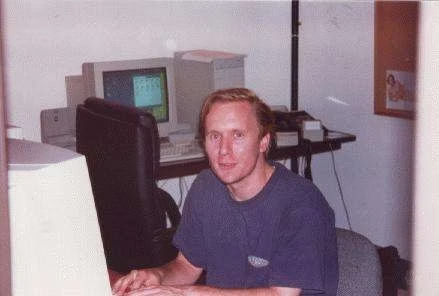
Broussard directed the project. Replogle handled game programming. Blum’s responsibilities reached beyond individual maps into the game’s overall production. Chuck Jones created 3D models, while artists including Stephen Hornback and Dirk Jones helped fill the world with the images that would become its walls, props, weapons, and creatures.
A model did not mean a modern polygonal enemy walking around the level. Much of that artwork became two-dimensional frames, shown from different angles or at different stages of an animation. The monsters could have considerable personality without being assembled from polygons in the player’s view.
Somebody opens Doom’s window
Richard Gray, known as Levelord, came to the team from making Doom maps. In his 2016 interview, he remembered changing the first Doom level by removing the wall around a window. Loading it up and seeing his change work was enough to redirect his spare time.
He was a software engineer in aerospace, not a teenager taking a first job. His GrayDOOM levels reached CompuServe and attracted professional interest. He chose Duke, joining Blum in the work that would give the original game’s episodes their shape.

Blum knew the character and the developing tools. Gray arrived with the appetite of someone who had discovered that a commercial game could contain a room he had made himself. Between them, the levels gained a geography you could learn and a sense that somebody had enjoyed hiding things just beyond your first look.
Behind each convincing street were less glamorous decisions: which doors should open, where a player would see the next enemy, how far a sight line could stretch before the computer began to complain. There were plenty of opportunities for an attractive level to become a miserable fight. It had to be played, adjusted, and played again.
Part III: Duke finds his voice, and Los Angeles finds its monsters (1995 to 1996)
The man on the other end of the microphone
Before Jon St. John supplied the voice, Duke could explore the same rooms without quite being the fellow the audience would remember. The talking changed the companionship. A successful shot no longer happened in silence. Somebody on your side was enjoying it an indecent amount.

St. John was working in radio in San Diego when casting director and performer Lani Minella heard what he could do. His account of the audition describes Minella directing him in the studio while Broussard listened remotely. Clint Eastwood’s Dirty Harry supplied a starting point. Broussard wanted a larger man, and the voice went lower.
A tight jaw, a low register, and a dry delivery did much of the work. St. John could make a short line sound as though it belonged to somebody who had already won the argument. The joke often comes from how little effort Duke seems to be making.
The cinema in his head was not subtle. They Live and Army of Darkness supplied recognizable touchstones, alongside the broader vocabulary of action films. A player could spot a borrowed idea, recognize the reference, and feel included in a joke that had probably been repeated around a television at the developers’ homes.
Not every line was a quotation, and Duke was not simply a soundboard. Brief reactions attached the voice to what had just happened. He could admire himself, complain, threaten somebody who was already losing, or puncture a moment that another shooter might have played solemnly.
There is a practical virtue to that brevity. He rarely needs to stop the game to explain himself. You are moving through a level, something happens, and the voice gets a few seconds before the next shot. Duke’s confidence is more entertaining in short bursts than it would be as a companion delivering a speech in every room.
Lee Jackson gives him an entrance
Lee Jackson had been answering technical-support calls at Apogee before music became his main work there. His later interview with Arcade Attack describes bringing MIDI pieces to the developers and eventually persuading Miller and Broussard to let him concentrate on audio.
For Duke, he borrowed heavy-metal albums from coworkers and listened. The ideas that followed became Grabbag, the theme that seems ready to flex its shoulders before the menu has finished loading. Its guitar-like MIDI phrases and swaggering rhythm introduce the character without needing a picture of his sunglasses.
Jackson and Robert Prince contributed music to the original game. Duke’s soundtrack is not one long performance of the title theme. The opening level’s Stalker leaves room for suspicion, while later pieces accompany stations, streets, and machinery with considerably more atmosphere than the hero’s reputation might suggest.
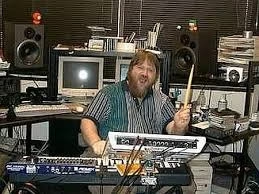
On a period PC, the sound of a MIDI composition depended on the equipment playing it. Two players could know the same melody through quite different instruments. The tune was there, but its guitar might have a much better afternoon in one bedroom than another.
Music, effects, and voice then shared the same crowded rooms. Pig noises, a door moving, and the sudden arrival of gunfire could tell you more than the view ahead. Duke might be delighted with himself, but listening past him remained good survival practice.
The city has acquired a police problem
The Pig Cop is one of the game’s best visual decisions. The name has become a body: a bulky pig in police gear with a shotgun and a thoroughly unpleasant attitude. You do not need a paragraph of enemy lore to understand the joke or the danger.
Other creatures change the kind of fight. Assault Troopers can make distance and vertical movement troublesome. Octabrains are particularly unwelcome in confined or underwater spaces. A hovering Assault Commander brings a much more explosive reason to stop admiring the architecture.

The sprites have blunt, readable silhouettes. A brief glimpse can be enough to make you change weapons or back away from a doorway. At close range their flatness becomes obvious, but by then the shotgun blast is usually a more urgent concern.
The invasion is grotesque, ridiculous, and occasionally nasty in ways the comedy cannot soften. Its treatment of women as decoration or endangered bodies is part of that original game, and one of the reasons some scenes are much less enjoyable to revisit. The city can still be a terrific place to explore without every joke earning a laugh.
By the beginning of 1996, the voice, the monsters, the score, and the levels had become something recognizable. The next job was to let people play enough of it to want the rest.
Part IV: Hollywood Holocaust sells the game (January 1996)
A free episode with a very good first address
The shareware version of Duke Nukem 3D appeared on January 29, 1996. L.A. Meltdown, the first episode, could travel through downloads and magazine discs without a buyer first committing to the full game. Apogee’s old arrangement was still doing its job. The opening level had to make the case.
Hollywood Holocaust, designed by Blum, is an exceptionally good introduction. It starts above the street, giving you a view before it puts you among the enemies. The ruined ride explains Duke’s immediate mood. A vent offers a route down. The city becomes somewhere you enter, rather than a picture displayed before the first corridor.

The movie theater is recognizable before you know its layout. There is an entrance, a lobby, places where customers would sit, and somewhere a projectionist would work. These are useful expectations for a player who has never visited this particular building.
Then the game starts rewarding impolite behavior. Try the walls. Investigate the bathroom. Find a way behind something that looks like scenery. An ordinary business becomes a network of alternate routes and places to stash equipment. You can understand the theater while still being surprised by it.
Blum does not make a tidy architectural model and hope that fighting will happen somewhere inside. The useful windows, changes of height, and connections between spaces arrange encounters. A return to a familiar area may reveal a different angle from which something can shoot you.
The theater also tells you how much attention to give the props. An image can move, a pane can break, and an object can answer the use key. Not everything does something useful, which is part of the pleasure. You are allowed a few seconds of pointless curiosity.
The next street is not simply more of the first
Red Light District widens the invitation. Buildings and alleys make room for a more disreputable evening out, and the game keeps finding ways to connect its spaces. Explosives can turn a boundary into a route. The player who has learned a map as a fixed set of corridors now has to reconsider it.
Broussard recalled that opening walls helped make more circular, interesting routes for DukeMatch. You can feel the benefit even alone. A level that feeds back into itself gives you the satisfaction of recognizing where you have arrived. With another player, the same connection can be the reason an apparently safe retreat becomes a very short retreat.
Death Row begins with Duke captured and stripped of the arsenal you may have been carefully collecting. The change makes the pistol and the next weapon feel important again. It is a mean little interruption, but a useful one: the adventure is not promising that every success will let you remain comfortably equipped.

Toxic Dump and The Abyss then pull the episode away from the neon and into industrial trouble, water, rock, and a much more direct confrontation. The shareware package is not just an hour of city streets ending at an order form. It shows that the game can change locations and make you use its movement in different ways.
Water is particularly effective. The familiar assumption that a surface ends your route no longer holds. Drop below it and another space is available, with different visibility, a limited air supply, and creatures that make the route back up seem much farther away.

Switches, secrets, and the occasional lost afternoon
The freedom has limits. Colored keycards still control progress. Some switches are much less obvious than their importance deserves, and a room full of interesting detail can hide the one small thing needed to move on.
That is where Duke can become more tiring than its reputation for immediate action suggests. A fight is usually easy to recognize. A switch that has changed something elsewhere is a much less helpful traveling companion. The automap and a careful return through familiar rooms can become essential.
Secrets encourage the same behavior for better reasons. A suspicious wall might conceal supplies or an entire route. Discovering it feels personal because the game has let you do the looking. The best finds seem almost reasonable afterward, which makes the next unpromising corner worth checking.
There is a useful balance in that opening episode. You can enjoy the gunfire without understanding every trick, finish it while missing quite a lot, then hear somebody mention a place you never found. Now the free game has another evening in it, and the paid episodes have become a much easier proposition.
Part V: Lunar Apocalypse, Shrapnel City, and an arsenal worth sharing (1996)
The registered game leaves Earth
The full three-episode game reached buyers in spring 1996, with FormGen handling its retail publication. Its second episode, Lunar Apocalypse, takes Duke into space stations and alien installations. Anyone buying the rest solely for another Los Angeles street could be in for a surprise.
The change lets the designers play with scale and isolation. A station can put the outside very close while keeping it unreachable. Machinery and dark surfaces replace the immediate familiarity of the theater. Doors still open, weapons still make an impressive mess, but the building no longer needs a ticket counter to explain itself.

That makes the episode less instantly distinctive than L.A. Meltdown, especially for a player coming from other science-fiction shooters. Its best stretches answer with movement, atmosphere, and the arrangement of spaces. Dark Side’s transport and industrial passages give the journey more texture than a simple succession of metal rooms.
There is another pleasure in being sent away from the original setting: the third episode’s return to Earth feels like a return. Shrapnel City restores the hotels, restaurants, streets, and other human places. The invasion has not politely waited for Duke to finish his space trip.
A restaurant can make a fine battlefield
The third episode benefits from the sense that its places have functions besides containing enemies. Raw Meat has the fittings of a restaurant. Flood Zone makes water an organizing feature of the neighborhood. Freeway offers the wreckage of infrastructure that ought to connect a city.
Gray’s levels frequently enjoy the awkward space between recognizable place and impossible shooter construction. A room can have a plausible purpose without its surrounding building surviving a visit from a surveyor. Once you are fighting through it, the choice of route matters much more than whether the plumbing would meet inspection.
Build lets these places do tricks that are not immediately visible in a screenshot. Sectors can move, floors can slope, and cleverly arranged geometry can make spaces overlap in ways that do not obey a simple flat map. It is tempting to call the whole thing either fully 3D or fake. Neither description is very useful while you are trying to reach a ledge.
The engine has genuine limits, including what it can show when looking up and down. The designers work with those limits. Water transitions, mirrors, sprite constructions, and carefully hidden connections can suggest a more complicated building than the underlying arrangement would lead you to expect.
In a 2021 interview with Strife Streams, Gray remembered Blum as the person he turned to when Build presented a difficult problem. Their desks were close enough that asking could be a matter of turning around. The more elaborate a finished room looks, the easier it is to forget that somebody first had to ask how to make it happen.
The pistol has some very strange company
Duke’s weapon selection keeps the straightforward and the absurd within easy reach. A pistol and shotgun are reassuring. The Chaingun Cannon supplies rapid, noisy pressure. An RPG turns a small opening into an invitation to make a large mistake.
Then the weapons become personal. The Shrinker makes an enemy small enough to step on. The Freezethrower leaves a frozen target waiting for the follow-up. A pipe bomb can be thrown, left in an inconvenient place, and detonated when the timing becomes much funnier.

The Shrinker is the weapon that most neatly captures the game’s spiteful sense of fun. Hitting the enemy is not quite the end of the transaction. You have to move in and finish it, which turns a shooting decision into a little chase. In multiplayer, that tiny figure is somebody you may have to sit beside afterward.
The same appetite for troublesome possibilities fills the inventory. A jetpack makes the ceiling less final. Scuba gear extends an underwater excursion. A portable medkit lets you choose when to recover. The holographic decoy promises a particularly satisfying moment if the other player is sufficiently distracted.
You cannot assume that the game will supply each toy exactly when you feel like using it. Keeping something for later makes exploration more interesting, and using it carelessly can make the next area less comfortable. Duke looks like a walking excess, but the player still has to manage him.
There is a stadium at the end of this road
The original campaign eventually stages its final confrontation in a football stadium. After corridors, rooftops, and the insides of somebody else’s machinery, the enormous arena gives the boss room to be a boss.
It is also an appropriately ridiculous place for Duke to finish. The game has already treated Los Angeles as a place where a shootout might interrupt ordinary entertainment. Now the entertainment has become the shootout, with the hero thoroughly convinced that he belongs in front of a crowd.
Across the three episodes, the quality is not perfectly even. Some spaces are more rewarding to remember than to navigate again, and the joke density can get ahead of the judgment. But the campaign keeps offering actual places and situations to discuss. Players do not merely remember that they completed level seven. They remember what was in the restaurant.
Part VI: DukeMatch, modem trouble, and a box that kept growing (1996 to 1997)
Somebody else has found the pipe bombs
A room becomes much more suspicious when the enemy can remember where you went last time. DukeMatch takes the campaign’s routes, hiding places, and moving scenery and fills them with opponents who are learning the same tricks.
You can hear a fight, work out where it is happening, and approach from another direction. You can leave an explosive where somebody is likely to pause. The jetpack makes a roof part of the contest. The Shrinker can turn an argument over who is winning into an argument over where the other person has disappeared to.
Up to eight players could join a network game, with modem and serial options for smaller arrangements. Setting one up in DOS could involve a different sort of puzzle from finding the next keycard. The Atomic Edition manual devotes pages to the connections and setup, beside instructions for cooperative play and taunts.
Silverman’s answer in our interview begins with a refreshingly unromantic assessment:
“Sure. The network code was a mess. Using a synchronous protocol was a clever way to minimize bandwidth.”
Ken Silverman, on Duke Nukem 3D’s multiplayer work
The computers had to keep the same game in progress, not merely display roughly similar gunfights. Physics needed to advance consistently. Random events had to agree. A machine drawing more frames could not quietly give its player a different simulation.
As Silverman explains, that meant coaching the game teams through changes to their own code. A tiny difference could eventually leave the players disagreeing about what had happened. The symptom might be a broken match; the cause might be buried in a routine that had looked perfectly harmless in single-player.
The interpolation between those simulation steps helped motion look smooth without making the rules depend on the rendering speed. For the person at the keyboard, the goal was much simpler: when a rocket arrived, everybody should agree about whose fault it was.
One more episode before the year is out
The enthusiasm was visible in the reviews. Tim Soete’s archived GameSpot review awarded the original game 8.8 out of ten, praising its action and tangible settings while objecting to the treatment of captive women. Admiration and discomfort were already able to occupy the same review. The later argument about Duke did not have to wait for anybody to grow up.
The Plutonium Pak expanded the original game in late 1996. Atomic Edition brought the original episodes and the new material together. The Birth, its fourth episode, added eleven levels, new enemies, and an Expander function alongside the Shrinker.

The new episode makes good use of the team’s affection for ordinary places with terrible things happening inside them. Duke-Burger and Shop-N-Bag put fast food and groceries into the path of the invasion. Going Postal and the episode’s other locations make the urban joke broader without needing to invent an entirely different game.

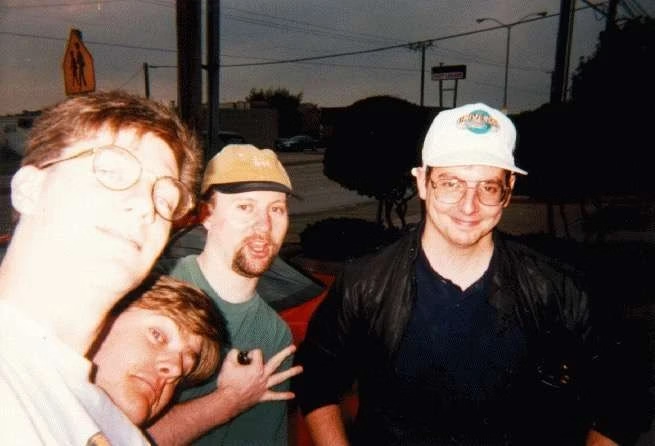
Randy Pitchford and Keith Schuler appear among the new episode’s map designers alongside Blum. The Atomic team photograph and credits show a production that had moved on from the original release’s lineup. It is worth keeping the editions straight when looking back at who made which room.
The Expander reverses the Shrinker’s joke. Instead of making something easy to tread on, it makes the target grow toward an unpleasant conclusion. It is not a modest addition, but modest additions were never likely to survive very long in Duke’s inventory.
Washington, beaches, and an expanding shelf
Other developers also found work in Duke’s world. Duke It Out in D.C., Duke Caribbean: Life’s a Beach, and Duke: Nuclear Winter became the best-known commercial add-ons. Sunstorm Interactive developed the D.C. and Caribbean adventures; Simply Silly Software made Nuclear Winter.
The appeal was wonderfully direct. You knew how the game worked. A new set of maps could send the same weapons and movement into somewhere else. The Caribbean pack could replace the mood of the original streets with a holiday that had gone exceptionally wrong.
For players, more levels were a way to keep using a game they already understood. For the people making them, Duke’s editor offered a way into professional work. The tools that had supplied the original city were about to acquire a great many new architects, some more considerate of their visitors than others.
Part VII: Build leaves the office, and the players move in (1996 onward)
The editor is on the disc
For a certain sort of player, the most dangerous discovery was not a secret level. It was the editor. Finishing Duke Nukem 3D no longer had to mean waiting for somebody else to make more.
Build’s editing tools let a designer draw spaces and then inspect them in a three-dimensional view. Texture a wall, change a height, place an object, and look at what you have done. The short distance between an idea and seeing it in a room made it very easy to lose an evening.
The first result might be a box with a door. Add an enemy, a light, and somewhere to hide a weapon, and it begins suggesting the next room. The person who previously searched every wall for a secret could now spend an unreasonable amount of time deciding how to conceal one.
Not everything required a new engine feature. Map tags, special sprites, and game scripts gave the existing machinery instructions. Understanding the arrangement could be frustrating, but the reward was something you could hand to another player as a small file.
Silverman’s own example game helped demonstrate possibilities. He describes its purpose in our interview:
“While I could use Ken-Build to reproduce bugs, I used it more as a test bench to show off my latest effects, such as doors, subways, or bouncing platforms. It was my hope that every game would adopt these things in their code.”
Ken Silverman, on the engine’s demonstration game
The demonstration could show how something moved. A designer then had to decide why a player should care about it. A subway was impressive; a subway that carried you somewhere interesting was a level.
A new map arrives with a text file
User maps spread through the same computer culture that had carried the shareware game. A download could bring a new setting, a few instructions, and an author’s explanation of what had gone wrong, what had finally worked, and whom they wanted to thank.
The variation was enormous. Someone might build a deathmatch arena with a beautifully judged rhythm. Somebody else might build a school, house, or imaginary city whose first obligation was to resemble the picture in their head. Playability could arrive later, if it arrived at all.
That unevenness was part of browsing. A file did not need to meet a publisher’s standard before another player could try it. Screenshots and recommendations helped, but curiosity often supplied the rest. A map could be awkward and still contain a room worth remembering.
Gray’s career already showed where this could lead. He had gone from altering Doom to making commercial levels. Duke’s players now had professional tools of their own, and the route from hobby to paid work did not require inventing a renderer first.
The box full of other people’s levels

The growing map supply also attracted people who wanted something to sell. Collections could put an impressive number on a box without providing much assurance about the quality inside.
One compilation became a court case. Micro Star downloaded 300 user-made levels and sold them as Nuke It. FormGen and its partners objected. The 1998 appellate opinion in Micro Star v. FormGen treated the commercial compilation as an infringement of the right to make derivative works, despite the map files drawing on the original game’s separate artwork.
The dispute was about that commercial product, not a sudden discovery that the editor should never have existed. Players had been encouraged to exchange their levels. Selling a collected box of them raised a different question, and the court did not accept that providing the tools had surrendered the underlying rights.
For the player, the more pleasant consequence of Build remained the next map. The city could expand through another person’s imagination, whether or not a publisher had put a new edition on a shelf.
Part VIII: Three consoles, three different ways through the city (1997)
The Nintendo cartridge changes the rules
Duke Nukem 64, developed by Eurocom, brought the invasion to Nintendo’s machine in 1997. It changed more than the shape of the controller. Weapons were reworked, parts of the levels were altered, and the sexual material and language were reduced.

The four-player split-screen game gave the conversion a reason to exist even in a room containing a PC. Now the opponents were on the same television, and keeping your eyes away from the other corners of the screen could become an ambitious personal policy.
Eurocom artist Nick Dry’s interview with Nintendo Player describes a much wider job than the word artist suggests: weapons, interface, controls, level work, replacement audio, and balancing. His recollections include changing the weapons into newly rendered sprites and borrowing the idea of ammunition types from Judge Dredd.
The cartridge also changes the atmosphere. Without the PC game’s continuous level music, spaces can feel barer, leaving effects and gunfire to occupy more of the room. You are still visiting recognizable Duke locations, but the sound and tempo are not quite those of the DOS game.
The reduction in sexual content did not turn it into a gentle game. There are still plenty of things to shoot, and the violence remains very visible. For a Nintendo player, this was a different version of the same outrageous visitor, not a suddenly respectable houseguest.
Lobotomy has to rebuild the view
The Saturn conversion, also released in 1997, came from Lobotomy Software. Its first-person work on PowerSlave had given it an engine suited to Sega’s hardware. Duke’s familiar places would be rebuilt around that technology rather than arrive through a straightforward copy of Build.
Programmer Ezra Dreisbach explained the distinction in a 2002 interview preserved on NeoGAF. The Saturn games used the PowerSlave engine, and Duke’s imported level data still needed substantial reworking in Lobotomy’s tools.
The distinction is easy to miss when the screen contains the same textures and a familiar shotgun. The team was trying to deliver a recognizable journey through different machinery. Getting a room to look right did not mean the original code was secretly doing the work underneath.
Lighting gives the Saturn edition much of its character. Places you remember can acquire a different mood, while the compromises remind you that reproducing a fast PC shooter on a console was a job with its own decisions. Lobotomy’s version is interesting precisely because it is more than a reduced-resolution souvenir.
Total Meltdown brings its own episode
The PlayStation received Duke Nukem: Total Meltdown, developed by Aardvark Software. It included the original three episodes and a new one, Plug ‘n’ Pray. The title alone announced that somebody had understood the assignment.
Its extra levels and different audio made another branch of the 1996 game available to people who might never have typed a DOS command. Performance, controls, and visual presentation could all change the experience. The console shelf did not contain three identical boxes with different logos.
None of these conversions needs to defeat the PC original to earn a place in the history. Each brought different priorities to the job: split-screen play, a rebuilt renderer, or another episode. A player could become attached to one of those versions first and meet the original later, finding a familiar city with some very unfamiliar corners.
The much later third-person Duke adventures belong to another part of the series. Here, the busy afterlife was already happening inside the same basic game, on different hardware and in maps made by people the original team had never met.
Part IX: The source comes out, and the old city gets new streets (2000 to today)
A very welcome announcement on April Fool’s Day
Silverman released Build’s source in June 2000. On April 1, 2003, 3D Realms released Duke Nukem 3D’s game source. The date invited suspicion, but programmers really could download it.
The original release notice, preserved in the icculus port, thanks Charlie Wiederhold for getting the archive into a compiling state. It also thanks Silverman and Jim Dosé for allowing their material to be included. The game code carried a GPL license; the game’s pictures, sounds, and maps remained commercial data.
For someone who just wanted Duke to run properly on a newer computer, the important possibility was immediate. The program could be adapted rather than coaxed through every assumption it had made about a DOS machine.
Ryan Gordon’s work and Jonathon Fowler’s JFDuke3D were among the routes into modern systems. Silverman’s Polymost renderer contributed another route through Build’s scenery, using hardware acceleration. The old streets could remain intact while the program drawing them changed.
EDuke32, created by Richard Gobeille and developed with a wider team, carried that work into a particularly important home for Duke players and modders. Its additions reach beyond compatibility into scripting, editing, rendering, and the things a new map can ask the game to do.

It is a source port, not an emulator. You supply suitable game data, and a native program runs it on the newer machine. Classic-looking rooms and modern conveniences can coexist without every object needing to become a newly modeled replacement.
The same extended family of technology helped power Ion Fury in 2019. That is another game with its own developers and ambitions, but the connection makes Duke’s continuing technical life unusually visible. The tools had not simply been placed behind glass.
Megaton gathers the luggage
The 2013 Megaton Edition gathered Atomic Edition and the three familiar commercial add-ons into a convenient modern package. It suited a game whose extra maps had become scattered across old releases and shelves.
That convenience did not last indefinitely. Megaton was withdrawn from sale, becoming another edition that existing owners could remember having bought while new buyers encountered something else. A game can remain famous and still become surprisingly awkward to purchase in exactly the form somebody recommends.
The original’s reputation was also carrying baggage from Duke Nukem Forever, finally released in 2011. It became easy for an argument about the later game’s writing, development, or disappointment to swallow a conversation about the 1996 shooter. Go back to the theater and the older game’s pace is much easier to hear.
Blum and Levelord turn back toward the editor
Duke Nukem 3D: 20th Anniversary World Tour arrived on October 11, 2016, developed by Nerve Software and Gearbox. Allen Blum and Richard Gray returned to design Alien World Order, a fifth episode taking Duke through locations around the world. Lee Jackson supplied new music, and Jon St. John returned with new lines and fresh recordings.
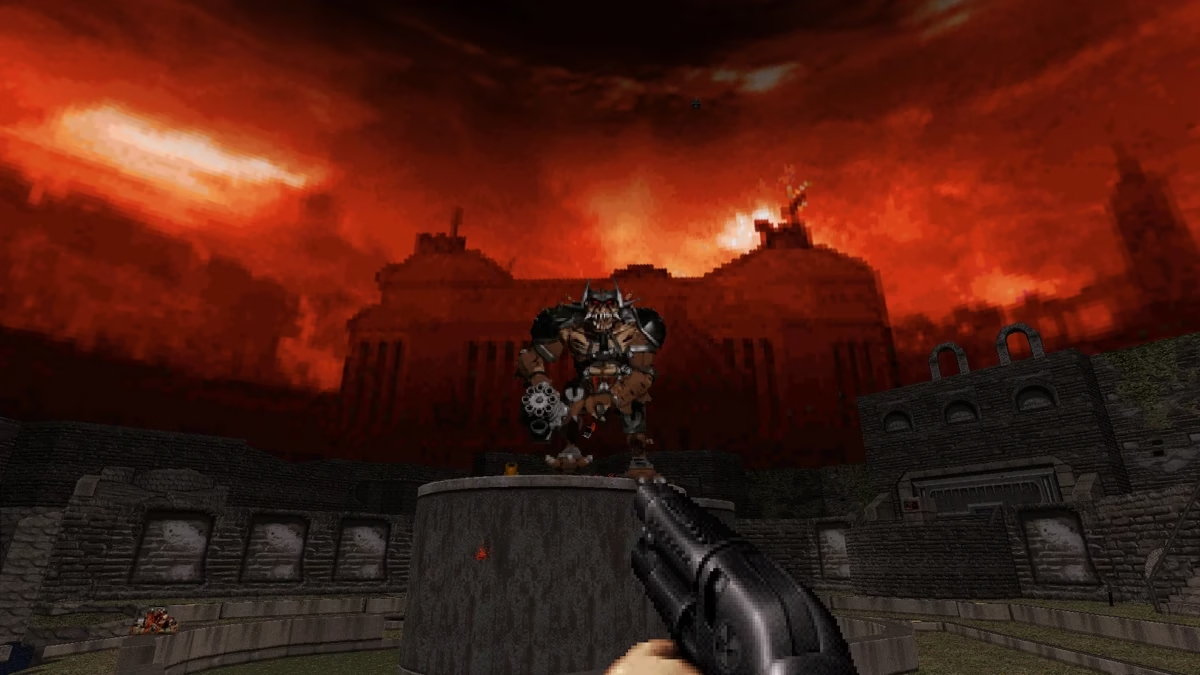
The publisher’s description emphasizes those returning creators, and rightly so. A new episode made by the original level designers is a more substantial anniversary present than another number on the box.
Gray’s Strife Streams interview contains a lovely memory of the work. While making the new levels, he would catch himself wanting to turn around and ask Blum a question, as he had when they shared an office. By then they were on different continents. The old habit had outlasted the seating plan.
World Tour was not the complete archive that Megaton had offered. It contained the four Atomic episodes and the new fifth one, but omitted those three commercial add-ons. Its new lighting and presentation also gave players another set of choices about how they wanted Duke to look and sound.
A buyer looking for Alien World Order wants a different package from somebody seeking the old holiday and Washington adventures. A mapper may care more about source-port support than new lighting. The shared title does not make those editions interchangeable.
The people, and the rooms they left
The game reached its thirtieth anniversary in 2026. That October brought much sadder news: Richard Gray had died. Tributes from his colleagues remembered both his work and the person who had made it. His mischievous messages and intricate routes remain inside the levels.
A return to Duke is now also a visit to other people’s younger work. Replogle’s game code, Silverman’s engine, Blum’s theater, Gray’s cities, the artists’ creatures, Jackson and Prince’s music, and St. John’s voice have been carried through several generations of computers.
The easiest route back depends on what you want to play. ZOOM Platform lists Atomic Edition with extras, while Steam carries World Tour. Check the listed contents rather than assuming that two packages with Duke on the front include the same episodes.
For original game data and player-made maps, EDuke32 is a useful starting point; its installation instructions explain the files it needs. Fowler also maintains JFDuke3D, whose page lists supported editions and notes that World Tour’s fifth episode is not supported there.
Keep the first visit simple. You can decide later whether the furniture needs high-resolution replacements. The game already has plenty of things competing for your attention. Then step off the roof again. The street is still below, the theater is still open, and the aliens have not become any more considerate of the customers. Somewhere inside is a switch you are almost certain you remember.
More from Retro Replay
- Ken Silverman on Build, Duke Nukem 3D, and saving CPU cycles
- The complete history of the Atari Jaguar, including Doom and Alien vs Predator in the console shooter race.
Sources and further reading
- Ken Silverman interview, Retro Replay. Original answers about Duke’s map effects, engine and game responsibilities, demonstration code, and keeping multiplayer synchronized.
- Ken Silverman’s Build history. Firsthand chronology of the engine, Apogee agreement, Brown, remote work, technical additions, and source release.
- Duke Nukem 3D: The making of, George Broussard interviewed by Joe Donnelly. Broussard’s production recollections, experiments, late additions, and development of the talking character.
- id as Super-Ego: The Creation of Duke Nukem 3D, Rene Patnode, 2001. Study with creator interviews and attached period documents, including Miller on the early team and Apogee’s publishing model.
- Duke Nukem 3D: Atomic Edition manual. A preserved later printing of the manual, used for Atomic credits, network options, and inventory. Its team list belongs to that edition.
- Level Design with Levelord, 2016. Gray’s own account of discovering Doom editing, his aerospace work, and the maps that led to Duke.
- Richard Gray interview, Strife Streams, 2021. The working relationship with Blum and the experience of returning for World Tour. Also an archival portrait source.
- Jon St. John interview, Benjamin Maltbie, GodisaGeek. The actor’s account of meeting Lani Minella and the directed audition, with a studio portrait.
- Lee Jackson interview, Arcade Attack. The move from technical support to audio, heavy-metal listening behind Grabbag, and music for particular levels. Also a portrait source.
- The music of Duke Nukem 3D, original SONGS.TXT reproduced by Ryan Lennox. Track-by-track Jackson and Prince credits and the original EMIDI attribution.
- Duke Nukem 3D review, Tim Soete, GameSpot archive. The original-game review’s praise, 8.8 score, and objection to captive-women scenes. The current archive carries a November 2000 timestamp.
- Micro Star v. FormGen, 1998 appellate opinion. The actual Nuke It dispute and the 300-map commercial collection, rather than a general ban on player mapping.
- Duke Nukem 64: Nick Dry interview, Nintendo Player. Firsthand account of Eurocom’s weapon, interface, audio, and balancing work, alongside a study of the conversion.
- Ezra Dreisbach interview, 2002, preserved on NeoGAF. The Saturn engine’s PowerSlave origin and the substantial reworking behind the Duke conversion.
- Duke Nukem 3D source release, April 1, 2003. The original 3D Realms release notice preserved in Ryan Gordon’s port, including Wiederhold’s work and the separation between code and commercial game data.
- JFDuke3D, Jonathon Fowler. The maintained source port, supported data editions, and its note about World Tour’s fifth episode.
- Duke Nukem 3D edition history and screenshots, Jonathon Fowler. Release and developer records, including Total Meltdown and Megaton, plus the game gallery used for additional illustrations.
- EDuke32 official project. Source-port history, contributors, renderers, Mapster32, modern platforms, and the connection to Ion Fury.
- EDuke32 installation guide. Instructions for adding supported game data. The port does not replace ownership of the commercial game.
- 20th Anniversary World Tour, publisher listing. October 11, 2016 release, returning designers, new music and voice work, and the publisher screenshots.
- 20th Anniversary World Tour review, Brett Todd, 2016. The comparison with Megaton and the absence of the three older commercial add-ons.
- Atomic Edition and extras, ZOOM Platform. Current listing and package contents, checked while preparing this history.
- Joe Siegler’s 3D Realms recollections, part seven. Archival photographs of Replogle and his colleagues, identified by Siegler. The group image is from the later early-Forever period.
- Richard Gray tributes, PC Gamer, October 2026. The report of Gray’s death and firsthand tributes from former colleagues.
- World Tour teaser, Gearbox, September 2016. The publisher’s announcement video embedded in the later-history chapter.