Retro Replay Retro Gaming History, Reviews & Emulation
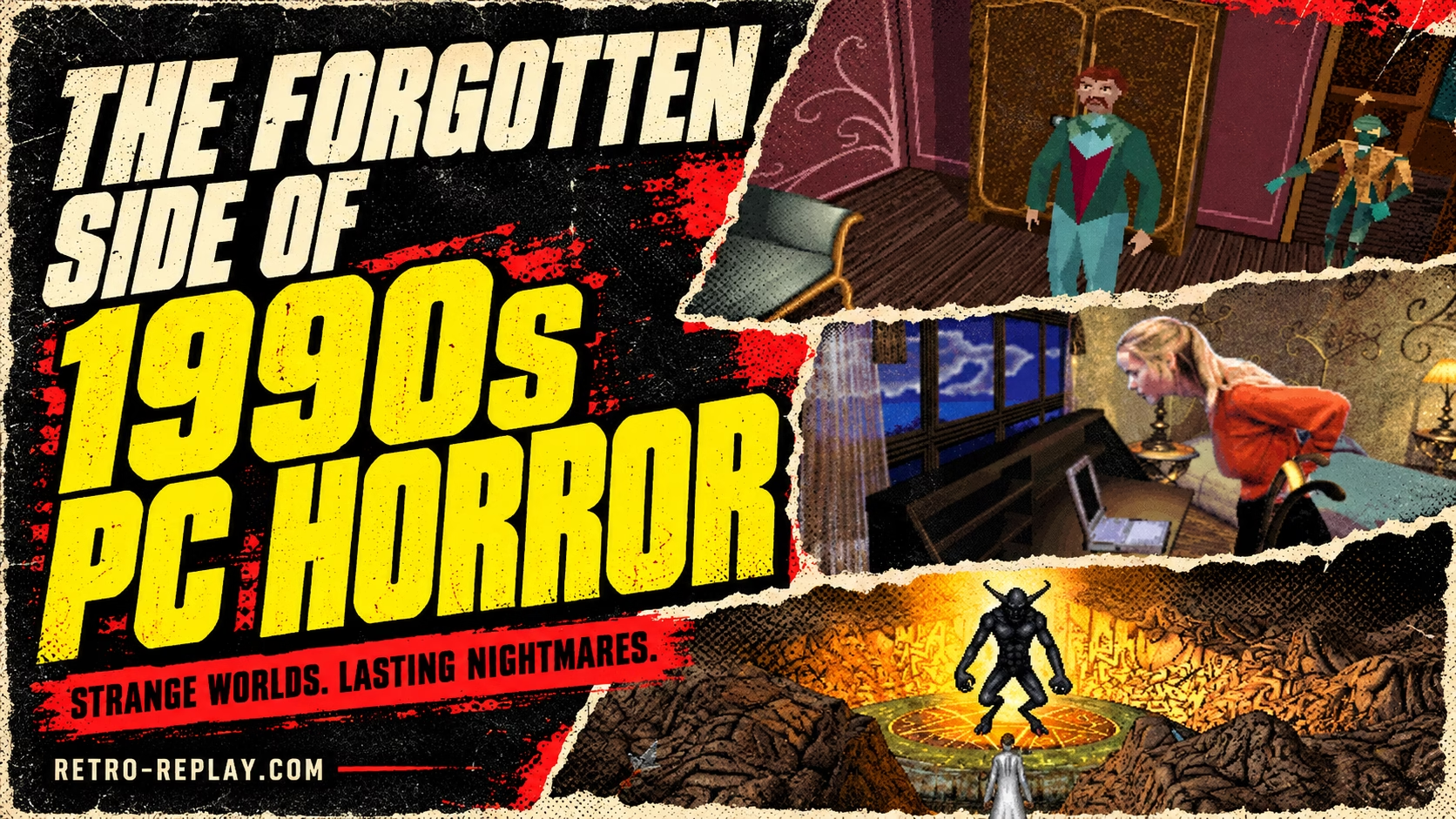
The horror genre is experiencing a renaissance. Games that gave us nightmares have had the remake treatment, with Silent Hill and Resident Evil leading the charge. But underneath the flashiness of Unreal Engine graphics and spine-chilling voice acting, it’s easy to forget our roots.
As kids growing up in the 90s, we saw the rise of some of the first full-motion video games, which integrated live action to add realism. This realistic vantage point let developers push the envelope further than ever before. Surrealism, heavy psychological elements, and a generally disturbing view of human nature became the core of the decade’s most memorable and scarring games.
We also saw some of the quirkiest, earliest forms of horror storytelling. Text adventure games took a darker turn, while first-person shooters and point-and-click games kept us eager for the next scare. Not all of these aged well, but their nostalgic sounds and gritty graphics enhance the experience in 2026. There’s something about a low-definition monster or an unidentifiable sound coming from a dark room that still makes us look over our shoulders.
Survival Horror Was Born In 1990
Some argue that Hunt the Wumpus was the first official horror PC game. Its 1973 release excited fans of darker genres, but it paved the way for another forgotten 1990 text-based game: Hugo’s House of Horrors.
Released first for MS-DOS, it was created by independent developer David P. Gray (now, it would be known as an “indie”). Part graphic adventure, part horror, it became part of a trilogy of text-based games that followed Hugo on a harrowing search for his long-lost girlfriend, Penelope.

Text-based commands made players feel as though they were playing a game ahead of its time. Hugo responded to logical commands, putting full control in the player’s hands. The Hugo trilogy also introduced puzzle-solving and a scorecard, two elements modern horror games still use today.
As the games booted up, classic DOS pings rang out each time Hugo encountered a monster or villain. These tones became tied to dread and fear of what would happen next, alongside pixelated graphics of witches, mad scientists, and unexpected monsters. Hugo II: Whodunit? and Hugo III: Jungle of Doom! became known for plot twists and sudden deaths, giving rise to some of the earliest survival horror themes.
Psychological Horror Played On Gamers’ Worst Fears In 1992
The horror genre turned toward realism as 3D graphics and technical advances entered the chat. Gamers no longer watched a flat, 2D screen and typed in commands. Now, they used the same keyboard and mouse controls to experience a horrifying story in a brand-new way.
Alone in the Dark was released on MS-DOS and dropped gamers into a haunted Louisiana mansion in 1924. Playing as either an investigator or the niece of the missing mansion owner, the goal was to investigate the owner’s suspicious suicide.

This would later be called the “grandfather of survival horror,” scaring first-time horror gamers to their cores.
The game’s beauty lay in its fixed camera angles, which let players see only what the dev, Infogrames, wanted them to see. It was also one of the first horror games to let players explore an area in 3D, adding a previously unseen sense of realism.
You’d fight a zombie with a sword before running from a swamp monster in a dungeon. And while its polygon graphics might feel clunky now, beating a boss back then took brag-worthy finesse. Eerie music, creepy movement, and a steady sense of dread inspired future survival-horror franchises.

But the game’s dark theme made other devs wonder how far they could push the limits. In the years that followed, horror games flirted with the line between “disturbing” and “controversial.”
In 1995, One Game Set the Psychological Bar Too High
An ancient demon. Multiple murders. An abusive husband. Demonic possession. These elements formed the basis for Phantasmagoria, a point-and-click psychological horror designed by Roberta Williams. Players take on the role of Adrienne Delaney, a writer, as she struggles to free her demon-possessed husband, Don Gordon.
The kicker? You unlocked the box and set the murderous demon loose.

As Don becomes increasingly abusive and homicidal, players unravel the origins of the demon, who turns out to be the owner of your New England mansion. In this one, the anxiety-inducing dread starts the moment you open the game.
A gothic, baritone-laced song plays on the game’s menu screen. After you hit play, a sad violin takes over as the camera pans in on a woman in a 19th-century New England estate. At that moment, it becomes clear what an enormous milestone this was for the horror PC genre.

Phantasmagoria came out on seven CD-ROMs because its files were so large. Live-action footage, voice acting, and 3D renderings of each environment made it a first. With its disturbing, at times heavily debated, content, it made an impression.
For many, this game played like a movie—and it scared like one, too. Today, this game would have trigger warnings written all over it for graphic violence, abuse, and gore. In 1995, it was equally shocking, but it also fueled the root of psychological horror: The inability to fight our own personal demons.
Even when the real ones are right in front of us.
For another trip through that uneasy house, our complete history of Phantasmagoria follows the actors, film studio, and seven-disc production behind the scares. In our interview with Roberta Williams, the designer talks about Phantasmagoria alongside the other adventures that shaped her career.
By 1998, Nothing Was Off-Limits In Horror Games
In the late 1990s, horror was booming. Resident Evil had become the gold standard in survival horror, while Silent Hill and Parasite Eve were making early runs. In the PC world, one game stood out by taking players inside the mind of an asylum patient.

Sanitarium introduced Max, an amnesiac who wakes up in a dilapidated asylum covered in bandages. DreamForge Intertainment was one of the first to blur the line between reality and delusion. In each hand-drawn setting, players ride the psychotic wave between the asylum’s unsettling walls and Max’s own psychological episodes.
Each time this happens, more of Max’s past is revealed, along with his reason for being in the asylum in the first place. These nightmarish states became the basis for the surreal environments many modern games use in storytelling, forcing players to question their own in-game realities.

Sanitarium quickly joined the ranks of other grotesque, disturbing games, with an enhanced Steam version slated for late 2026. Dark Seed, I Have No Mouth, and I Must Scream, and The 7th Guest also followed suit in equally dark, dread-inducing storylines.
These games are a testament to horror: an escape and an experience, and, most importantly, a genre that transcends decades. Our nightmares evolve, and so do the games that make us lock our doors and leave on the lights.