Retro Replay Retro Gaming History, Reviews & Emulation

The house is enormous, the view is lovely, and Adrienne has room to write. Her husband can work on his photography. There is even a little town nearby when they need something. For a few minutes, Phantasmagoria looks like a particularly ambitious property purchase. Then you begin opening doors.
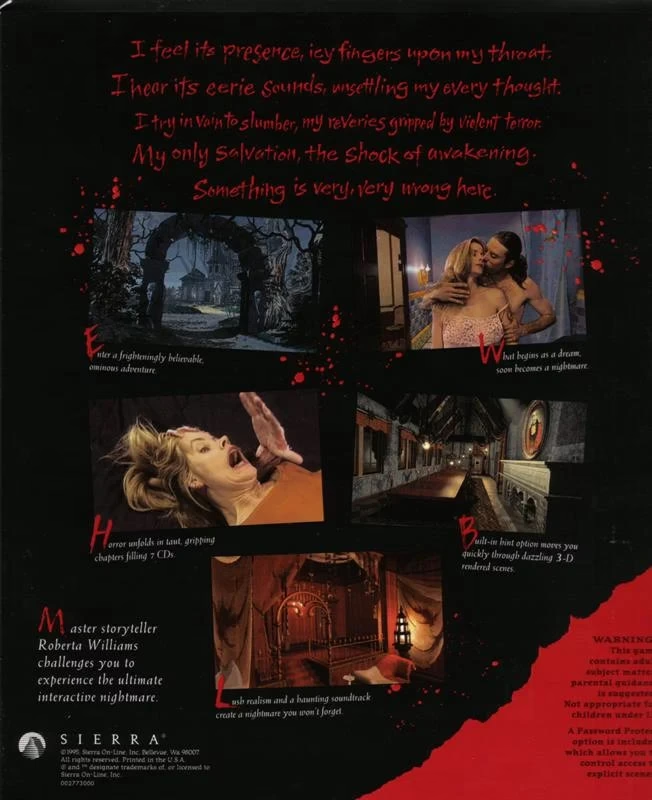
Sierra had been putting suspicious houses on computer screens for fifteen years when Phantasmagoria arrived in 1995. This one was different. A filmed actress crossed its rooms, reached for its objects, and looked increasingly uncomfortable inside an estate assembled by computer artists. Seven CD-ROMs held the adventure. The box made a fairly substantial promise before the first disc entered the drive.
For Roberta Williams, the challenge was more personal than finding another use for CD storage. Players knew her through King’s Quest, but the designer who had begun with a house full of murders had not lost her taste for suspense. She wanted a story that could frighten someone sitting at a computer, with a person on screen they could follow through it.
Getting there required Sierra to build a studio, hire actors, and discover how much more complicated a walk across a room becomes when the room does not exist. The finished game could be beautiful, awkward, frightening, unintentionally funny, and unexpectedly welcoming to someone who had never solved a Sierra puzzle. Sometimes it managed several of those things before you reached the next doorway.
This history discusses major story spoilers, domestic abuse, and the game’s depiction of sexual assault.
Explore the history of Phantasmagoria (click to expand)
- Part I: The house Roberta wanted to return to (1980 to 1993)
- Part II: Sierra builds a studio for a house that is not there (1993 to 1994)
- Part III: Adrienne and Don arrive on the blue stage (1994)
- Part IV: The person inside the picture
- Part V: Seven days in the Carnovasch house
- Part VI: When the house stops playing fair
- Part VII: Seven discs arrive in the shops (1995 to 1996)
- Part VIII: The house remains, while the people move on (1996 to today)
Part I: The house Roberta wanted to return to (1980 to 1993)
The fairy tales were only part of her career
Roberta Williams had not started with a prince. In 1980, she and Ken Williams made Mystery House for the Apple II, letting players explore a mansion whose guests were being murdered. Its sparse drawings could not supply much spectacle. A closed room and another body were quite enough to suggest that staying might be a mistake.

Sierra grew, and King’s Quest became the series most closely associated with her. Players followed Graham and his family through fairy tales, legends, and places that could be dangerous despite their cheerful appearance. Murder mysteries remained part of her work too, including The Colonel’s Bequest and The Dagger of Amon Ra.
By the early 1990s, the familiar description of Williams as a designer of family-friendly fairy tales had become a rather small box. In our interview, she describes wanting to find out what else she could do:
“The thing that really got me going on wanting to do it is, I guess I was a little bit tired of being branded as the goody-good sort of King’s Quest, nursery-rhyme, family-for-kids, G-rated. I wanted to see if I had anything more in me than that.”
Roberta Williams, speaking to Retro Replay
Her interests were not limited to blood and elaborate deaths. She talks about campfire stories, Stephen King, and the unease of fog concealing something you cannot quite identify. The unknown could be useful long before a monster arrived to explain it.
Actors, certainly. But somebody still has to walk around
CD-ROM had made recorded video a tempting ingredient for computer games. Faces and voices could appear on the same machine that had once asked the player to imagine nearly everything. Designers were trying different ways to join those performances to puzzles, choices, and exploration.
Williams noticed the experiments, including The 7th Guest. She could see why developers wanted to work with actors, but the arrangement did not automatically satisfy her. A sequence of clips, interrupted by choices about which clip came next, could feel uncomfortably close to a branching adventure book.
In our conversation, she distinguishes that experience from having a character to guide around a place. She wanted the filmed person to remain part of an adventure. You would see Adrienne in the house and decide where to take her, rather than watch everything exclusively through her eyes.
That choice gave the production its hardest practical problem. A filmed person would need to stand beside a rendered table, pass through a rendered doorway, and appear to belong in a room made by somebody else. The idea was simple to recognize on screen. Producing enough movements to make it work was another matter.
Mystery House had not quite been left behind
Williams makes an especially striking connection in the interview: the room arrangement of Phantasmagoria’s house grew out of Mystery House. The property had acquired much more surrounding land and a small coastal town, but the older adventure remained beneath it.
Seen that way, the project becomes less of a sudden change of career. She was returning to a place she knew, with tools that could put an actor in the room and a voice behind the next door.
Her challenge was wonderfully direct:
“I want to see if we can scare people with this computer.”
Roberta Williams, speaking to Retro Replay about conceiving Phantasmagoria
It would not be a small experiment. The house needed a history, the people moving into it needed lives, and Sierra needed a way to film all the things a curious player might make the heroine do.
Part II: Sierra builds a studio for a house that is not there (1993 to 1994)
A magician leaves the wrong kind of inheritance
The story Williams settled on concerned a young woman, an old magician, and a mansion whose impressive rooms concealed something much worse than expensive repairs. Adrienne Delaney, a novelist, moves in with her photographer husband, Don Gordon. The estate previously belonged to the illusionist Zoltan Carnovasch, known as Carno.
The magician’s professional life gives the property an excuse for almost anything. A theatrical room, a curious device, a prop with a concealed mechanism: these might all be normal possessions for its former owner. That makes it easier for Adrienne to investigate something she would be wiser to leave untouched.

Williams later explained that the title came from reading about old magic-lantern ghost shows. The connection is pleasingly appropriate to the finished production. An apparatus makes a figure appear where it is not really standing, and an audience supplies the willingness to believe it.
Her 1997 interview puts the completed script at roughly 550 pages. It had to account for more than a film’s orderly procession from beginning to end. Adrienne might investigate one room before another, return after an event, or leave an object alone until much later.
A film can let the camera pass a locked door without worrying about an audience member insisting on trying the handle. Williams was making something for people who had been trained to try every handle in the building.
The names behind the production
Producer Mark Seibert was a familiar Sierra musician as well as one of the people responsible for getting this much larger project finished. Peter Maris, a film director, took charge of directing the live-action performances. Williams remained the writer and game designer, working across a production that needed both a shoot and a functioning adventure.
Art director Andy Hoyos also shared the story credit with Williams. The house’s theatrical excess and the horrifying imagery were the work of an art department whose contribution could be seen long before a player reached the ending.
The original manual’s credits spread across game development, art, filming, audio, effects, and testing. The list belongs to a company learning to make a production that would not fit comfortably inside its old departments.
Oakhurst gets its blue room
Sierra constructed a blue-screen facility in Oakhurst, California. On that stage, an actor could be recorded against blue surfaces and placed inside the computer-generated house. A chair or platform gave the performer something physical to use, while the finished furniture and architecture would be supplied elsewhere.

Tom R. Halfhill’s December 1995 BYTE report describes the new studio, the compositing equipment, and the artists building rooms with Silicon Graphics tools. Their work was not merely a background laid behind a completed film. The actor’s position, the imagined geometry, and the camera had to agree.
If Adrienne appeared to touch a door, her hand needed to arrive where the door would be. If she walked behind furniture, the finished picture had to place that furniture in front of her. A convincing second of action could depend on several departments agreeing about a room none of the performers could actually enter.
The Ultimatte compositing equipment helped replace blue with the rendered environment. Other tools handled the editing and detailed work around the footage. The audience would see Adrienne open something. The production saw an alignment problem, a performance, a background, and a collection of frames that had to cooperate.
Getting the television picture into the computer
The source footage was recorded with broadcast-quality equipment. That may sound extravagant for the small image eventually displayed by a mid-1990s computer, but starting with a clear picture gave the production something usable to composite and compress.
A poor edge around an actor could make the blue-screen trick obvious. Compression could then turn a face or a subtle movement into a less helpful collection of blocks. Sierra had to make the footage survive both the illusion of the house and the limited route from a CD drive to the screen.
The company was not short of ambition. It was short of finished examples showing exactly how to do this particular job at this scale. As the script became a shooting schedule, the people arriving to play Adrienne and Don were about to discover how much of their new home existed only on a monitor.
Part III: Adrienne and Don arrive on the blue stage (1994)
Victoria Morsell has to believe in the room
Victoria Morsell, now known as Victoria Morsell Hemingson, plays Adrienne. The role asks her to carry much more than a series of dramatic scenes. She has to search cupboards, examine objects, wait for someone to finish speaking, and make another trip through the house because the player has remembered something.

Maris already knew her acting. In her 2025 interview with James Wood, she recalls knowing little about computer games when she was hired. On stage, boxes stood in for furniture and steps. A monitor helped the performers understand where they would appear inside the completed environment.
The scale of the performance was another uncertainty. Something that read naturally to the camera might look different once reduced and placed in the game’s wide view. Morsell remembers the work as a shared experiment:
“We were all figuring it out as we went along.”
Victoria Morsell Hemingson, interviewed by James Wood in 2025

Adrienne’s orange top and black trousers became a practical part of the arrangement. A player might visit rooms in different orders, so the production needed footage that could join without a sudden unexplained change of clothes. Her wardrobe became as recognizable as the house.
It also makes her unusually easy to locate in a complicated picture. Among dark wood, theatrical decoration, and the mansion’s more extravagant choices, there is the woman in orange whom you are supposed to help. The player can be confused about a puzzle without being confused about which part of the screen is Adrienne.
David Homb discovers what a computer game can ask of an actor
David Homb plays Don, the photographer whose new home becomes a very bad influence. He did not arrive with an expert understanding of game development either. In a later Joypad interview, he recalled Maris approaching him and his initial disbelief that a computer game would require an actor in this way.
An audition persuaded him. The script that followed was another surprise: a much larger bundle than the film scripts he was used to receiving. Don needed to exist in ordinary scenes as well as in the transformations that would make him frightening.
In the finished game, that shift can be disconcerting. Homb has to play a husband, a man behaving oddly, and an increasingly theatrical threat, while leaving room for the player to spend quite a while doing something else. A film can cut directly from a warning sign to its consequence. Here, Adrienne may go shopping first.
The delay changes the experience. The player can notice Don becoming dangerous before Adrienne has fully accepted what is happening. Returning to him becomes an action you choose, and eventually one you may postpone.
The people behind the fright have a rather good time
Morsell’s memories of the shoot include cabins by a lake and the pleasure of a steady job with a close group. That is a considerably nicer setting than the one the actors were pretending to inhabit. Their working day could involve imaginary furniture and very real technical delays without requiring the actual discovery of a haunted estate.
Production photographs are a useful corrective to the finished picture. A spacious room becomes a blue floor, a platform, a monitor, and several people waiting for a take. The threatening husband is an actor trying to stand in the right place. The woman trapped in the mansion can step away once the shot is finished.
Eventually, the actors’ work had to leave the studio. The next people handling it would make sure Adrienne could cross the mansion without bringing a blue rectangle along behind her.
Part IV: The person inside the picture
An old Sierra engine learns another trick
Behind the filmed faces, Phantasmagoria still belonged to Sierra’s adventure technology. Its SCI system had grown through earlier games. Programmers now had to make that machinery handle a person recorded on camera alongside the house’s art, inventory, chapter changes, and the decisions that determined what could happen next.
Systems programmer Greg Tomko-Pavia explained some of the work in an August 1996 interview. The VMD movie technology came from Coktel Vision, Sierra’s French subsidiary. It gave the company a way to play the footage across DOS and Windows without maintaining two complete copies in different video formats.
Other recorded actions used Sierra’s RBT, or Robot, system. These were not necessarily movies occupying their own rectangular screen. They could be footage with transparent areas and positioning information, allowing a figure to appear within the room and behind parts of its scenery.

For the player, this could be a small pleasure: Adrienne belongs beside a desk rather than on a television floating in front of it. The effect is not always perfect. An edge can shimmer, a hand can look peculiar against an object, or a change of angle can expose the join.
But perfection is not required for the mind to accept a room. Spend a few minutes deciding where Adrienne should look, and the picture begins doing its job. You know where she is, what she has investigated, and which doorway you have been avoiding.
Seven discs are a practical arrangement as well as a boast
The amount of video made Phantasmagoria an unusually large physical object. Seven CD-ROMs could make a purchase feel impressively substantial. They could also give you seven opportunities to put the wrong disc back in the box.

Some files were repeated across discs so that returning to an earlier area would not require constant swapping. Tomko-Pavia described the duplication as necessary to keep the experience practical. The small program files were not what filled the package. Recorded picture and sound demanded the space.
The technical instructions make the period hardware feel very close again: a CD drive, a sound card, memory, and an installation that had to suit the computer on the desk. An expensive production still needed to arrive through a household machine that might be less enthusiastic about it than the purchaser.
A new player today can meet the same rooms without ever opening a jewel case. In 1995, the disc change could become part of the pause between sections. The game was a story and a small collection of objects you had to keep in order.
The music has to carry the empty rooms too
Seibert’s role extended from production into the score. Jay Usher also contributed music. The original credits identify the CSUF Concert Choir and conductor Dr. Gary Unruh among the performers, alongside the musicians who supplied the recorded instrumental parts.

The opening announces something much larger than an ordinary afternoon of puzzle solving. Voices give the mansion an almost ceremonial weight before the player knows what has happened there. The music can make a space feel occupied even when Adrienne is alone.
Seibert explained in comments preserved with Tomko-Pavia’s interview that he wrote the music for the opening, ending, and movie sequences. Other musicians adapted themes into MIDI backgrounds for play. The score therefore reached the player through more than one route, with live recording and computer-controlled music serving different parts of the experience.
That distinction becomes audible when a scene gives way to exploration. A dramatic passage can tell you that something has happened. A quieter repeating figure has to remain tolerable while you try the next object, reconsider the last hint, and take another look through a room.
Phantasmagoria gives the music plenty of room to work. Adrienne’s search is often slow. Long before the story reaches its most notorious scenes, the score has been encouraging the suspicion that the house is not nearly as empty as it looks.
Part V: Seven days in the Carnovasch house
The most dangerous activity is having a look around
Playing Phantasmagoria begins with an appealingly undramatic job: get to know the house. Adrienne has moved in. Rooms, grounds, objects, and nearby businesses are available to investigate. The previous owner’s taste is alarming, but not everything peculiar is immediately a threat.

The large rooms give you plenty to inspect. Some objects matter, some establish the place, and some seem to exist mainly because Carno was not a man who believed a room could be improved by removing an ornament. The theatrical machinery is particularly difficult to pass without trying it.
That curiosity is useful to the story. A locked or concealed space does not feel like a warning to stop playing. It feels like the next thing the game has put there for you to open. When Adrienne releases the force imprisoned in the mansion, the catastrophe comes from doing exactly the sort of investigation an adventure game normally rewards.
She does not know the history yet. You may recognize enough horror-film furniture to have reservations, but recognizing the genre does not supply the information needed to help her. The search has to continue after the mistake.
A cursor that wants you to get on with it
The interface is much less demanding than many earlier Sierra adventures. You do not have to compose a sentence for a parser or constantly choose among a large collection of action icons. The cursor changes to indicate useful places and objects, while inventory items occupy a clear part of the screen.
A skull offers hints. An eye lets you examine an object more closely. Movie controls can help when you have already watched a sequence. The manual spends time showing a new player how to use these things instead of assuming years of Sierra experience.

Going into Nipawomsett gives the adventure another rhythm. Adrienne can meet people and carry out practical errands away from the mansion. The coastal view and the ordinary act of driving into town help make the estate feel like a place in a larger world, rather than a succession of sealed puzzle rooms.
The contrast is welcome. A person can spend only so long inspecting a sinister room before wanting to visit somewhere with a cash register and another human being. Returning afterward makes the isolation of the house more noticeable.
Meeting Carno after he is gone
Carno’s story comes through evidence, conversations, and scenes from the past. His career as an illusionist supplies spectacle, while the deaths surrounding him supply the suspicion that not everything on stage was a trick.

The fortune-telling machine is a fine example of the house’s appeal. It looks like something built to be used, with just enough theatrical oddness to make trying it irresistible. The game can invite you to enjoy its props while preparing to explain why enjoying them might be unwise.
Malcolm, the elderly man who knew Carno, provides a human route into that past. Douglas Seale plays him with a different pace from the mansion’s more extravagant performances. After so many objects that seem to promise a secret, sitting with somebody who remembers becomes its own attraction.
Harriet and Cyrus bring further company to the grounds. Their presence can make an estate feel lived in while also giving the story more people to place in danger. Phantasmagoria is rarely shy about announcing a personality. Some of its supporting figures seem ready to begin a theatrical performance before Adrienne has finished asking a question.
The days move on, and so does the house
The seven chapters provide a clear march through the week. New scenes appear as events change the household, and previous rooms become worth checking again. The day is not simply a clock counting down while you search. Progress depends on the events the game expects you to discover.
That structure can make the unfolding story easy to follow. It can also make the search repetitive. A useful item may become relevant only after another event, and revisiting a familiar spot can feel less like noticing a clue than waiting for the game to decide that it is time.
The relative ease is a deliberate part of the design. Williams wanted people who were intimidated by adventure games to be able to keep going. If a puzzle prevented them from ever seeing the next frightening development, it was obstructing the experience she had spent so much effort creating.
The trade-off is obvious to a veteran player. You may solve a stretch almost as soon as it appears, then spend longer watching Adrienne carry out the action than deciding what she should do. The performance that gives her presence can also become the thing you are waiting to finish.
Then Don says something, or the next event changes the house, and the unhurried pace begins to feel less comfortable. The person Adrienne came here with is becoming harder to recognize.
Part VI: When the house stops playing fair
Don becomes the danger in the room
The mansion’s hidden history is one source of dread. Don’s behavior is another, and the more immediate one. Adrienne does not have to discover an ancient passage to encounter something wrong. She can find it in a conversation with her husband.
At first, his changed mood can be explained away. He is tired, hurt, irritable, or absorbed in his work. The player has reasons to suspect possession before Adrienne has assembled the same picture. The time spent investigating elsewhere lets that difference grow.
Homb’s performance becomes larger as Don deteriorates. Sometimes the exaggeration is effective because he no longer seems to belong to the man Adrienne knows. Sometimes it moves into a register that invites a laugh. Phantasmagoria can cross that border quite abruptly, and an old video image makes the crossing even harder to control.

Morsell gives the story a person to remain concerned about through those changes. Adrienne can be slow to recognize a threat, and the script does not always provide enough reason for her to continue as though the household can recover. Yet a frightened face, held on screen for a moment, can do work that another line of explanation would not.
The scene that cannot be filed under ordinary haunted-house fun
In the fourth chapter, Don sexually assaults Adrienne. The game depicts the attack as part of his possession and her growing realization that her husband is dangerous. It is a significant break from the invitation to enjoy an eccentric estate and its theatrical past.
Williams defended the scene in her 1997 interview as a turning point that makes Adrienne afraid of Don. That explains the decision she was trying to make. It also leaves the player to judge how the scene actually works.
Using sexual assault to establish a villain’s evil carries a weight that the surrounding horror tricks cannot absorb. The attack happens to the character you have been guiding, and the later business of collecting objects and opening doors has to continue around it. The game does not give her experience the sustained attention that such a scene demands.
That is one of Phantasmagoria’s hardest failures to set aside. Its theatrical murders can be approached as elaborate horror effects. The assault brings a recognizable form of intimate violence into Adrienne’s marriage, then asks it to serve the progress of a supernatural plot.
Carno’s stage was built for more than applause
The discoveries about Carno grow more horrific as Adrienne learns what happened to the women around him. The visions turn his profession into an opportunity for a succession of cruel set pieces. What initially looked like theatrical clutter has a history the player would rather not have seen demonstrated.
These scenes made the game’s reputation travel well beyond the people who finished it. They are easy to describe in a review, easy to isolate from the surrounding adventure, and much more sensational than a woman investigating a pantry.
They also create an uneven rhythm. The next atrocity can feel like a reward for progress, even though Adrienne is discovering something dreadful. The game wants the player to recoil and keep looking. Its elaborate effects sometimes make the second response more conspicuous than the first.
There is genuine craft in the imagery, and plenty of excess. Williams’s desire for suspense sits beside a production that repeatedly reaches for the biggest shock available. The two impulses do not always help each other.
The last chapter finally puts the player in a hurry
By the final chapter, Don’s pursuit changes the activity. The long, relatively forgiving investigation gives way to an escape in which remembered objects and quick decisions can become essential. You have had a week to become familiar with this house. Now you need to get through it alive.

The shift can be exciting. Familiar spaces become routes, barriers, or places you do not want to be trapped. An object that once seemed like another curious possession can become useful under pressure.
It can also be a rude surprise. The adventure has spent hours teaching a newcomer to proceed at leisure, use hints, and watch the next scene. Suddenly, a delay can be fatal. A player who arrived for a story may discover that the ending expects a rather different pair of hands.
The final confrontation takes the haunted-house machinery as far as it will go. Adrienne must survive the physical pursuit and deal with the force behind it, bringing the investigation’s objects and revelations into an urgent sequence.
The uncertainty is part of the memory the game leaves. You can enjoy the escape, resent having to repeat it, and still feel relief when Adrienne finally gets out. The house has stopped being a place you want to inspect. It has become somewhere you are happy to leave unexplored.
Part VII: Seven discs arrive in the shops (1995 to 1996)
A very expensive way to introduce somebody to adventure games
By the time Phantasmagoria reached players in 1995, Sierra had invested in much more than a single finished program. It had a studio, a production pipeline, and experience joining filmed performances to its adventure technology.
The contemporary BYTE account described a roughly $4 million project. Sierra had put the sort of money behind Adrienne’s house that could make a producer nervous before a single ghost appeared.
Mark Hood, the project manager interviewed by BYTE, explained that Sierra wanted a wider audience and relatively approachable puzzles. The intimidatingly large package contained an adventure designed to let an inexperienced player keep moving.
The reviews disagree about what they have played
Joe DeRouen’s October 1995 review for Texas Computer Currents was delighted by the combination of story, exploration, and imagery. He noticed occasional effects that did not quite convince, but found them easy to forgive while becoming involved in Adrienne’s search.
Jeff Sengstack’s 1996 GameSpot review arrived at a much colder conclusion. He praised aspects of the graphics and music while criticizing weak characters, easy puzzles, repetition, and the excess of violence. The published score was six out of ten.
The argument reaches the sales counter
CompUSA declined to carry the game, a decision reported in the contemporary BYTE feature. The controversy was therefore more than a lively exchange in the review pages. It affected where someone could buy the box.
The Australian Classification database records a Refused Classification decision dated August 25, 1995. The route to an Australian audience had closed.
The game included a censorship setting intended to reduce exposure to its stronger material. That was a product feature, not a way to make the story or its reputation disappear. A package being sold through adult horror still had to pass through shops and classification systems that did not all respond alike.
The numbers belong to a hit
The argument did not prevent substantial sales. Sierra’s fiscal 1996 corporate filing, preserved in this filing excerpt, recorded more than 600,000 copies sold worldwide during that fiscal year.
Phantasmagoria had made its commercial case. The harder question was what Sierra, Williams, and the audience wanted the name to mean next.
Part VIII: The house remains, while the people move on (1996 to today)
A second title, another person’s nightmare
Phantasmagoria: A Puzzle of Flesh followed in 1996, written and designed by Lorelei Shannon. It tells a different story with different characters. Adrienne’s escape does not lead directly into Curtis Craig’s life, and Williams was not designing another visit to the Carnovasch estate.

The wider filming work continued too. The Beast Within used actors in another Sierra adventure, with its own design, performances, and reasons for putting the player into a story. Phantasmagoria’s studio and technical work had become experience the company could carry into other productions.
Adrienne even reaches the Saturn
The original Phantasmagoria also acquired an unusual console life. A Japanese Saturn version, titled Phantasm, appeared in 1997. It occupied eight discs, one more than the familiar PC package.

The release put Sierra’s filmed heroine onto Sega hardware, with a different presentation and a Japanese localization surrounding the familiar rooms.
Guinness World Records records its eight-disc arrangement. It is a wonderfully cumbersome footnote to a game already remembered for the size of its box. The mansion had found another route into a living room, but it was still bringing a substantial amount of luggage.
The Phantasmagoria Williams might have made
Williams was working on King’s Quest: Mask of Eternity when the possibility of another Phantasmagoria arose. Her 1997 interview records Sierra asking her to consider a third game. It was an idea under discussion, not a finished adventure waiting to be released.
In our interview, she describes wanting to continue making games when Sierra was sold, including another Phantasmagoria and perhaps another Laura Bow mystery. Those intentions belong to the person whose name had been on the boxes. The corporate future did not supply the projects she had imagined.
The people on screen get to meet the player
One of the nicer developments in the game’s later life has been watching its performers encounter the thing they helped make. Conversations with Curtis, hosted by A Puzzle of Flesh actor Paul Morgan Stetler with collaborators including Daniel Albu, has brought original cast members and developers into discussions and playthroughs.
A reunion with Williams and Morsell Hemingson reconnects the people behind the production. The actress’s 2025 account also describes playing the game through the channel after years in which her memory had primarily been of making it.
That produces a rather different kind of commentary from a modern player simply laughing at an old clip. A gesture, a room, or an awkward transition can bring back the physical job behind it. The person who remembers the blue stage is seeing the finished room, while the audience can ask about both.
Opening the house now
The original game is available through GOG and Steam. Modern packages remove much of the physical disc handling, though the underlying images and filmed actions remain unmistakably products of the original production.
ScummVM also supports the original game, with a Good rating in its stable compatibility chart. Use the project’s installation notes to gather the required files from your copy. It is a convenient way back into the house without rebuilding a 1995 computer.
Allow the first chapter some time. Look around, use the hint system when a repeated search has stopped being interesting, and notice how much of the effect comes from the house remaining available to explore. A dramatic clip can be watched in isolation. Choosing to take Adrienne back through the door is the part that makes it her adventure and yours.
Roberta’s answer
When we asked which game best represented what she had wanted to accomplish as a designer, Williams answered immediately:
“Phantasmagoria, and then King’s Quest. I don’t think there’s any doubt, it’s got to be Phantasmagoria.”
Roberta Williams, speaking to Retro Replay
It is an answer worth keeping beside the finished game, with its awkward pauses, beautiful rooms, troubling decisions, and determination to put a person into the picture. She had wanted to find out whether the computer could frighten somebody. A great many players can still remember the room where it did.
And at the beginning, the house is still lovely. There is a view, a place to work, and all that space to investigate. Adrienne has just arrived. The player can leave the doors alone for another moment, even if that has never been what an adventure player is especially good at.
More from Retro Replay
- Roberta Williams on Mystery House, King’s Quest, and Phantasmagoria
- The complete history of FMV video games
- The history of Gabriel Knight
Sources and further reading
- Roberta Williams interview, Retro Replay. Her own account of the game’s inspiration, Mystery House connection, filmed characters, and personal favorite. Includes the interview video excerpt embedded above.
- Phantasmagoria original manual. Production credits, interface, hints, and original instructions. The Williams archive preserves the scan.
- Phantasmagoria technical sheet. Period installation and hardware information.
- When Multimedia Meets the Masterpiece, Tom R. Halfhill, BYTE, December 1995. Contemporary reporting on the studio, compositing, budget, intended audience, and retail controversy.
- Roberta Williams interview, Anthony Larme and Andy Bellatti, 1997. The script, title, wardrobe, controversial scene, and discussion of another Phantasmagoria.
- Greg Tomko-Pavia interview and Mark Seibert comments, 1996. Firsthand explanation of the video systems, disc organization, and music production.
- Victoria Morsell Hemingson, interviewed by James Wood, 2025. The actor remembers the unfamiliar production, blue stage, crew, and later return to the game. Also the source of her recent portrait.
- David Homb interview, Joypad, 2021. Casting and performance recollections, with archival production frames.
- Phantasmagoria review, Joe DeRouen, October 1995. The favorable Texas Computer Currents response discussed in the release chapter.
- Phantasmagoria review, Jeff Sengstack, GameSpot, May 1996. A contrasting critical response to the writing, puzzles, acting, and violence.
- Phantasmagoria, Australian Classification. Official Refused Classification record dated August 25, 1995.
- Sierra corporate filing excerpt, preserved by RaceSimCentral. The fiscal 1996 sales statement, more than 600,000 copies worldwide during that fiscal year.
- Phantasmagoria archive, Sierra Gamers. Original packaging, discs, manuals, and production materials maintained in the Williams archive.
- Most CDs for a point-and-click videogame, Guinness World Records. The eight-disc Japanese Saturn release.
- Phantasmagoria reunion, Conversations with Curtis. Williams and Morsell revisit the production with Paul Morgan Stetler and Daniel Albu.
- Phantasmagoria, Steam. Current publisher listing and the original-game promotional screenshots used here.
- Phantasmagoria, GOG. Modern storefront for the original game.
- ScummVM stable compatibility. Lists Phantasmagoria as supported with a Good rating. Consult the current project notes for your edition and data files.
- A Puzzle of Flesh original manual. Credits for Lorelei Shannon’s separate 1996 sequel.