 Retro Replay Retro Gaming History, Reviews & Emulation
Retro Replay Review
Gameplay
The first few minutes of Donut County tap directly into the childish pleasure of making stuff disappear. You guide a small hole under stray objects, watch it grow as it eats them, and soon start clearing out pieces of an entire scene. It has some of the same accumulating-object pleasure as Katamari Damacy, except you are removing the world instead of rolling it up. The change sounds minor, but it gives every space the feeling of a compact physics puzzle.
What starts to click is that swallowing objects is not always the final answer. Items can be combined, soup can be cooked, rabbits can be bred, fireworks can be launched, and swallowed material can be catapulted back out. These variations keep the central joke from wearing out. Donut County rarely asks you to master a complicated system; instead, it presents a friendly problem, lets you experiment, and moves on before any one idea gets stale.
That light touch is also its limitation. The puzzles are easygoing, and the game favors a quick, playful rhythm over extended problem solving. If you want dense challenges that demand repeated attempts, you may reach the end wishing the ideas had been pushed further. If you want a smart, cheerful game that respects your time and gets pleasure from turning ordinary clutter into a solution, it lands nicely.
Graphics
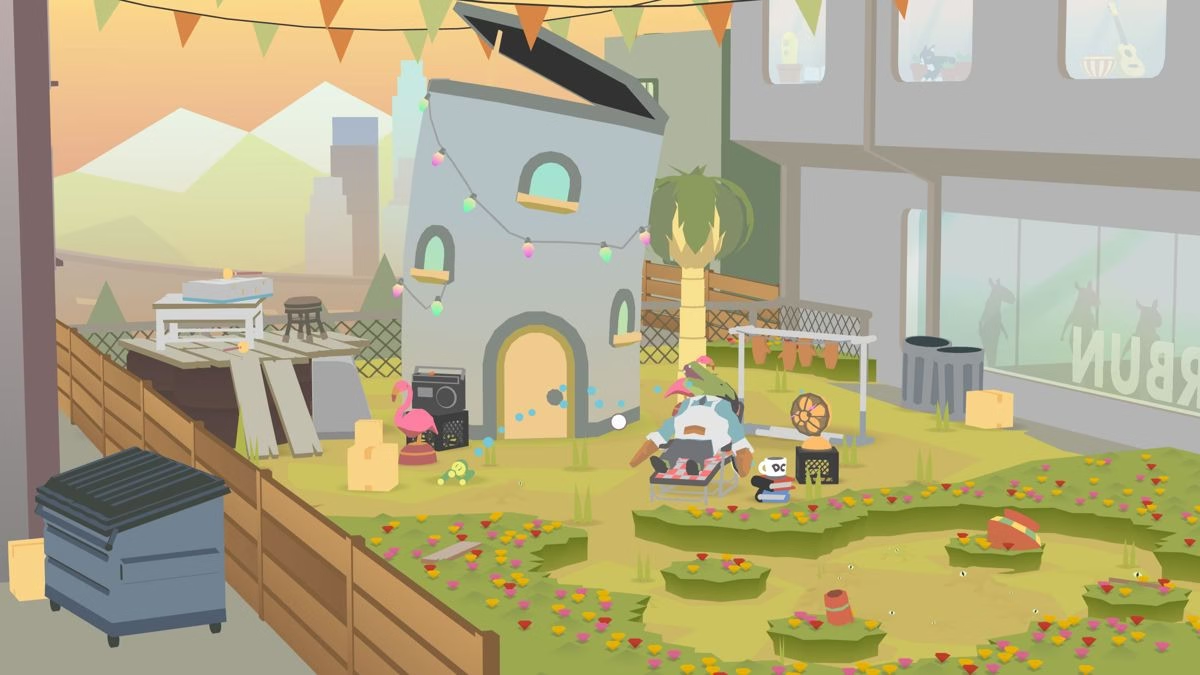
Miniature outdoor areas use flat-shaded pastel colors and simple angular shapes: yellow grass surrounds a crooked gray-blue house with a bright yellow door, bunting, pink lawn flamingos, trash bins, and a crocodile lounging in a chair. The stripped-down surfaces suit the toy-box scale, while the carefully separated colors make each object easy to pick out before you swallow it.
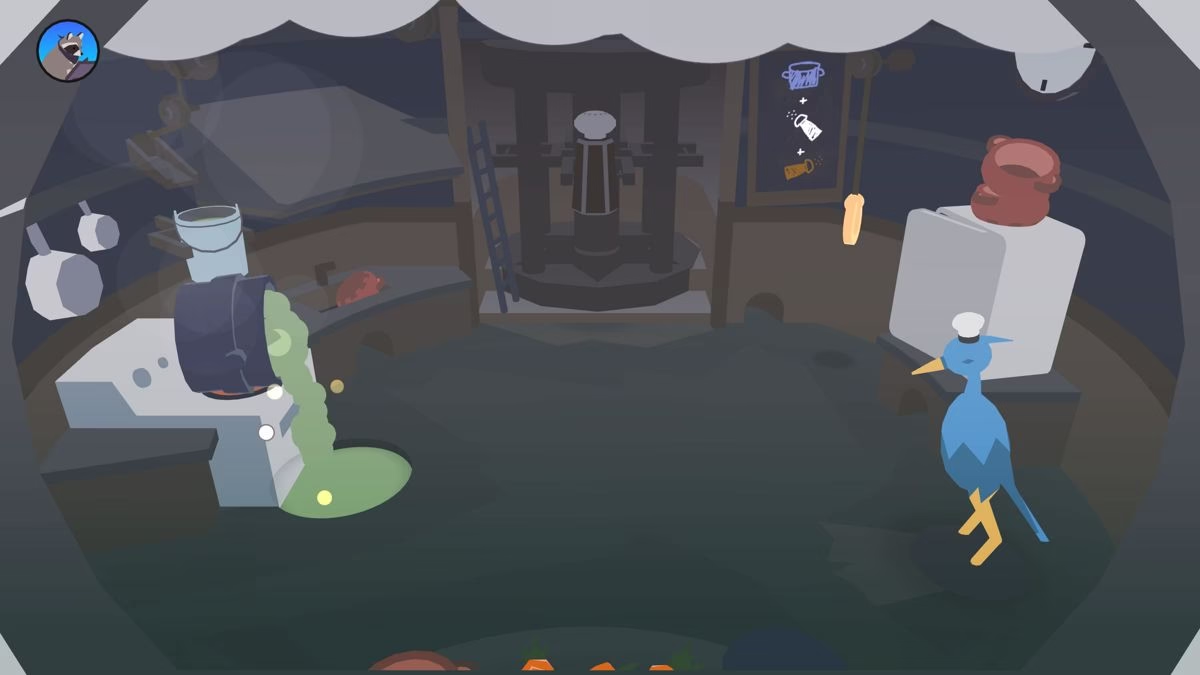
Indoor scenes keep that playful look. A blue, long-beaked chef bird stands near gray kitchen appliances while a black pot spills green soup and a carrot hangs overhead. These spaces are not detailed or realistic, but their odd little props give each puzzle a warm, handmade sense of place.
Story
BK, a raccoon who uses remote-controlled holes to steal trash for prizes, is an immediately funny engine for the game’s escalating nonsense. His scheme does not just clear away junk. It swallows his neighbors and their homes, and eventually drops him into trouble of his own when he falls into one of his holes.
From 999 feet underground, Mira and the other residents confront BK, framing the action with comic conversations between short levels. That structure gives the disappearing-neighborhood premise a human center without asking the story to carry more weight than its mischievous tone needs. BK’s selfishness supplies the conflict, while the neighbors give the chaos someone to answer to.
The writing works best as a steady stream of character comedy tied to the situations you have just dismantled. It is not a sprawling narrative, but it does give the puzzles context and makes each new resident feel like more than another pile of objects waiting to be eaten.
Overall Experience
Donut County succeeds because it commits to one strong joke and keeps finding new ways to make you participate in it. There is a special satisfaction in beginning with a hole too small for a mug and ending with enough space to erase the larger parts of a scene. The physics-puzzle twists provide just enough friction to make that growth feel earned.
Its modest scale and low difficulty are real tradeoffs, not hidden flaws. You are unlikely to come away with a marathon’s worth of intricate puzzles, but the game does not drag its premise through unnecessary repetition either. It is a compact comedy with a clear point of view and a welcome sense of momentum.
Give it a chance if you want an inventive, relaxed puzzle game with personality, especially if the act of tidying up by swallowing an entire county sounds appealing. Ben Esposito’s Donut County page offers more on the game’s creation, but the essential recommendation is simple: this is a small, silly adventure that understands exactly why making a hole bigger is fun.


Reviews
There are no reviews yet.