Retro Replay Retro Gaming History, Reviews & Emulation
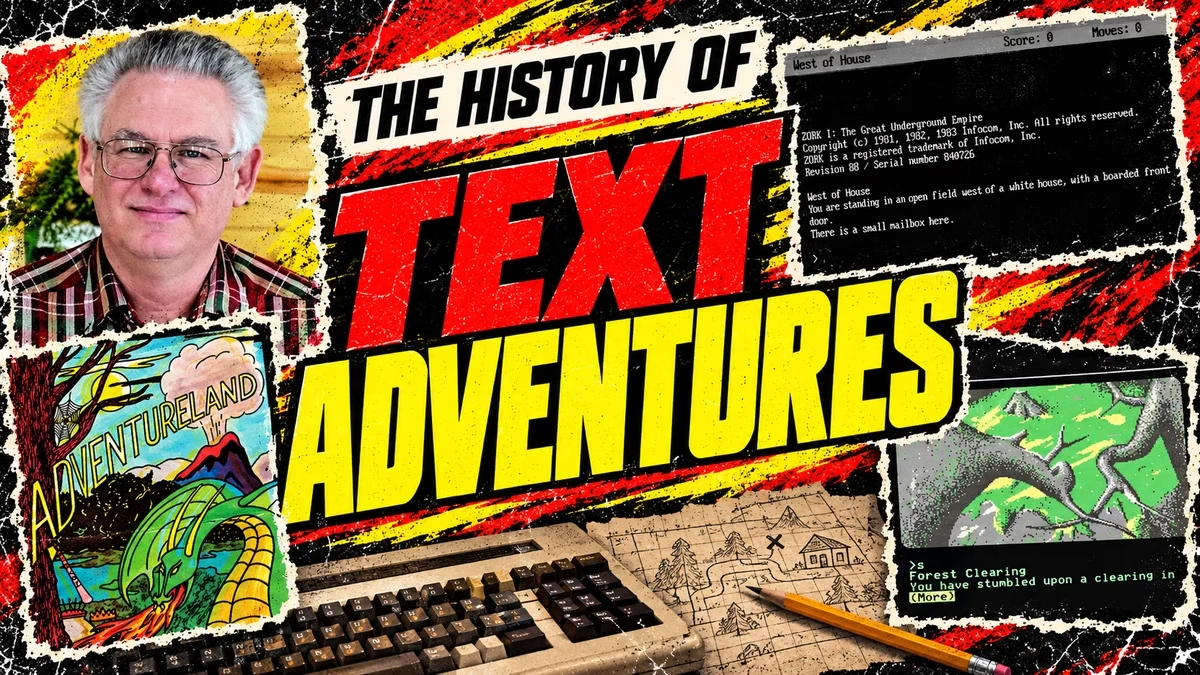
The house is locked. Knocking does not help. Neither does asking the computer to open the door again, although you give that a try. Beside the path is a mailbox. Well, you might as well look.
That is how an evening disappears in Zork. You go looking for a way into a house and end up underground, carrying a sword, worrying about your lamp and wondering where the thief has put something you were absolutely certain you still had. Somewhere beside the keyboard, a few boxes and connecting lines have become a map.
For the people who made these games, evenings could disappear just as easily. Scott Adams started coming to work early to explore somebody else’s adventure, then spent his spare time squeezing one into his TRS-80. At MIT, a group of programmers finished the cave game everyone was playing and decided they could do better. Before long, their own players were finding holes in the new world.
But the first cave had come from someone who knew the real thing. Before there was a treasure score or an adventure shelf in a computer store, Will Crowther had been underground with a surveying team, helping turn difficult passages into a map.
Explore the history of text adventures
- Part I: A real cave becomes an imaginary world (1975 to 1977)
- Part II: Scott Adams brings adventures home (1978 to 1985)
- Part III: Zork becomes a company (1977 to 1982)
- Part IV: Infocom’s writers leave the dungeon (1982 to 1987)
- Part V: Adventures abroad and Infocom’s last years (1981 to 1989)
- Part VI: The readers start writing back (1990s to today)
Part I: A real cave becomes an imaginary world (1975 to 1977)
Will Crowther brings the cave home

Will Crowther was a programmer at Bolt Beranek and Newman, where his working life involved the early computer networks. Away from the machines, he and his wife Patricia explored and mapped Kentucky’s caves. The rooms he would later describe on a screen began with places he had actually visited underground.
During 1975 and 1976, Crowther used a PDP-10 to make Adventure, the text game that became widely known as Colossal Cave Adventure. It drew on the Bedquilt region of the caves he knew. After his divorce, he shared it with his daughters. They could visit his imaginary underground world by telling the computer where they wanted to go.
The surviving early program, examined in Dennis Jerz’s research into the code, cave and family accounts, already had its impossible inhabitants. The recognizable passages shared space with magic, an axe-wielding dwarf and puzzles. The surveyor’s cave had acquired some very unexpected residents.
The player begins above ground, near a small building beside a road. There is a stream to follow and equipment to collect. Going into the building is a good idea. Remembering to take the lamp is an even better one.
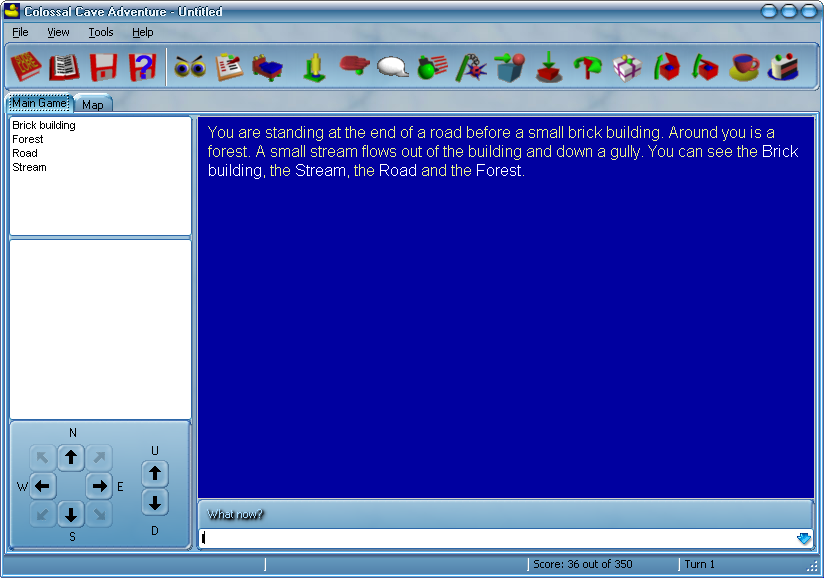
Once underground, the screen becomes a surprisingly demanding companion. It tells you what is nearby and which way you might go, then waits. A snake blocks the route. Somewhere else, a bird is available to anyone who can work out how to catch it. A few short descriptions have given you several jobs.
There is nobody on the screen to watch you make a mistake. You supply the explorer, along with most of the scenery. Yet when you arrive at a locked grate without the necessary key, being outside feels quite specific. The computer has remembered the key perfectly well. You are the one who left it behind.
Don Woods follows the stream

In 1977, Stanford programmer Don Woods found Adventure and contacted Crowther. With permission, he began enlarging it. More passages, treasures and complications filled out the expedition. The Open Adventure project’s historical account dates the familiar expanded Stanford release to June 1977.
Woods had an unusual distribution network at his disposal. Adventure could pass between people with access to research computers, without a box, a shop or a publisher arranging an introduction. One person found it, another heard about it, and somewhere a terminal that had been available for useful work became occupied by an explorer.
The treasure hunt gave those explorers a reason to keep coming back. Find something valuable, work out how to get it home, then go back for the thing you could see but could not reach. A successful expedition might end with more points. An unsuccessful one could end with a much better understanding of why you should have saved.
Maps accumulated beside terminals. Players drew a box for a room, added a line for an exit and discovered that the return journey did not always behave as expected. In the maze, similar descriptions made it painfully easy to confuse one place with another. A discarded object could become a landmark. Your inventory was suddenly helping with cartography.
The game could be maddening. A sound idea and a command the program did not recognize might produce the same unhelpful evening. Its parser, the code that read the player’s instructions, generally wanted compact exchanges such as a verb and a noun. Knowing what to do did not always mean knowing how to say it.
Still, people persisted. They compared discoveries, tried another route and returned to a puzzle that had looked hopeless the night before. By early 1977, Adventure had reached MIT. There, some of its most enthusiastic players were about to start making trouble of their own.
For most people at home, however, there was no way to join the expedition. The cave ran on computers they could not put on a desk or buy from a local store. In Florida, one of its newly devoted players decided to make an adventure for a machine he already owned.
Part II: Scott Adams brings adventures home (1978 to 1985)
Adventureland (1978): Scott Adams brings the cave to his desk
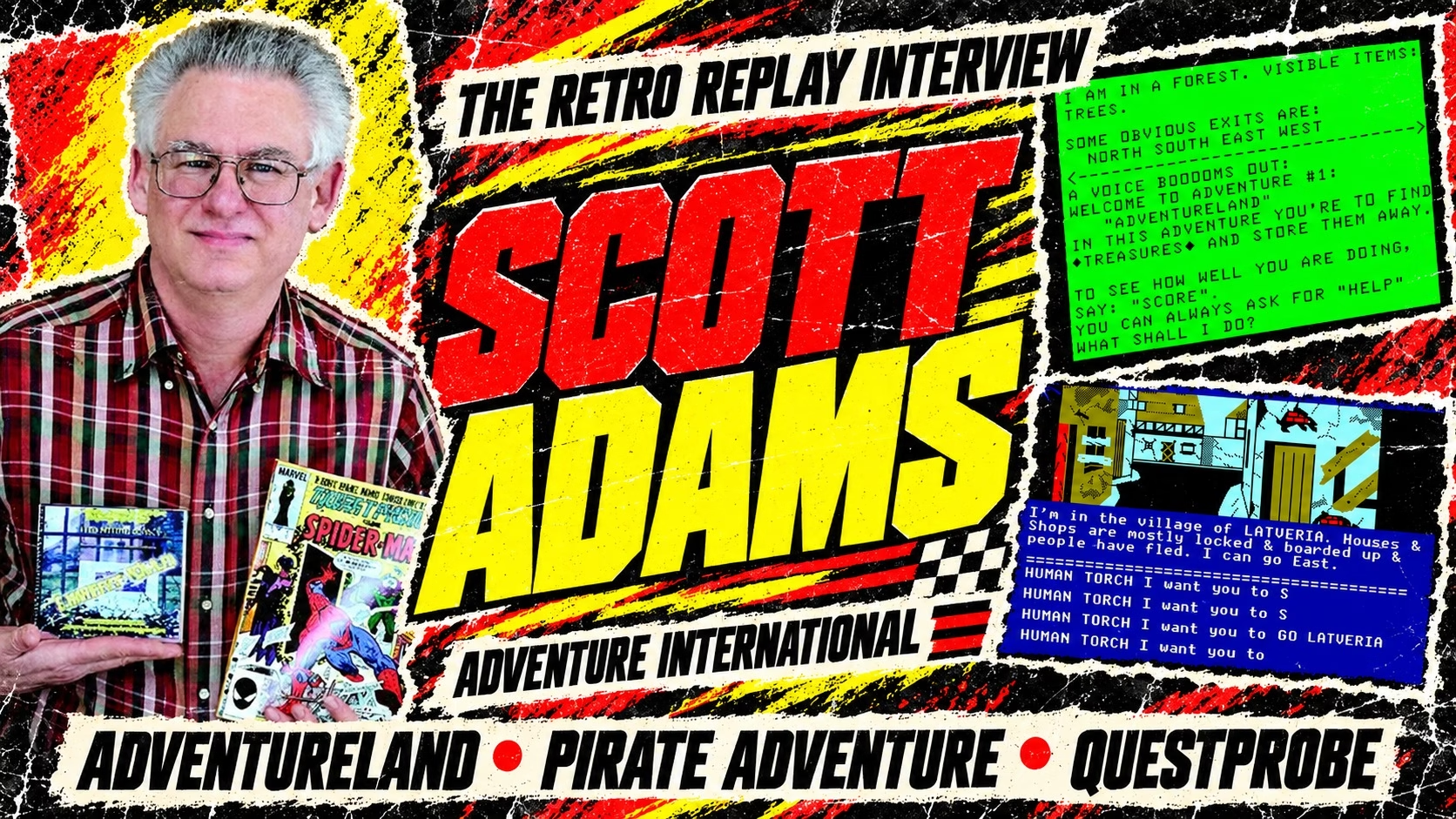
Scott Adams earned his living programming mainframes at Stromberg-Carlson. When a coworker introduced him to Colossal Cave Adventure, the working day acquired an irresistible attraction at either end: he came in early and stayed late to play. After a week, he had finished the cave. At home, his TRS-80 Level II was waiting for something equally absorbing.
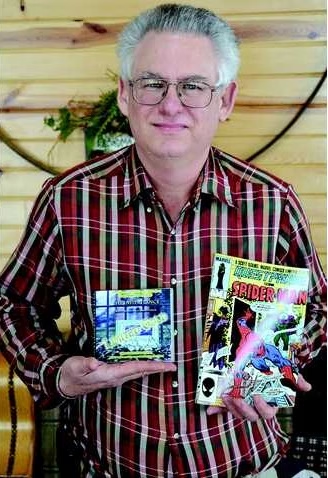
When Adams told his coworkers he would make a similar adventure for his own computer, they laughed. The TRS-80 had 16K of memory. The machine running the cave belonged to another class entirely. Bringing that experience home looked like an excellent way to keep himself occupied without getting very far.
Of course, I didn’t listen and the rest is history.
Adams tells the story in our Scott Adams interview. He began making the game, the language used to describe it and the compiler that processed that language together. When something would not fit, he went looking for another saving.
Words were expensive. Early versions needed only their first three letters to recognize them. Messages could be assembled from reusable fragments. He separated the places, objects and rules from the engine that read them, so the next game would not require building everything again.
The work became Adventureland, released in 1978. Now a player could sit at a home computer and enter a forest, investigate a swamp and go looking for treasures. The descriptions were short, but they gave you enough to get yourself thoroughly stuck.
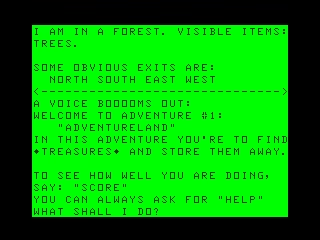
Adventureland keeps the essentials close. Here is your location. Here are the things you can see. These are the exits. You look at the list, choose something promising and type. A forest on a small display can occupy a remarkably large part of your attention when you are convinced the answer must be somewhere you have already visited.
Adams had tried selling a TRS-80 game before. His Dog Race, offered through a Radio Shack store, sold about five copies by his recollection. He has a much less flattering description of that effort in the interview. Adventureland gave him a more promising business, along with the problem of running it while keeping his day job.
This was the work that earned him the nickname “godfather of home computer adventure games.” Crowther and Woods had come first on larger machines. Adams was a home computer adventure pioneer and one of gaming’s original independent developers, making the adventure available to people who could buy the computer themselves.
Pirates in the library
After Adventureland, Adams could use the engine he had built to send players somewhere else. His second game, Pirate Adventure, arrived in 1978 with a tropical island and another treasure hunt. Alexis Adams joined the brainstorming, asking questions and contributing ideas as Scott worked out the new adventure.
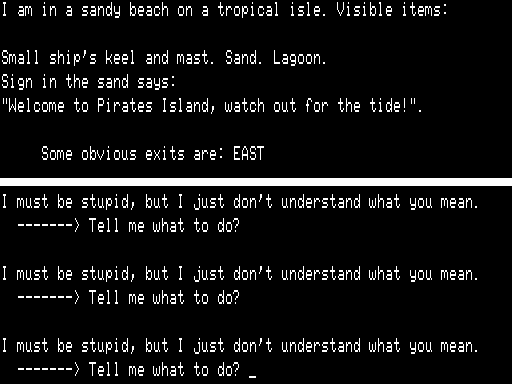
For a player, the familiar commands made the new setting easy to enter. The difficult part was what to do after arriving. You still needed to examine the objects, notice what seemed out of place and resist the very reasonable temptation to carry absolutely everything. A numbered adventure might be small enough to load from cassette and large enough to consume several evenings.
Meanwhile, the Adams home was acquiring the less romantic contents of a software business. Orders needed filling. Customers needed help. The operation occupied a ten-by-ten-foot room that had previously held Scott’s books.
Linda Novak became his first employee. Her husband Neal, a friend from Stromberg-Carlson, was also one of his most dependable testers. The games had to work for someone who had not written them, and Neal was useful at discovering where that hope came apart.
Eventually, the business moved into a strip mall. A computer shop occupied the front; the software operation worked behind it. Scott gave two weeks’ notice at Stromberg-Carlson. His employer offered him a way back if the venture failed, a reassuring thing to hear when you are leaving a programming job to sell imaginary problems.
Adventure International grew into a publisher of other developers’ work as well as Adams’s own. The reusable engine helped his adventures reach more computers. Once it worked on a new machine, much of the existing game data could make the trip with it. A different keyboard did not require a different pirate island.
The Count (1979): trouble after sunset
With adventures becoming his business, Adams could keep trying new settings. In 1979, The Count took players to a vampire’s castle, drawing on the Dracula movies he remembered from the 1930s and 1940s. He mixed their horror with humor and gave the place a day-and-night routine. Now the clock was another thing to worry about.
There is still a castle to investigate and a collection of objects to make sense of, but sunset makes taking your time seem less sensible. Adams intended a little fun with the old horror conventions. Some younger players told him they found the game frightening anyway. Dracula had apparently survived the trip into a small computer rather well.
Adams kept watching people play. A puzzle he understood perfectly might leave a tester stranded for reasons he had not anticipated. He could change it, test it again and see whether the discovery finally landed.
He connects that pleasure to comedy: Good jokes are very similar to good puzzles. When the receiver gets them, there is usually a burst of pleasure!
In his recollections of designing the adventures, the testing comes up repeatedly. A good solution needed someone besides its author to enjoy finding it.
Pictures, superheroes and an unfinished fourth adventure
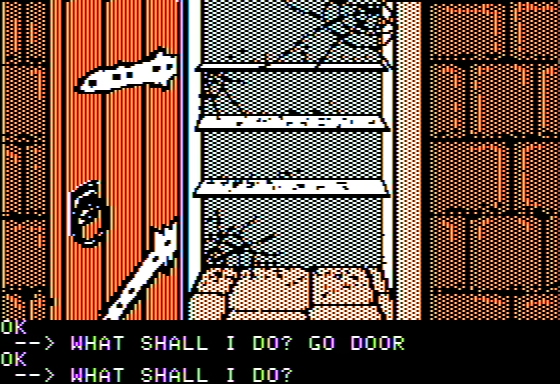
The illustrated Scott Adams Graphic Adventures, or SAGA, put pictures above the familiar commands. The Count’s castle could now show its stairs and doors. The artist, however, could also draw something the game had never heard of. Adams found himself checking what belonged in each picture and what needed to come out.
The illustrated adventures also took Adams into a collaboration with Marvel. Their Questprobe series put comic-book heroes into adventures he designed, beginning with the Hulk and continuing with Spider-Man, then Human Torch and the Thing. The faces were familiar, and their abilities were extraordinary. You still had to work out what to tell them to do.
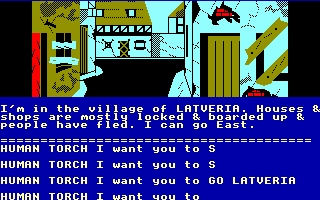
The plan called for twelve Questprobe games. Three reached players. Adventure International closed in 1985 while a fourth, involving the X-Men, was in development. The company that had outgrown a room of books and taken over the back of a shop was gone.
By then, Adams’s adventures had traveled across a remarkable variety of incompatible computers. He had shown that a home machine could hold enough world to keep somebody exploring. Another group had reached the same market with a larger world, longer sentences and a name that had started as a programmer’s temporary joke.
Part III: Zork becomes a company (1977 to 1982)
Zork (1977): four programmers make another way underground
Adams was not alone in wanting another adventure. At MIT, programmers Dave Lebling, Marc Blank, Tim Anderson and Bruce Daniels began Zork in 1977. Their underground fantasy would grow into a larger, more talkative expedition.

Lebling supplied a parser in MDL, also called Muddle. Blank, on a medical-school break, and Anderson built a four-room prototype. Lebling thought it was awful and went on vacation.
Blank and Anderson kept working, with Bruce Daniels helping design puzzles. They drew maps and argued. When Lebling returned two weeks later, they had a working adventure with a house, a thief, a troll and a dam.
They kept the temporary name, Zork. In Anderson’s history of the project, other players find MIT’s computer and begin exploring. Their complaints give the creators more work to do.
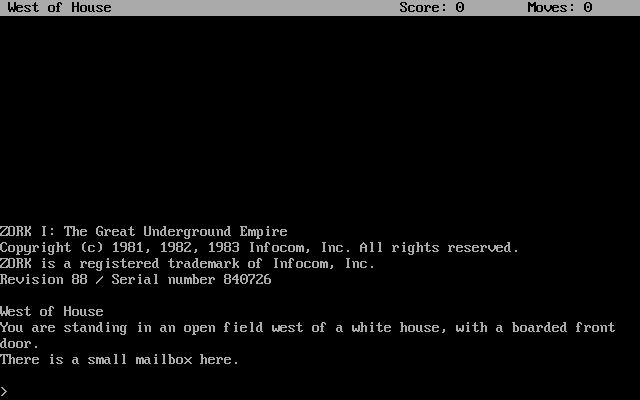
The commercial Zork’s white house is a marvelous invitation. The front door refuses to cooperate, but you can walk around the building, investigate the window and get inside. There are ordinary domestic things to examine. Then there is a trapdoor. So much for an ordinary house.
The game has a sly way of making you curious about something that is clearly going to be a problem. The thief is particularly good at rearranging an expedition. You can have a sensible plan, a useful object and a place to take it, then discover that the inventory has become shorter since you last checked.
Even the darkness had to survive the players’ scrutiny. Early Zork killed explorers with bottomless pits. Players pointed out that a bottomless pit in an attic ought to be noticeable downstairs. Lebling replaced the pits with grues. The house was structurally more convincing, and being in the dark remained an excellent way to die.
Marc Blank and the questions after the question

Blank and his colleagues spent a great deal of time making the computer a less exasperating listener. If you wanted to attack something but had more than one suitable weapon, the game could ask which one you meant. Answering that question did not require starting the whole command again.
Lebling, Blank and Anderson described their work in the 1979 IEEE Computer article, Zork: A Computerized Fantasy Simulation Game. Behind the rooms were objects with properties and general rules for using them, plus special handling where a puzzle needed it. A bottle could hold something; a particular bottle could also be involved in a particular problem.
You could spend a long time testing the hospitality of that arrangement. Examine the sack. Open it. Try taking its contents. Try an action the description seems to invite and see whether somebody has anticipated it. Occasionally, the reply is funny enough to reward an idea that was never going to work.
And occasionally, the program simply does not understand. Zork never became a conversation with an infinitely patient human. It did, however, get remarkably good at sounding as though someone had been waiting for you to try that.
Getting Zork out of MIT
Infocom formed in 1979, bringing together people connected with MIT who wanted to keep working together commercially. Games were among several possibilities. Zork was already attracting players, but those players were using large computers. A customer with a TRS-80 needed something they could actually load.
Blank and Joel Berez, a fellow member of the MIT group and one of Infocom’s founders, worked on the escape plan. They designed an imaginary computer, the Z-machine, and a compact form of instructions for it. Each real home computer would run a smaller program that understood those instructions. The story itself could stay largely the same.
There was still too much of it. Blank and Stu Galley’s 1980 Creative Computing account explains how the system fetched material from disk as needed. The player’s computer did not have to hold the entire world in memory. It could bring in the next piece while keeping the adventure moving.
The practical payoff was a game that could reach an Apple II as well as a TRS-80 without its writers rebuilding every room. That mattered in a computer store where customers might own machines that agreed on very little.
Zork I: The Great Underground Empire reached the TRS-80 in 1980 through Personal Software, with Infocom later handling its own publishing. Getting it there meant dividing and reworking the larger adventure. Blank and Lebling continued the commercial series with Zork II in 1981 and Zork III in 1982, giving returning players more of the world they had started beneath the house.

Returning players found more than another set of valuables. Zork II supplied a wizard quite capable of interfering with their plans. Zork III made the journey toward the Dungeon Master stranger and less comfortably settled than the first game’s treasure hunt. Familiar commands were useful. Assuming that every new situation existed to add to your score could be less helpful.
By 1982, Infocom had three Zork adventures in the shops and a system its writers could use for something else. Blank’s next project brought the player out of the dungeon and into a household where somebody had died. The people inside were going to need more attention than the furniture.
Part IV: Infocom’s writers leave the dungeon (1982 to 1987)
Deadline (1982): Marc Blank opens a murder investigation
After helping build Zork’s underground empire, Marc Blank gave players a rather different reason to search a house. His next adventure, Deadline, was a murder mystery. There would be no treasure to carry home. You had to find out how a man died, and you had one day to do it.
Published by Infocom in 1982, Deadline casts you as the detective investigating the apparent suicide of businessman Marshall Robner. You arrive at his estate at eight in the morning. By eight that evening, you need something more convincing than a collection of suspicions.
The case documents supplied with the game get the investigation started before you enter the house. Read the evidence, consider the people involved and decide where to begin. It is a lovely way to draw you in, right up to the moment you realize how much you do not know.

Inside, the household keeps moving. Following one suspect means leaving another unwatched, and a conversation that gets nowhere can use up time you would dearly like back. You can be poking around one room while something useful happens elsewhere. Nobody offers to repeat it because the detective was busy.
That makes Deadline demanding in a way Zork’s treasure hunt usually is not. You are trying to reconstruct somebody else’s day while deciding how to spend your own. Saving, replaying a stretch and following a different person can begin to feel like checking a theory. Eventually, the movements and the evidence start to belong to the same case.
Enchanter (1983): back underground, with a spell book
Blank and Dave Lebling had not finished with fantasy. Together they wrote Enchanter, released in 1983, which returned to the world of Zork with a new occupation for its visitor. This time, you were a novice magician sent to confront a dangerous sorcerer. Your spell book was going to need some work.
Finding another spell gave you a reason to reconsider places you had already visited. Something that had resisted ordinary meddling might be less troublesome once magic became involved. The contemporary Ahoy review followed players into a game that made learning spells part of exploring its world.
It was familiar territory with a welcome new set of toys. The old habit of trying everything remained useful, although now the consequences could be more spectacular. Infocom could return to its fantasy world without simply sending someone else through the same trapdoor.
Planetfall (1983): Steve Meretzky reports for duty
The next writer to take players somewhere new had first encountered Infocom at his dining room table. Steve Meretzky shared a home with Mike Dornbrook, who tested the company’s games there. Meretzky watched, then started looking for bugs himself when his roommate was away.

When Dornbrook left for business school, Blank needed someone to test Deadline. Meretzky became a paid tester in November 1981. About a year later, Blank offered him a game of his own. His biography, prepared with his contributions, follows that route from interested spectator to Infocom author.
That game was Planetfall, a science-fiction adventure released in 1983. Meretzky put the player in the Stellar Patrol, then handed over a mop. Whatever glorious space career you might have pictured, you were starting near the bottom.
The recruiting brochure in the package made the job look rather more attractive. Then a disaster interrupted the chores and left you trying to survive on an unfamiliar planet. Cleaning duty began to seem like a perfectly acceptable assignment.

There are abandoned facilities to explore and machines whose owners are no longer available to explain them. Floyd, a childlike robot, supplies the company. He comments, gets excited and interrupts the search with his own activities. Soon you are looking for news of him among the descriptions of rooms and equipment.
Meretzky gives that friendship time to become ordinary before putting Floyd in danger. The later sequence has become one of the most famous in text adventures, but it earns its force during the quieter business of exploring together. By then, he is your companion. You would quite like both of you to get out of this place.
The Hitchhiker’s Guide to the Galaxy (1984): an author becomes a co-conspirator
Planetfall had established Meretzky as a writer of funny science fiction with room for something more painful. His next collaborator already had a considerable reputation for making space travel go badly. British author Douglas Adams had created The Hitchhiker’s Guide to the Galaxy for radio, then turned it into novels. He was also an enthusiastic Infocom player.

For the 1984 game, Adams worked with Meretzky to turn Arthur Dent’s disasters into problems the audience could attempt to solve. They exchanged material through a computer network and met in England to finish the work. Their 1985 Commodore Power/Play interview describes a collaboration in which the player could keep departing from the author’s preferred sequence.
It starts with a hangover. Arthur’s house is scheduled for demolition, and there are larger demolitions to worry about shortly. First, though, you have to get him through a morning that is already going very badly. Adams’s universe has found another person to inconvenience: the one typing.
The Babel fish makes that relationship particularly personal. You need the little creature to understand alien speech. Getting it requires a chain of preparations, with each failed attempt exposing something else you should have arranged. You fix the latest problem, try again and discover the next one.
The sequence is funny enough to admire and demanding enough to resent. Hitchhiker’s can make a player laugh while reaching for an earlier save, which is a very particular kind of hospitality. Having read the book does not guarantee that the fish will cooperate.
Suspect (1984): Dave Lebling and the unobservant household
While Meretzky and Adams were putting Arthur through that ordeal, Lebling had another murder mystery in the works. His 1984 adventure Suspect returned to the business of questioning people and piecing together a killing. Before customers could investigate, Infocom’s testers had to find out whether the cast could survive their own story.
Lebling’s account in The New Zork Times records what happened. The murder victim could listen to conversations. Once testers discovered that, they checked what else could listen. Her husband failed to react when shown the body. Testers carried it into the ballroom unnoticed, and police could walk straight past it.
A carefully arranged mystery had briefly become a farce. These were the rehearsals that customers were not meant to see, with testers doing the inconvenient things a writer might never think to try. The corpse had to stop listening. The living needed to pay considerably more attention.
A Mind Forever Voyaging (1985): Meretzky takes a darker turn
After the jokes and repeated disasters of Hitchhiker’s, Meretzky wrote a science-fiction adventure with a much grimmer destination. A Mind Forever Voyaging, released in 1985, asks what happens when a political promise is allowed to shape the decades ahead. The player has been built to find out.
You are PRISM, an artificial intelligence that has experienced a simulated human life as Perry Simm. Discovering what you really are is only the beginning. Now the researchers want you to enter projected futures, observe the changes and bring back a record.
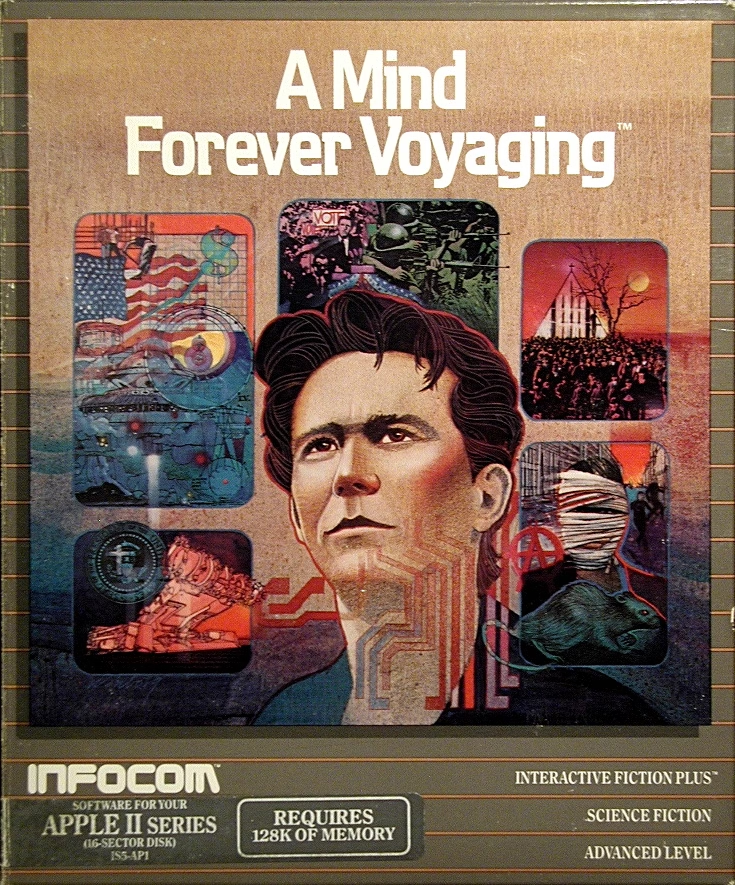
The manual and fictional documents establish the research project and the world of 2031. Inside the simulations, the city of Rockvil becomes a place you learn by returning to it. A street encountered earlier is still there to visit, but the years have done something to it.
You walk, watch and record. The ordinary adventure habit of examining everything now gives you a job much closer to reporting. Remembering an earlier visit can make the next one deeply unpleasant.
Meretzky is making a political argument, and the futures are his written consequences of the plan. What makes the game linger is having to spend time in them. You cannot put the city’s troubles away quite as neatly as a solved puzzle.
Wishbringer (1985): Brian Moriarty’s first Infocom story
Elsewhere at Infocom, Brian Moriarty had been helping the adventures reach home computers, working on the programs that made their stories run on different machines. Blank gave him the chance to write one himself. His first Infocom adventure, Wishbringer, would welcome players with an errand in a seaside town.
Released in 1985, it began with a practical idea for the box. Moriarty wanted an inexpensive magical object. A ring seemed overfamiliar, so he chose a glowing stone and built the story around it, as he explained in his playful AmigaWorld interview with himself.
You play a mail clerk delivering a letter to a magic shop. A kidnapped cat turns the errand into a rescue, and the town changes into somewhere considerably less welcoming. The stone offers wishes when the obstacles become too much. Experienced players can attempt solutions that leave its magic unused.
It is a generous invitation to someone curious about Infocom but wary of spending a week trapped in the opening rooms. You can get help and keep going, then come back to see whether you can manage without it.
Trinity (1986): Moriarty’s holiday ends badly
Having guided newcomers through Wishbringer, Moriarty went somewhere far less reassuring for his second Infocom adventure. Trinity, released in 1986, combines a fantastic landscape with the history of nuclear weapons. It begins with an American tourist trying to enjoy the last day of a London vacation.
Kensington Gardens offers a little peace away from the tour bus. The international news has been grim, but there is still a park to wander around. Then nuclear catastrophe arrives, and finding a way out becomes rather more urgent than sightseeing.
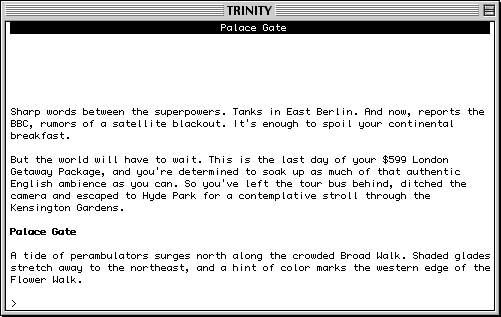
The escape leads into an impossible world where mushroom doors open routes into atomic history. The original package places a history of the bomb beside the fantasy. The journey eventually reaches the first atomic test in New Mexico.
Moriarty lets you enjoy the strangeness before confronting you with where it leads. A curious object still invites investigation. A path still makes you want to see what is at the other end. The places beyond the doors make those familiar pleasures increasingly uneasy.
What came home in the box
By this point, an Infocom purchase could leave quite a collection beside the keyboard. Deadline supplied case documents. Planetfall tried to recruit you. Wishbringer handed over a stone that belonged inside its adventure.
These objects, widely called feelies, were part of the company’s appeal. In a 1984 Family Computing interview, Blank and fellow Infocom author Michael Berlyn discussed games sold in unusually inviting packages. Starcross, a science-fiction adventure, had appeared in a flying-saucer-shaped box. The Witness, a period murder mystery, came with material suited to its case.

Some of it was useful evidence, some of it helped establish the setting, and all of it gave a screen full of words something a customer could pick up. Keep it when you return to the games. A working story file is a wonderful thing to have, but it may still expect you to read the paper that arrived with the original disk.
Part V: Adventures abroad and Infocom’s last years (1981 to 1989)
The Hobbit (1982): Thorin has found somewhere to sit
Across those same years, players outside Infocom’s audience had been making adventures of their own. One of the most ambitious came from Melbourne. The Hobbit, published by Melbourne House in 1982, sent players out of Bilbo Baggins’s comfortable home and into Tolkien’s journey with companions who could be alarmingly unhelpful.
Its creators were computer science students Veronika Megler and Philip Mitchell, working at Beam Software. Megler had found the earlier cave adventure too static and wanted a world with more independent life. She developed its behavior while Mitchell worked on the language players would use. Alfred Milgrom’s suggestion of The Hobbit supplied the story around which their work took shape.

In her Classic Adventurer interview, Megler recalls building a system that could support a changing world, rather than only the one route through Tolkien’s book. The inhabitants could act while Bilbo was occupied with something else. That made them more interesting company and considerably less dependable equipment.
The manual celebrated Inglish, the language system that allowed more elaborate instructions and commands addressed to characters. Getting those instructions accepted was one challenge. Getting the journey to proceed as you hoped was another.
Thorin’s habit of sitting down and singing about gold became part of the game’s personality. Tolkien might have supplied a quest of enormous importance, but your companion could still find time for a song. Players who remember the adventure often remember the company as clearly as the destination.
Level 9: send an envelope if you get stuck
Brothers Pete, Mike and Nick Austin had a more modest start to their British software business. In 1981, Level 9 became a registered company with £40 and a 16K Nascom kit computer. Orders came through classified advertisements. The programs were recorded and mailed individually.
Its fifth-anniversary history records the first three adventures arriving in 1982, including Colossal Adventure. Players received a booklet and an addressed, stamped envelope for requesting a personal hint. When a puzzle became impossible, someone at the company would help.
By 1983, with their science-fiction adventure Snowball taking players into space and the games reaching more home computers, the business had grown enough to recruit family and friends for Christmas packaging. The following year, Pete was being swamped by as many as a hundred clue requests a day. Comprehensive clue sheets became a practical necessity. The audience had become too large for every stuck explorer to receive an individually written rescue.
Graeme Yeandle approached adventure-making from another small operation. Visiting nearby Gilsoft to inspect its software led to an agreement that he would write an adventure for it. The company was operating from Tim Gilberts’s bedroom.
Yeandle’s first game, Timeline, exposed a tiresome routine. Changing its data meant assembling, linking, saving and loading again, all with cassette tapes involved. He built a better editor to make his own work easier. Selling that editor became The Quill, released for the Spectrum in 1983.
In his account of the project, Yeandle remembers worrying about errors that might corrupt somebody’s game. The tool was no longer just his convenience. People would be trusting it with their own adventures. They could define a world and its puzzles without writing an entire engine, then send somebody else into the trouble they had made.
The Pawn (1985 to 1986): something to show the magazines
Another British team was preparing an adventure that would look particularly good on the newer machines. Magnetic Scrolls’ The Pawn first appeared for the Sinclair QL in 1985, then reached a wider audience in illustrated editions. Its fantasy kingdom, Kerovnia, came with an unhelpful assortment of people and a writer who had never been paid to write before.
Rob Steggles knew programmers Ken Gordon and Hugh Steers from school. With Anita Sinclair, they asked him to write the adventure. He received a text-entry tool called Fred23 and set about defining objects, writing descriptions and filling their world. The beautiful pictures would come later.

Steers often supplied the starting idea, and the team followed what amused or interested them. Dull ideas came out. Steggles’ recollection of the writing makes the process sound much closer to friends entertaining one another than a carefully plotted production schedule.
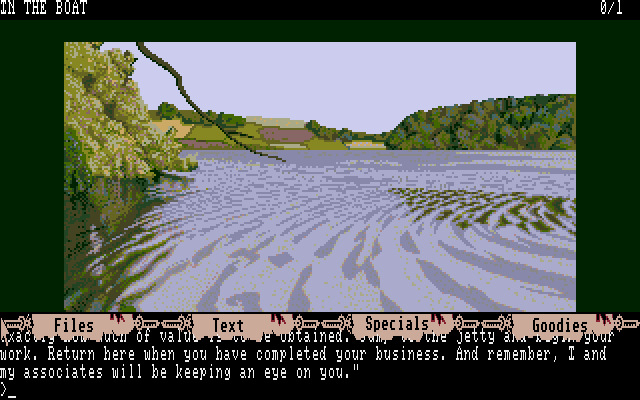
The text-only QL release appeared in 1985. Illustrated versions followed through Rainbird. Geoff Quilley’s pictures gave magazines something striking to print, and Steggles remembered their importance to the publicity. A reader who had not yet typed a command could already want to see the place.
Pictures also gave players more things to ask about. Scott Adams knew the problem well: Biggest problem with graphic adventures was the artist might put something into the picture that the text game was not expecting.
His recollection of checking the SAGA artwork will sound familiar to anyone who has tried to pick up a conspicuous object and been told that it does not exist.
The Guild of Thieves followed in 1987. Steggles thought it more coherent and accessible. Treasure gathering now had an organization considering your application. You were trying to join a thieves’ guild, and the interview involved taking things.
The Lurking Horror and Plundered Hearts (1987): familiar writers, new trouble
By the time The Guild of Thieves arrived, Infocom’s writers had also traveled well beyond the cave. In 1987, Lebling returned to the university world he knew for The Lurking Horror. His horror adventure begins with a student at a computer, an assignment to finish and a snowstorm outside. It is an excellent excuse to stay in the building, until the building gives you reasons to reconsider.

The Amiga edition even let the horror make itself heard. In an interview in Infocom’s newsletter, Lebling described selecting sound effects with the help of a tester who cataloged sounds mentioned in the story. A text adventure could still find another way to make someone jump.
Amy Briggs, another player who had joined Infocom as a tester, was writing a very different adventure. She had studied English and enjoyed historical fiction and romance. For Plundered Hearts, released in 1987, she wrote the kind of game she wanted to play: a romantic adventure with a woman at its center.
The heroine travels to the West Indies and becomes entangled in danger, pirates and rescues. Briggs explained in the same newsletter that rescuing people interested her more than accumulating treasure. A romantic setting did not mean standing around waiting for the hero to sort everything out. He might need rescuing himself.
Beyond Zork (1987) and Zork Zero (1988): going back with new equipment
Moriarty followed Trinity with Beyond Zork, a fantasy adventure that brought role-playing statistics and an on-screen map into the old empire. Released in 1987, it gave players more to consider when a confrontation turned unpleasant. The person carrying the inventory now had abilities of their own to worry about.
Meretzky returned the following year with Zork Zero, a prequel that added graphical elements around its text. These were recognizable Infocom adventures being adapted and extended by writers who already knew the format intimately. Their work continued while the company behind it was running short of room to maneuver.
Cornerstone and the end of the Cambridge office
The expensive trouble had begun earlier. Infocom’s founders had never intended to make only games. Cornerstone, their database product, arrived in 1985 with the hope of reaching business customers. The company had hired people, expanded and committed money to that future. The sales did not pay for it.
Down From the Top of Its Game, the MIT study based on records and staff interviews, follows the strain inside the company. Revenue from adventures helped support the business-software effort. Game developers still needed resources for their own work, including the new technology customers were coming to expect.
It is a particularly unhappy piece of timing. While Meretzky was sending PRISM into projected futures and Moriarty was building a town around a glowing stone, the company supporting them was gambling on a very different customer.
Activision acquired Infocom in 1986. The games continued, but the old independence did not. In 1989, the Cambridge operation closed. The name would appear on later releases, and Zork would return in graphical adventures. The original studio, with its writers, testers and accumulated ways of making an imaginary world misbehave, was finished.
Players still had unfinished games. Some also wanted to know how to write one. They began exchanging the answers in places that did not need a distributor or a shipping department.
Part VI: The readers start writing back (1990s to today)
A new adventure in an old format
One of those players was Graham Nelson, a mathematician at Oxford who had first encountered Adventure as a child. A neighbor took him to play at weekends in a converted biscuit factory. Later, Nelson wrote small adventures on his Acorn Atom and played Infocom’s games. When the company was gone, he remained curious about how its stories worked.
In 1993, that curiosity produced Inform, his own system for creating games in the Z-machine format, and Curses, the adventure he wrote with it. His interview in the first XYZZYnews follows the investigation that led him to build a compiler he had not originally intended to write.
Curses begins with an errand in a house and sends the player into a much larger adventure. It was a new game that could offer the old pleasure of searching somewhere ordinary and discovering that the place had far more in it than expected. Anyone tempted to write their own could use the tools Nelson released alongside it.
Michael J. Roberts’s TADS offered another language and set of tools. Someone who wanted to write an adventure could now choose a system, work on a game and ask other authors for help. On computer networks, those authors were finding one another.
The conversation did not require a publisher to approve the next box. A new game could be uploaded, played and argued over. Its author could repair a bug and put out another version. The people who had once waited for a release could be the people making it.
IFComp (1995): please finish something shorter
Kevin Wilson was an undergraduate at Berkeley, working on his own adventure, when a discussion on rec.arts.int-fiction suggested a competition for short Inform games. He took up the idea. After debate on the newsgroup, the first competition in 1995 admitted games that could be won in under two hours, with separate Inform and TADS divisions.
Twelve entries arrived. According to IFComp’s history, discussion continued for weeks after the votes. There would be another competition. In 1996, the separate divisions went away and the games competed together.
A deadline gave an author a reason to finish. The length rule gave players a chance of seeing the ending before the season changed. You could try several adventures, find something surprising and talk to the person who had written it.
That annual gathering gave new writers somewhere to bring work that might never have found a place on the old software shelf. By 1998, one of its winning games was asking experienced adventurers to put aside the habits they had spent years learning.
Photopia and Spider and Web (1998): be careful what you assume
The author was Adam Cadre, who was dividing his writing between prose and interactive fiction. After finishing a novel in the summer of 1998, he returned to game-making with the competition deadline approaching. Photopia looked like an idea he could finish in time. In his account of making it, watching The Sweet Hereafter had helped turn his attention toward a more literary, emotionally direct adventure.
His Photopia won the 1998 competition. It tells its story through shifting scenes, giving the player commands to type and things to do while the connections gradually become clear. Collecting an inventory and hunting for the next obstacle will not tell you what is happening.
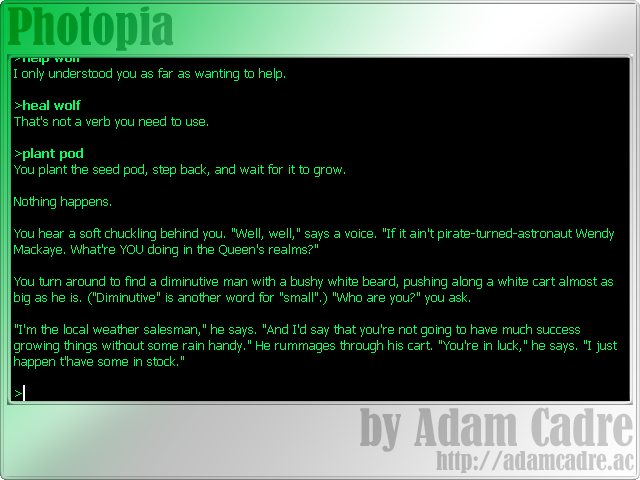
The colors, the shifts of setting and the people in those scenes begin to connect. By the time the connection lands, you may wish you had paid a different kind of attention earlier. Cadre’s own pages about his interactive fiction distinguish playing to win from participating in a story. Photopia gives a player accustomed to the first plenty of reason to stay for the second.
Interactive-fiction writer Andrew Plotkin was developing another sort of surprise. He traced the idea for Spider and Web to a walk toward a bookstore in February 1997. Released the following year, his spy thriller made an interrogation the frame for the adventure. You had to operate the equipment of an espionage story while paying attention to who was hearing your account.
Plotkin’s own playing advice is unusually revealing. He asks players to accept nonfatal mistakes rather than replay every scene for maximum efficiency. Later, he warns, the danger becomes real and careful saves matter. The author is telling you that the habits used to perfect an adventure can get in the way of this one.
Galatea (2000): stay and talk
Two years later, interactive-fiction writer Emily Short brought Galatea to the 2000 IF Art Show. Where Cadre had moved between scenes and Plotkin had reconstructed a mission, Short kept the player in a conversation with an animated statue. Her adventure was built around finding out who this person was and how the encounter might develop.
In her account of the design, Short describes interests in art, identity and relationships that fed into the work. You can ask questions, follow a subject and find the exchange moving toward one of several endings. The Electronic Literature Collection preserves the game and its original presentation.
Coming back and trying another approach can produce another encounter with the same statue. The room has not become larger. There is simply more to hear.
Twine and 80 Days: choose your route
As more writers found their way into interactive fiction, the typed command became one of several ways to lead a reader through a story. Chris Klimas created Twine, an authoring tool that let people connect passages through choices and publish the result as a web page. A writer could begin with the words and the decisions, without first building a parser.
For authors whose stories did not need an inventory or a simulation of containers, the tool removed a considerable amount of work. Readers chose from the words on the page. The next passage could answer that decision immediately, without an argument about the verb.
Around-the-world travel proved a splendid home for that kind of reading. In 2014, British studio inkle released 80 Days, an illustrated adventure based on Phileas Fogg’s wager. Directors Jon Ingold and Joseph Humfrey worked with lead writer Meg Jayanth to make a journey shaped by the player’s route and the people encountered along it.

The globe looks inviting until you consider the time and money. A promising route costs something. A conversation may reveal another possibility. Fogg still expects to win his wager, even when the person managing the trip would quite like to investigate something off the most efficient path.
Its official description offers airships, submarines and mechanical camels among the means of travel. An adventure that began with someone typing a direction in a cave had acquired a great many ways to miss a connection.
The old house is still there
In November 2025, Microsoft, Xbox and Activision announced an MIT-licensed source release for Zork I, II and III. The announcement worked with the games’ historical repositories, giving programmers another route into studying the original adventures. It covered those three games, rather than the entire Infocom catalog.
Opening the code is one way back. Playing is another. Windows Frotz runs Infocom and other Z-machine story files. ScummVM supports several interactive-fiction formats through its Glk engines; its compatibility list is the place to check a particular game and release.
Keep the manual beside you, especially if the original box contained evidence. Make a separate save before doing something reckless. A little graph paper remains useful, although you can now put a map in a second window and pretend the desk is less cluttered.
Then go back to the white house. Walk around it. Try the window.
Once inside, you will find a lamp and a trapdoor. There is probably time to look underneath before bed.
Related histories
- The Complete History of ScummVM: 25 Years of Adventure
- The History of Team Fat: From Maniac Mansion to Wing Commander and The 7th Guest
Sources and further reading
- Scott Adams interview, Retro Replay. Firsthand memories of Adventureland, the business, puzzles and illustrated adventures.
- Dennis G. Jerz, Somewhere Nearby Is Colossal Cave. Original code, Kentucky cave research and family interviews.
- Open Adventure, a brief history. Crowther and Woods versions and the expanded game’s chronology.
- Tim Anderson and Stu Galley, The History of Zork. The creators’ accounts, published in The New Zork Times in 1985.
- Lebling, Blank and Anderson, Zork: A Computerized Fantasy Simulation Game. Their April 1979 IEEE Computer article.
- Blank and Galley, How to Fit a Large Program Into a Small Machine. The 1980 Creative Computing article on the commercial system.
- Dave Lebling, They’re Never Satisfied. Testing Suspect, from The New Zork Times, fall 1984.
- Stu Galley, Parser???. A developer’s explanation from The Status Line, spring 1989.
- Deadline, original instructions. Infocom’s detective-game instructions and case material.
- Planetfall, original manual and recruiting material. The Stellar Patrol and the original game’s presentation.
- Steve Meretzky biography, prepared with his contributions. Dornbrook’s dining room testing, Meretzky’s November 1981 hire and his move into writing.
- The Hitchhiker’s Guide to Douglas Adams, Commodore Power/Play. The 1985 interview about Adams and Meretzky’s collaboration.
- A Mind Forever Voyaging, original package and manual. PRISM, the simulation assignment and the fictional political program.
- Brian Moriarty, The Wizard of Wishbringer. A self-interview and studio visit from AmigaWorld, early 1986.
- Trinity, original package and manual. The game’s setting, instructions and historical framing.
- The Hard-Boiled School of Software, Family Computing. A June 1984 interview with Marc Blank and Michael Berlyn.
- Veronika Megler interview, The Classic Adventurer, issue one. The Hobbit’s world model, parser and collaboration.
- The Hobbit, original manual. Inglish, characters and the illustrated adventure.
- Level 9, fifth-anniversary history. The company’s account of its early games and expansion.
- Graeme Yeandle interview, CASA. The Quill, its development and authoring tools.
- Rob Steggles interview, Magnetic Scrolls Chronicles. The Pawn, writing tools, illustrations and The Guild of Thieves.
- Enchanter review, Ahoy, March 1984. A contemporary account of the magic-based adventure.
- The Status Line, winter 1987. Dave Lebling on The Lurking Horror sound effects, Amy Briggs on Plundered Hearts and the introduction of Beyond Zork.
- Down From the Top of Its Game. Infocom research based on records and staff interviews.
- Graham Nelson interview, XYZZYnews, issue one. The development of Inform and Curses.
- IFComp, official competition history. The first competition and its later community.
- Adam Cadre, interactive fiction. The author’s games, descriptions and playing resources.
- Adam Cadre, the Photopia Phaq. The author on writing Photopia, its literary influences and the competition deadline. Contains game spoilers.
- Andrew Plotkin, About Spider and Web. Author’s notes and a route to the game.
- Galatea, Electronic Literature Collection. Emily Short’s conversation-centered work and publication history.
- Emily Short, Multilinear IF. The author on the structure and interests behind Galatea.
- TADS, official site. Michael J. Roberts’s interactive-fiction development system.
- Twine, official site. Chris Klimas’s tool for interactive, nonlinear stories.
- 80 Days, inkle press kit. Release dates, credits, images and the text-driven journey.
- Microsoft, Zork I, II and III open-source announcement. The November 2025 code release and historical repositories.
- Windows Frotz, David Kinder. A dedicated interpreter for Z-machine adventures.
- ScummVM compatibility information. Supported interactive-fiction engines and release-specific notes.
- The Interactive Fiction Archive. Games, tools, historical material and supporting documents.