Retro Replay Retro Gaming History, Reviews & Emulation
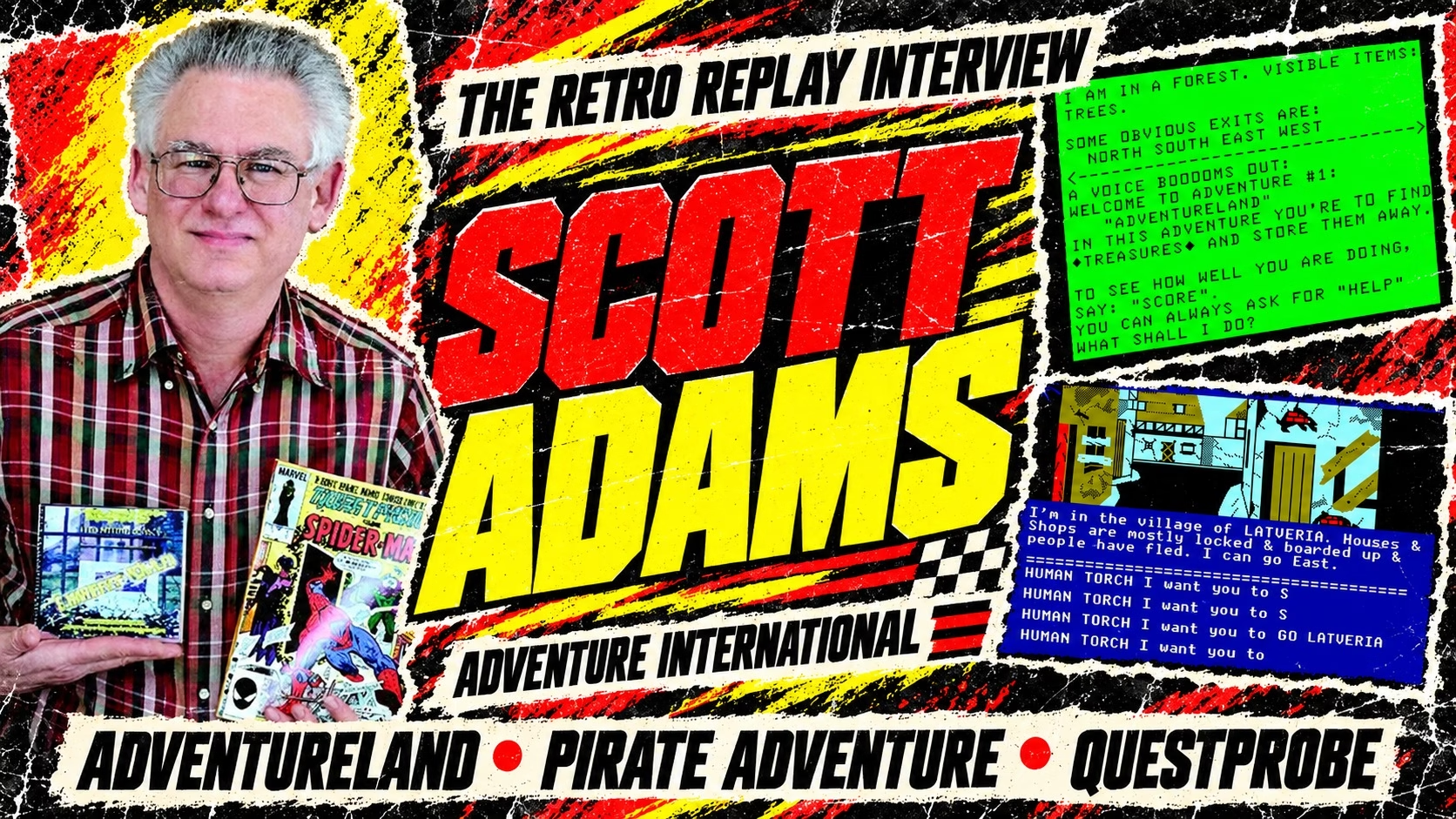
Scott Adams told his coworkers he was going to write an adventure game for his TRS-80. They laughed. He had spent the previous week coming into work early and staying late to play Colossal Cave Adventure, and now he wanted something like it on the computer at home. Sixteen kilobytes would have to do.
Long before “indie developer” became a familiar label, Adams was making games at home and trying to sell them at Radio Shack. Adventureland helped bring text adventures to personal computers, and Adventure International grew out of a business that once occupied the room where he kept his books. Eventually, there was a strip-mall storefront, employees, other developers’ games to publish, and a mainframe programming job to leave behind.
His adventures took players to a pirate island, into Dracula’s territory, and into Marvel’s world through Questprobe. The screen could give you only a handful of words, so you read carefully, tried a command, and hoped the parser understood what you meant. Behind those small worlds were compressed messages, reusable game data and a great deal of watching people play.
Scott answered all thirty of our questions, from the glass wall at the University of Miami computer center to the software he is building today.
Interview by David of Retro Replay. Answers by Scott Adams.
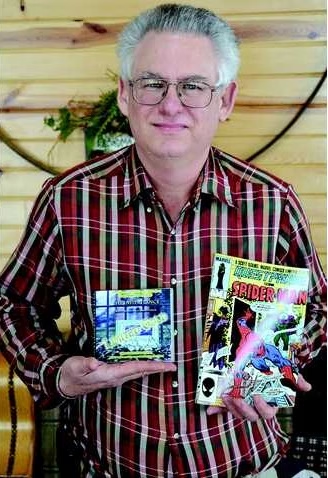
Through the glass, then into Adventureland
Retro Replay: What first made you interested in computers, and what was your earliest experience actually programming one?
Scott Adams: I saw my first computer while on a field trip in the early 1960s. Our elementary school class took a field trip to the University of Miami computer center. There was a visitor center and a glass wall where we could watch. I wanted to go inside but as told I couldn’t. That’s when I decided someday I would! The first time I got to hands on use a computer was in 1969 when our high school was picked for an experiment and we got a computer terminal in our math/science lab. It was connected to a mainframe at U of M computer center and as running APL/360.
Retro Replay: What do you remember about first encountering Colossal Cave Adventure, and what made you think a similar experience could work on a home computer?
Scott Adams: I was working at Stromberg Carlson as a mainframe programmer. At that time everyone then was a mainframe programmer since there were no personal computers. Except there were. I had one of the very early TRS-80 Level 2 16k computers. It was my second home computer and the first one I didn’t have to build! Anyways I was looking for some sort of game to write to on it that would use BASIC strings. They were a new concept for me and I wanted to play with them. At work someone mentioned that the IT staff was playing a neat game and called Colossal Caves Adventures and did I want to see it? Once I did I started coming into work early every morning and leaving late at night so I could play it. In a week I had beaten and was hooked. I told my co-workers I as going to write a game like that for my TRS-80. They laughed and said impossible. Of course, I didn’t listen and the rest is history.
Retro Replay: Adventureland had to fit into the extremely limited memory of the TRS-80. How did you approach squeezing the interpreter, vocabulary, locations, objects, and game logic into such a small amount of space?
Scott Adams: I decided to invent my own language for writing the game and I worked on the language and the game and the compiler for the language all at the same time. It just seemed like the best way to handle the tiny memory space I had. It was fun
Retro Replay: Were there particular programming tricks or compromises that made Adventureland possible that players would never have noticed?
Scott Adams: Certainly. For one originally I only used the first three letters of each word. So take became tak, Throw became thr etc. Later I expanded it to 4 letters but still the basic engine never needed more. I also took sentence fragments and tied them together as needed. For example I am sorry, was one and I see was an example of another. You get the idea. Originally I thought I would only need 50 messages and then commands would be 51-255 I realized quickly that wasn’t enough so the command s where restricted to 51-127 and messages also extended 128-255 (one byte) things .
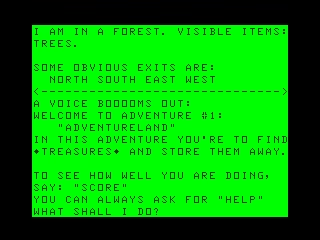
Retro Replay: When you were creating Adventureland, did you think of it primarily as a programming experiment, a game, or the beginning of something that could become a business?
Scott Adams: Yes to all 3. I had already tried to sell my first TRS-80 game at a local Radio Shack. Sold about 5 copies I think. It was called Dog Race and it was pretty pathetic.
Retro Replay: What was it like seeing people actually buy and play something you had created at home?
Scott Adams: It was fun, I also found beta testing was an important part of the game. As people played it gave me ideas on how to harden current puzzles and ideas for new ones to add.
From the home library to Adventure International
Retro Replay: How did Adventure International grow from selling your own games into a genuine software publishing company?
Scott Adams: The very first outside game I accepted for publishing was by Doug Carlson called Galactic Empire. He and his brother with a loan from their aunt later went on to found Broderbund software.
Retro Replay: What do you remember about those early mail-order days, including packaging disks or tapes and communicating directly with customers?
Scott Adams: It ws a lot of work and caused me to get serious and hire my first employee to help with the work. Her name was Linda Novak and her husband Neal was friend I had made at Stromberg Carlson. He was also one of my best beta testers.
Retro Replay: At what point did you realize the demand had become too large to handle as a small side operation?
Scott Adams: I don’ remember the date exactly but I was a little bit after my article on Pirate Adventure appeared in Byte magazine. It was the cover. but I do remember we moved the business from the library at the house ( I had a 10×10 ft room dedicated to my books) and rent space in a strip mall. I opened a computer store in the front and used the back as the software business. At the time I was still working full time at Stromberg Carlson. I went in and gave 2 weeks’ notice. They let me know that if I wanted to come back they always have a place for me.
Pirates, Dracula and the people testing the puzzles
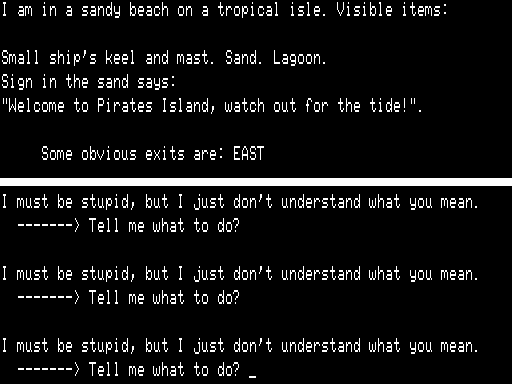
Retro Replay: Pirate Adventure was created with Alexis Adams. What was the creative process like when the two of you worked together on that game?
Scott Adams: Mostly me asking her questions and then brainstorming together. She was determined to be a part of it. She tried to do one game later on her own Voodoo Castle but bogged down. I stepped in and we did the same thing we did on Pirate Adventure. After that she lost all interest in writing anymore games herself.
Retro Replay: Do you think working with another person changed the way you approached puzzle design or storytelling?
Scott Adams: Certainly. Every person I worked with would provide ideas that would feed my own creative process. The games would have been totally different (and I think less fun) if I hadn’t had folks to bounce ideas off and to watch beta test)
Retro Replay: The Count had a very different horror and comedy flavor from Adventureland and Pirate Adventure. Where did the idea for that game come from?
Scott Adams: Just another genre I wanted to try. I really wasn’t meaning to scare anyone as I did try to keep it somewhat tongue in cheek. But later I have heard from folks who played the game as a kid as it was a bit scary for them. Every game I wrote I wanted to do something different than the previous games. This was loosely based on the 1930s/40s Dracula movies and it was the first game I did with day/night scenes and activities.
Retro Replay: Your games often had a dry, playful sense of humor despite the severe text and memory limitations. How important was humor to your design style?
Scott Adams: I tried my best to have folks have fun and enjoy their time with my game. Good jokes are very similar to good puzzles. When the receiver gets them, there is usually a burst of pleasure!
Retro Replay: How did you decide whether a puzzle was difficult in a satisfying way rather than simply frustrating?
Scott Adams: Play testing, play testing, PLAY TESTING and of course there is the ever popular p.l.a.y. t.e.s.t.i.n.g !
Retro Replay: Did you receive much feedback from players in those early years, and did their letters ever influence the design of later games?
Scott Adams: There was nice letters and even phone calls. At the moment I don’t remember being influenced in later games but I suspect I was. I just can’t point to any examples of it!
Every byte, every machine, every picture
Retro Replay: Adventure International brought your games to an enormous number of different computers. How difficult was it to support so many incompatible systems?
Scott Adams: It wasn’t as hard as it seems. At least for my text adventure games. 80% of the work was in the game database (my adventure language) and the other 20% in making the tools and engine so it would work on diverse hardware. Once the engine was working it was just a mater of bringing over a new game database. So that 20% effort was only done once per machine. Other games were much more challenging as video systems and even the main CPU differed from platform to platform.
Retro Replay: Were there platforms that were particularly enjoyable to work with, or others that were especially difficult to support?
Scott Adams: My favorite platform was the Atari ST but it was a much later generation machine. My main work horse in the text era was a TRS-80 model 1 with disk drive. The machine that was the hardest work on was the Vic-20 as I had to fight for every byte of optimizations to get it to fit in a cartridge. Even going so far as removing the automatic boot code and requiring the user to type a sys command to the game to start
Retro Replay: When graphics began appearing in adventure games, did you see them as a natural improvement, or did you worry that something might be lost by moving away from pure text?
Scott Adams: Biggest problem with graphic adventures was the artist might put something into the picture that the text game was not expecting. That caused a lot of headaches. A point and click adventure did not have those drawbacks but faced their own problems.
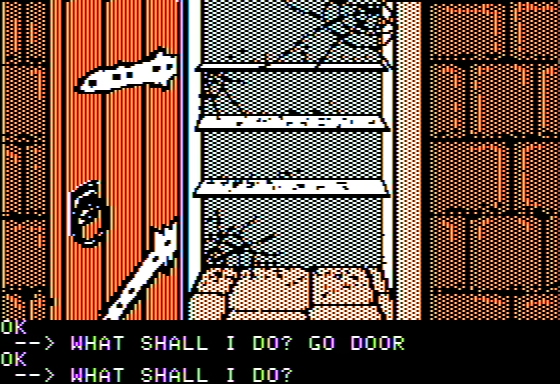
Retro Replay: How involved were you in the transition from your original text adventures to the illustrated Graphic Adventure versions?
Scott Adams: Going from pure text to the SAGA (Scott Adams Graphic Adventures) meant I had to vet all the art and discuss with the artist what was important to show and also what was important NOT to show. Was a challenge!
Marvel comes calling
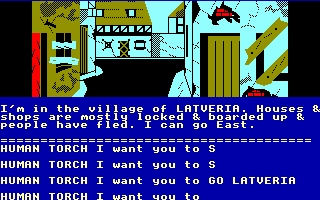
Retro Replay: The Questprobe games brought Marvel characters into the adventure-game format. How did that relationship with Marvel come about?
Scott Adams: They contacted me. Joe Clamari the vice president of Marvel wanted to bring the IP to home computers. Everyone he asked said talk to Scott Adams.
Retro Replay: What was it like working with characters such as Spider-Man, the Hulk, and the Human Torch at a time when licensed video games were still relatively unusual?
Scott Adams: It was a great deal of fun https://archive.org/details/commodore-power-play-13/page/n75/mode/2up
Retro Replay: Were there additional Questprobe games or Marvel characters planned that never made it to release?
Scott Adams: Yes Adventure International closed while I was working on Questprobe #4 there had been planned 12 in the series. If you search you should be able to find a review of the unfinished Questprobe game X-men.
Old adventures and new players
Retro Replay: Looking back, is there one Adventure International title that you think deserves more attention than it receives today?
Scott Adams: I think Star Fighter was a really special game. A real space simulator with a lot of depth to it.
Retro Replay: Is there a game from that period that you would particularly enjoy redesigning today if you could keep the original spirit but remove the old hardware limitations?
Scott Adams: I did do a 40th anniversary release of Adventureland called Adventureland XL it was both XL for the roman numeral version of 40 and extra large for XL as well. The entire original game with a big add on section.
Retro Replay: Adventure games have changed tremendously since Adventureland. What do you think modern interactive storytelling gained, and what did it lose, as games became more visual and cinematic?
Scott Adams: Each type game has its niche. Today text only adventures are still popular and usually better suited for the players with limited or no eyesight.
Retro Replay: Do you think there is still something uniquely powerful about asking the player to imagine a world from text rather than showing them everything directly?
Scott Adams: As in the tv show Big Bang there was this exchange while playing a text adventure game: Leonard: “That’s pretty cool.” Sheldon: “Oh, yes. It runs on the world’s most powerful graphics chip: imagination.”
Retro Replay: When you see people still playing, preserving, porting, and discussing your games nearly half a century later, what does that feel like?
Scott Adams: I am happy to know that I touched so many people in a positive way. G-D really used my efforts to enrich other’s lives.
Retro Replay: Did you ever imagine while working on a TRS-80 that Adventureland would eventually be discussed as an important part of video game history?
Scott Adams: No, I didn’t I was just having a lot of fun bringing joy to others.
What Scott is building now
Retro Replay: What are you working on these days, and are there any current projects you would like Retro Replay readers to know about?
Scott Adams: I am currently working at https://deft.co see also https://deft.md on tooling to help make AI work properly and responsibly in creating software. One of my projects in using Directive is to redo The Inheritance as a browser based game suitable for phones. I am also working as time permits on www.finalpilot.com as well.
Retro Replay: Finally, are there any websites, archives, books, social media accounts, current projects, or other places you would like me to include or link to when the interview is published?
Scott Adams: I try to answer all email msadams@msadams.com and www.msadams.com are my live links (at least while I live). If you write me and get no response, please feel free to try again. As a Messianic Jew I normally don’t bother with email on Sabbath (Friday night through Saturday night) but will get to it later. I love to hear from folks.
Thank you, Scott
Our sincere thanks to Scott for his time and for answering every question. The detail about his first computer visit is a lovely place to leave things: a schoolboy looking through a glass wall, told he could not go inside, already deciding that someday he would.
You can visit Scott’s official website for his updates and classic-game resources. He also points readers toward Deft, deft.md and FinalPilot, and welcomes messages at msadams@msadams.com. For more conversations about adventure games, explore our interviews with Steve Ince and Eugene Sandulenko, or browse all Retro Replay interviews.
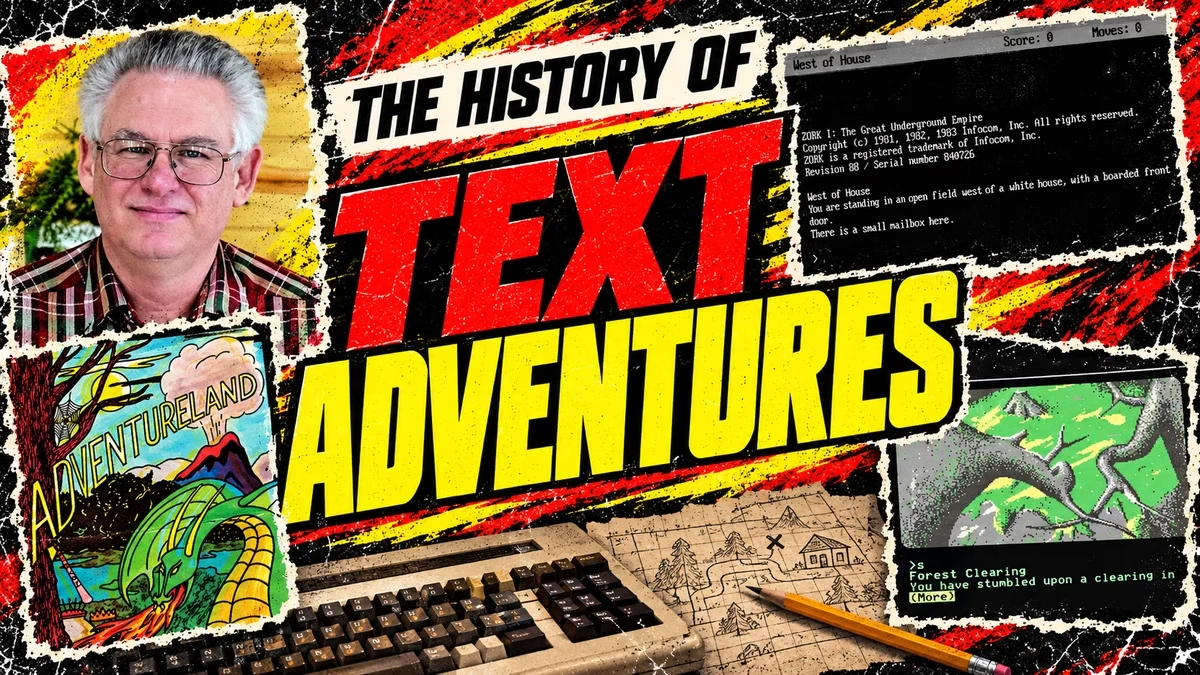
Read the history: Our six-part history of text adventures follows the story from Colossal Cave and Scott’s Adventureland to Zork, Infocom and the writers who kept the adventures coming.