 Retro Replay Retro Gaming History, Reviews & Emulation


Retro Replay Review
Gameplay
The first few turns make Fate of the World look almost tidy: recruit an agent, choose a policy, pay its cost, and advance five years. Then the news flashes and statistics arrive, and that tidy plan starts coming apart. Oil availability, sea levels, extinctions, unrest, and warming all react to the direction you have chosen. The central pleasure is watching a decision made for one sensible reason create a fresh problem somewhere else.
This is less about micromanaging a planet than making hard commitments with incomplete comfort. Agents establish your reach across nations and continents, while cards let you pursue development, environmental protection, technology, energy, welfare, and political goals. Some policies vanish after one turn but lead to further options; others remain in force. Because every card costs money and later turns bring funds based on your strategy, you are always weighing an immediate intervention against a longer-term investment.
Adaptation is the point, and it is where the game becomes compelling. New technologies emerge in later years, current conditions change, and a policy that looked correct five years ago may no longer fit the target in front of you. That also makes failure sting: a bad draw or poorly timed commitment can leave you struggling to satisfy a scenario’s specific conditions before time runs out. If you want a relaxed city-builder rhythm, this can feel punishingly clinical. If you enjoy revising a plan when the numbers refuse to cooperate, its pressure is exactly the hook.
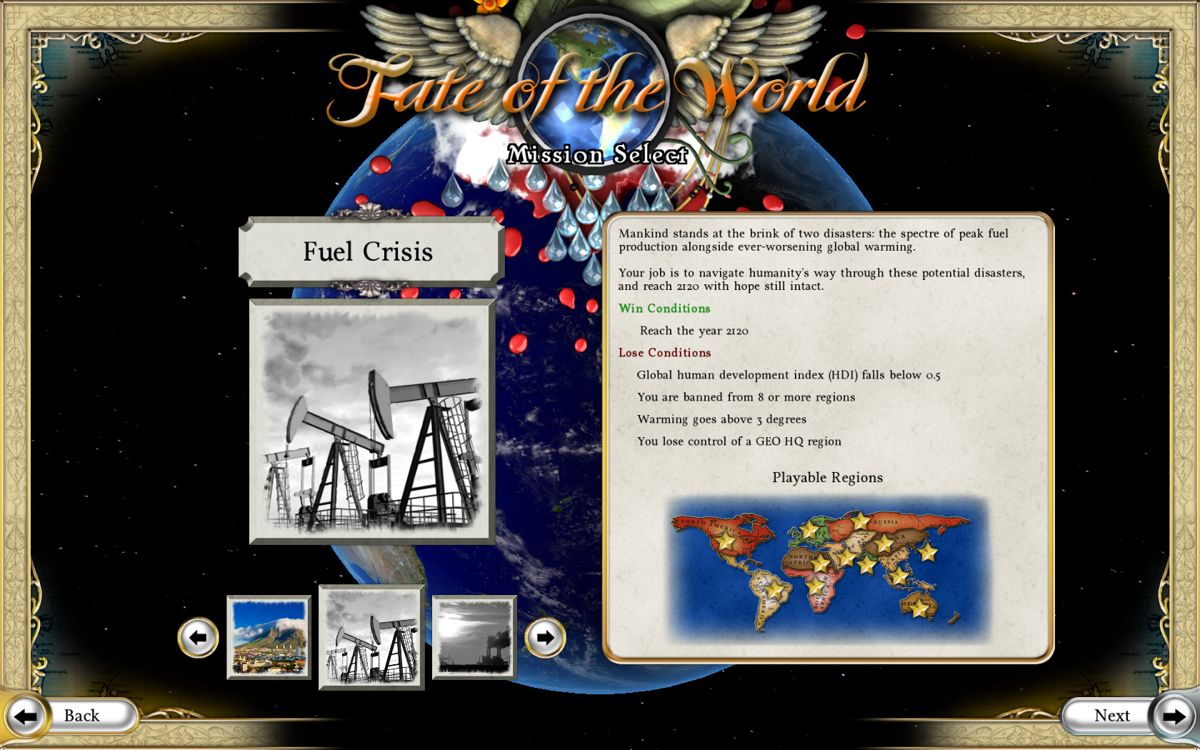
The four scenarios give the simulation sharper boundaries. The Rise of Africa introduces the framework, while Fuel Crisis, Three Degrees, and Dr. Apocalypse put different limits and victory conditions in your way as they unlock. Crucially, success does not always mean choosing the kindest or greenest answer. Military intervention, clandestine operations, and risky environmental measures can be useful when economic growth is the demanded outcome. That moral friction keeps the card choices from becoming a simple checklist of obviously good policies.

Graphics
Fate of the World is built around its globe-spanning management view, policy cards, and information screens. The most memorable images are the changing numerical reports and news flashes that arrive after each five-year jump, turning distant global trends into an immediate verdict on your last round of decisions.

Story
You lead GEO, an independent Global Environment Organization founded in 2020 because individual national decisions have begun creating threats that cross borders. It is a strong setup for a management game: you have broad ambitions, but must earn permission to act across different nations and continents rather than simply commanding the entire world.
There is no need for a conventional cast or a single dramatic campaign arc when each scenario supplies its own crisis. The story comes from the uncomfortable chain of cause and effect you create: a push for prosperity, a worsening environmental measure, political disorder, or an intervention made because the stated objective leaves little room for idealism.
The climate model is based on research by Oxford University professor Myles Allen, which suits the game’s serious tone. More importantly, the subject matter is not treated as a distant backdrop. The scenarios make you confront the fact that a global solution can still demand local compromises, and that a result deemed successful by one objective may look grim through another.
Overall Experience
Fate of the World is a strategy game for anyone who likes wrestling with systems that do not offer a clean answer. Its card-based turns are approachable, but the results are not: five-year leaps make every commitment feel consequential, and scenario goals can force choices you would rather avoid. It asks you to think in trade-offs, not fantasies of fixing everything at once.
The 6.9 score feels fair. The game has a focused, unusually thoughtful premise and a structure that rewards careful reassessment, yet its abstract card play and stern scenario constraints can make it feel more like a difficult policy exercise than a sweeping power fantasy. You need to enjoy studying the fallout of your choices, not merely making them.
Give it a chance if climate policy, long-range planning, and difficult scenario puzzles sound more exciting than they sound exhausting. Go in ready to fail, learn what a particular objective actually demands, and reshape your priorities on the next attempt. When a revised strategy survives the next five-year report, Fate of the World delivers a tense kind of satisfaction few management games can match.



Reviews
There are no reviews yet.