 Retro Replay Retro Replay gaming reviews, news, emulation, geek stuff and more!



Retro Replay Review
Gameplay
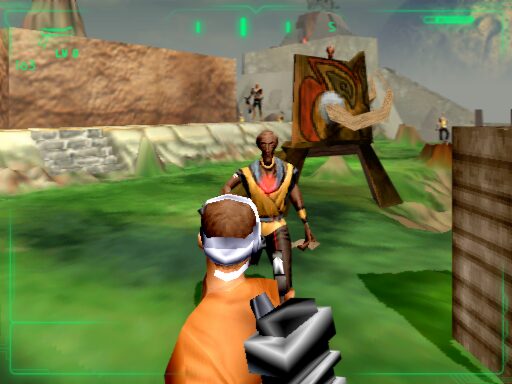
Outcast delivers a seamless blend of exploration, puzzle-solving, and action that feels remarkably open for its time. You begin on a small tutorial island, mastering Cutter Slade’s core abilities—jumping, climbing, swimming, and stealth maneuvers—before venturing into each of the five main continents of Adelpha. The freedom to tackle objectives in multiple ways keeps the experience fresh, whether you’re sneaking past guards or engaging in full-on firefights with futuristic weaponry.
(HEY YOU!! We hope you enjoy! We try not to run ads. So basically, this is a very expensive hobby running this site. Please consider joining us for updates, forums, and more. Network w/ us to make some cash or friends while retro gaming, and you can win some free retro games for posting. Okay, carry on 👍)
The quest structure revolves around retrieving five sacred relics, but the journey is far from linear. Each landmass brims with optional side missions that range from healing sick villagers to negotiating tribal disputes. Dialogue trees allow Cutter to converse with dozens of Talan characters about local history, ecology, and the growing threat of Faé Rhan’s forces. These interactions often yield new clues, crafting materials, or allies who can assist in combat.
Combat itself is a satisfying mix of gunplay and gadgets. Cutter has access to six advanced weapons, including a powerful railgun and a rapid-fire bio-rifle, each of which can be upgraded by combining scavenged parts. Ammunition is scarce enough to keep you on your toes, encouraging judicious use of your holo-decoy device and silent takedowns. For those seeking variety, leaping onto a Twon-Ha mount transforms traversal into a high-speed chase across lush plains or misty mountains.
Graphics
Even by today’s standards, Outcast’s world of Adelpha feels strikingly vibrant. The original engine uses voxel-based rendering to produce sweeping vistas of dense forests, crystalline lakes, and towering peaks. While textures may appear low-resolution on modern displays, the color palette and environmental design evoke a sense of wonder that more photorealistic titles often miss.
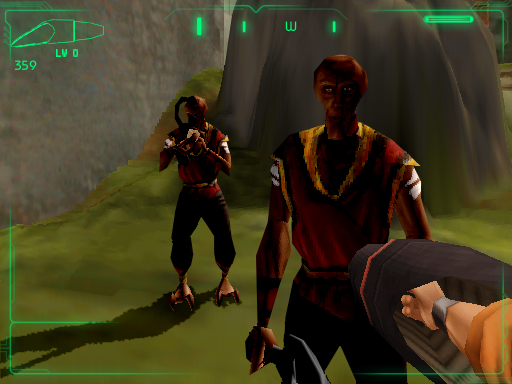
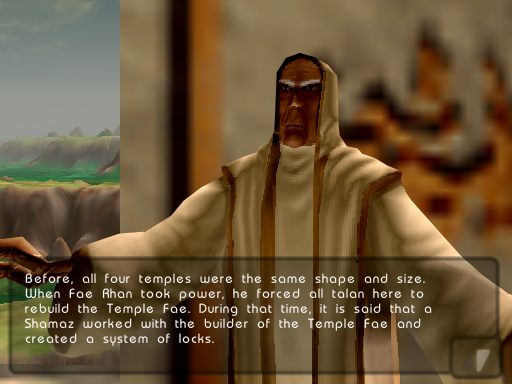
Character models and animations are surprisingly expressive, especially during conversations with Talan villagers. Small flourishes—like the sway of a palm-wrapped hut in a coastal breeze or the glint of sunlight on a holographic display—bring the world to life. Enemies, from disciplined Faé Rhan soldiers to feral creatures, are distinct in silhouette and behavior, reducing the tedium of combat repetition.
Lighting effects remain one of Outcast’s strongest suits. Dynamic day-night cycles and localized light sources (torches, bioluminescent plants) cast realistic shadows that heighten tension during stealth segments. Even in darker caves, your laser sight and multifunctional goggles pierce the gloom, turning potential frustration into a tactical puzzle.
Story
Outcast introduces a high-stakes narrative from the very first mission: a damaged probe from our world has ripped a hole in spacetime, threatening Earth with a catastrophic black hole. Cutter Slade’s mission is twofold: locate the missing scientists and repair the probe. But Adelpha’s rich history and political turmoil quickly take center stage, elevating the plot beyond a straightforward rescue operation.
The local Talan civilization is on the brink of civil war, manipulated by the enigmatic Faé Rhan, who preaches supremacy and wields terror to rally followers. When the Talan proclaim Cutter as the Ulukai, a prophesied savior, the story pivots into a classic hero’s journey—retrieve ancient relics, unite rival factions, and challenge the dark overlord. Yet the game never feels clichéd; every quest deepens your understanding of Adelpha’s culture, ecology, and moral complexity.
Dialogue is extensive and well-voiced, offering both lore buffs and action fans something to sink their teeth into. While most missions are mandatory to advance the main plot, side quests frequently reveal unexpected twists: an injured beast spared in one quest might later avenge a village, for instance. This interconnectedness of world and story rewards players who take the time to explore off the beaten path.
Overall Experience
Outcast remains a landmark title in action-adventure gaming, even decades after its initial release. Its ambitious world-building and non-linear quest design laid the groundwork for many modern open-world titles, yet it avoids bloated mechanics by keeping its toolkit focused and meaningful. You won’t find crafting trees with endless permutations—just enough gadgets and weapons to feel versatile without overwhelming.
The pacing strikes an excellent balance between exploration, narrative progression, and combat. Travel between continents via teleportation gates keeps downtime minimal, yet each new island feels like a memorable destination with unique environmental and cultural challenges. Whether you’re scaling icy ridges in Afreeta or navigating volcanic caverns in Oandika, the sense of discovery remains palpable.
For players seeking an adventure that marries cerebral quest design with dynamic action, Outcast delivers in spades. Its slightly dated visuals are more than compensated by the depth of its world and the ingenuity of its mechanics. If you’re looking for a game that challenges you to think on multiple fronts—political, ecological, and tactical—while offering an epic storyline that spans two universes, Outcast is well worth your time.


Reviews
There are no reviews yet.