 Retro Replay Retro Gaming History, Reviews & Emulation



Retro Replay Review
Gameplay
Vermeer: Die Kunst zu erben presents a distinctive blend of strategic planning and time management, set across the globe at the dawn of the twentieth century. Each turn represents one day, and players decide the pace of the game by selecting round lengths from five seconds to an infinite duration. This flexibility allows both fast-paced sessions and more contemplative, methodical play, catering to different player preferences. You must chart travel routes, manage resources, and stay ahead of competitors in real time, creating a satisfying rhythm as you shuttle between Europe, North America, and the plantations of the Third World.
The core of the gameplay loop revolves around acquiring Walther von Grünschild’s stolen masterpieces at auction. Success demands a careful balance of capital generation and shrewd bidding tactics. To raise funds, you establish up to 24 plantations that produce commodities like coffee, cacao, tea, and tobacco. Harvesting and shipping these goods to warehouses in New York or London injects a complex layer of logistics: you must position yourself on-site for each action, forcing you to plan several moves ahead and prioritize objectives effectively.
Complementing the plantation economy are alternative money-making avenues. You can try your luck at horse racing or invest in art education to distinguish genuine paintings from forgeries. Hiring a middleman provides anonymity at auctions—driving down prices but increasing the risk of buying fakes. In Chicago, you can even employ robbers to purloin artworks from rival heirs. This variety of approaches keeps each playthrough fresh and allows players to tailor a strategy aligned with their risk tolerance and playstyle.
Overall, Vermeer’s gameplay encourages you to juggle long-term estate building with the immediacy of auction dynamics. It rewards foresight and adaptability while maintaining a strong thematic connection to the cutthroat world of early twentieth-century art patronage. The result is a uniquely engaging simulation that challenges your managerial acumen and your nerve at the bidding table.
Graphics
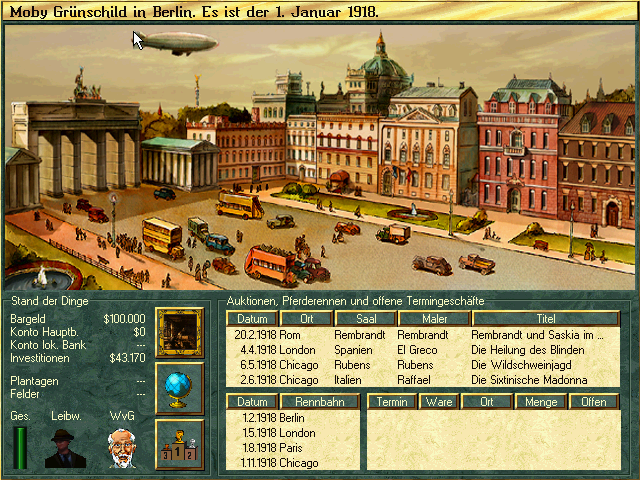
As a Windows 95 remake of the 1987 original, Vermeer: Die Kunst zu erben employs 2D graphics rendered in a period-appropriate color palette. The user interface features detailed icons for plantations, ships, and auction halls, evoking the feel of business management software from the era. While these visuals might seem dated by modern standards, they deliver clarity and a nostalgic charm that complements the historical setting.
The game’s map screens—spanning Berlin, New York, London, and plantations in South America and Africa—are functional and informative. Each region is clearly delineated, with clickable hotspots for sending shipments, purchasing equipment, or attending auctions. Subtle animations, such as ships moving on trade routes and commodity icons updating in warehouses, bring the world to life without overwhelming the player with unnecessary flair.
Portraits of Walther von Grünschild, his nephews, and various art schools are hand-drawn and retain the illustrative style common to mid-90s PC titles. These portraits, along with period-appropriate typefaces and UI elements, help to immerse the player in the game’s historical milieu. Even the auction interface, with its simple bid increments and on-screen gavel sound effect, feels authentic and suitably tense.
Though the graphics lack the polish of modern high-definition titles, they serve the game’s strategic focus brilliantly. The clear presentation ensures that crucial information is readily visible, and the nostalgic aesthetic adds to the overall atmosphere. For players who appreciate retro visuals with a functional design, Vermeer’s graphical package remains endearingly effective.
Story
At its heart, Vermeer tells the tale of Walther von Grünschild, a wealthy Berlin merchant whose beloved art collection has been dispersed under mysterious circumstances. On his deathbed, he challenges his four nephews to recover the missing paintings. The nephew who proves the most successful becomes his heir—a premise that injects personal stakes into every auction and plantation deal.
The narrative unfolds against the turbulent backdrop of post–World War I Europe, beginning in 1918 and concluding with von Grünschild’s passing. Although the story is delivered through sparse text rather than elaborate cutscenes, each game event—such as a rare Vermeer work appearing at auction or a rival nephew seizing a prized canvas—carries significant weight. These moments foster a sense of competition and urgency that drives players to optimize every action.
Character interactions are minimal but meaningful: visits to art schools allow for tutor encounters, while hiring a middleman or local gang members introduces colorful side characters. These narrative touches deepen immersion without detracting from the game’s strategic core. The historical art world setting, combined with entrepreneurial ventures into commodity markets, creates a compelling hybrid of business sim and treasure hunt.
Overall, the story’s strength lies in its elegant integration with gameplay mechanics. Recovering lost masterpieces is more than a goal—it’s a motivation that shapes every decision, from where to open new plantations to how boldly you bid at an auction. While not a story-heavy title by modern standards, Vermeer’s narrative framework provides an evocative backdrop for a richly strategic experience.
Overall Experience
Vermeer: Die Kunst zu erben delivers a distinctive blend of art-world intrigue and mercantile strategy that stands out among Windows 95–era simulations. Its nuanced balance between plantation management, auction tactics, and time-driven decision-making makes for a rewarding challenge. Each session feels like a historical journey, requiring you to think like both a businessman and an astute art collector.
The game’s pacing can be tailored to your preference, whether you seek quick, adrenaline-fueled auctions or a more measured, empire-building campaign. The risk–reward tension of bidding wars, coupled with the unpredictability of forging and theft, keeps the experience fresh across multiple playthroughs. Learning to weigh the benefits of direct bidding against the safety of a middleman or the subterfuge of hired robbers becomes an engrossing strategic puzzle.
While the graphics and interface bear the hallmarks of their mid-90s origins, they reinforce the period setting and ensure that crucial information is always at hand. Nostalgia aside, the design choices support clear, intuitive gameplay. The map layouts, commodity icons, and auction screens all contribute to a cohesive package that invites players to dive into the complex world of early twentieth-century art patronage.
For fans of historical strategy and business simulations, Vermeer: Die Kunst zu erben remains a hidden gem. Its unique premise, strategic depth, and atmospheric presentation coalesce into an experience that feels fresh even decades after its initial release. If you’re seeking a game that challenges both your managerial skills and your appetite for art-world intrigue, this title is well worth exploring.


Reviews
There are no reviews yet.