 Retro Replay Retro Gaming History, Reviews & Emulation
Retro Replay Review
Gameplay
The first mission asks a useful question before the shooting even starts: what kind of machine do you want to live in? The Light, Middle, and Heavy Frames are not cosmetic labels. Taking a Light Frame means accepting weakness for mobility, while the Heavy Frame lets you carry the more powerful equipment but makes every slow turn and bad position matter. The Middle Frame sounds like the compromise because it is one, and that can be the sensible choice when you are still learning how a mission punishes mistakes.
Weapon selection gives the combat its best layer of planning. Small arms occupy two slots, while heavier choices such as missile launchers, sniper rifles, and Gatling guns take the other two. Ammo is limited, and sustained fire overheats a weapon, so you cannot just hold the trigger and expect a Gatling gun or machine gun to solve every encounter. The more satisfying moments should come from bringing the right tools, pacing your shots, and resisting the urge to waste ammunition early.
Damage is also more involved than a single shrinking health bar. Armor is tracked across individual frame parts; once a part’s armor is gone, further hits damage the frame itself. That makes incoming fire feel consequential, especially in a lighter machine. It is a good foundation for mech combat because it turns survival into something you manage rather than something you take for granted. Still, the strictly linear structure limits how far those loadout choices can carry the game. You are refining your approach to a prescribed sequence, not carving out your own campaign.
That focus will either feel disciplined or restrictive. If you enjoy replaying a mission with a different frame and a more suitable weapon mix, Exaskeleton has a real tactical hook. If you want constant mechanical surprises or broad freedom between battles, its mission-to-mission routine may start to feel narrow.
Graphics
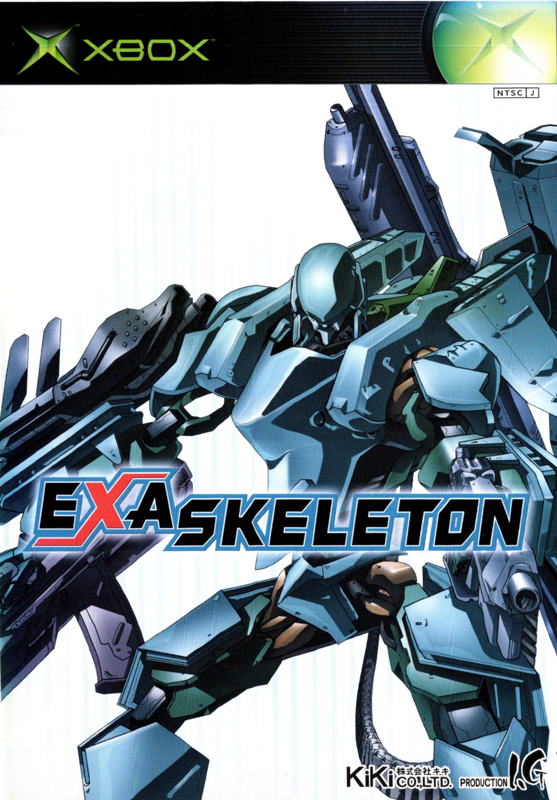
The game is viewed from a third-person perspective during its mech action, then cuts to long talking-head conversations around missions. Those dialogue scenes put the party front and center, while the battles keep attention on Joe’s frame, allied units when present, and the dangerous terrain of a blasted Earth.
Story
Joe’s transition from I.G-1 competitor to someone fighting for real is a strong, clean setup. His sport-trained skills and Exaskeleton becoming necessary for survival gives the action a personal stake that a purely abstract tournament story would lack. The shift from sheltered home life to Earth’s ruined surface also gives the campaign a natural sense of escalation.
The tradeoff is its pacing. Every mission is book-ended by long dialogue scenes featuring Joe’s party, so you spend substantial time listening before returning to combat. If you are invested in the group and want a mecha story delivered in a visual-novel-like rhythm, that structure can help missions feel connected. If you came mainly for immediate robot combat, the talking-head stretches can test your patience.
Its story works best when you meet it halfway: treat the conversations as the connective tissue for Joe and his friends rather than an interruption you must rush through. The premise has enough tension to support that approach, but the game’s emphasis on dialogue means the narrative pace is not going to suit every action fan.
Overall Experience
Exaskeleton is a modest but thoughtful mech-action game whose best idea is that your machine is a commitment. Frame weight, weapon limits, overheating, ammunition, and localized armor damage all push you to plan rather than simply shoot harder. That is a worthwhile mix for anyone who likes their third-person combat with a little pre-mission consideration.
Its biggest hurdle is the contrast between that measured combat and the long stretches of character dialogue. The game is linear, and its rhythm asks you to accept missions as chapters in Joe’s story instead of as a sandbox for experimentation. Some gamers will appreciate the focus; others will feel held back whenever the conversation runs long.
Give it a chance if the premise of a former mechanized-sport competitor taking his frame into a real post-apocalyptic conflict sounds more interesting than nonstop spectacle. The payoff is a combat system with enough equipment and damage-management pressure to reward patience, even if the narrow structure and dialogue-heavy pacing keep it from being an easy recommendation for every mech fan.


Reviews
There are no reviews yet.