 Retro Replay Retro Gaming History, Reviews & Emulation

Retro Replay Review
Gameplay
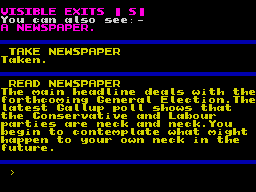
Operation Berlin asks you to do the work that many later adventures do for you. You view a location, read its description, and type commands to investigate, use objects, and push John Blake’s mission forward. That can be wonderfully involving when you are mentally mapping the situation and trying to turn a small clue into a useful action; you are not simply following an objective marker, but actively deciding what might matter.
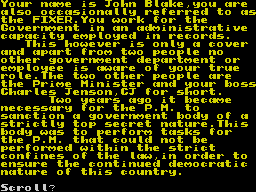
The espionage framing helps the format. Getting into East Berlin and reaching KGB headquarters gives your actions a firm direction, while the missing nuclear-engine plans provide a clear reason to keep probing for a way through. A lot of text adventures lean on vague fantasy errands; Operation Berlin at least knows what its mission is and why time matters.
Still, this is very much for a particular mood. You need to enjoy reading carefully, taking notes if necessary, and trying your own wording when a puzzle does not yield immediately. There is no sense in pretending that typed-command adventures suit everybody. If you want quick feedback or a guided path, this will feel laborious. If you enjoy the small victory of finally expressing the right idea in a text parser, its deliberately hands-on pace is the point.
Graphics
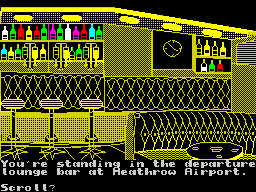
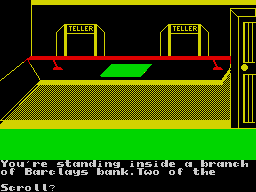
Each area is accompanied by a picture alongside its written description, giving the adventure more to look at than a purely text-only game. The images serve as scene-setting snapshots for the places Blake explores, while the text remains where you will spend most of your attention.
Story
The hook is pure 1980s spy fiction in the best uncomplicated sense. Professor Wolff has developed a more efficient nuclear engine, then vanishes en route to speak with NATO. His plans are taken to East Berlin, an accident leaves him in a coma, and Britain sends John Blake to retrieve the material before the KGB gets the answers it wants.
That coma creates a useful ticking-clock tension without requiring the plot to become complicated. Wolff is both the key to the plans and the immediate reason you cannot wait around. The Russians may decipher the material themselves, or they may persuade him to do it once he wakes. Either outcome gives Blake’s infiltration a credible urgency.
The story’s strength is its directness. You are a British agent crossing into hostile territory for a specific recovery job, not an undefined adventurer wandering until a plot arrives. Anyone fond of straightforward Cold War thrillers will find plenty to latch onto in that premise, even if the game’s real drama comes from solving its obstacles rather than watching elaborate narrative scenes unfold.
Overall Experience
Operation Berlin is a compact, old-fashioned interactive-fiction challenge wrapped in an effective spy-movie setup. Its best moments come from inhabiting the role: reading a description, considering your limited information, and finding the action that moves an undercover mission another step forward. The two-part structure also gives the game a little more sense of occasion than a single short scenario.
It will frustrate you if you come in wanting modern adventure-game convenience. Typing commands places a lot of responsibility on you, and the pleasure depends on accepting that deliberate back-and-forth with the game’s text. That is not a minor caveat; it is the defining feature of the experience.
Give it a chance if you enjoy ZX Spectrum adventures, Cold War fiction, or the particular satisfaction of untangling puzzles through written commands. For everyone else, Operation Berlin is more interesting as a focused example of its era than as an easy recommendation. The premise is strong enough to carry you into the mission, but the payoff belongs to patient puzzle-solvers.


Reviews
There are no reviews yet.