 Retro Replay Retro Gaming History, Reviews & Emulation


Game Overview
Gameplay
The first few turns ask for more nerve than the simple board layout suggests. You can move one stone each round, but you do not know an enemy stone’s rank until somebody attacks. That turns every advance into a question: is this a useful scout, a sacrifice, or the move that hands your opponent a clear route through your defenses?
Combat is wonderfully blunt. The higher rank wins; equal ranks remove both stones; bombs kill anything that attacks them. There is no room to argue with those rules, and that clarity gives each lost piece weight. A strong stone can feel precious, yet treating it too cautiously leaves you without the information needed to find the palace.
Its close resemblance to Stratego is not incidental; that is the whole foundation of the match. You win by capturing the stationary palace represented by a flag, while trying to stop the same attempt on your own side. Early on, it is tempting to push forward with whatever looks expendable. Before long, careful placement, remembered clashes, and preserving enough force for a breakthrough start to matter more.
Frustration arrives when hidden ranks punish a confident guess, especially if that guess hits a bomb. But that sting belongs to the game’s intended psychological contest rather than random clutter. Give it a chance if you like turn-based board-game tactics in which incomplete information matters as much as raw rank.
Graphics
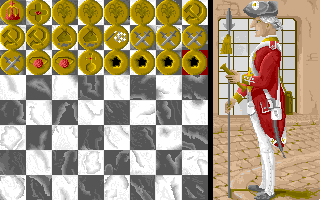
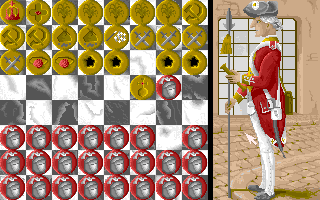
The action is shown from above on a chessboard-like field divided between the two sides. Playing stones carry the contest, with the palace represented by a flag, so the board remains focused on where pieces are positioned and which routes are still open.
Story
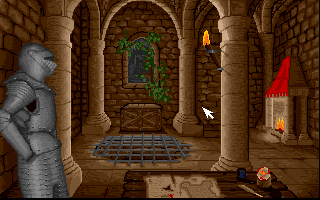
The setup is lean: an evil lord must be driven out of his castle. It supplies a reason for the opposing sides to fight over the palace, then quickly gets out of the way.
That sparseness fits a game built around secret ranks and board control. You are not here for a developing tale; the drama comes from deciding which stones are decoys, which are threats, and when to risk an attack.
The castle framing at least gives the flag objective a little more flavor than an entirely abstract match. Still, the lasting stories are the ones you create on the board: the bomb that stopped a charge, the equal-ranked trade that opened a lane, or the hidden defender that ruined a plan.
Overall Experience
Brain Challenge: The Arena of Death is a stripped-down strategic duel that understands the value of uncertainty. The rules are easy to state, but hidden ranks make every move carry suspicion. When your deductions pay off and a guarded route finally opens, it delivers the satisfying snap of a good tabletop confrontation.
Its narrow focus also means your enjoyment depends heavily on how much you value the Stratego formula. There is no need to look for a broader kind of strategy experience here; the pleasure is in deploying 24 stones, testing a formation, and protecting your palace better than the other side does.
For an Amiga player who enjoys deliberate turn-based board tactics, it is worth trying for that concentrated cat-and-mouse tension. Anyone who dislikes losing pieces to unknown information may find it harsh, but the harshness is exactly what makes a successful read of the board feel earned.


Reviews
There are no reviews yet.