 Retro Replay Retro Gaming History, Reviews & Emulation
Retro Replay Review
Gameplay
The first few levels of Gotcha! are easy to misread. A ball bounces on its own, blocks disappear when struck, and your job is simply to slide its path left or right. That sounds like Breakout with a missing paddle, but removing the paddle changes the feeling completely. You are not carefully returning a ball; you are constantly correcting its route, trying to make the next bounce useful before it drifts into danger.
Color-coded blocks give that simple movement a welcome bit of bite. A colored block only disappears when the ball shares its color, so blindly sweeping through a layout is not enough. Stationary skull blocks follow the same color rule, but touching them is deadly, while moving enemies are lethal regardless. The tension comes from balancing efficient clearing against self-preservation: a tempting route can become a mistake in a split second.
Forty levels is a respectable run for this kind of compact arcade design, and the structure is friendlier than it first appears. You can choose freely among the first 20 stages, while the second half opens once you have beaten that initial set. That leaves room to practice a troublesome layout rather than repeatedly pushing through a fixed sequence. Two-player play and a level editor are meaningful extras, especially if the core bounce-and-dodge rhythm gets its hooks into you.
Graphics
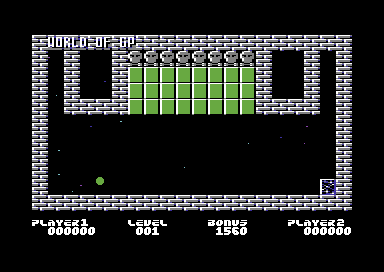
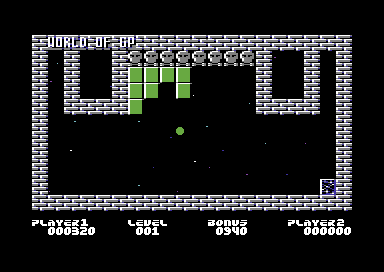
The action is presented from the side in single-screen stages, with blocks, skull hazards, and moving enemies sharing the same tight play area. Color matters directly to the action, so keeping track of the ball and the matching blocks is more than decoration; it is part of reading each crowded board.
Story
Gotcha! does not build its momentum through a story. Its reason to continue is immediate and mechanical: clear every viable block without letting the ball collide with something fatal.
That puts the burden on the individual layouts. Each stage is its own small puzzle of routes, color requirements, fixed skulls, and roaming threats, rather than a chapter in a larger adventure.
If you need characters, plot turns, or a final narrative payoff, this will feel bare. If you are happy letting a difficult board become the whole drama, the game is refreshingly direct about what it wants from you.
Overall Experience
Gotcha! is a neat variation on a very old arcade foundation, and its best idea is the decision to make ball control indirect. Steering an automatic bounce has a slippery, reactive quality that can be exciting once you stop expecting paddle-style precision.
Its harshness is also real. Skull blocks and enemies kill on contact, so a promising attempt can vanish quickly, and color restrictions can make a level feel stubborn when the ball is not where you need it. That friction is likely to divide you: it creates pressure, but it can also make a bad bounce feel disproportionately punishing.
Give it a chance if you enjoy short, replayable arcade stages where learning routes matters as much as reflexes. The selectable first 20 levels reduce some of the grind, and the editor plus two-player option add replay value beyond the built-in challenge. It is a focused, demanding oddball rather than a broad crowd-pleaser, but its twist on block breaking is strong enough to earn a few more tries.


Reviews
There are no reviews yet.