 Retro Replay Retro Gaming History, Reviews & Emulation

Retro Replay Review
Gameplay
The first pull of ‘Nam 1965-1975 is that it refuses to let you think like a battlefield commander alone. You have to prevent South Vietnam from falling to the Vietcong, but you are also responsible for the wider cost of trying to do so. Military resources matter, direct tactical decisions matter, and public opinion can reject the war even when your military priorities seem sound. That is a strong foundation for a strategy game because every decision carries pressure beyond the immediate fighting.
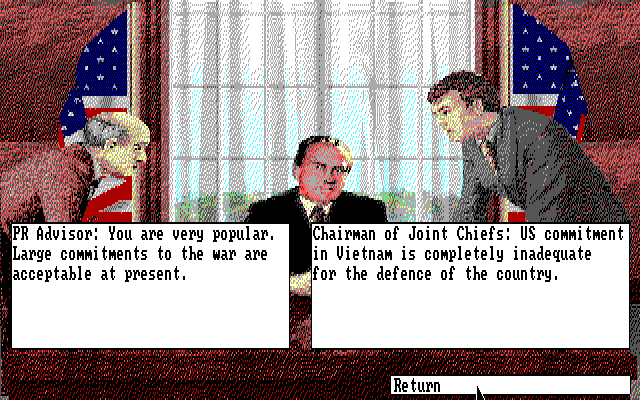
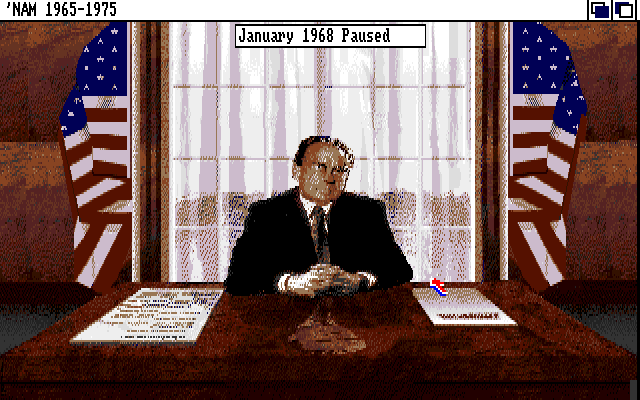
The dual President-and-commander-in-chief role is the game’s best idea. At the presidential level, you are managing the means to fight; at the command level, you are choosing tactics and deciding when to engage enemies. The result is a more complicated kind of turn-based strategy than simply moving toward a clean military victory. It asks you to balance what you can commit with what the public will tolerate, and that friction is where the game starts to click.
Its scenario selection is also a meaningful strength. Khe Sanh, the Tet Offensive, and the 1975 offensive offer decisive conflict-focused situations, while the Johnson and Nixon options change the starting year to 1964 or 1968. That range gives you reasons to return after learning the game’s priorities. If you want immediate action with no interest in political constraints, this will feel restrictive. If you enjoy strategy games that make the larger consequences part of the challenge, the frustration is much easier to appreciate.

Graphics
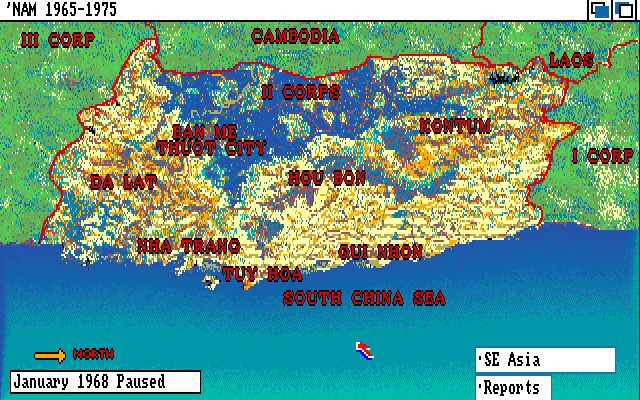
The game uses a top-down viewpoint suited to its strategic focus. It is a functional angle for a war game concerned with command decisions rather than a close-up, character-driven view of combat.

Story
This is historical strategy first, not a personal war story. Its subject is the Vietnam War from 1965 to 1975, with the central objective framed around stopping the fall of South Vietnam to the Vietcong. That focus gives the game weight, because it does not treat military action as separate from the political support needed to continue it.
The named scenarios provide the historical structure: Khe Sanh, the Tet Offensive, and the 1975 offensive concentrate on major moments, while the Johnson and Nixon starts let you enter the conflict in different years. You are not being carried through a scripted tale so much as being handed difficult historical circumstances and asked to manage them.
That approach will work best if you like history as a source of strategic problems. The subject matter is inherently grim, and the game’s insistence on public opinion makes it harder to reduce the conflict to a simple series of engagements. It is a more interesting frame than a generic war-game campaign, even if it demands that you meet it on its own serious terms.
Overall Experience
‘Nam 1965-1975 earns its reputation as a thoughtful strategy game through the constant collision of battlefield command and political responsibility. You are not merely asked whether an engagement is worth taking; you are asked to manage the war as a continuing national commitment. That makes success feel less straightforward, but far more considered.
The payoff depends on your taste for pressure and trade-offs. A player looking for a purely tactical Vietnam War game may find the public-opinion concern and resource management an unwanted layer. For anyone who wants the commander’s decisions tied to the President’s wider responsibilities, they are the whole reason to play.
With five scenarios and two longer-term starting positions, it has enough variation to reward learning its systems. It is a solid recommendation for patient turn-based strategy fans, especially if you prefer historical games that make you reckon with more than the next battle.


Reviews
There are no reviews yet.