 Retro Replay Retro Gaming History, Reviews & Emulation


Retro Replay Review
Gameplay
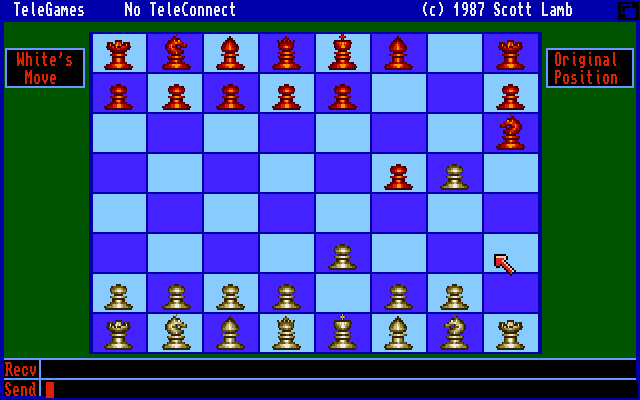
The first few minutes of TeleGames are refreshingly uncomplicated. You choose chess, checkers, or backgammon, pick how you are playing, and get on with a game whose rules you probably already know. There is no need to learn a new strategy-game system before the competition starts; the tension comes from the board and, more importantly, the person on the other side.
That remote-play angle is the reason to care about TeleGames rather than treating it as merely a three-game compilation. Playing by modem or null-modem turns a familiar chess match into a small event, while the included phone book gives repeat opponents a bit of continuity. If another person is in the room, taking turns at one computer remains the simplest and most immediately useful option.
The selection is narrow, and your mileage rests almost entirely on how much you enjoy these three classics. Chess offers the deepest long-term commitment, backgammon brings quicker swings of fortune and calculation, and checkers is the most approachable pick for a casual rematch. TeleGames does not need to reinvent any of them; it succeeds when you have a willing rival and want the board game itself to remain the focus.

Graphics
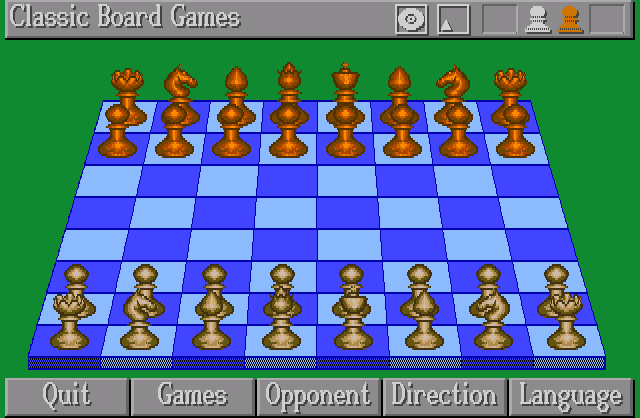
The boards use colourful graphics and can be viewed from directly overhead or in 3D from several perspectives. The flat view is the practical choice when you want to study a position cleanly, while the alternate angles add a little variety to a long match.

Story
There is no narrative campaign wrapped around TeleGames. Its “story” is the one that naturally develops between opponents: a careful chess position, a backgammon comeback, or the satisfaction of finally beating someone whose name is already in your phone book.
That absence of framing is appropriate for the format. You are not being pushed through a theme or set of characters; you are being handed three durable games and asked to make the occasion yourself.
On the CDTV version, spoken instructions can explain how to play in English, German, Japanese, French, Spanish, or Italian. That makes the package friendlier for someone learning the basics, even if experienced board-game regulars will likely go straight to arranging the first match.
Overall Experience
TeleGames is strongest as a social artifact from the era when connecting two computers for a board game felt special. Its pleasures are uncomplicated but real: familiar rules, a human opponent, and just enough viewing flexibility to make the boards comfortable to use.
Do not come in hoping for a huge strategy package. Come in because chess, checkers, and backgammon still hold up when the opponent can think, bluff, and gloat. If you can provide that opponent, the collection has a clear purpose; if you cannot, much of its distinctive appeal disappears.
The CDTV edition is more limited because it only supports local multiplayer, though its multilingual spoken guidance adds value for beginners. For a little more historical context around the name and its releases, see TeleGames history. As a lean two-player board-game disc, it earns a recommendation for retro social play rather than for breadth or novelty.



Reviews
There are no reviews yet.