 Retro Replay Retro Gaming History, Reviews & Emulation
Retro Replay Review
Gameplay
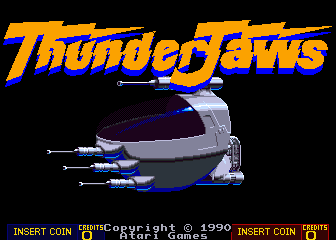
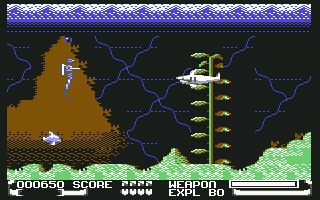
ThunderJaws gets you moving quickly. You begin by scuba diving from a submarine toward an enemy base, firing spear-shooting harpoons at sharks and hostile divers while threading through mines and chemical spills. That is a strong arcade opening: the objective is clear, the threats are immediate, and you are doing something more memorable than simply running from left to right on dry land.
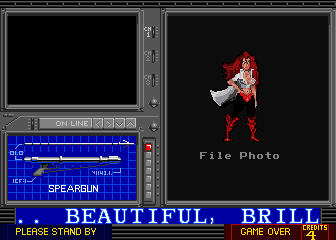
Once you enter Madame Q’s fortress, the game shifts into the side-scrolling run-and-gun territory that has made people compare it to Rolling Thunder. Enemies can drop extra weapons, giving you a welcome reason to push forward and capitalize on a good streak rather than treating every encounter as identical. The rescue mission is a simple excuse for the action, but it works because the game stays focused on penetrating a dangerous compound one screen at a time.
The difficulty curve is where your patience gets tested. Stages grow harder, more elaborate, and more crowded with enemies, so the brisk early momentum gives way to a more demanding arcade fight for survival. That can be satisfying when you are learning enemy placement and reaching farther than before; it can also feel punishing if you want a forgiving action game. Two-player mode is the best reason to revisit it, since sharing the pressure makes its hard-edged design feel more like a lively co-op challenge than a solo endurance test.

Graphics
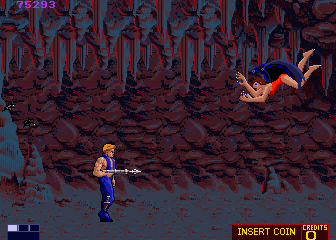
The game’s most distinctive imagery comes from its opening underwater approach: a diver with a harpoon facing sharks, enemy divers, mines, and drifting chemical hazards before reaching a secret fortress. Inside, the side-view base action follows the familiar Rolling Thunder-style template, putting the focus on armed enemies and the route through the compound.
Story
This is unabashedly a B-movie mission. Madame Q wants world control, has abducted thousands of girls for experiments, and has hidden herself in an underwater base. You are one member of a government-hired expert team sent to break in and free the hostages. It is broad, lurid arcade storytelling, built to get you into danger rather than to develop characters.
The underwater setting does more for the premise than the villain does. Starting outside the base gives the assault a sense of progression: first survive the sea, then force your way into the fortress. That transition helps the mission feel like an infiltration instead of a disconnected set of stages.
Don’t come in expecting the hostage-rescue setup to carry emotional weight. Its value is in the immediate stakes and the comic-book urgency it gives every shark, diver, and corridor full of enemies. For a game this action-driven, that is enough, but it never becomes more than a sturdy arcade excuse to keep shooting.
Overall Experience
ThunderJaws has a better hook than its reputation might suggest. Harpoon combat under the sea is a neat way to open a side-scrolling shooter, and the move into a hostile fortress gives the game a recognizable arcade rhythm. You can see why the Rolling Thunder comparison sticks: this is a compact, enemy-heavy assault built around advancing through dangerous territory.
Its limitations show up as the stages become more crowded and demanding. The same escalating pressure that gives an arcade run its bite can make the game feel more exhausting than exhilarating, particularly alone. There is little room here for a relaxed sightseeing tour through its underwater lair; you need to enjoy learning through failure and returning for a cleaner attempt.
At 5.9, it lands as a decent curiosity rather than an essential action classic. Give it a chance if you like tough early-1990s arcade platform shooters, have a co-op partner, or want a Rolling Thunder-adjacent game with an underwater twist. Skip it if you need generous pacing or a richer story to carry you through the hard parts.


Reviews
There are no reviews yet.