 Retro Replay Retro Gaming History, Reviews & Emulation
Retro Replay Review
Gameplay
The first few rounds of 3D Boxing are less about landing a perfect combination than learning to speak its control language. Movement and punching share the same directions, with the fire button changing a directional move into an attack. Push up-right and you step that way; add fire and you jab toward the head. It is a clever economy for a keyboard or joystick game, but it asks for patience before it feels natural.
Once you stop treating every direction as a simple command and start thinking about whether you are holding fire, the bouts gain some tension. Positioning is tied tightly to your offense, so backing away, closing distance, and throwing a punch are not separate layers of management. That can make each input feel purposeful. It can also be frustrating when your hands have not yet caught up with the scheme, especially in a sport where a mistimed action is exactly the kind of opening you do not want to offer.
The six opponents give the climb toward the AMSOFT belt its needed variety. Mad Joe moves constantly but does not throw much, while Jef is a stationary champion with a killer punch. Those are simple character sketches, yet they suggest different priorities: chase one fighter down, respect another fighter’s threat. Fifteen rounds is a long time to maintain concentration, and the game’s strongest quality is that it asks you to adjust rather than merely repeat the same attack.
Two-player support is a real reason to return after taking on the computer roster. Because both fighters work within the same compact set of movement-and-fire inputs, a human opponent can turn that initially awkward control setup into a contest of nerve and prediction. If you enjoy early direct-control sports games that demand a little practice, 3D Boxing has a sturdy competitive core. If you want immediate, intuitive button mapping, its learning curve may feel more like a barrier than a challenge.
Graphics
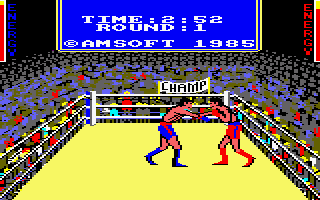
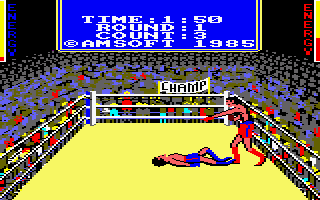
Despite the title, 3D Boxing is presented as a side-view, fixed-screen boxing game. The clearest visual distinction comes from the opponent roster itself: six named rivals are built around contrasting behavior, from the mobile Mad Joe to the planted, powerful Jef. The straightforward view keeps the important question in front of you—where the other boxer is moving and when he is likely to punch.
Story
There is no sprawling boxing drama here; the story is the title chase. You fight through six opponents over fifteen rounds with the AMSOFT belt as the prize, and that is enough to give individual bouts a place in a larger run.
The named opponents do most of the character work. Mad Joe’s evasive habits and Jef’s fearsome punch make them feel less like interchangeable hurdles, even without elaborate narrative framing. You remember them by what they force you to do in the ring.
That stripped-back approach suits the game. The motivation is plain: beat the next boxer, then earn the belt. It will not pull you along with plot, but the opponent differences give the campaign a modest sense of progression.
Overall Experience
3D Boxing is a compact boxing game with a genuinely distinctive control idea at its center. It does not win you over by drowning you in choices. Instead, it makes you learn one shared movement-and-punch language, then tests whether you can use it calmly across lengthy bouts.
The payoff depends on your tolerance for that initial awkwardness. Give it a few rounds and the fire-button modifier starts to make sense: direction is no longer just travel, but a potential attack angle. The game becomes more satisfying when you deliberately choose between moving and striking instead of wrestling with the input.
The roster is the other reason it holds attention. Six rivals with different tendencies give you a practical reason to change your approach, and the AMSOFT belt supplies a clean finish line. It is worth a look for retro sports fans who enjoy mastering a peculiar control scheme and for two friends willing to meet it on its own terms. Everyone else may admire the idea while wishing the punches were easier to call up on instinct.


Reviews
There are no reviews yet.