 Retro Replay Retro Gaming History, Reviews & Emulation

Retro Replay Review
Gameplay
The hook is immediate: each stage is a maze viewed from above, and your job is to arrest every villain inside it. That simple target makes Sergeant Seymour: Robot Cop easy to understand within minutes. You are not wandering around looking for a vague objective; clear the criminals and the boss is automatically destroyed. It is a satisfyingly brisk loop when you find a good route through the maze and keep the screen under control.
Seymour’s two weapons add more thought than the premise initially suggests. His stretching bionic arm and cuff gun both become more powerful when you hold the fire button, so there is a real trade-off between committing to a charge and staying ready to react. The game asks you to manage distance rather than merely rush at targets. That is where its action starts to click: line up an arrest, avoid incoming clutter, grab the dropped bonus, then decide whether it is safe to charge another shot.
Danger comes from more than the villains. Apples and cans can be thrown at Seymour, while bombs are hazards you simply need to avoid. Pickups offer useful breathing room: a telephone calls in the SWAT team, a blue light absorbs one hit, and a rainbow tile increases speed. These bonuses make a difference, especially once the maze layouts and enemy traffic make careless movement costly.
The downside is that the core task does not substantially change. You clear another maze, arrest another set of villains, and repeat. Collecting the letters in ROBOTCOP opens bonus stages, which helps break up the routine, but this remains a game for gamers who enjoy refining a straightforward arcade pattern rather than chasing constant surprises. The 30-level run has enough structure to feel like a campaign, yet repetition is the price of admission.
Graphics
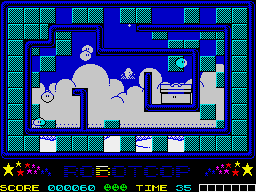
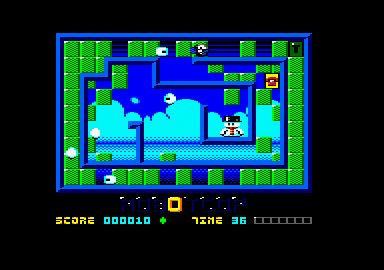
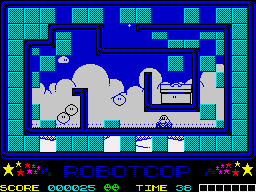
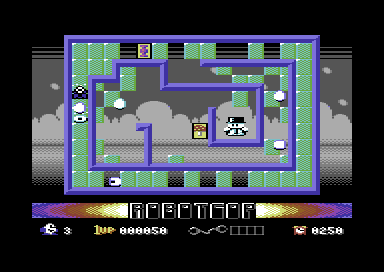
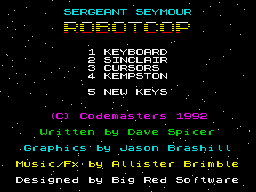
The top-down maze view keeps Seymour, enemies, hazards, and collectible bonuses in the same practical space, making it easy to follow where the immediate danger lies. Its grim future-city framing gives the action a fitting backdrop, while the screen’s main priority is clearly the next arrest and the next obstacle in your path.
Story
Robot Cop uses its story as a quick excuse to put Sergeant Seymour back on patrol in a grim city of the future. Seymour is cast as the star of his latest blockbuster, which gives the setup a knowingly pulpy tone rather than asking you to take its robot-police premise too seriously.
There is no complicated narrative burden on the action. Every level is about cleaning up villains, and the boss disappears once the arrests are complete. That makes the story feel more like an arcade framing device than a reason to press onward, but it is clean and appropriate for the game’s compact structure.
The title’s obvious genre wink is probably the most memorable storytelling choice. If you want a detailed future-city plot, this will not be the draw. If a broad, cartoonish cop-versus-criminals setup is enough to give each maze some context, it does its job without getting in the way.
Overall Experience
Sergeant Seymour: Robot Cop is at its best when you treat it as a focused 8-bit action challenge. The charged attacks, maze navigation, hazards, and situational pickups create more tension than a basic enemy-clear game might suggest. An efficient arrest can feel clever; getting clipped while greedily holding a charge can feel deserved.
Frustration is most likely to set in if you need lots of new ideas from level to level. The game has one strong central routine and returns to it repeatedly. Still, the automatic boss defeat after a full clear is a smart touch: it keeps the emphasis on the maze fight instead of dragging each stage into a separate boss encounter.
Give it a chance if you have a soft spot for top-down arcade games built around precision, positioning, and repeatable score-chasing runs. The SWAT call, protective blue light, speed boost, and ROBOTCOP letter hunt provide welcome variations, but they do not transform the basic formula. For the right mood, Seymour’s oddball future-cop chase is a solid, modest diversion rather than a lost classic.


Reviews
There are no reviews yet.