 Retro Replay Retro Gaming History, Reviews & Emulation
Retro Replay Review
Gameplay
Solar Star starts with a clear objective, then makes every part of reaching it awkward in an interesting way. You pilot a specialist craft through one of 16 solar grids, hunting ten energy crystals. Crystals are not simply sitting around waiting to be grabbed: you must find and shoot one of four disruptors, then quickly pursue the energy left behind before it vanishes. That little chase is the heart of the game, and it gives the first hour a sharp, anxious rhythm.
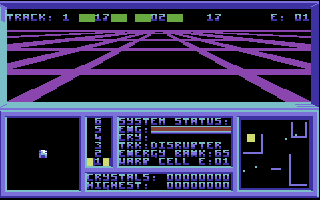
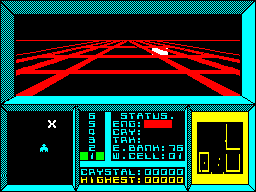
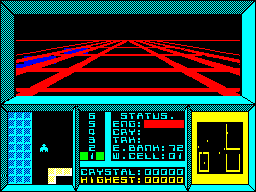
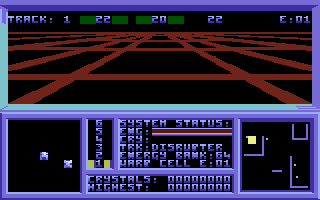
The first-person view makes finding your way through the grids feel more immediate than a typical overhead 8-bit shooter. A top-down radar sits at the bottom of the screen, and learning to glance between it and the cockpit view is where the game begins to click. At first, you are likely to waste shots or arrive at a crystal too late. With practice, you start planning where a disruptor will send you and how much danger lies between your ship and the prize.
Energy management is Solar Star’s strongest idea and its biggest source of frustration. Firing and crashing into obstacles drain your reserves, while hyper warps restore energy at the cost of one crystal you have already collected. Since warps are limited per level, you cannot casually erase a bad route. You have to decide whether preserving the current run is worth sacrificing progress, and that makes successful clears feel earned. It also means a few clumsy collisions can make a level feel unrecoverable.
The action is repetitive by design: locate disruptor, fire, race for crystal, survive, repeat. If you enjoy old-school score-and-survival pressure and the satisfaction of gradually mastering a strict ruleset, that loop has real bite. If you want constant variety or a forgiving learning curve, Solar Star can feel like it is punishing you for experimenting.
Graphics
The game frames its action from a first-person cockpit view, with a top-down radar occupying the bottom of the screen. That split is useful rather than decorative: the forward view handles immediate flying, while the radar helps you keep track of the surrounding solar grid and plan a route toward disruptors or crystals.
Story
Solar Star keeps its fiction simple and functional. You command a specially built spacecraft sent to gather energy from solar grids in space. There is no need for a larger tale here; the premise exists to put a time-sensitive resource-collection job in your hands.
That stripped-back setup suits the game’s arcade focus. You are not pushed forward by characters or plot turns, but by the immediate pressure of collecting enough crystals before your ship runs out of energy or a promising run falls apart.
The solar-grid setting does at least give the task a coherent shape. Disruptors, teleporting energy, hazards, and hyper warps all belong to the same sci-fi logic, even if the game is far more interested in the next difficult decision than in explaining the world around it.
Overall Experience
Solar Star is a compact 8-bit action game with more tension than its simple objective initially suggests. The need to shoot disruptors before collecting their brief-lived energy, combined with a fuel supply that punishes both firing and collisions, turns each level into a small exercise in restraint and route planning.
Its best moments arrive when you stop reacting blindly and begin flying with intent: checking the radar, lining up a disruptor, and committing to the dash for a crystal without spending more energy than the reward is worth. The hyper-warp trade-off is especially memorable because it forces you to spend progress to stay alive.
The downside is that Solar Star does not soften its rough edges. Repeating the same central task across 16 grids can wear thin, and the collision-and-energy penalties leave little room for careless flying. Still, the payoff is there for gamers who like demanding arcade design with a tactical wrinkle. It earns its 6.7 for a clever core that remains engaging, even when the surrounding routine becomes hard to shake.


Reviews
There are no reviews yet.